Page 236 of 414
Downloaded from www.Manualslib.com manuals search engine If No Steam Is Coming From Your Engine
If you get the overheat warning but see or hear no
steam, the problem may not be too serious. Sometimes
the engine can get a little too hot when you:
Climb a long hill on a hot day.
Stop after high-speed driving.
Idle for long periods in traffic.
0 Tow a trailer. See “Driving on Grades” in the Index.
If
you get the overheat warning with no sign of steam,
try this for a minute or
so:
I. Turn off your air conditioner.
2. Turn on your heater to full hot at the highest fan
speed and open the window as necessary.
3. If you’re in a traffic jam, shift to NEUTRAL (N);
otherwise, shift to the highest gear while
driving
-- DRIVE (D).
If you no longer have the overheat warning, you
can drive. Just
to be safe, drive slower for about
10 minutes. If the warning doesn’t come back on,
you can drive normally.
If
the warning continues, pull over, stop, and park
your vehicle right away.
If there’s still
no sign of steam, push the accelerator
until the engine speed is about twice as fast as normal
idle speed. Bring the engine speed back
to normal idle
speed after two or three minutes. Now see if the warning
stops. But then,
if you still have the warning, turn ofs
the engine nncl get everyone out of the vehicle until it
cools down.
You
may decide not to lift the hood but to get service
help right away.
5-14
Page 244 of 414
Downloaded from www.Manualslib.com manuals search engine Engine Fan Noise
This vehicle has a clutched engine cooling fan. When
the clutch is engaged, the fan spins faster to provide
more air to cool the engine. In most everyday driving
conditions, the clutch is not
fully engaged. This
improves fuel economy and reduces fan noise. Under
heavy vehicle loading, trailer towing andor high
outside temperatures, the fan speed increases when the
clutch engages.
So you may hear an increase in fan
noise. This is normal and should not be mistaken
as the
transmission slipping or making extra shifts. It is merely
the cooling system functioning properly. The fan will
slow down when additional cooling
is not required and
the clutch disengages.
You may also hear this fan noise when you start the
engine. It will go away
as the fan clutch disengages.
If a Tire Goes Flat
It’s unusual for a tire to “blow out” while you’re driving,
especially
if you maintain your tires properly. If air goes
out of
a tire, it’s much more likely to leak out slowly.
But
if you should ever have a “blowout,” here are a few
tips about what to expect and what
to do:
If a front tire fails, the flat tire will create a drag that
pulls the vehicle toward that side. Take your foot off
the
accelerator pedal and grip the steering wheel firmly.
Steer
to maintain lane position, and then gently brake to
a stop well out of the traffic lane.
A rear blowout, particularly on a curve, acts much like a
skid and may require the same correction you’d use in a
skid. In any rear blowout, remove your foot from the
accelerator pedal. Get the vehicle under control by
steering the way you want the vehicle to go. It may be
very bumpy and noisy, but you can still steer. Gently
brake to
a stop -- well off the road if possible.
If
a tire goes flat, the next part shows how to use your
jacking equipment to change a flat tire safely.
5-22
Page 246 of 414
Downloaded from www.Manualslib.com manuals search engine Removing the Spare Tire and Tools
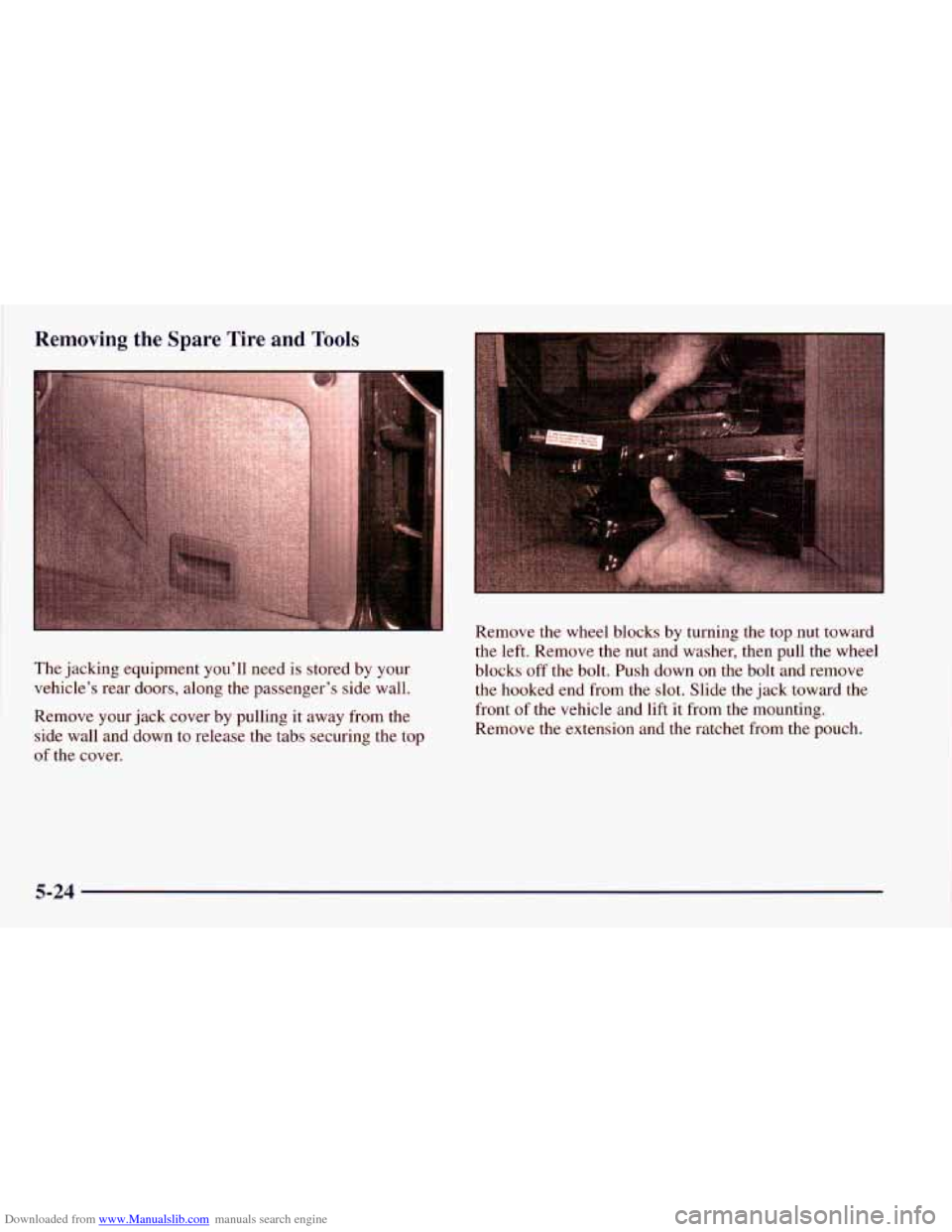
The jacking equipment you'll need is stored by your
vehicle's rear doors, along the passenger's side wall.
Remove your jack cover by pulling it away from the
side wall and down to release the tabs securing the top
of the cover. Remove
the wheel blocks by turning the top nut toward
the left. Remove the nut and washer, then pull the wheel
blocks off the bolt. Push down on the bolt and remove
the hooked end from the slot. Slide the jack toward the
front of the vehicle and lift it from the mounting.
Remove the extension and the ratchet from the pouch.
5-24
Page 248 of 414
Downloaded from www.Manualslib.com manuals search engine Put the flat end of the extension on an angle through the
hole in the rear door frame, above the bumper. Be sure
the flat end connects into the hoist shaft. When the
tire has been
lowered, tilt the retainer
plate at the end
of the
cable and pull it through
the wheel opening.
Turn the ratchet toward the left to lower the spare tire to
can be pulled
out from under the vehicle.
i the ground. Keep turning the ratchet until the spare tire Pull the
tire out from under the vehicle.
I NOTICE:
To help avoid vehicle damage, do not drive the
vehicle before cable is restored.
I
5-26
Page 253 of 414
Downloaded from www.Manualslib.com manuals search engine /II CAUTION:
Getting under a vehicle when it is :ked up is
dangerous.
If the vehicle slips off the jack, you
could be badly injured or killed. Never get under
a vehicle when it is supported only by a jack.
A CAUTION:
-
Raising yUdr vehicle with the jack improperly
positioned can damage the vehicle and even
make the vehicle fall.
To help avoid personal
injury and vehicle damage, be sure to fit the jack
lift head into the proper location before raising
the vehicle.
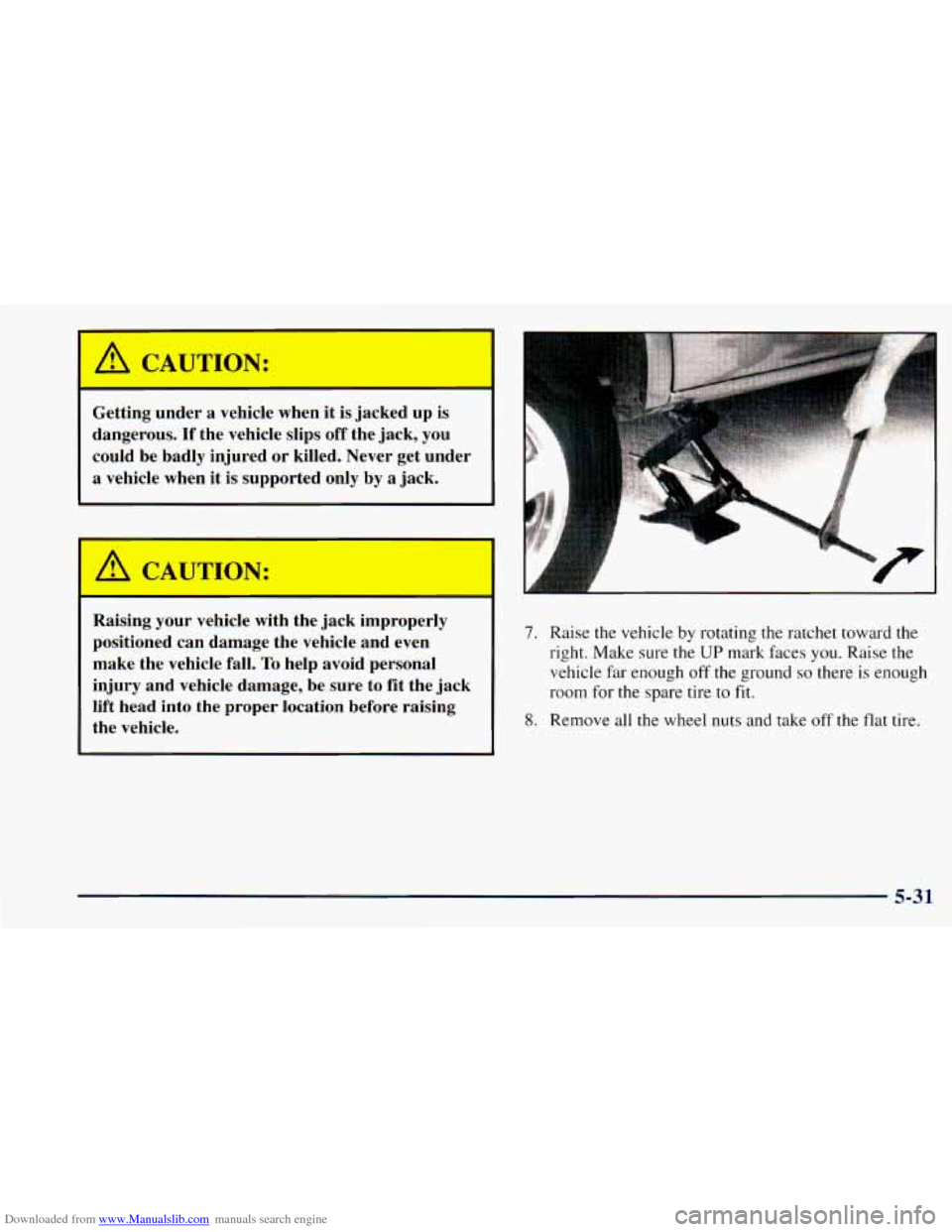
7. Raise the vehicle by rotating the ratchet toward the
right. Make sure the
UP mark faces you. Raise the
vehicle far enough off the ground
so there is enough
room for
the spare tire to fit.
8. Remove all the wheel nuts and take off the flat tire.
5-31
Page 254 of 414
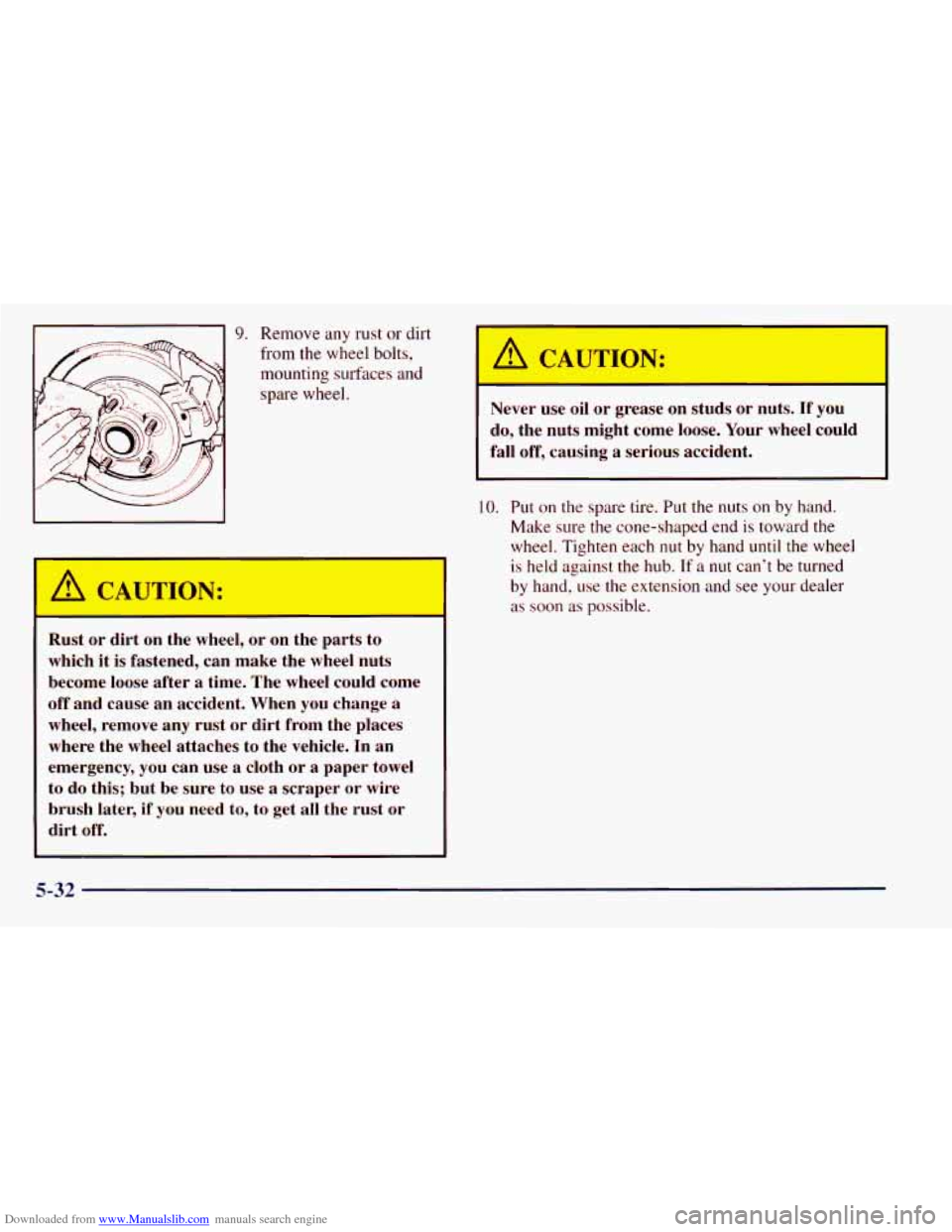
Downloaded from www.Manualslib.com manuals search engine 9. Remove any rust or dirt
from the wheel bolts,
mounting surfaces and
spare wheel. I A CAUTION:
L
Rust or dirt on the wheel, or on the parts to
which it is fastened, can make the wheel nuts
become loose after
a time. The wheel could come
off and cause
an accident. When you change a
wheel, remove any rust or dirt from the places
where the wheel attaches to the vehicle. In an
emergency, you can use a cloth or
a paper towel
to
do this; but be sure to use a scraper or wire
brush later,
if you need to, to get all the rust or
dirt off.
I1
Never use oil or grease on studs or nuts. If you
do, the nuts might come loose. Your wheel could
fall off, causing
a serious accident.
10. Put on the spare tire. Put the nuts on by hand.
Make sure the cone-shaped end is toward
the
wheel. Tighten each nut by hand until the wheel
is held against the hub. If a nut can’t be turned
by hand, use the extension and see your dealer
as
soon as possible.
5-32
Page 255 of 414
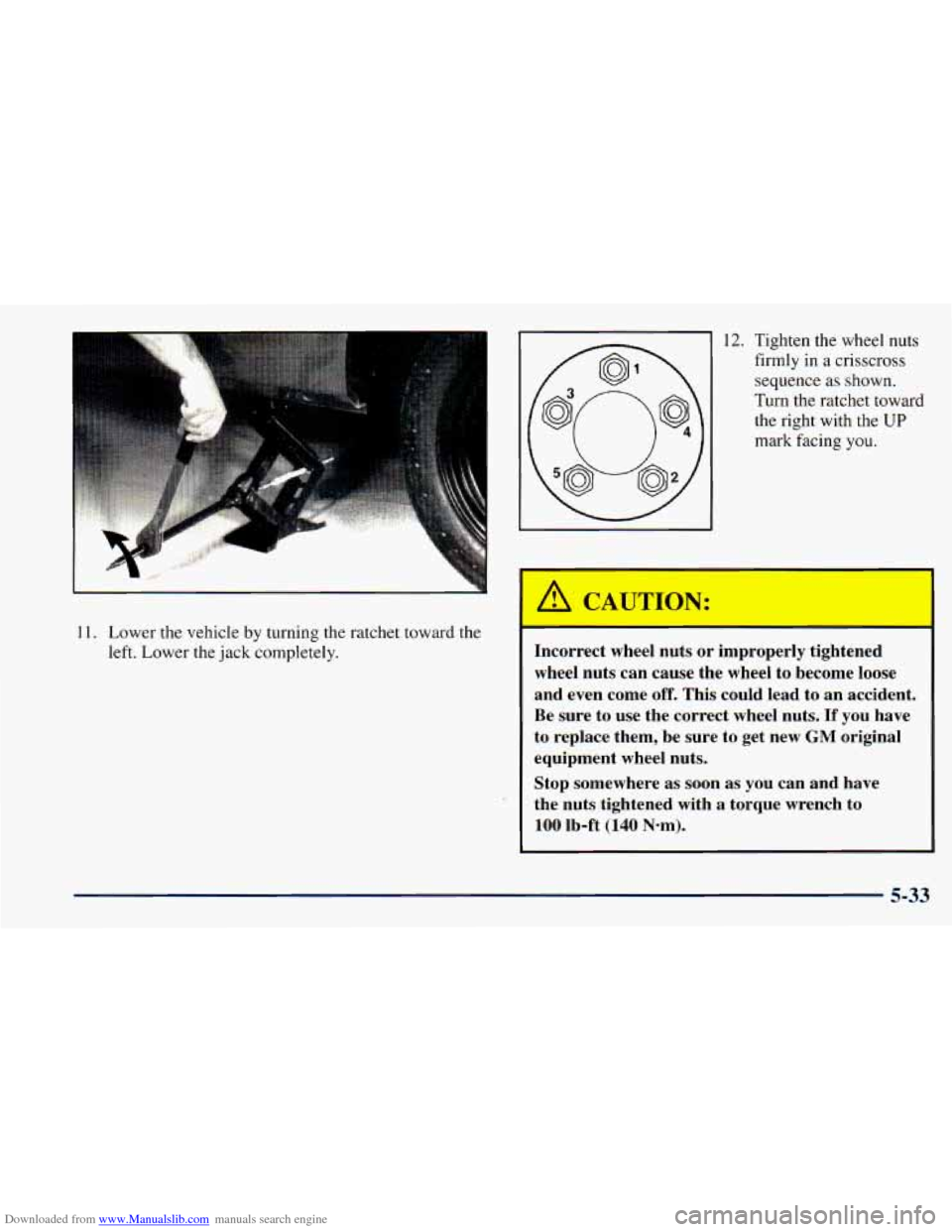
Downloaded from www.Manualslib.com manuals search engine 11. Lower the vehicle by turning the ratchet toward the
left. Lower the jack completely.
12. Tighten the wheel nuts
firmly in a crisscross
sequence as shown.
Turn the ratchet toward the right with the
UP
mark facing you.
A CAUTION:
___ -- I
In1 *rect lee1 nuts or improperly tightened
wheel nuts can cause the wheel to become loose
and even come
off. This could lead to an accident.
Be sure to use the correct wheel nuts. If you have
to replace them, be
sure to get new GM original
equipment wheel nuts.
Stop somewhere
as soon as you can and have
the nuts tightened with
a torque wrench to
100 lb-ft (140 N-m).
5-33
Page 257 of 414
Downloaded from www.Manualslib.com manuals search engine 3. Put the flat end of the extension on an angle through
the hole in the rear door frame, above the bumper.
Turn the ratchet toward the right until the tire is
against the underside of the vehicle.
Keep turning the ratchet until you feel at least two
“clicks” when the tire is up all the way. Try to move
the tire with your hands to make sure it is securely
in place.
The compact spare is for temporary use only. Replace
the compact spare tire with a full-size tire as soon as
you can. See “Compact Spare Tire” in the Index. See
the storage instructions label to restore your compact
spare properly.
Return the jacking equipment to its proper location.
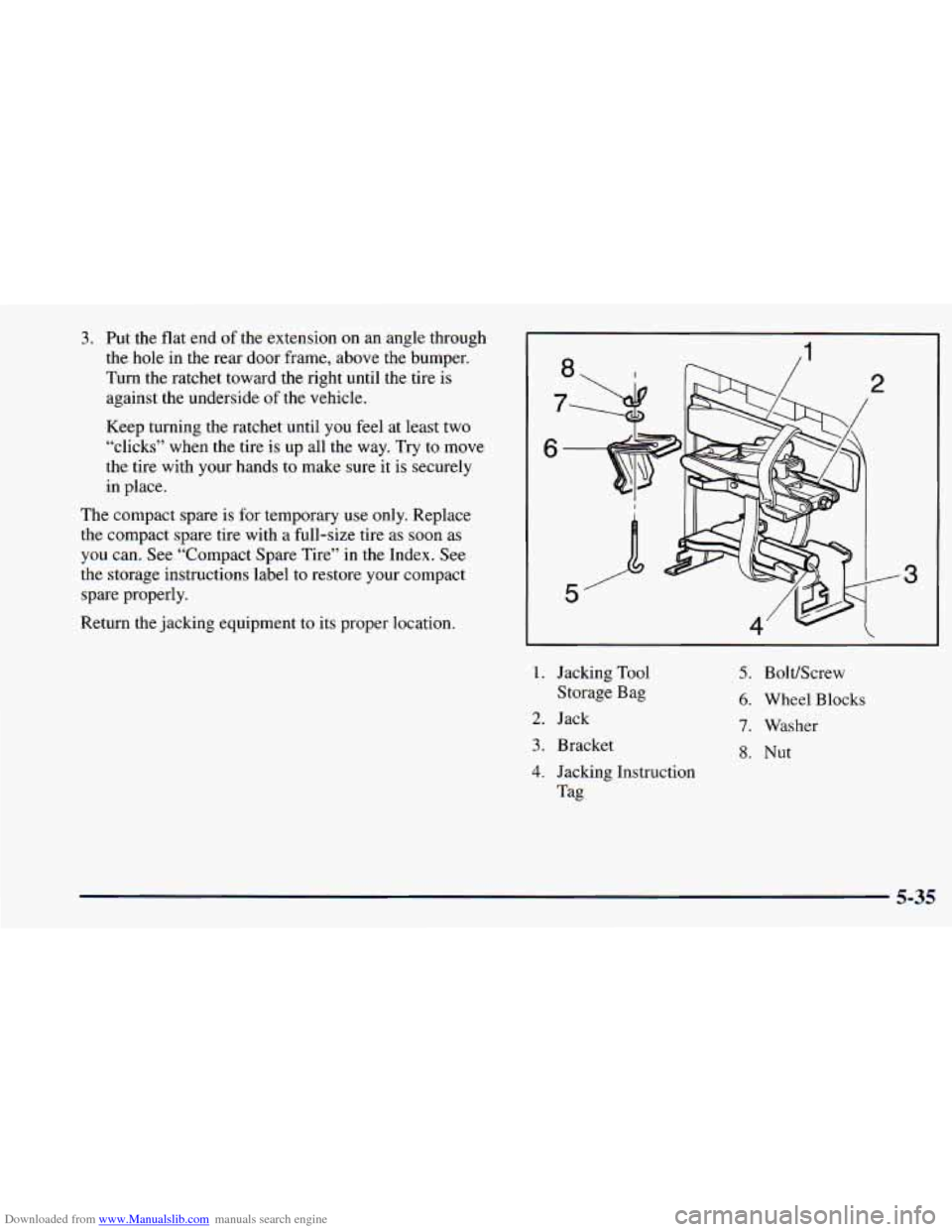
1. Jacking Tool
Storage Bag
2. Jack
3. Bracket
3
5. Bolt/Screw
6. Wheel Blocks
7. Washer
8. Nut
4. Jacking Instruction
Tag
5-35