1998 CHEVROLET ASTRO tow
[x] Cancel search: towPage 124 of 414
Downloaded from www.Manualslib.com manuals search engine I Mirrors
I Inside Daymight Rearview Mirror
You can adjust the mirror for day or night driving. Press
the tab forward (away from you) for day driving. Pull
the tab back (toward you) for night driving.
1 Outside Mirrors
j of your vehicle. Adjust your outside mirrors
so you can just see the side
Some mirrors are manually adjustable. The optional
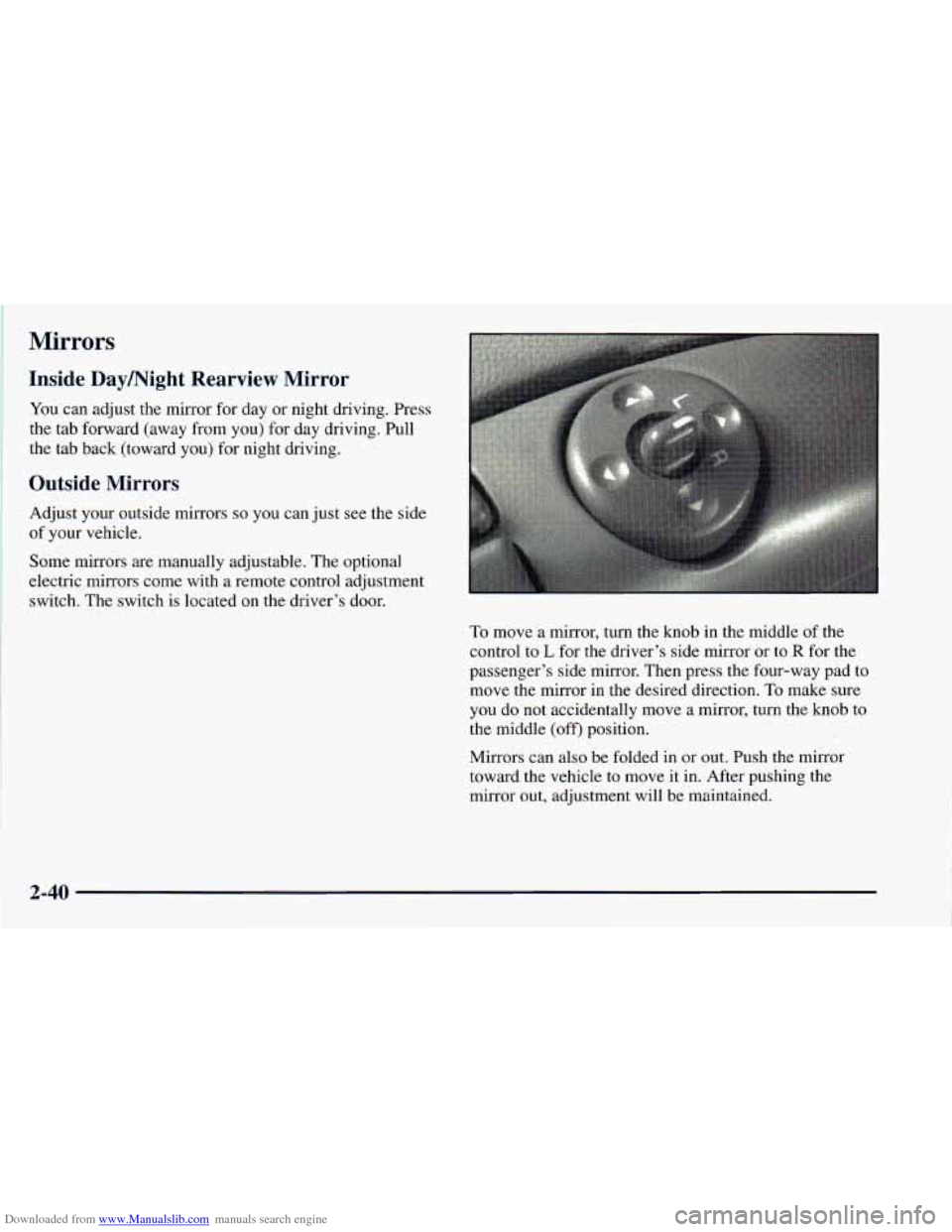
electric mirrors come with a remote control adjustment
switch. The switch is located on the driver’s door.
To move a mirror, turn the knob in the middle of the
control to
L for the driver’s side mirror or to R for the
passenger’s side mirror. Then press the four-way pad to
move the mirror in the desired direction.
To make sure
you do not accidentally move a mirror, turn the knob to
the middle (off) position.
Mirrors can also be folded in or out. Push the mirror
toward the vehicle to move
it in. After pushing the
mirror out, adjustment will be maintained.
2-40
Page 144 of 414
Downloaded from www.Manualslib.com manuals search engine You can only drive for a short time with the readings in
either warning
zone. If you must drive, turn off all
unnecessary accessories.
Readings in either warning zone indicate a possible
problem in the electrical system. Have the vehicle
serviced as soon as possible.
Brake System Warning Light
When the ignition is on, the brake system warning light
will come
on when you set your parking brake. The light
will stay on if your parking brake doesn’t release
fully.
If it stays on after your parking brake is fully released, it
means
you have a brake problem.
Your vehicle’s hydraulic brake system is divided into
two parts. If one part isn’t working, the other part can
still work and stop
you. For good braking, though, you
need both parts working well.
If the warning light comes on, there could be a brake
problem. Have
your brake system inspected right away.
BRAKE
This light should come on
briefly when
you turn the
ignition key to
RUN. If it
doesn’t come
on then, have
it fixed so it will be ready to
warn
you if there’s
a problem.
If the light comes on while you are driving, pull off the
road and stop carefully. You may notice that the pedal is
harder to push. Or, the pedal may go closer
to the floor.
It may take longer to stop. If the light is still on, have the
vehicle towed for service. (See “Towing Your Vehicle”
in the Index.)
A CAUi iON:
-
Your brake system may not be working prop( y
if the brake system warning light is on. Driving
with the brake system warning light on can lead
to an accident. If the light
is still on after you’ve
pulled off the road and stopped carefully, have
the vehicle towed for service.
2-60
Page 147 of 414
Downloaded from www.Manualslib.com manuals search engine If the Light Is Flashing
The following may prevent more serious damage to
your vehicle:
0 Reducing vehicle speed.
0 Avoiding hard accelerations.
Avoiding steep uphill grades.
0 If you are towing a trailer, reduce the amount of
cargo being hauled as soon as it is possible.
If the light stops flashing and remains on steady, see “If
the Light Is
On Steady” following.
If the light continues to flash, when it is safe to do
so,
stop the vehicle. Find a safe place to park your vehicle.
Turn the key off, wait at least 10 seconds and restart the
engine. If the light remains
on steady, see “If the Light
Is On Steady” following. If the light is still flashing,
follow
the previous steps, and drive the vehicle to your
dealer or qualified service center for service.
If the Light Is On Steady
You may be able to correct the emission system
malfunction by considering the following:
Did
you recently put fuel into your vehicle?
If
so, reinstall the fuel cap, making sure to fully install
the cap. The diagnostic system can determine if the fuel
cap has been left off or improperly installed. A loose or
missing
fuel cap will allow fuel to evaporate into the
atmosphere. A few driving trips with the cap properly
installed should turn the light
off.
Did you just drive through a deep puddle of water?
If so, your electrical system may be wet. The condition
will usually be corrected when the electrical system
dries out.
A few driving trips should turn the light off.
Have you recently changed brands of fuel?
2-63
Page 154 of 414
Downloaded from www.Manualslib.com manuals search engine Comfort Controls
This section tells you how to make your air system
work for you. Your comfort control system uses
ozone-friendly
R- 134a refrigerant.
With these systems, you can control the heating,
cooling and ventilation in your vehicle. Your vehicle
also has a flow-through ventilation system described
later in this section.
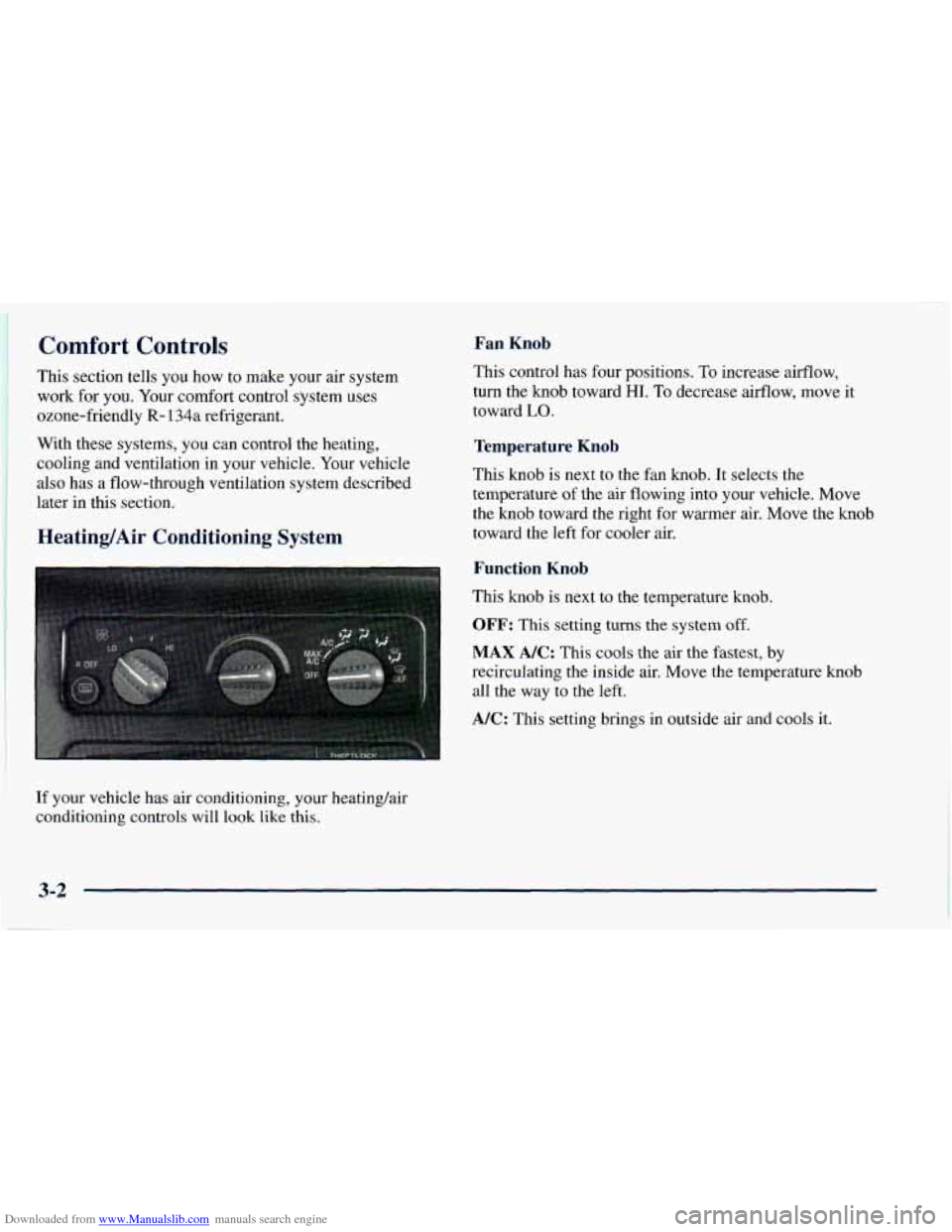
Heating/Air Conditioning System
If your vehicle has air conditioning, your heating/air
conditioning controls will look like this.
Fan Knob
This control has four positions. To increase airflow,
turn the knob toward
HI. To decrease airflow, move it
toward
LO.
Temperature Knob
This knob is next to the fan knob. It selects the
temperature of the air flowing into your vehicle. Move
the knob toward the right for warmer air. Move the knob
toward the left for cooler air.
Function Knob
This knob is next to the temperature knob.
OFF: This setting turns the system off.
MAX NC: This cools the air the fastest, by
recirculating the inside air. Move the temperature knob
all the way to the left.
A/C: This setting brings in outside air and cools it.
3-2
Page 155 of 414
Downloaded from www.Manualslib.com manuals search engine -bo
+@ BI-LEVEL: This setting brings in outside air
and blows
it out through the heater floor vents and the
instrument panel
vents. If you move the temperature
knob between hot and cold, cooler air will come
out of
the upper vents while warmer air comes out of the floor
vent. The air conditioning compressor may operate in
this setting to cool the air.
/J VENT The air comes out at the vents on your
instrument panel. The air conditioning compressor will
not run in this position. Adjust the temperature knob for
warmer or cooler air.
+' HEATER: Most of the air comes out near the
floor. The rest comes
out from the defroster vents under
the windshield and at the front side windows.
+, BLEND: With this setting, the heated outside air
comes out both the heater vents and defroster vents.
Adjust the temperature knob for warmer or cooler air.
The air conditioning compressor may operate in this
setting
to dehumidify the air.
rl*.
0
w.
DEFROST This setting operates the defroster.
Most
of the air comes out near the windshield, with
some going
to the floor vents and front side windows.
The air conditioning compressor may operate in this
setting to dehumidify the air.
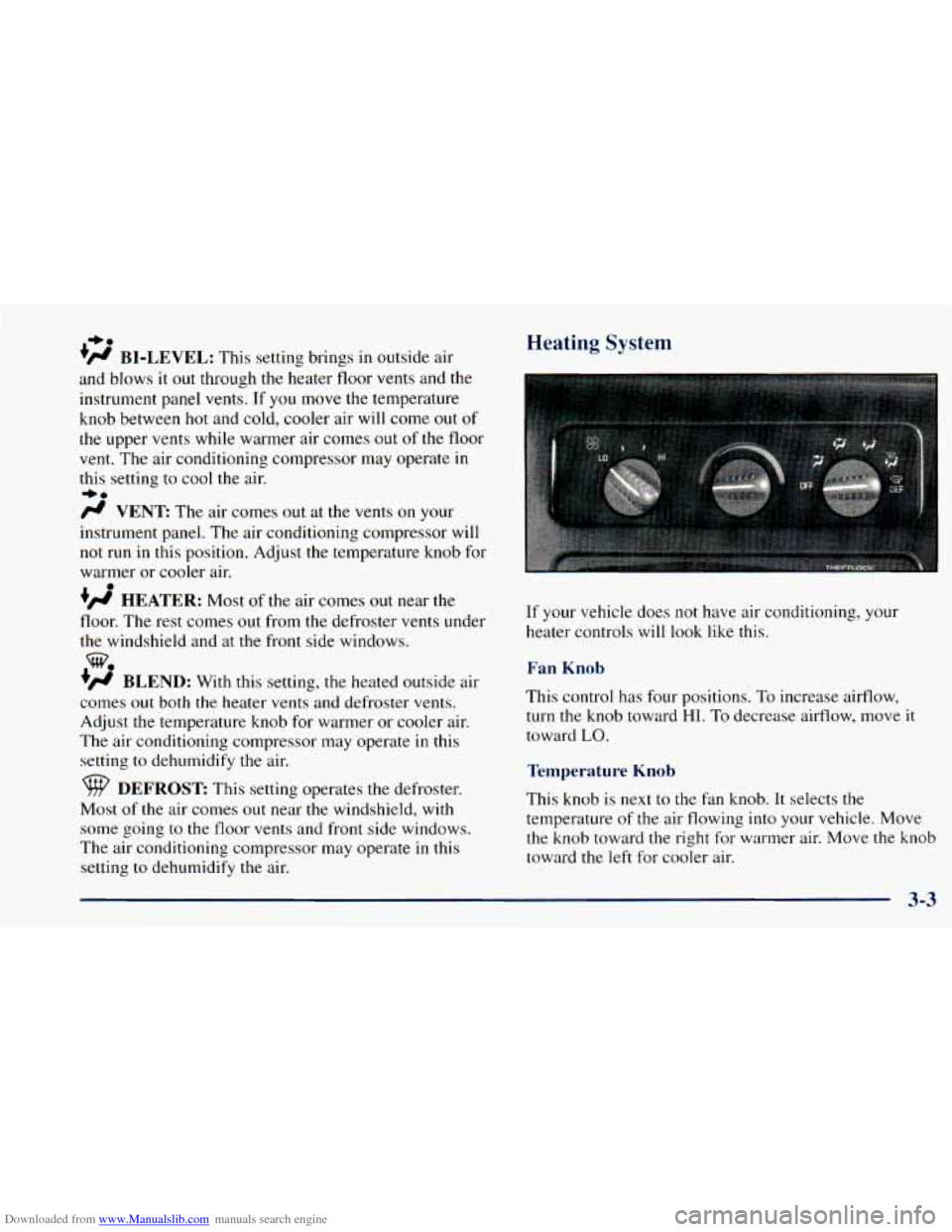
Heating System
If your vehicle does not have air conditioning, your
heater controls will look like this.
Fan Knob
This control has four positions. To increase airflow,
turn
the knob toward HI. To decrease airflow, move it
toward
LO.
Temperature Knob
This knob is next to the fan knob. It selects the
temperature of the air flowing into your vehicle. Move
the knob toward the right for warmer air. Move
the knob
toward
the left for cooler air.
3-3
Page 156 of 414
Downloaded from www.Manualslib.com manuals search engine Function Knob
This knob is next to the temperature knob. The function
knob allows you to choose the direction
of air delivery.
OFF: This setting turns the system off.
+*
P@ VENT: The air comes out at the vents on your
instrument panel.
'' BI-LEVEL: With this setting, the heated
outside air comes
out both the instrument panel vents
and heater vents. Adjust the temperature knob for
warmer or cooler air.
+P@ HEATER: Most of the air comes out near the
floor. The rest comes out from
the defroster vents under
the windshield and at the front side windows.
+d BLEND: With this setting, the heated outside air
comes out both the heater vents and defroster vents,
Adjust
the temperature knob for warmer or cooler air.
+e
0
DEFROST This setting operates the defroster.
Most of the air comes
out near the windshield, with
some going
to the floor vents and front side windows.
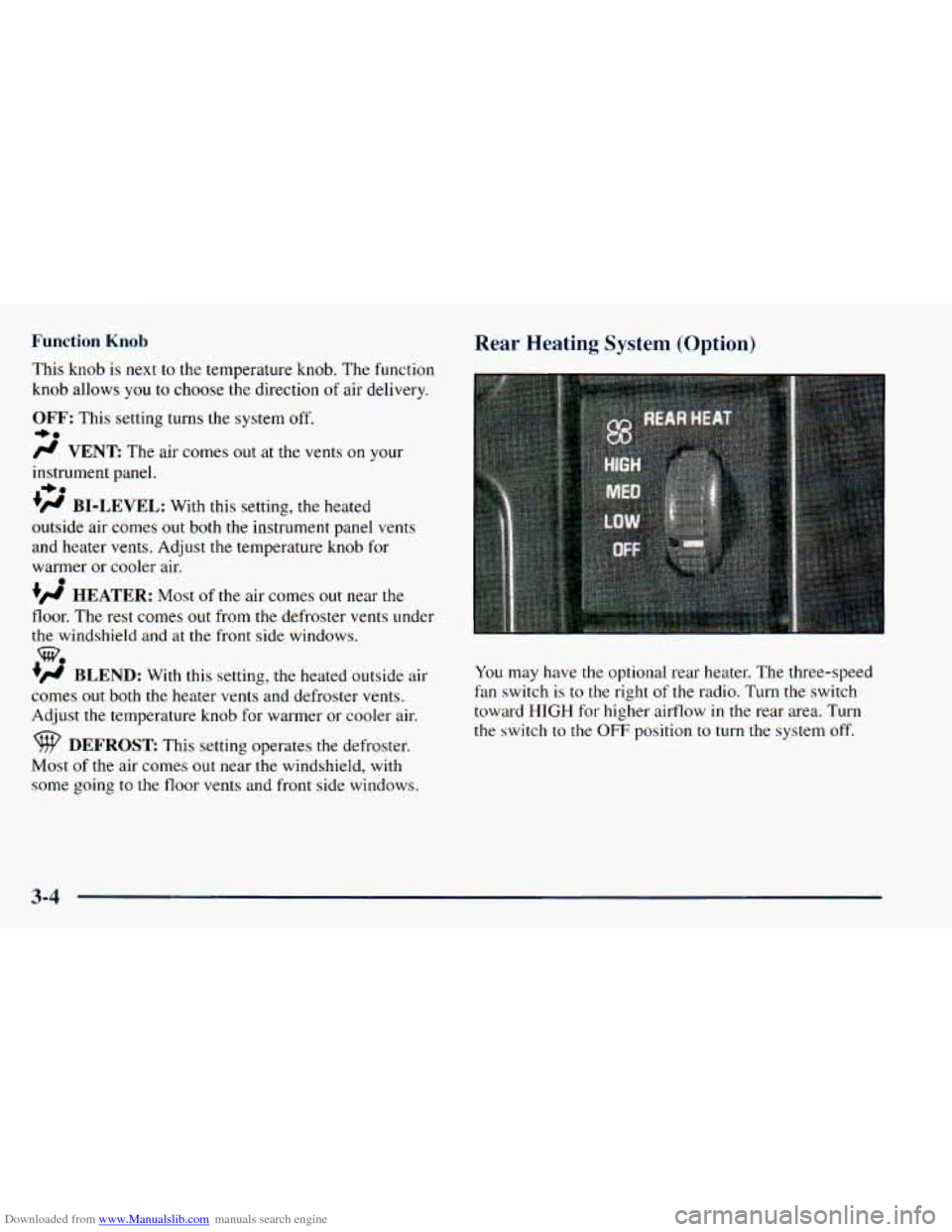
Rear Heating System (Option)
You may have the optional rear heater. The three-speed
fan switch is to the right
of the radio. Turn the switch
toward
HIGH for higher airflow in the rear area. Turn
the switch to the
OFF position to turn the system off.
3-4
Page 157 of 414
Downloaded from www.Manualslib.com manuals search engine Rear Air Conditioning System (Option) Air Conditioning
Before using
your vehicle’s air conditioning, open the
windows to clear the vehicle
of hot air. This reduces the
time
it takes for your vehicle to cool down. Then keep
your windows closed for the air conditioner to work at
its best.
You can use
MAX A/C with the temperature knob in the
blue area when it’s really
hot outside and you need to
cool the inside air quickly.
MAX A/C lets in only a little
air from the outside.
If you first
use MAX A/C, you can then use A/C with
the temperature knob
in the blue area, as soon as the
vehicle has cooled down,
so outside air will be going
through your vehicle.
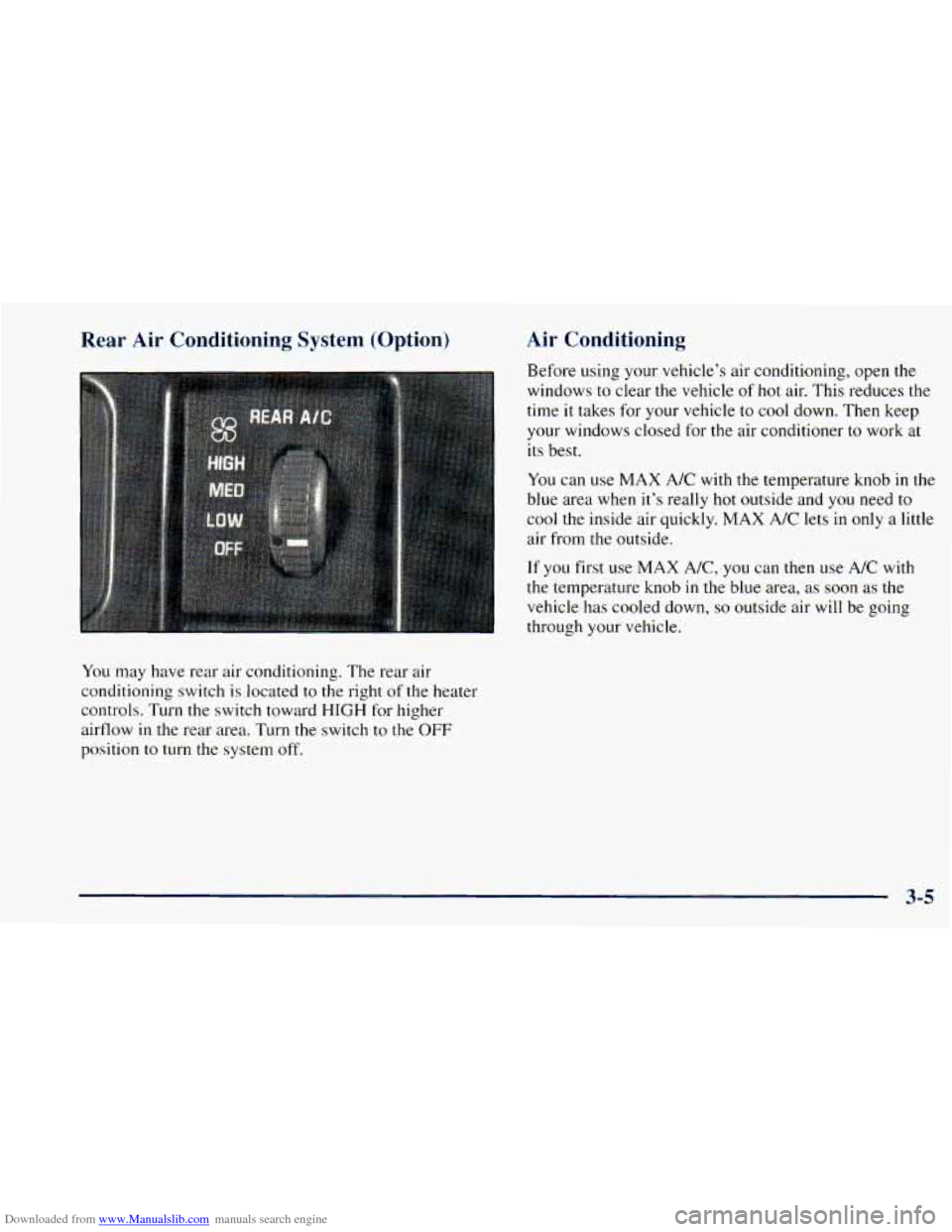
You may have rear air conditioning. The rear air
conditioning switch is located
to the right of the heater
controls. Turn the switch toward
HIGH for higher
airflow in the rear area. Turn the switch to the
OFF
position to turn the system off.
3-5
Page 158 of 414
Downloaded from www.Manualslib.com manuals search engine If your vehicle has rear air conditioning, setting it on
LOW may enhance the front
A/C performance by
allowing trapped refrigerant in
the rear lines to circulate.
The rear air conditioning system will
only send cooled
air if the front system is
on. It can still be used to
circulate air,
even if the front system is off.
When the air conditioning, DEFROST or BLEND is on,
you may notice a slight increase or decrease in engine
speed, due to compressor operation. This is normal
because the system is designed
to cycle the compressor
on and off to keep the desired temperature.
Heating
On cold days, use HEATER with the temperature knob
in the red area. Outside air will be brought in through
the floor outlets. The heater works best if you keep your
windows closed while using it.
If you use the optional engine coolant heater before
starting your engine, your heating system
will produce
warmer air faster
to heat the passenger compartment in
cold weather. See “Engine Coolant Heater” in the Index.
Defrosting
Use DEFROST to remove fog or ice from the
windshield quickly in extremely cold conditions. The
temperature knob should be in the red area and the fan
control toward high. The air conditioning compressor
may operate
in this setting to dehumidify the air.
The BLEND setting is useful for cold weather with
a
large number of passengers or very humid conditions to
help keep the windshield clear.
Ventilation System
For mild outside temperatures when little heating or
cooling is needed, use VENT
to direct outside air
through your vehicle. Air will flow through the
instrument panel vents.
Your vehicle’s flow-through ventilation system supplies
outside air to the inside of your vehicle when it is
moving. With the side windows closed, air will flow into
the front air inlet grilles at the base of the windshield,
through the vehicle and
out the rear air exhaust valve.
Outside air will also
enter the vehicle when the heater or
the air conditioning fan is running.
3-6