Page 80 of 414
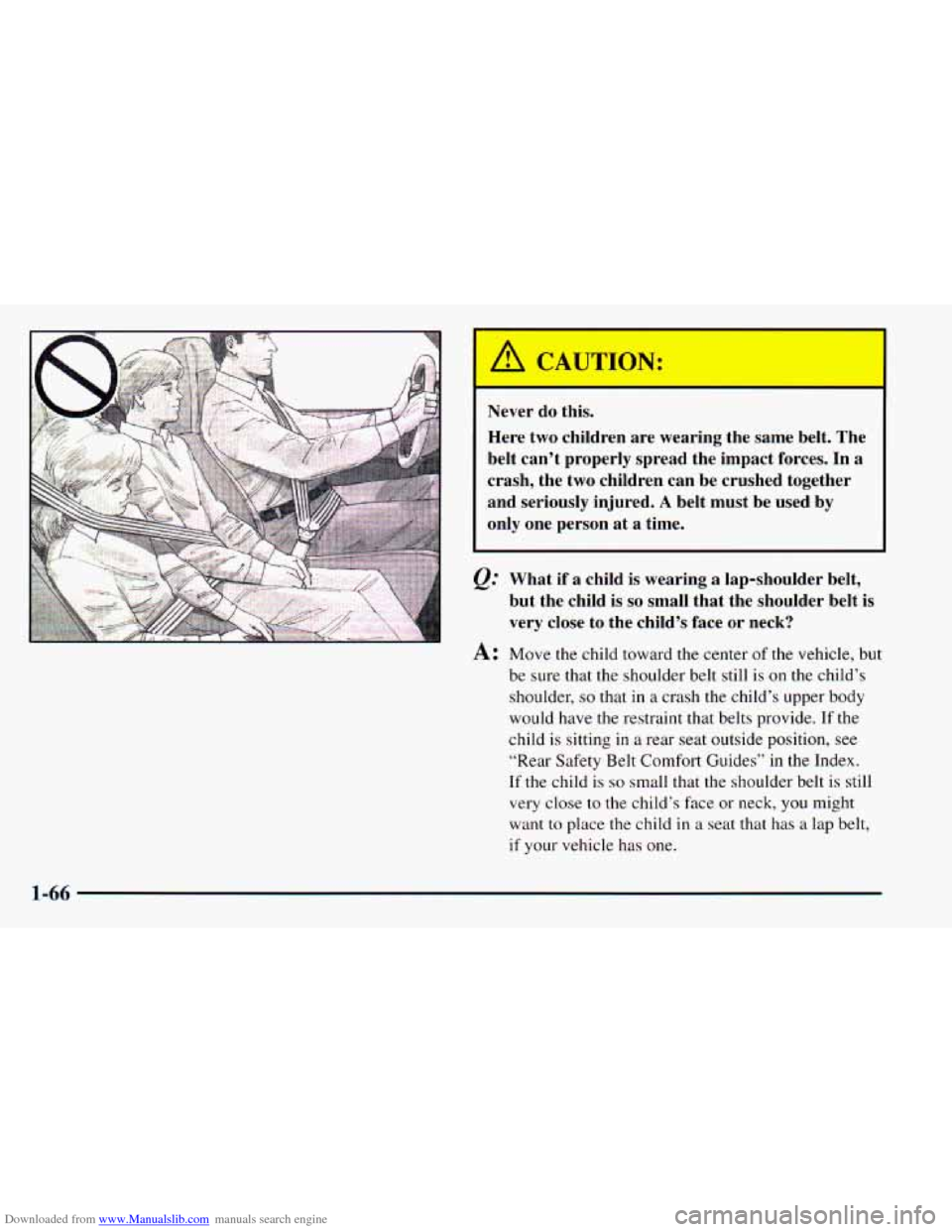
Downloaded from www.Manualslib.com manuals search engine Never do this.
Here two children are wearing the same belt. The
belt can’t properly spread the impact forces.
In a
crash, the two children can be crushed together
and seriously injured.
A belt must be used by
only one person at a time.
Q: What if a child is wearing a lap-shoulder belt,
but the child is
so small that the shoulder belt is
very close to the child’s face or neck?
A: Move the child toward the center of the vehicle, but
be sure that the shoulder belt still is on the child’s
shoulder,
so that in a crash the child’s upper body
would have the restraint that belts provide.
If the
child is sitting
in a rear seat outside position, see
“Rear Safety Belt Comfort Guides” in the Index.
If the child is so small that the shoulder belt is still
very close to the child’s face or neck, you might
want to place the child
in a seat that has a lap belt,
if your vehicle has one.
1-66
Page 88 of 414
Downloaded from www.Manualslib.com manuals search engine Front Doors
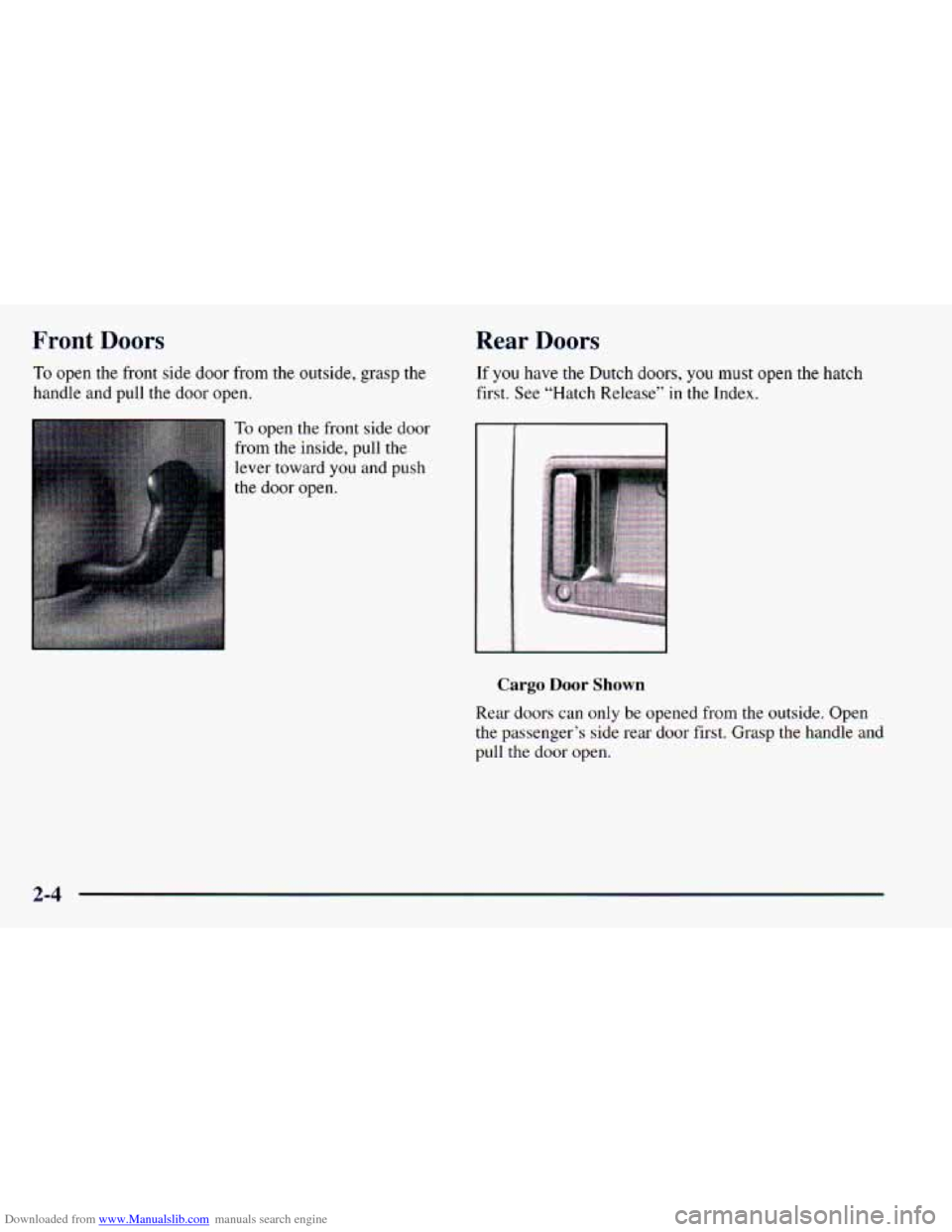
To open the front side door from the outside, grasp the
handle and pull the door open.
Rear Doors
If you have the Dutch doors, you must open the hatch
first. See “Hatch
Release” in the Index.
To open the front side door
from the inside, pull the
lever toward
you and push
the door open.
Cargo Door Shown
Rear doors can only be opened from the outside. Open
the passenger’s side rear door first. Grasp the handle and
pull the door open.
2-4
Page 94 of 414
Downloaded from www.Manualslib.com manuals search engine Synchronization
Synchronization may be necessary due to the security
method used by this system. The transmitter does not
send the same signal twice to the receiver.
The receiver
will not respond to a signal it has been sent previously.
This will prevent anyone from recording and playing
back the signal from the transmitter.
To resynchronize your transmitter, stand close to your
vehicle and simultaneously press and hold the
LOCK
and UNLOCK buttons on the transmitter for eight
seconds. The door locks should cycle
to confirm
synchronization.
If the locks do not cycle, see your
dealer for service.
Sliding Door
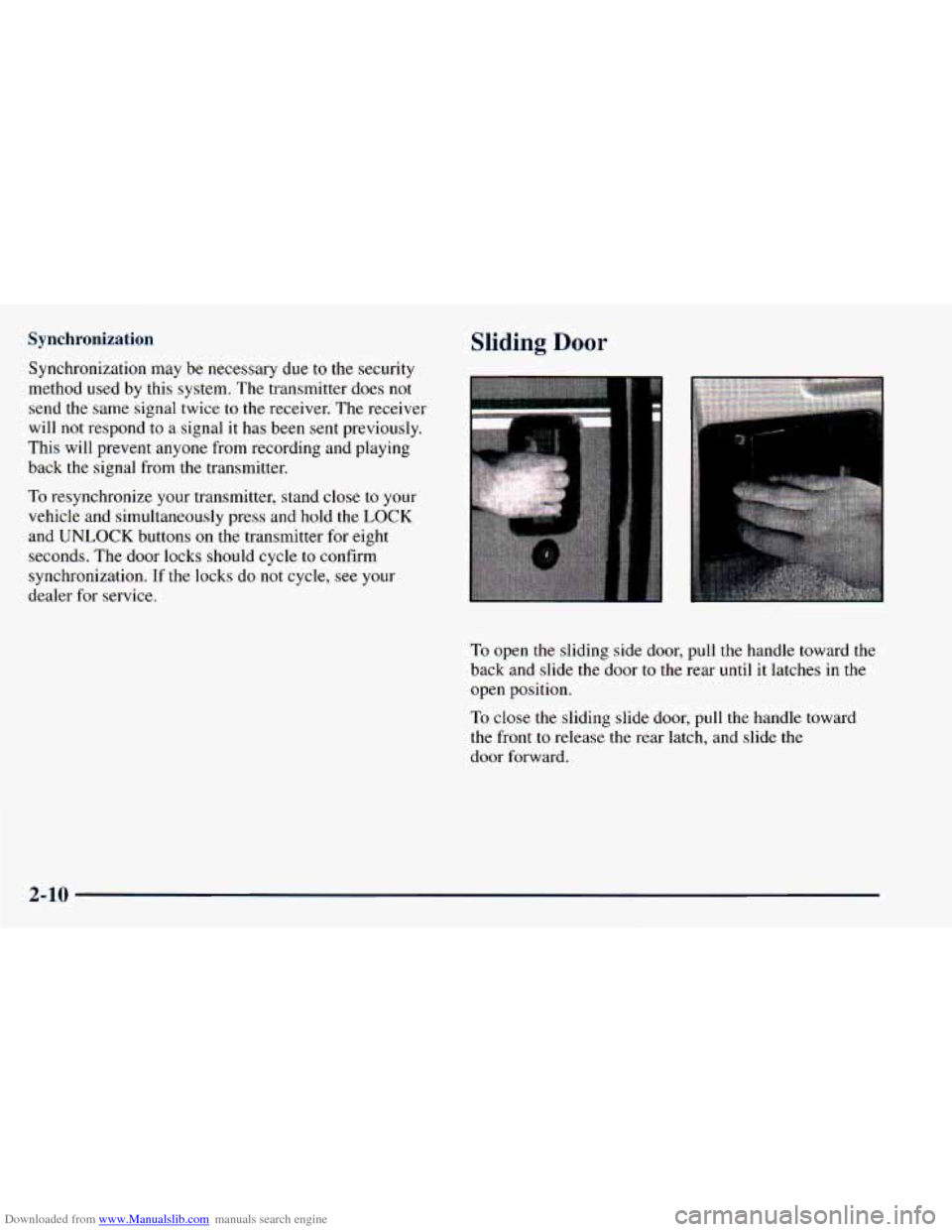
To open the sliding side door, pull the handle toward the
back and slide the door to
the rear until it latches in the
open position.
To close the sliding slide door, pull the handle toward
the front
to release the rear latch, and slide the
door forward.
2-10
Page 96 of 414

Downloaded from www.Manualslib.com manuals search engine There are two labels on your vehicle to remind you that
you have this feature. One can be seen from the outside
on your sliding door. It is located near the bottom of the
door glass, toward the front of the door.
Lu c3
c3
z w
n
a
l- I
The other label is at the
front of the sliding door,
near the child security
door lock.
This feature prevents passengers from opening the
sliding side door from the inside.
To use this feature, do the following:
1. Move the lever all the way up.
2. Close the door. To
open the sliding side door while the child security
lock
is engaged, unlock the door and open it from
the outside.
If you don’t cancel the security lock feature, adults or
older children who ride in the rear won’t be able to open
the sliding door from the inside.
You should let adults
and older children know how the security door lock
works, and how
to cancel the lock.
Canceling the Sliding Door Child
Security
Lock
To cancel the child security lock:
1. Unlock the door and open it from the outside.
2. Move the lever all the way down.
2-12
Page 99 of 414

Downloaded from www.Manualslib.com manuals search engine If the engine stalls and the SECURITY light flashes,
wait until the light stops flashing before trying to restart
the engine. Remember to release the key from the
START position as soon as the engine starts.
If you are driving and the SECURITY light comes on,
you will be able to restart the engine if you turn the
engine
off. However, your Passlock system is not
working properly and must be serviced by your dealer.
Your vehicle is not protected by Passlock at this time.
You may also want
to check the fuses (see “Fuses and
Circuit Breakers”
in the Index). See your dealer
for service.
If the SECURITY light comes on while the engine is
running, a problem has been detected and the system
may need service. See your dealer for service.
In an emergency, call
the GM Roadside Assistance
Center.
See “Roadside Assistance” in the Index.
New Vehicle “Break-In”
NOTICE:
Your vehicle doesn’t need an elaborate
“break-in.” But it will perform better in the long
run if you follow these guidelines:
0
0
0
0
Keep your speed at 55 mph (88 kmh) or
less for the first
500 miles (805 km).
Don’t drive at any one speed
-- fast or
slow
-- for the first 500 miles (805 km).
Don’t make full-throttle starts.
Avoid making hard stops for the first
200 miles (322 km) or so. During this time
your new brake linings aren’t yet broken
in. Hard stops with new linings can mean
premature wear and earlier replacement.
Follow this breaking-in guideline every
time you get new brake linings.
Don’t tow
a trailer during break-in.
See “Towing
a Trailer” in the Index for
more information.
2-15
Page 100 of 414
Downloaded from www.Manualslib.com manuals search engine Ignition Positions
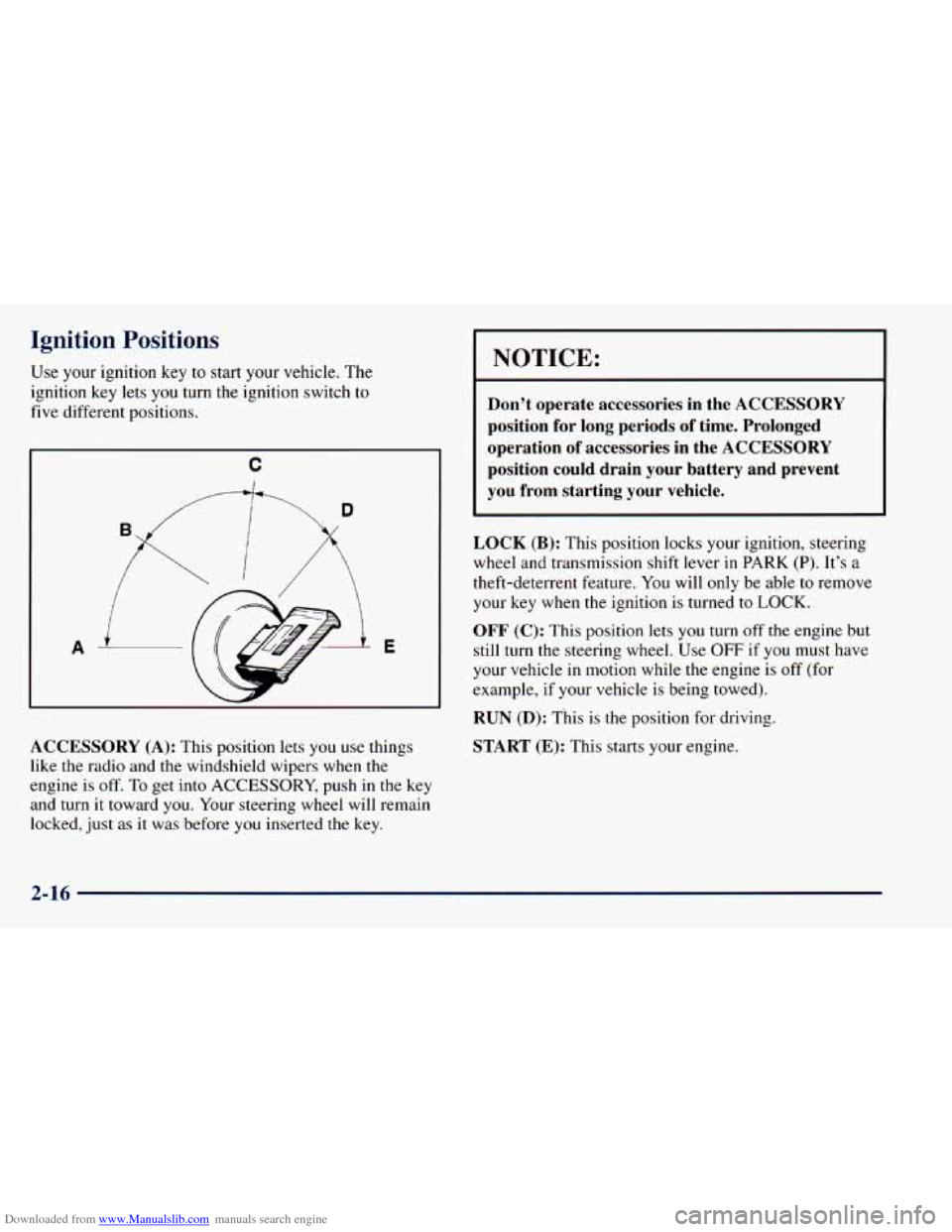
Use your ignition key to start your vehicle. The
ignition key lets you turn the ignition switch to
five different positions.
C
I
A i E
ACCESSORY (A): This position lets you use things
like
the radio and the windshield wipers when the
engine is off. To get into ACCESSORY, push in the key
and turn it toward you. Your steering wheel will remain
locked, just
as it was before you inserted the key.
NOTICE:
Don’t operate accessories in the ACCESSORY
position for long periods of time. Prolonged
operation of accessories in the ACCESSORY position could drain your battery and prevent
you from starting your vehicle.
LOCK (B): This position locks your ignition, steering
wheel and transmission shift lever in PARK
(P). It’s a
theft-deterrent feature. You will only be able to remove
your key when the ignition is turned
to LOCK.
OFF (C): This position lets you turn off the engine but
still turn the steering wheel. Use
OFF if you must have
your vehicle
in motion while the engine is off (for
example,
if your vehicle is being towed).
RUN (D): This is the position for driving.
START (E): This starts your engine.
2-16
Page 102 of 414

Downloaded from www.Manualslib.com manuals search engine 3. If your engine still won’t start (or starts but then
stops), wait
15 seconds and start over.
When the engine starts, let go
of the key and the
accelerator pedal.
I NOTICE:
Your engine is designed to work with the
electronics in your vehicle. If you add electrical
parts or accessories, you could change the way
the engine operates. Before adding electrical
equipment, check with your dealer. If you don’t,
your engine might not perform properly.
If you ever have to have your vehicle towed, see
the part
of this manual that tells how to do it
without damaging your vehicle. See “Towing
Your Vehicle” in the Index.
Fuel Regulator
You have a fuel regulator that shuts the fuel off when the
engine reaches
5,600 rpm.
Engine Coolant Heater (If Equipped)
In very cold weather,
0°F (-18°C) or colder,
the engine coolant heater
can help. You’ll get easier
starting and better
fuel
economy during engine
warm-up. Usually, the
coolant heater should
be
plugged in a minimum of
four hours prior to starting
your vehicle.
To Use the Engine Coolant Heater
1. Turn off the engine.
2. Open the hood and unwrap the electrical cord.
The engine coolant heater cord is located on the
driver’s side
of the engine compartment, near the
power steering fluid reservoir.
3. Plug it into a normal, grounded 110-volt AC outlet.
2-18
Page 104 of 414
Downloaded from www.Manualslib.com manuals search engine A CAUhON:
It is dangerous to get out of your vehicle if the
shift lever
is not fully in PARK (P) with the
parking brake firmly set. Your vehicle can roll.
Don’t leave your vehicle when the engine is
running unless you have to.
If you have left the
engine running, the vehicle can move suddenly.
You or others could be injured. To be sure your
vehicle won’t move, even when you’re on fairly
level ground, always set your parking brake and
move the shift lever to
PARK (P).
See “Shifting Into PARK (P)” in the Index. If
you’re pulling a trailer, see “Towing a Trailer” in
the Index.
Ensure the shift lever
is fully in PARK (P) before starting
the engine. Your vehicle has a brake-transmission shift
interlock. You have to fully apply your regular brakes
before you can shift from
PARK (P) when the ignition key is in the
RUN position. If you cannot shift out of
PARK (P), ease pressure on the shift lever
-- push the
shift lever all the way into
PARK (P) as you maintain
brake application. Then move the shift lever into the gear you wish. See “Shifting Out of PARK
(P)” in this section.
REVERSE (R): Use this gear to back up.
NOTICE:
Shifting to REVERSE (R) while your vehicle
is moving forward could damage your
transmission. Shift to
REVERSE (R) only
after your vehicle is stopped.
To rock your vehicle back and forth to get out of snow,
ice or sand without damaging your transmission, see
“Stuck: In Sand, Mud,
Ice or Snow” in the Index.
NEUTRAL (N): In this position, your engine doesn’t
connect with the wheels.
To restart when you’re
already moving, use NEUTRAL
(N) only. Also, use
NEUTRAL
(N) when your vehicle is being towed. ’
2-20