1998 CADILLAC SEVILLE key
[x] Cancel search: keyPage 81 of 378
Downloaded from www.Manualslib.com manuals search engine 3. If your engine still won’t start (or starts but then
stops), it could be flooded with too much gasoline.
Try pushing your accelerator pedal all the way to the
floor and holding
it there as you hold the key in
START for about three seconds. If the vehicle starts
briefly but then stops again,
do the same thing.
I NOTICE:
Your engine is designed to work with the
electronics in
your vehicle. If you add electrical
parts or accessories, you could change the way
the engine operates. Before adding electrical
equipment, check with your dealer.
If you don’t,
your engine might not perform properly.
If you ever have to have your vehicle towed, see
the part of this manual that tells how
to do it
without damaging your vehicle. See “Towing
Your Vehicle” in the Index.
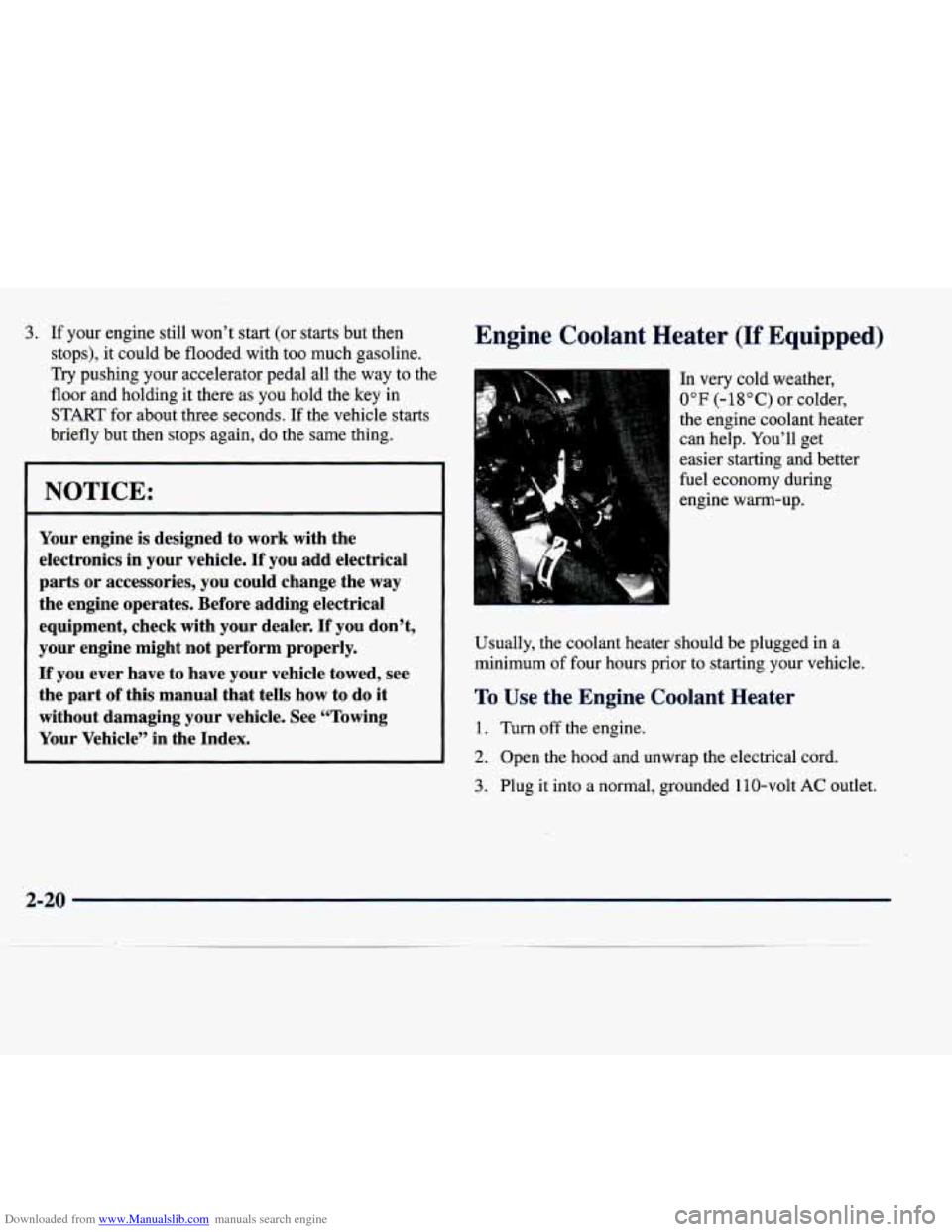
Engine Coolant Heater (If Equipped)
In very cold weather,
0°F (-18°C) or colder,
the engine coolant heater
can help. You’ll get
easier starting and better
fuel economy during
engine warm-up.
Usually, the coolant heater should be plugged in a minimum
of four hours prior to starting your vehicle.
To Use the Engine Coolant Heater
1. Turn off the engine.
2. Open the hood and unwrap the electrical cord.
3. Plug
it into a normal, grounded 110-volt AC outlet.
2-20
Page 83 of 378
Downloaded from www.Manualslib.com manuals search engine Don’t leave your vehicle when the engine is
running unless you have to. If you have left the
engine running, the vehicle can move suddenly.
You or others could be injured. To be sure your
vehicle won’t move, even when you’re on fairly
level ground, always set your parking brake and
move the shift lever to PARK
(P).
See “Shifting Into PARK (P)” in the Index. If
you’re pulling a trailer, see “Towing a Trailer’’ in
the Index.
Ensure the shift lever is fully in PARK (P) before
starting the engine. Your Cadillac has a brake-transaxle
shift interlock. You have to fully
apply your regular
brakes
before you can shift from PARK (P) when the
ignition key is in the
ON position. If you cannot shift the
shift lever all the way into PARK (P), ease pressure
on the shift lever push the shift lever all the way into
PARK (P) as you maintain brake application. Then
move the shift lever into the gear you wish. See “Shifting Out of PARK (P)”
in the Index. REVERSE
(R): Use this gear
to back up.
NOTICE:
Shifting to REVERSE (R) while your vehicle is
moving forward could damage your transaxle.
Shift to REVERSE (R) only after your vehicle
has stopped.
Also use this gear to rock your vehicle back and
forth to
get out of snow, ice or sand without damaging your
transaxle. See “If You’re Stuck
in Sand, Mud, Ice or
Snow” in the Index for additional information.
NEUTRAL
(N): In this position, the engine
doesn’t connect with the wheels.
To restart when you’re
already moving, use
NEUTRAL (N) only. Also use
NEUTRAL (N) when your vehicle is being towed.
2-22
Page 88 of 378
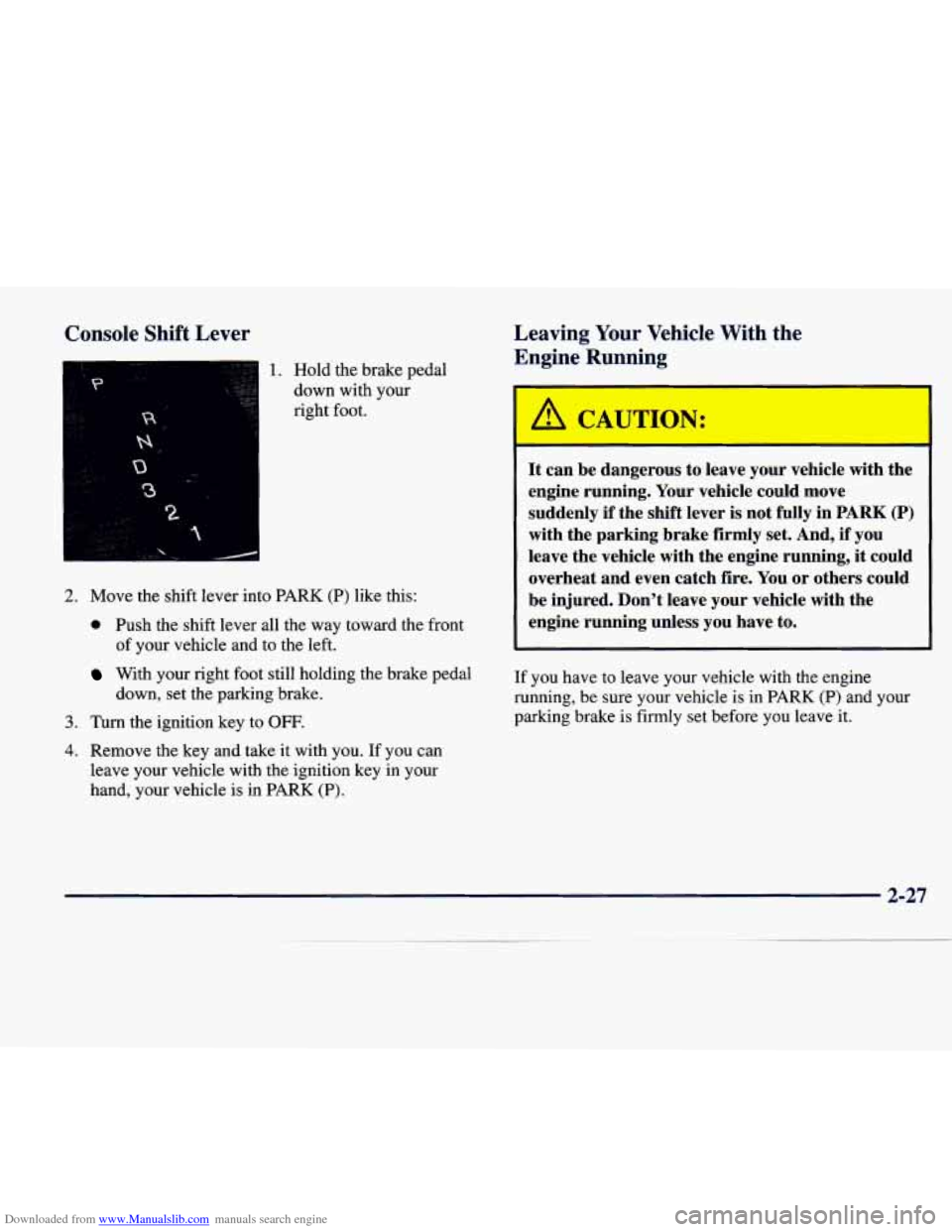
Downloaded from www.Manualslib.com manuals search engine Console Shift Lever
P
a
3
1. Hold the brake pedal
down with your
right foot.
2. Move the shift lever into PARK (P) like this:
0 Push the shift lever all the way toward the front
of your vehicle and to the left.
With your right foot still holding the brake pedal
down, set the parking brake.
3. Turn the ignition key to OFF.
4. Remove the key and take it with you. If you can
leave your vehicle with the ignition key in your
hand, your vehicle is in PARK
(P).
Leaving Your Vehicle With the
Engine Running
I I
U:
It can be dangerous to leave your vehicle with the
engine running. Your vehicle could move
suddenly if the shift lever is not fully in PARK
(P)
with the parking brake firmly set. And, if you
leave the vehicle with the engine running,
it could
overheat and even catch fire. You
or others could
be injured. Don’t leave your vehicle with the
engine running unless you have to.
If you have to leave your vehicle with the engine
running, be sure your vehicle is in
PARK (P) and your
parking brake is firmly set before you leave
it.
I
2-27
Page 89 of 378
Downloaded from www.Manualslib.com manuals search engine Torque Lock
If you are parking on a hill and you don’t shift your
transaxle into
PARK (P) properly, the weight of the
vehicle may put too much force on the parking pawl in
the transaxle.
You may find it difficult to pull the shift
lever out of
PARK (P). This is called “torque lock.” To
prevent torque lock, set the parking brake and then shift into
PARK (P) properly before you leave the driver’s
seat. To find out how, see “Shifting Into
PARK (P)” in
the Index.
If torque lock does occur, you may need to have another
vehicle push yours a little uphill to take some of the
pressure from the parking pawl in the transaxle,
so you
can pull the shift lever out
of PARK (P).
Shifting Out of PARK (P)
Your vehicle has a Brake-Transaxle Shift Interlock
(BTSI). You have to fully
apply your regular brakes
before you can shift from PARK (P) when the ignition is
in
ON. See “Automatic Transaxle” in the Index.
If you cannot shift out
of PARK (P), ease pressure on
the shift lever. Push the shift lever all the way into
PARK (P) as you maintain brake application. Then
move the shift lever into the gear you want. If you ever
hold
the brake pedal down but still can’t shift out of
PARK (P), try this:
1. Turn the ignition key to OFF. Open and close the
2. Apply and hold the brake until the end of Step 4.
driver’s door to turn off the RAP feature.
3. Shift to NEUTRAL (N).
4. Start the vehicle and then shift to the drive gear
you want.
5. Have the vehicle fixed as soon as you can.
2-28
Page 92 of 378
Downloaded from www.Manualslib.com manuals search engine Windows
Power Windows
I
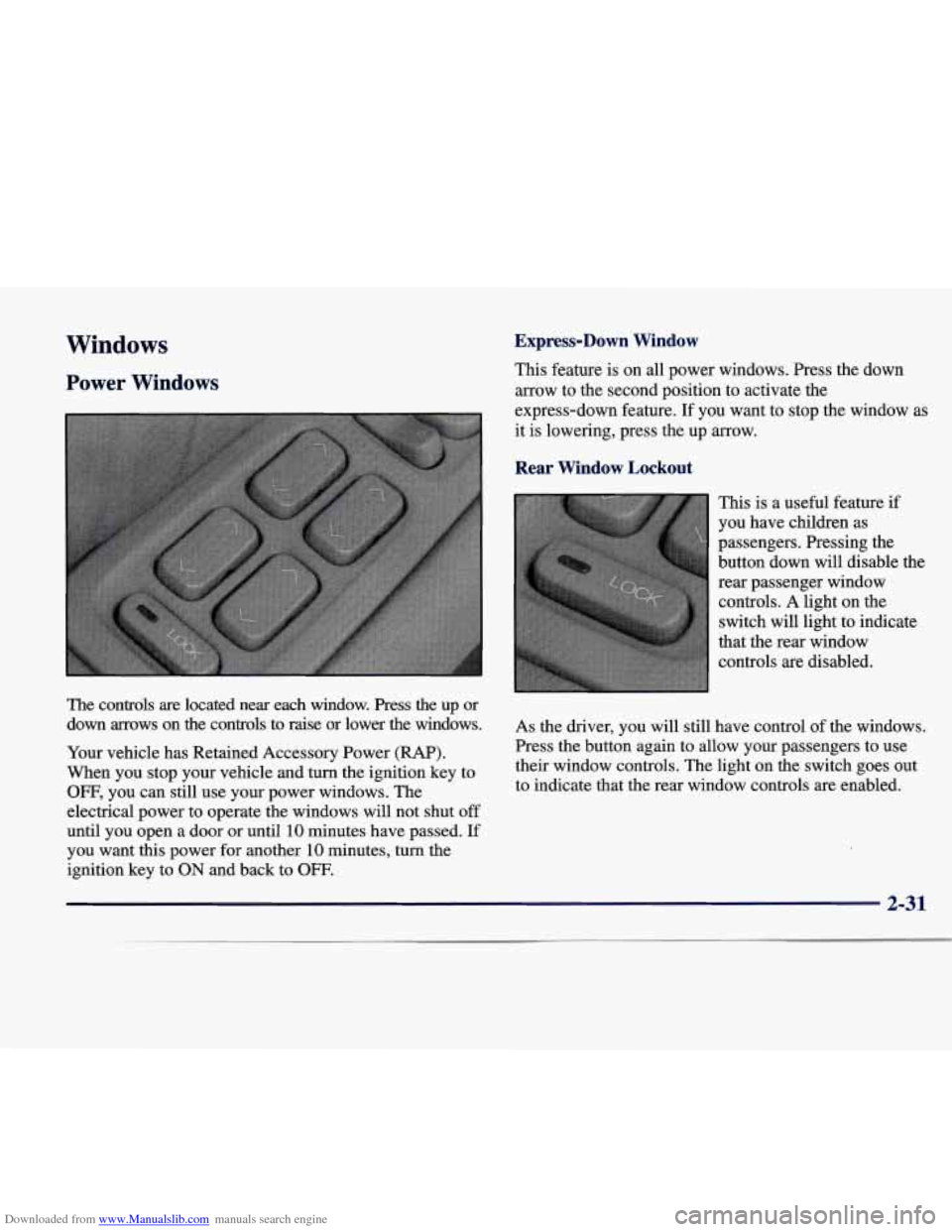
The controls are located near each window. Press the up or down arrows on the controls to raise or lower the windows.
Your vehicle has Retained Accessory Power
(RAP).
When you stop your vehicle and turn the ignition key to
OFF, you can still use your power windows. The
electrical power to operate the windows will not shut
off
until you open a door or until 10 minutes have passed. If
you want this power for another 10 minutes, turn the
ignition key to
ON and back to OFF.
Express-Down Window
This feature is on all power windows. Press the down
arrow
to the second position to activate the
express-down feature. If you want to stop the window as
it is lowering, press the up arrow.
Rear Window Lockout
This is a useful feature if
you have children as
passengers. Pressing the
button down will disable the
rear passenger window controls.
A light on the
switch will light to indicate
that the rear window controls are disabled.
As the driver, you will still have control
of the windows.
Press the button again to allow your passengers to use
their window controls. The light on the switch goes out
to indicate that the rear window controls are enabled.
2-31
Page 101 of 378
Downloaded from www.Manualslib.com manuals search engine Exterior Lamps
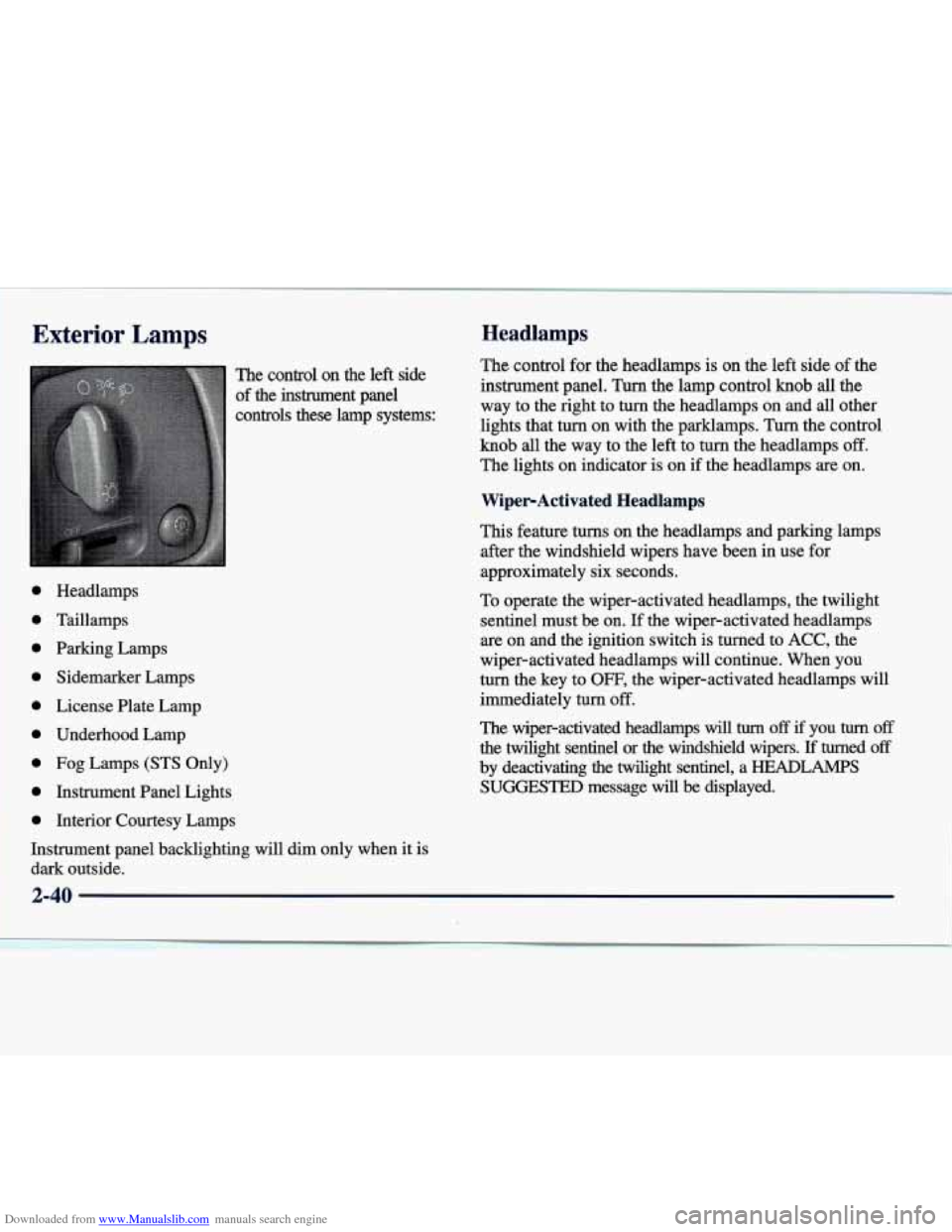
The control on the left side
of the instrument panel
controls these lamp systems:
0
0
0
0
0
0
0
0
0
Headlamps
Taillamps
Parking Lamps
Sidemarker Lamps
License Plate Lamp
Underhood Lamp
Fog Lamps
(STS Only)
Instrument Panel Lights
Interior Courtesy Lamps
Instrument panel backlighting will dim only when it is
dark outside.
~~ ~~ ~
~~ ~ ~~
~ ~~~~
Headlamps
The control for the headlamps is on the left side of the
instrument panel.
Turn the lamp control knob all the
way to the right to turn the headlamps
on and all other
lights that turn on with the parklamps. Turn the control
knob all the way to the left to turn the headlamps
off.
The lights on indicator is on if the headlamps are on.
WiperActivated Headlamps
This feature turns on the headlamps and parking lamps
after the windshield wipers have been in use for
approximately six seconds.
To operate the wiper-activated headlamps, the twilight
sentinel must be on. If the wiper-activated headlamps
are on and the ignition switch is turned to
ACC, the
wiper-activated headlamps will continue. When you
turn the key to OFF, the wiper-activated headlamps will
immediately turn
off.
The wiper-activated headlamps will turn off if you turn off
the twilight sentinel or the windshield wipers. I€ turned off
by deactivating the twilight sentinel, a HEADLAMPS
SUGGESTED message will be displayed.
2-40
Page 106 of 378
Downloaded from www.Manualslib.com manuals search engine Illuminated Entry
The illuminated entry system turns on the courtesy
lamps and the backlighting to the driver's door switches
and to the ignition key when a door is opened or if you
press the
RKE transmitter unlock button. The
illuminated entry system works with the light sensor and
it must be dark outside in order for the courtesy lamps or
backlighting to turn on. The courtesy lamps turn off
approximately
25 seconds after the last door is closed or
after the ignition key is placed in the
RUN position or if
the
RKE transmitter lock button is pressed.
Reading Lamps
The reading lamps are located in the roof. These lamps
and the interior courtesy lamps come on when any door
is opened and it is dark outside. The rear lamps come
on when a rear door
is opened. Press the button to turn
them on. Press it again to turn them off.
Parade Dimming
This feature prohibits the dimming of the instrument
panel lights during daylight while the parking lamps are
on. This feature works with the light sensor and is fully
automatic. When the light sensor reads darkness outside,
the instrument panel lights can be adjusted. Backlighting
to the instrument panel will also turn on. If
the reading lamps are left on, they automatically shut
off
10 minutes after the ignition has been turned off.
Battery Load Management
The battery load management feature is designed to
monitor the vehicle electrical load and determine when
the battery
is in a heavy discharge condition. During
times of high electrical loading, the engine may idle at a
higher
R€" setting than normal to make sure the battery
charges. High electrical loads may occur when several
of the following are on: headlamps, high beams, fog
lamps, rear window defogger, high blower fan, heated seats and engine cooling fans.
2-45
Page 112 of 378
Downloaded from www.Manualslib.com manuals search engine Curbview Assist Mirror (If Equipped)
If your vehicle is equipped with memory mirrors, it will
also be equipped with the curbview assist
mirror feature.
This feature
will cause the passenger mirror to tip when
the vehicle is in REVERSE (R). This feature is
especially useful in allowing you to view the curb when
you are parallel parking. If further adjustment is needed
after the mirror
is tipped, the mirror switch may be used
to adjust the mirror. If the mirror switch
is pressed while
the passenger mirror is tipped, the mirror will move in
that direction, but will return to its original position once
the vehicle is shifted out of
REVERSE (R).
Once the shift lever is shifted out of REVERSE (R) and
a five second delay has occurred, the passenger side
mirror will return to its original position.
To program the feature, see “Curbview Assist Mirror” in
the Index.
Storage Compartments
Glove Box
The glove box is located in front of the passenger’s seat.
To lock the glove box door, insert the master key into
the lock cylinder and
turn it to the right. Turn the key to
the left
to unlock the door.
Map Pocket
The mapktorage pockets are located on each front door as
well as on the passenger’s and driver’s front seatbacks.