1998 CADILLAC ELDORADO check engine
[x] Cancel search: check enginePage 300 of 380
Downloaded from www.Manualslib.com manuals search engine Then, without shutting off the engine, follow these steps:
I
1.
L. 3
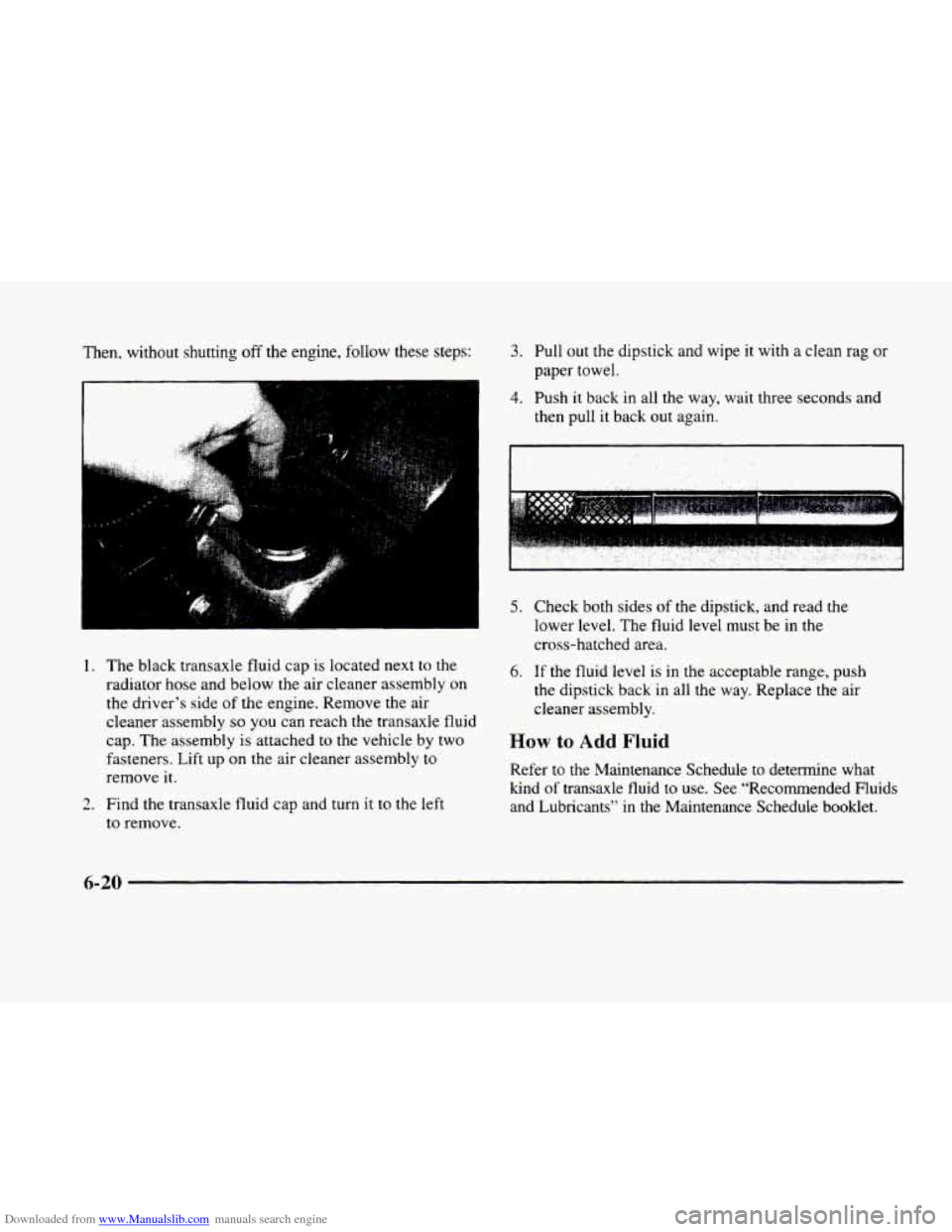
The black transaxle fluid cap is located next to the
radiator hose and below the air cleaner assembly on
the driver’s side
of the engine. Remove the air
cleaner assembly
so you can reach the transaxle fluid
cap. The assembly is attached to the vehicle by two
fasteners. Lift up on
the air cleaner assembly to
remove it.
Find the transaxle fluid cap and turn it to the left
to remove.
3. Pull out the dipstick and wipe it with a clean rag or
paper towel.
then pull it back out again.
4. Push it back in all the way, wait three seconds and
.I
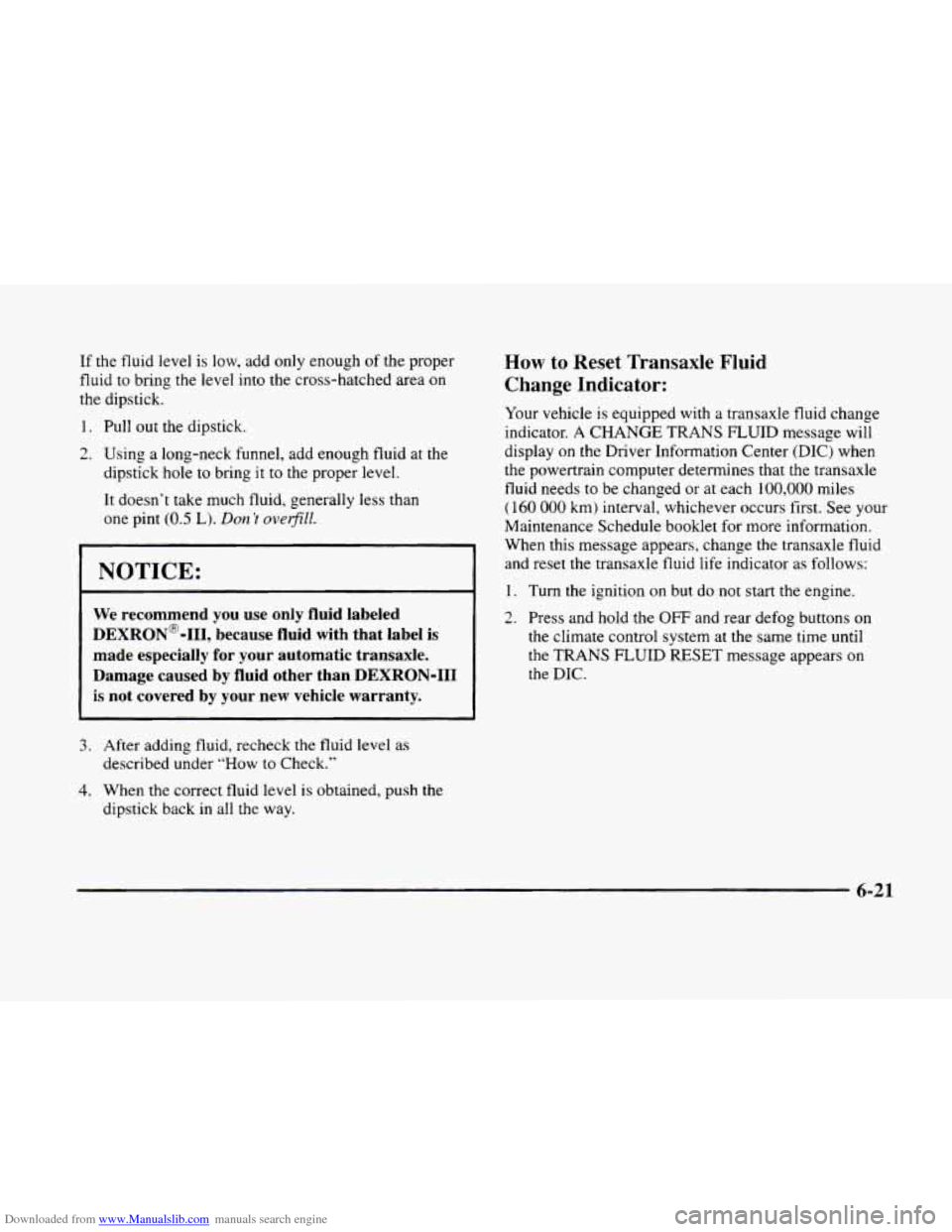
5. Check both sides of the dipstick, and read the
lower level. The fluid level must be in the
cross-hatched area.
6. If the fluid level is in the acceptable range, push
the dipstick back
in all the way. Replace the air
cleaner assembly.
How to Add Fluid
Refer to the Maintenance Schedule to determine what
kind
of transaxle fluid to use. See “Recommended Fluids
and Lubricants”
in the Maintenance Schedule booklet.
6-20
Page 301 of 380
Downloaded from www.Manualslib.com manuals search engine If the fluid level is low, add only enough of the proper
fluid to bring
the level into the cross-hatched area on
the dipstick.
1. Pull out the dipstick.
2. Using a long-neck funnel, add enough fluid at the
dipstick hole
to bring it to the proper level.
It doesn’t take much fluid, generally less than
one pint
(0.5 L). Don’t ovegi’ll.
-
NOTICE:
We recommend you use only fluid labeled
DEXRON@-111, because fluid with that label
is
made especially for your automatic transaxle.
Damage caused by fluid other than DEXRON-I11
is not covered by your new vehicle warranty.
3. After adding fluid, recheck the fluid level as
described under “How
to Check.”
4. When the correct fluid level is obtained, push the
dipstick back
in all the way.
How to Reset Transaxle Fluid
Change Indicator:
Your vehicle is equipped with a transaxle fluid change
indicator.
A CHANGE TRANS FLUID message will
display
on the Driver Information Center (DIC) when
the powertrain computer determines that the transaxle
fluid needs to be changed or at each
100,000 miles
(160 000 km) interval, whichever occurs first. See your
Maintenance Schedule booklet for more information.
When this message appears, change
the transaxle fluid
and reset the transaxle fluid life indicator as follows:
1. Turn the ignition on but do not start the engine.
2. Press and hold the OFF and rear defog buttons on
the climate control system at the same time until
the TRANS FLUID RESET message appears on
the DIC.
6-21
Page 303 of 380
Downloaded from www.Manualslib.com manuals search engine What to Use
Use a mixture of one-half clean water (preferably
distilled) and one-half
DEX-COOL” coolant which
won’t damage aluminum parts.
If you use this mixture.
you don’t need
to add anything else.
A CAUTION:
Adding only plain water to your cooling system
can be dangerous. Plain water, or some other liquid like alcohol, can boil before the proper
coolant mixture will. Your vehicle’s coolant
warning system is set for the proper coolant
mixture. With plain water
or the wrong mixture,
your engine could get too hot but you wouldn’t
get the overheat warning. Your engine could
catch fire and you or others could be burned.
Use a
50/50 mixture of clean water and
DEX-COOL@ coolant.
NOTICE:
If you use an improper coolant mixture, your
engine could overheat and be badly damaged. The repair cost wouldn’t be covered by your
warranty.
Too much water in the mixture can
freeze and crack the engine, radiator, heater
core and other parts.
If you have to add coolant more than four times a year,
have your dealer check your cooling system.
I NOTICE:
~~~~~
If you use the proper coolant, you don’t have to
add extra inhibitors or additives which claim to
improve the system. These can be harmful.
6-23
Page 304 of 380

Downloaded from www.Manualslib.com manuals search engine Checking Coolant
.
The surge tank is located next to the engine block on the
passenger's side
of the engine.
The cooling system is under a
lot of pressure when it
is hot. If the CHECK COOLANT LEVEL message
appears
on the Driver Information Center (DIC), you
will need to add coolant.
A CAUTION:
Turning the surge tank pressure cap when the
engine and radiator are hot can allow steam and
scalding liquids to blow out and burn
you badly.
Never turn the surge tank pressure cap
-- even a
little
-- when the engine and radiator are hot.
When your engine is cold. the coolant level should be at
the full cold mark, which
is 2.5 inches (6.4 cm) below
the base
of the fill neck. Use a flashlight as necessary to
see into the tank.
.................................................. ................. ...... ....... ............ ...... ............ ............ .......... ...................... ....... .................. ..... ..................................... .....................
If the CHECK COOLANT LEVEL message comes on.
it means you're low on engine coolant.
For more information, see "Check Coolant Level"
message in the Index.
6-24
Page 306 of 380

Downloaded from www.Manualslib.com manuals search engine Power Steering Fluid
c
The power steering fluid
reservoir
is located next
to the coolant surge tank
on the passenger’s side
When to Check Power Steering Fluid
It is not necessary to regularly check power steering
fluid unless you suspect there is
a leak in the system or
you hear an unusual noise.
A fluid loss in this system
could indicate a problem. Have the system inspected
and repaired.
How To Check Power Steering Fluid
When the engine compartment is cool, wipe the cap and
the top of
the reservoir clean, then unscrew the cap and
wipe the dipstick with a clean rag. Replace the cap and
completely tighten
it. Then remove the cap again and
look at the fluid level on the dipstick.
The level should be at the
FULL COLD mark. If
necessary, add
only enough fluid to bring the level up
to the mark.
What to Use
To determine what kind of fluid to use, see
“Recommended Fluids and Lubricants” in the
Maintenance Schedule booklet. Always use the
proper fluid. Failure to use the proper fluid can cause
leaks and damage
hoses and seals,
Windshield Washer Fluid
What to Use
When you need windshield washer fluid, be sure to read
the manufacturer’s instructions before use.
if you will be
operating your vehicle in an area where the temperature
may fall below freezing, use a fluid that has sufficient
protection against freezing.
6-26
Page 319 of 380
Downloaded from www.Manualslib.com manuals search engine r
r
!
r
I
r
r
I
r
I- t
A CAUTION:
~~ ~~
Poorly maintained and improperly used tires
are dangerous.
0
0
0
Overloading your tires can cause overheating
as a result of too much friction. You could have
an air-out and a serious accident. See “Loading
Your Vehicle”
h the Index.
UnderinfJated tires pose the same danger as
overloaded tires. The resulting accident
could cause serious injury. Check all tires
frequently to maintain the recommended
pressure. Tire pressure should be checked
when your tires are cold.
Overinflated tires are more likely to be
cut, punctured or broken by a sudden
impact
-- such as when you hit a pothole.
Keep tires at the recommended pressure.
CAUTION: (Continued) CAUTION: (Continued)
Worn, old
tires can cause accidents. If your
tread
is badly worn, or if your tires have
been damaged, replace them.
See “Inflation
-- Tire Pressure” in this section
for inflation pressure adjustment for higher
speed driving.
Inflation -- Tire Pressure
The Tire-Loading Information label, which is located
on the rear edge of the driver’s door, shows the correct
inflation pressures for your tires when they’re cold.
“Cold” means your vehicle has been sitting for at least
three hours or driven
no more than 1 mile (1.6 km).
If you’ll be driving at speeds higher than 100 mph
(160 km/h) where it is legal, raise the cold inflation
pressure of each tire to
35 psi (240 kPa). When you end
this very high-speed driving, reduce the cold inflation
pressures
to those listed on the Tire-Loading
Information label.
6-39
Page 320 of 380
Downloaded from www.Manualslib.com manuals search engine NOTICE:
Don’t let anyone tell you that underinflation or
overinflation
is all right. It’s not. If your tires
don’t have enough air (underinflation), you can
get
the following:
Too much flexing
Too much heat
0 Tire overloading
0 Bad wear
Bad handling
Bad fuel economy.
If your tires have too much air (overinflation),
you can get the following:
Unusual wear
Bad handling
0 Rough ride
0 Needless damage from road hazards. When
to Check
Check your tires once a month or more.
Don’t forget your compact spare tire. It should be at
60
psi (420 Wa).
How to Check
Use a good quality pocket-type gage to check tire
pressure.
You can’t tell if your tires are properly inflated
simply by looking
at them. Radial tires may look
properly inflated even when they’re underinflated.
Be sure to put the valve caps back on the valve
stems. They help prevent leaks by keeping out dirt
and moisture.
Tire Inspection and Rotation
Tires should be rotated every 6,000 to 8,000 miles
( 10 000 to 13 000 km). Any time you notice unusual
wear, rotate your tires as soon as possible and
check wheel alignment. Also check for damaged
tires or wheels. See “When It’s Time for New Tires”
and “Wheel Replacement” later in this section for
more information.
a
Page 322 of 380
Downloaded from www.Manualslib.com manuals search engine When It’s Time for New Tires
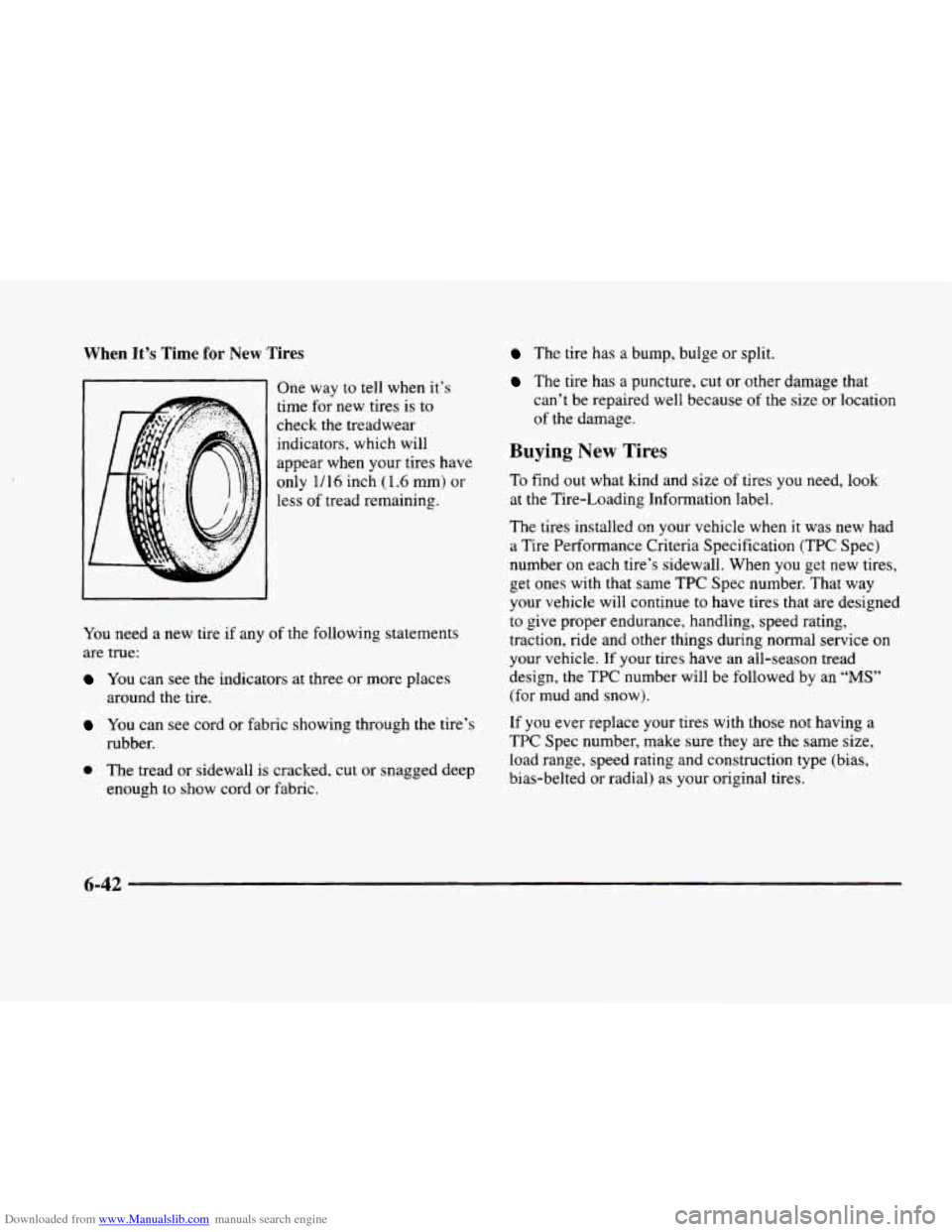
~ One way to tell when it’s
time for new tires is to
check the treadwear
indicators, which will
appear when your tires have
only 1/16 inch (1.6 mm) or
less of tread remaining.
You need a new tire if any
of the following statements
are true:
You can see the indicators at three or more places
around the tire.
You can see cord or fabric showing through the tire’s
rubber.
The tire has a bump, bulge or split.
The tire has a puncture, cut or other damage that
can’t be repaired well because
of the size or location
of the damage.
Buying New Tires
To find out what kind and size of tires you need, look
at the Tire-Loading Information label.
The tires installed on your vehicle when
it was new had
a Tire Performance Criteria Specification (TPC Spec)
number
on each tire’s sidewall. When you get new tires,
get ones with that same
TPC Spec number. That way
your vehicle will continue to have tires that are designed
to give proper endurance, handling, speed rating,
traction, ride and other things during normal service on
your vehicle.
If your tires have an all-season tread
design, the
TPC number will be followed by an ”MS”
(for mud and snow).
If you ever replace your tires with those not having
a
TPC Spec number, make sure they are the same size,
load range, speed rating and consiruction type (bias,
0 The tread or sidewall is cracked, cut or snagged deep bias-belted or radial) as your original tires.
enough to show cord or fabric.
6-42