1998 CADILLAC ELDORADO tow
[x] Cancel search: towPage 94 of 380
Downloaded from www.Manualslib.com manuals search engine THIRD (3): This position is also used for normal
driving, however, it offers more power and lower fuel
economy than
OVERDRIVE (@).
Here are examples for using THIRD (3) instead of
OVERDRIVE (0):
When driving on hilly, winding roads.
When towing a trailer, so there is less sh
When going down a steep hill.
between gears.
[ifting
SECOND (2): This position
gives you more power. You
can use SECOND (2) on hills. It can help control your
speed as you
go down steep mountain roads, but then
you would also want to use your brakes off and on.
~-
NOTICE:
~~~ ~~ ~~~~
Don’t shift into SECOND (2) unless you are going
slower than
65 mph (105 km/h), or you can
damage your engine.
FIRST (1): This position gives you even more power
than SECOND (2). You can use it on very steep hills,
or
in deep snow or mud. (If the shift lever is put in
FIRST
(l), the transaxle won’t shift into gear until the
vehicle is going slowly enough.)
NOTICE:
If your front wheels can’t rotate, don’t try to
drive. This might happen
if you were stuck in
very deep sand or mud or were~up against a solid
object. You could damage your transaxle.
Also,
if you stop when going uphill, don’t hold
your vehicle there with
only the accelerator
pedal. This could cause overheating and damage
the transaxle. Use your brakes to hold your
vehicle in position on a hill.
Page 95 of 380
Downloaded from www.Manualslib.com manuals search engine Parking Brake
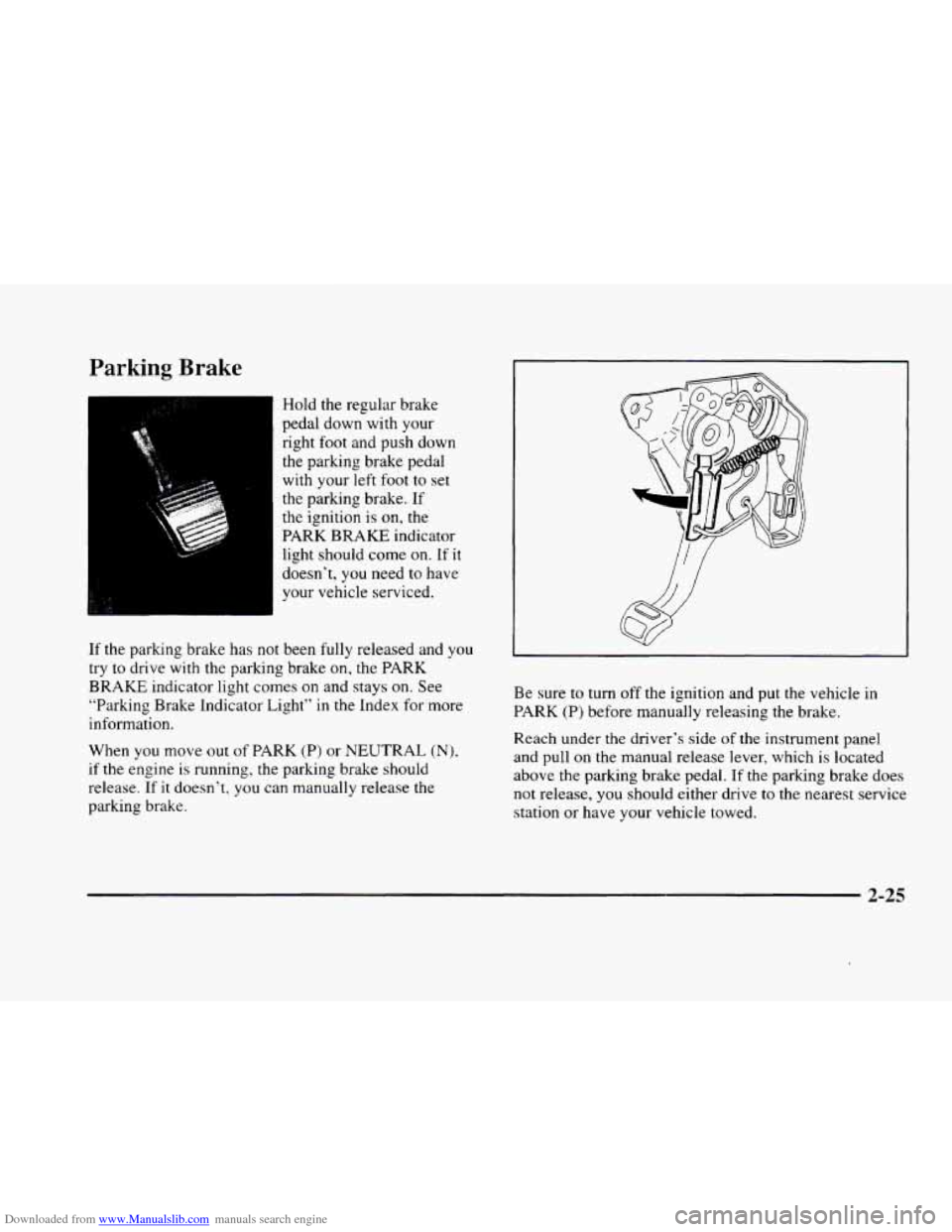
Hold the regular brake
pedal down with your
right
foot and push down
the parking brake pedal
with your left foot to set
the parking brake. If
the ignition is
on, the
PARK
BRAKE indicator
light should come
on. If it
doesn’t, you need to have
your vehicle serviced.
If the parking brake has not been fully released and you
try to drive with the parking brake
on, the PARK
BRAKE indicator light comes on and stays on. See
“Parking Brake Indicator Light“ in the Index for more
information.
When you move out of PARK
(P) or NEUTRAL (N),
if the engine is running, the parking brake should
release. If
it doesn’t, you can manually release the
parking brake. Be
sure
to turn off the ignition and put the vehicle in
PARK (P) before manually releasing the brake.
Reach under
the driver’s side of the instrument panel
and pull
on the manual release lever, which is located
above the parking brake pedal. If the parking brake does
not release, you should either drive
to the nearest service
station or have your vehicle towed.
2-25
Page 96 of 380
Downloaded from www.Manualslib.com manuals search engine A CAUTION:
Always shift to PARK (P) before pulling the
manual release lever.
If your hand or arm is in
the way of the pedal you could be hurt. The pedal
springs back quickly. Keep your hand and arm
away when you use the manual release
lever.
NOTICE:
Driving with the parking brake on can cause
your rear brakes to overheat.
You may have to
replace them and you could also damage other
parts of your vehicle.
If you are towing a trailer and are parking on a hill, see
“Towing a Trailer” in the Index. This section shows
what to do first to keep the trailer from moving.
Shifting Into PARK (P)
A CAUTION:
It can be dangerous to get out of your vehicle if
the shift lever
is not fully in PARK (P) with the
parking brake firmly
set. Your vehicle can roll. If
you have left the engine running, the vehicle can
move suddenly. You or others could be injured.
To be sure your vehicle won’t move, even when
you’re on fairly level ground, use the steps that
follow. If you’re pulling
a trailer, see “Towing a
Trailer” in the Index.
Console Shift Lever
1. Hold the brake pedal down with your right foot.
2-26
Page 97 of 380
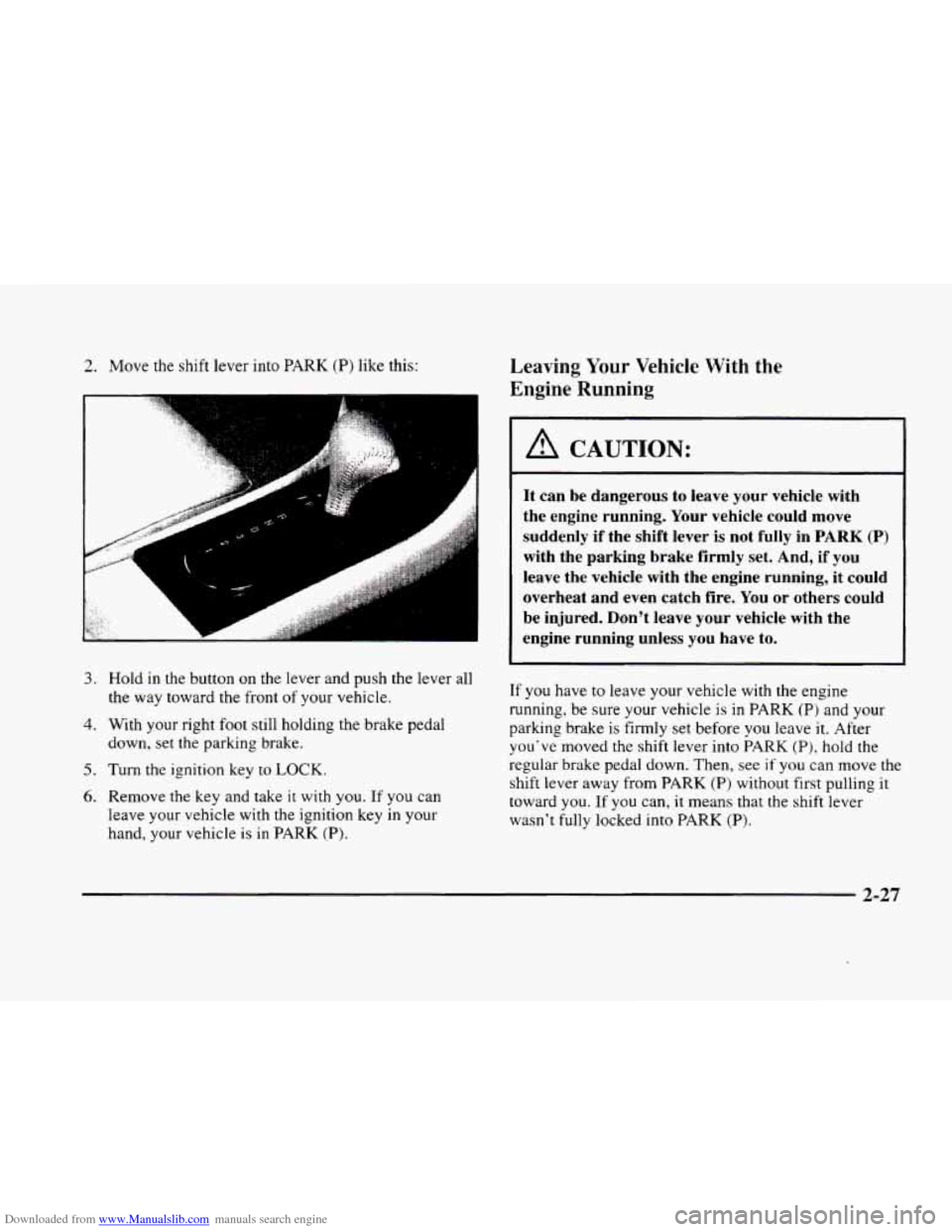
Downloaded from www.Manualslib.com manuals search engine 2. Move the shift lever into PARK (P) like this:
3. Hold in the button on the lever and push the lever all
4. With your right foot still holding the brake pedal
down, set the parking brake.
5. Turn the ignition key to LOCK.
6. Remove the key and take it with you. If you can
leave your vehicle with the ignition key in your
hand, your vehicle
is in PARK (P).
the way toward the front of your vehicle.
Leaving Your Vehicle With the
Engine Running
A CAUTION:
It can be dangerous to leave your vehicle with
the engine running. Your vehicle could move
suddenly if the shift lever is not fully in
PARK (P)
with the parking brake firmly set. And, if you
leave the vehicle with the engine running, it could
overheat and even catch fire. You or others could
be injured. Don't leave your vehicle with the
engine running unless you have to.
If you have to leave your vehicle with the engine
running. be sure your vehicle
is in PARK (P) and your
parking brake is firmly set before
you leave it. After
you've moved the shift lever into PARK
(P), hold the
regular brake pedal down. Then, see if
you can move the
shift lever away from PARK (P) without first pulling it
toward
you. If you can, it means that the shift lever
wasn't fully locked into PARK
(P).
2-27
Page 100 of 380
Downloaded from www.Manualslib.com manuals search engine Running Your Engine While
You’re Parked
It’s better not to park with the engine running. But if you
ever have
to, here are some things to know.
I A CAUTION:
I
Idling the engine with the climate control
system off could allow dangerous exhaust into
your vehicle (see the earlier Caution under
“Engine Exhaust”).
Also, idling in a closed-in place can let deadly
carbon monoxide
(CO) into your vehicle even if
the fan switch
is at the highest setting. One place
this can happen is
a garage. Exhaust -- with
CO -- can come in easily. NEVER park in a
garage with the engine running.
Another closed-in place can be a blizzard. (See
“Blizzard” in the Index.)
A CAUTION:
It can be dangerous to get out of your vehicle if
the shift lever is not fully in PARK (P) with the
parking brake firmly set. Your vehicle can roll.
Don’t leave your vehicle when the engine
is
running unless you have to. If you’ve left the
engine running, the vehicle can move suddenly.
You or others could be injured.
To be sure your
vehicle won’t move, even when you’re on
fairly
level ground, always set your parking brake after
you move the shift lever to PARK
(P).
Follow the proper steps to be sure your vehicle won’t
move. See “Shifting Into
PARK (P)” in the Index.
If you are parking on a hill and if you’re pulling a
trailer, also see “Towing a Trailer” in the Index.
2-30
Page 102 of 380
Downloaded from www.Manualslib.com manuals search engine Tilt Wheel
... .,
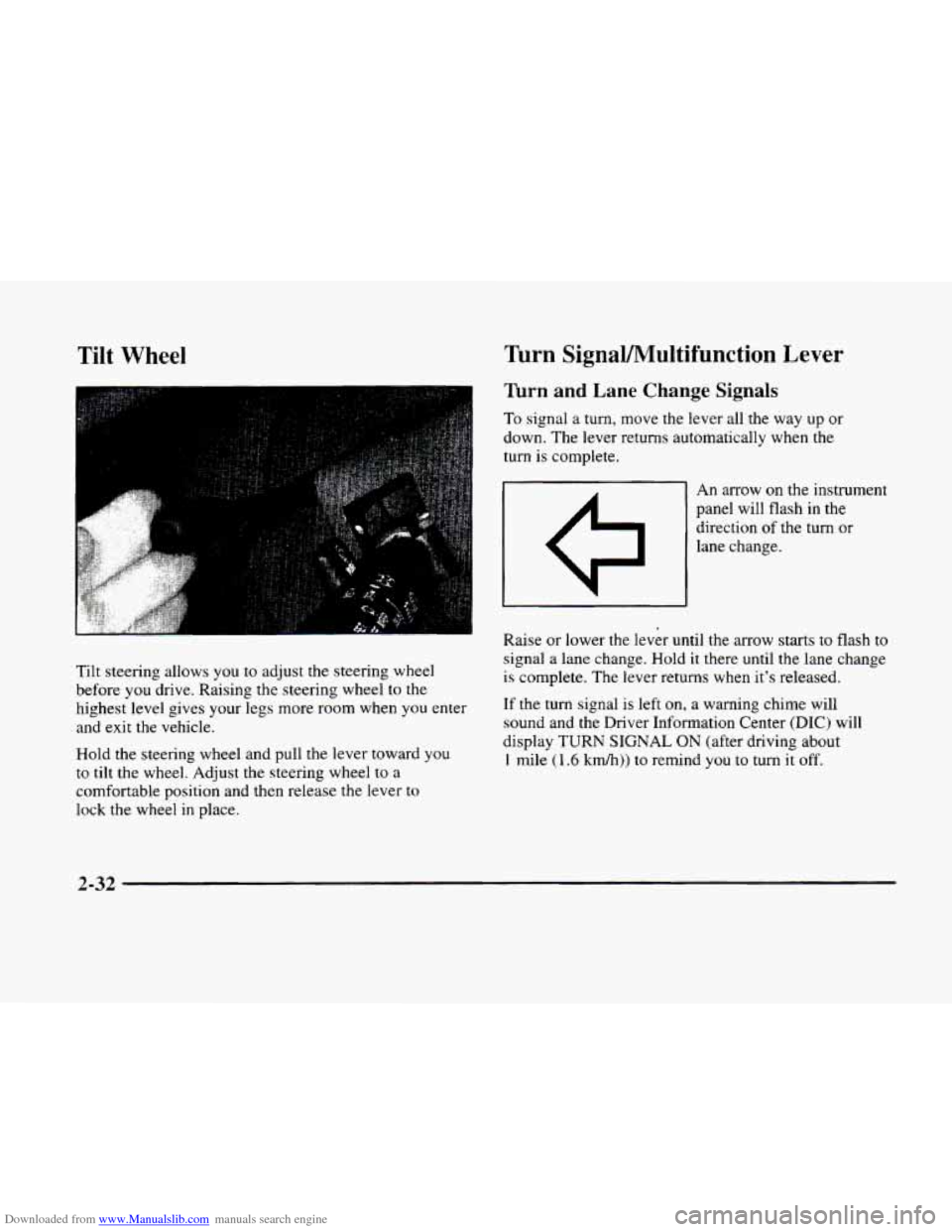
Tilt steering allows you to adjust the steering wheel
before
you drive. Raising the steering wheel to the
highest level gives your legs more room when you enter
and exit the vehicle.
Hold the steering wheel and pull
the lever toward you
to tilt the wheel. Adjust the steering wheel to a
comfortable position and then release the lever to
lock the wheel in place.
Turn SignaVMultifunction Lever
Turn and Lane Change Signals
To signal a turn, move the lever all the way up or
down, The lever returns automatically when the
turn is complete.
I 1
c7
An arrow on the instrument
panel will flash
in the
direction
of the turn or
lane change.
Raise
or lower the lever until the arrow starts to flash to
signal a lane change. Hold it there until the lane change
is complete. The lever returns when it's released.
If the turn signal is left on, a warning chime will
sound and the Driver Information Center
(DIC) will
display
TURN SIGNAL ON (after driving about
1 mile (1.6 km/h)) to remind you to turn it off.
2-32
Page 103 of 380

Downloaded from www.Manualslib.com manuals search engine Arrows that flash rapidly when signaling for a turn or
lane change may be caused by a burned-out signal bulb.
Other drivers won’t see
the turn signal.
Replace burned-out bulbs
to help avoid possible
accidents. Check the fuse
(see “Fuses and Circuit
Breakers”
in the Index) and for burned-out bulbs if
the arrow fails to work when signaling a turn.
Headlamp High/Low Beam Changer
Pull the turn signal lever
all the way toward
you and
then release it
to change the
headlamps from low beam
to high or from high beam
to low.
This light
on the instrument panel will be on, indicating
high beam usage.
Flash-To-Pass
This lets you use the high-beam headlamps to signal
the driver in front
of you that you want to pass.
Pull the
turn signal lever toward you to use. When
you do:
0
0
0
If the headlamps are either off or in the Daytime
Running Lamps
(DRL) mode, the high-beam
headlamps will turn
on. They’ll stay on as long
as you hold the lever there. Release the lever to
turn them off.
If the headlamps are
on low beam, they will shift to
high beam and stay there. Pull the lever toward you
to return to low beam.
If the headlamps are
on high beam, they will switch
to low beam.
To return to high beam. pull the lever
toward you.
2-33
Page 104 of 380

Downloaded from www.Manualslib.com manuals search engine Windshield Wipers
WIPER: Turn the band on the turn signal lever to
control the wipers.
MISE Turn the band toward you and then release it for
a single wipe cycle, For more cycles, hold the band on
MIST longer.
LO or HI: Turn the band away from you to either LO
(low speed) or to HI (high speed), depending on the
wiper speed you want.
DELAY: You can set the wiper speed for a long or short
delay between wipes with this setting. Move the band to
the
DELAY position. The closer you move it to LO, the
longer the delay. (Eldorado Only)
OFF: Turn the band to OFF to turn off the wipers.
Be
sure to clear ice and snow from the wiper blades
before using them.
If they're frozen to the windshield,
carefully loosen or thaw them.
If the blades do become
damaged, get new blades or blade inserts.
Heavy snow or
ice can overload the wiper motor. A
circuit breaker will stop the motor until it cools. Clear
away snow or ice to prevent an overload.
Rainsense Wipers (ETC Only)
This moisture sensor is mounted on the passenger's
interior side of the windshield behind the rearview
mirror and
is used to automatically operate the wipers
by monitoring the amount
of moisture that is on
the windshield.
2-34