1998 CADILLAC ELDORADO overheating
[x] Cancel search: overheatingPage 94 of 380
Downloaded from www.Manualslib.com manuals search engine THIRD (3): This position is also used for normal
driving, however, it offers more power and lower fuel
economy than
OVERDRIVE (@).
Here are examples for using THIRD (3) instead of
OVERDRIVE (0):
When driving on hilly, winding roads.
When towing a trailer, so there is less sh
When going down a steep hill.
between gears.
[ifting
SECOND (2): This position
gives you more power. You
can use SECOND (2) on hills. It can help control your
speed as you
go down steep mountain roads, but then
you would also want to use your brakes off and on.
~-
NOTICE:
~~~ ~~ ~~~~
Don’t shift into SECOND (2) unless you are going
slower than
65 mph (105 km/h), or you can
damage your engine.
FIRST (1): This position gives you even more power
than SECOND (2). You can use it on very steep hills,
or
in deep snow or mud. (If the shift lever is put in
FIRST
(l), the transaxle won’t shift into gear until the
vehicle is going slowly enough.)
NOTICE:
If your front wheels can’t rotate, don’t try to
drive. This might happen
if you were stuck in
very deep sand or mud or were~up against a solid
object. You could damage your transaxle.
Also,
if you stop when going uphill, don’t hold
your vehicle there with
only the accelerator
pedal. This could cause overheating and damage
the transaxle. Use your brakes to hold your
vehicle in position on a hill.
Page 135 of 380
Downloaded from www.Manualslib.com manuals search engine Engine Coolant Temperature
Warning Light
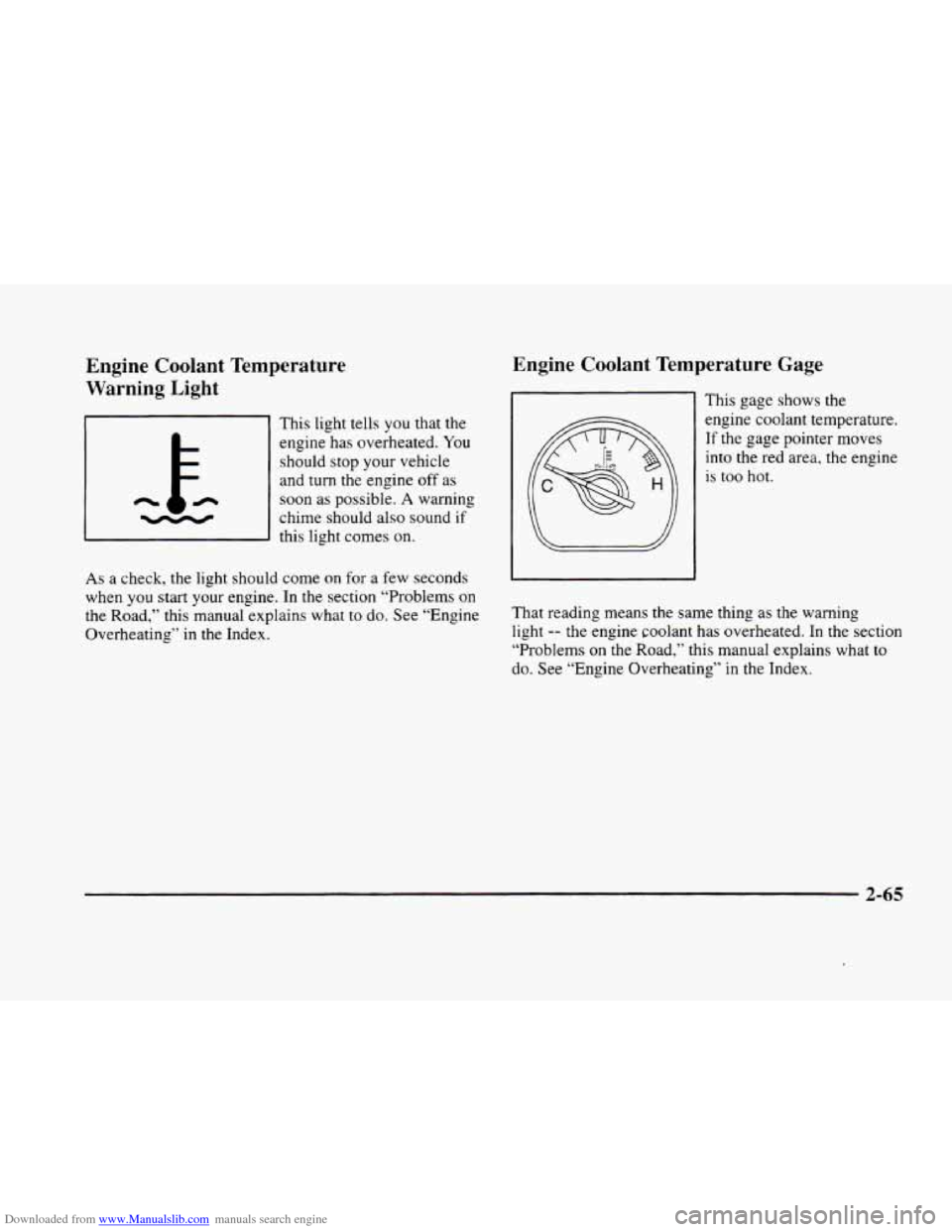
This light tells you that the
engine has overheated. You
should stop your vehicle
and
turn the engine off as
n
chime should also sound if -
soon as possible. A warning
this light comes on.
As
a check, the light should come on for a few seconds
when
you start your engine. In the section “Problems on
the Road,” this manual explains what
to do. See “Engine
Overheating’‘ in the Index.
Engine Coolant Temperature Gage
This gage shows the
engine coolant temperature. If the gage pointer moves
into the
red area, the engine
is
too hot.
That reading means the same thing as the warning
light -- the engine coolant has overheated. In the section
“Problems on the Road,” this manual explains what
to
do. See “Engine Overheating” in the Index.
2-65
Page 144 of 380

Downloaded from www.Manualslib.com manuals search engine ENGINE COOLANT HOT-IDLE ENGINE - 44:
This message will appear when the engine coolant
temperature is over
248 “F ( 126” C). To avoid added
strain on a hot engine, turn off the climate control
system. Stop and allow your vehicle to idle until it cools
down or the message
is removed. If it does not cool
down, turn off the engine and have
it serviced before
driving it again. Severe engine damage can result from
an overheated engine.
See “Engine Overheating” in
the Index.
ENGINE HOT - AC OFF - 16: This message displays
when the engine coolant becomes hotter than the normal
operating temperature.
To avoid added strain on a hot
engine, the air conditioning compressor is automatically
turned
off so that air conditioned air is not delivered.
If
the coolant temperature returns to normal, you
must select AC to return to a normal A/C compressor
operation.
If this message continues to appear, have
the system repaired as soon as possible to avoid
compressor damage.
ENGINE MISFIRE -- EASE OFF GAS
PEDAL
- 114: An engine misfire has occurred.
You’
11 need to ease off the gas pedal.
ENGINE OVERHEATED - STOP ENGINE - 42:
This message will appear when the engine has
overheated. Stop and
turn the engine off immediately to
avoid severe engine damage. See “Engine Overheating”
in the Index. A multiple chime will also sound when this
message
is displayed.
ENGINE POWER REDUCED - 41: This message
informs you that your vehicle is reducing engine power
because the transaxle is being placed
in gear under
conditions that may cause damage to the vehicle
powertrain or vehicle acceleration.
FUEL LEVEL LOW - 11: This message serves as a
warning that the fuel level in the tank is critically low.
Stop for fuel soon.
HEADLAMPS SUGGESTED - 23: If it’s dark
enough outside and the twilight sentinel control is
off,
a HEADLAMPS SUGGESTED message will display
on the Driver Information Center (DIC). This message
informs the driver that turning
on the exterior lamps
is recommended even though the Daytime Running
Lamps (DRL) are still illuminated (it’s become dark
enough outside to require the headlamps and/or other
exterior lamps).
2-74
Page 235 of 380
Downloaded from www.Manualslib.com manuals search engine Backing Up Turn Signals When Towing a Trailer
Hold the bottom of the steering wheel with one hand.
Then, to move the trailer
to the left, just move that hand
to
the left. To move the trailer to the right, move your
hand
to the right. Always back up slowly and, if
possible, have someone guide you.
Making Turns
I NOTICE:
Making very sharp turns while trailering could
cause the trailer to come in contact with the
vehicle. Your vehicle could be damaged. Avoid
making very sharp turns while trailering.
When you’re turning with a trailer, make wider turns
than normal.
Do this so your trailer won’t strike
soft shoulders, curbs, road signs, trees or other
objects. Avoid jerky or sudden maneuvers. Signal
well in advance. When you tow
a trailer,
your vehicle may need a
different
turn signal flasher and/or extra wiring. Check
with your Cadillac dealer. The green arrows
on your
instrument panel will flash whenever
you signal a turn
or lane change. Properly hooked up, the trailer lamps
will also flash, telling other drivers you’re about to turn,
change lanes or stop.
When towing a trailer, the green arrows on your
instrument panel will flash for turns even if the bulbs on
the trailer are burned
out. Thus, you may think drivers
behind you are seeing your signal when they are not. It’s
important to check occasionally
to be sure the trailer
bulbs are still working.
Driving On Grades
Reduce speed and shift to a lower gear before you start
down a long or steep downgrade. If
you don’t shift
down, you might have
to use your brakes so much that
they would get hot and no longer work well.
On a long uphill grade, shift down and reduce your
speed
to around 45 mph (70 kmh) or less to reduce the
possibility
of engine and transaxle overheating.
4-37
Page 236 of 380
Downloaded from www.Manualslib.com manuals search engine Parking on Hills Shift into a gear; and
a Be sure the parking brake has released.
You really should not park your vehicle, with a trailer
attached, on
a hill. If something goes wrong, your rig
could start
to move. People can be injured, and both
your vehicle and the trailer can be damaged.
But if you ever
have to park your rig on a hill, here’s
how to
do it:
1. Apply your regular brakes, but do not shift into
PARK (P).
2. Have someone place chocks under the trailer wheels.
3. When the wheel chocks are in place, release the
regular brakes until the chocks absorb the load.
4. Reapply the regular brakes. Then shift into
5. Release the regular brakes.
PARK (P) firmly and apply your parking brake.
When You Are Ready to Leave After
Parking on
a Hill
1. Apply your regular brakes and hold the pedal down
while you:
Start your engine;
2. Let up on the brake pedal.
3. Drive slowly until the trailer is clear of the chocks.
4. Stop and have someone pick up and store the chocks.
Maintenance When Trailer Towing
Your vehicle will need service more often when you’re
pulling a trailer. See the Maintenance Schedule for more
on this. Things that are especially important in trailer
operation are automatic transaxle fluid (don’t overfill),
engine oil, belt, cooling system and brake adjustment.
Each
of these is covered in this manual, and the Index
will help you find them quickly. If you’re trailering, it’s
a good idea to review these sections before you start
your trip.
Check periodically
to see that all hitch nuts and bolts
are tight.
Engine Cooling When Trailer Towing
Your cooling system may temporarily overheat during
severe operating conditions. See “Engine Overheating”
in the Index.
4-38
Page 241 of 380

Downloaded from www.Manualslib.com manuals search engine Section 5 Problems on the Koad
Here you'll find what to do about some problems that can occur on the road.
5-2
5-3
5-3
5-8
5- 15
Hazard Warning Flashers
Other Warning Devices
Jump Starting Towing Your Vehicle
Engine Overheating 5-24
If a Tire Goes Flat
5-24 Changing a Flat Tire
5-34 Compact Spare Tire
5-35
If You're Stuck: In Sand, Mud, Ice or Snow
5-1
Page 255 of 380
Downloaded from www.Manualslib.com manuals search engine Engine Overheating
You will find an ENGINE COOLANT HOT, IDLE
ENGINE message or an ENGINE OVERHEATED,
STOP ENGINE message
on the Driver Information
Center (DIC).
You will also hear a chime. There is also
an engine temperature warning light and/or gage
on the
instrument panel. See “Engine Coolant Temperature
Warning Light” or “Engine Coolant Temperature Gage”
in the Index.
Overheated Engine Protection
Operating
Mode
Should an overheated engine condition exist and the
message ENGINE OVERHEATED
STOP ENGINE is
displayed, an overheat protection mode which alternates
firing groups
of four cylinders helps prevent engine
damage. In this mode, you will notice a loss in power and
engine performance. This operating mode allows
your vehicle to be driven to a safe place
in an
emergency; you may drive
up to 50 miles (80 km).
Towing a trailer in the overheat protection mode
should be avoided.
-~
NOTICE:
After driving in the overheated engine protection
operating mode, to avoid engine damage, allow
the engine to cool before attempting any repair.
The engine oil will be severely degraded. Repair
the cause of coolant loss, change the oil and reset
the oil life indicator. See “Engine Oil, When to
Change”
in the Index.
5-15
Page 259 of 380

Downloaded from www.Manualslib.com manuals search engine .. ”.
If it isn’t, the coolant level should be indicated by a
CHECK COOLANT LEVEL message on the Driver
Information Center. If it is, you
may have a leak in the
radiator hoses, heater hoses, radiator, water pump or
somewhere else in the cooling system.
A CAUTION:
Heater and radiator hoses, and other engine
parts, can be very hot. Don’t touch them.
If you
do, you can be burned.
Don’t run the engine if there is
a leak. If you run
the engine, it could lose all coolant. That could
cause an engine fire, and you could be burned.
Get any leak fixed before you drive the vehicle.
NOTICE:
Engine damage if you keep running your engine
without coolant isn’t covered by your warranty.
See “Overheated Engine Protection Operating Mode” in the Index.
If there seems to be no leak, with the engine on, check to
see if the electric engine cooling fans are running. If the
engine is overheating, both fans should be running. If
they aren’t, your vehicle needs service.
5-19