Page 296 of 426
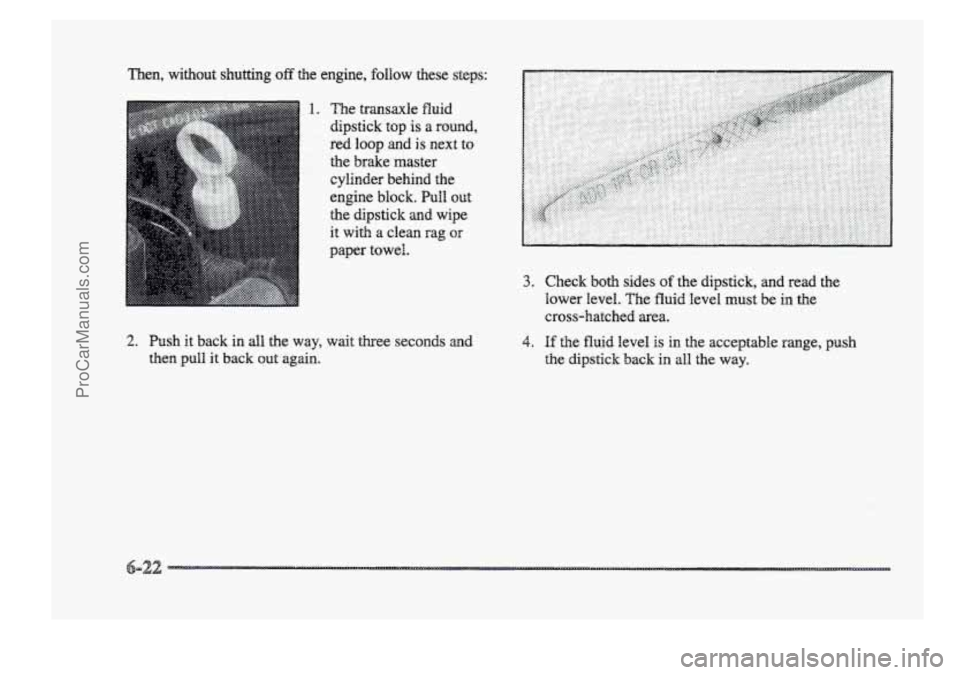
Then, without shutting off the engine, follow these steps:
1. The transaxle fluid
dipstick top is a round,
red
loop and is next to
............. ............. the brake master
cylinder behind
the
engine block. Pull out
the dipstick and wipe
it with a clean rag or
paper towel.
3. Check both sides of the dipstick, and read the
lower level. The fluid 'level
must be in the
cross-hatched area.
2. Push it back in all the way, wait thee seconds and 4. If the fluid level is in the acceptable range, push
then pull it back out again. the dipstick back in a11 the way.
ProCarManuals.com
Page 297 of 426

Refer to the Maintenance Schedule to determine what
kind
of transaxle fluid to use. See “Recommended
Fluids
md Eubricmts” in the Index.
If the fluid level is low, add only enough of the proper
fluid
to bring the level into the cross-hatched area on
the dipstick.
I. Pull out the dipstick.
2. Using a long-neck funnel, add enough fluid at the
dipstick hole
to bring it to the proper level.
It doesn’t
take much fluid, generally less than one
pint
(0.5 L). Don’t ove@Zl.
3. After adding fluid, recheck the fluid level ips
4. When the correct fluid level is obt.ained, push the
described
under “How to Check.”
dipstick back in
dl the way.
The cooling s stem in your vehicle is filled with
DEX-COOL engine coolant. This coolant is designed
to remain in your vehicle for 5 years or 150,000 miles
(240 MI0 h) whichever occurs first, if you add only
DEX-COOL“ extended life coolant,
The following explains
your coding system and
how to add coolant when it is low. If YOU have a
problem with engine overheating, see “Engine
Overheating”
in the Index.
A 50/50 mixture of water and DEX-COOL’
coolant will:
J
Give freezing protection down to -34°F (-37°C).
Give boiling protection up to 265 OF 129 ” C).
Protect against rust and corrosion.
Help keep the proper engine temperature.
Let the warning lights and gages work as
they should.
ProCarManuals.com
Page 300 of 426
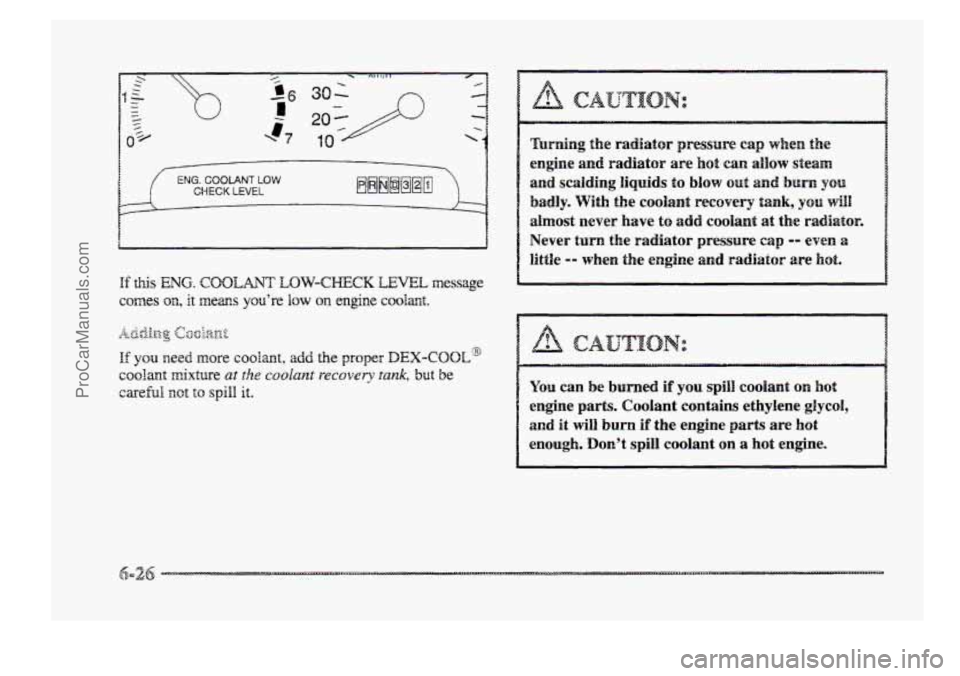
1 f ENG. COOLANT LOW CHECK LEVEL
Turning the radiator pressure cap when the
engine and radiator
are hot can allow steam
and scalding liquids to blow out and burn yon
badly. With the codant recovery tank, you will
almost never have fO add coolant at the radiator.
Never turn the radiator pressure cap -- even a
little -- when the engine sand radiator are hot.
You can be burned if you spill cooiant QPB hot
engine parts. Coolant contains ethylene glycol,
and it will burn if the engine parts are hot
enough. Don't spill coolant on a hot engine.
ProCarManuals.com
Page 348 of 426
Qverall
Length ................. 206.8 inches (525.3 cm)
Width ................... 74.7 inches ( B 89.7 cm)
Height ................... 58.8 inches (147.6 cm)
Wheelbase .............. B 13.8 inches (289.1 cm)
Front Tread ............... 62.7 inches (159.3 cm)
Rear Tread ............... 62.3 inches (158.2 cm)
".. - ?$ ~.p~~~$ 5 ~~4a~~.~ena~~~~ T:. '..
17. ~~~~ja-aee~~~~~~~ , ..-. yay&
Engine Oil Filter ................ AC Type PF-47
_L
Air Cleaner Element .......... AC Type A- 1096C
Fuel Filter .................... AC Type GF-627
Spark Plugs ................... AC Type 41-921
Gap: 0.060 inch (. 152 crn)
Windshield Wiper Blades
Type
............................ Hook Style
Length
..................... 22 inches (56 cm)
Filter
(HVAC air filter) ..... GM Part No. 52472175
Passenger
Compartment
Air
&g&ze &yggsGyy 15 jL2Q e. ,.', E c/ I'
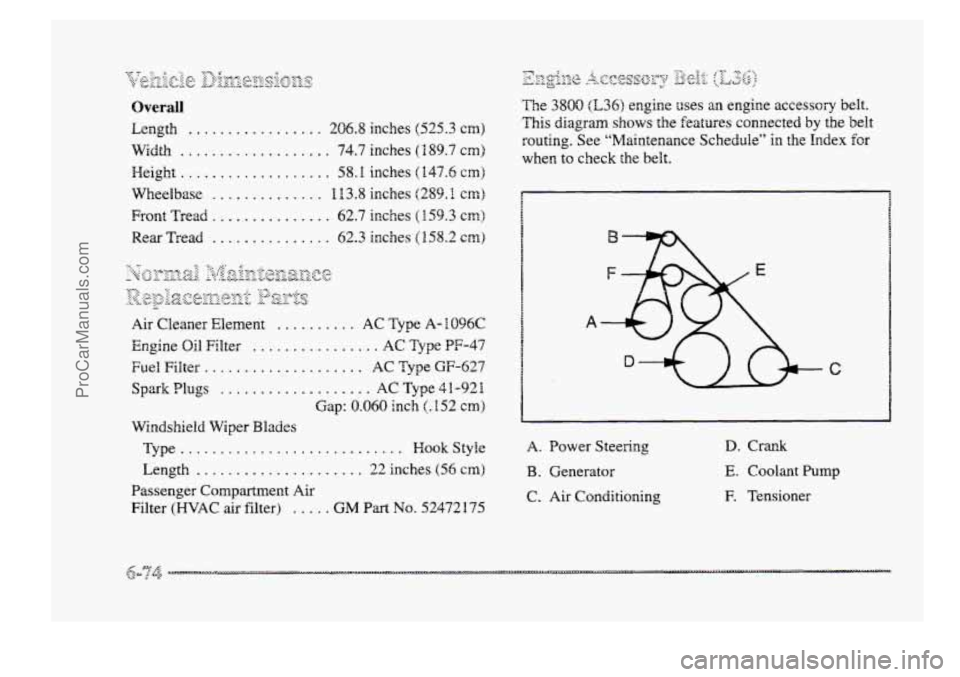
The 3800 (L36) engine uses an engine accessory belt.
This diagram shows the features connected by the belt
routing. See "Maintenance Schedule" in the Index for
when to check the belt.
A
C
A. Power Steering
B. Generator
C. Air Conditioning
D. Crank
E. Coolant Pump
E Tensioner
ProCarManuals.com
Page 349 of 426
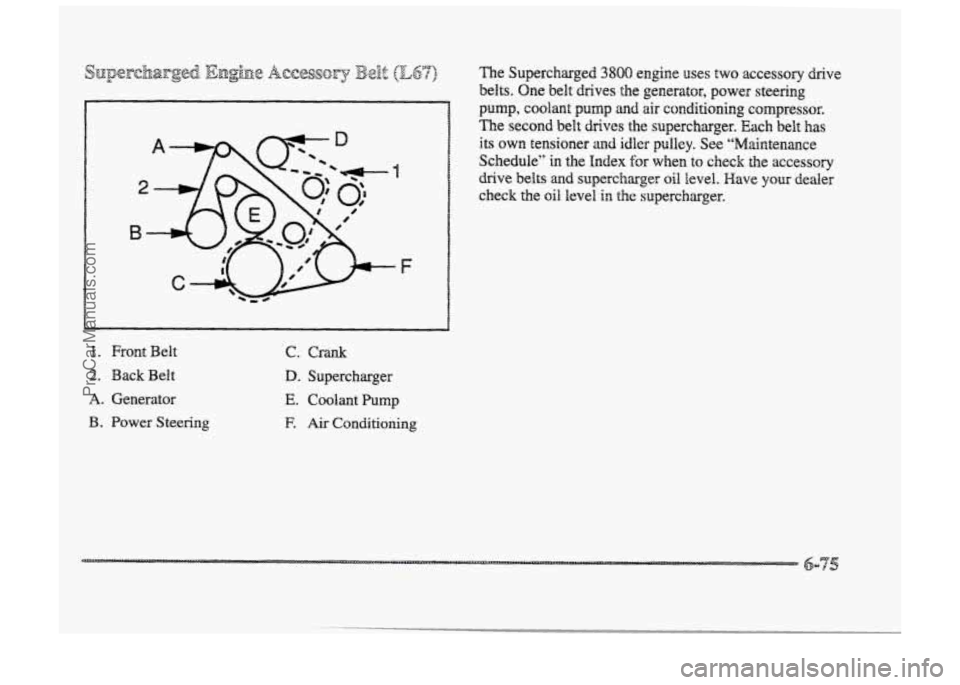
1. Front Belt C. Crank
2. Back Belt D. Supercharger
A. Generator E. Coolant Pump
B. Power Steering IF. Air Conditioning The Supercharged
3800 engine
uses two accessory drive
belts. One belt drives the generator, power steering
pump, coolant
pump surd air conditioning compressor.
The second belt drives the superchwger. Each belt has
its own tensioner
mi idler pulley. See ‘‘Maintenance
Schedule” in the Index
for when to check he accessory
drive belts and supercharger oil level. Have your dealer
check the
oil level in the supercharger.
ProCarManuals.com
Page 355 of 426
i ~~
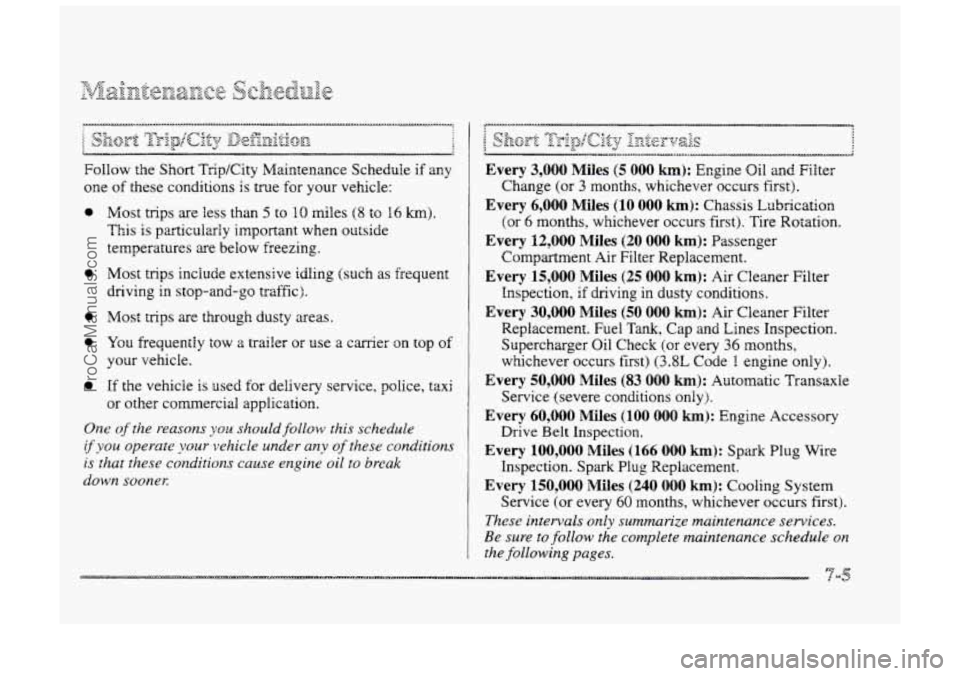
Follow the Short Trip/City Maintenance Schedule if any
one of these conditions
is true for your vehicle:
0
0
0
0
0
Most trips are less than 5 to 10 miles (8 to I6 km).
This is particularly important when outside
temperatures are below freezing.
Most
trips include extensive idling (such as frequent
driving
in stop-and-go traffic).
Most trips are through dusty areas.
You frequently tow a trailer or use a carrier on tog of
your vehicle.
If the vehicle
is used for delivery service, police, taxi
or other commercial application.
One of the reasons you should follow this schedule
if you operate your vehicle under any of these conditions
is that these conditions cause engine oil to break
down
soonep:
r---
ShQTt 7&+p/cigy &$-~~y& c .. 6 - I-
Every 3,000 Miles (5 000 km): Engine Oil md Filter
Every 6,000 Miles (10 000 km): Chassis Lubrication
Every 12,000 Miles (20 000 km): Passenger
Every 15,000 Miles (25 000 km): Air Cleaner Filter
Every 30,000 Miles (50 000 km): Air Cleaner Filter
Change (or
3 months, whichever
occurs first).
(or
6 mo-nth, whichever occurs first). Tire Rotation.
Compartment Air Filter Replacement.
Inspection,
if driving in dusty conditions.
Replacement. Fuel
Tank, Cap and Lines Inspection.
Supercharger
Oil Check (or every 36 months,
whichever occurs first)
(3.8L Code I engine only).
Every 50,000 Miles (83 080 km): Automatic Transaxle
Service (severe conditions only).
Every 60,000 Miles (100 000 km): Engine Accessory
Drive Belt Inspection.
Every 100,000 Miles (166 000 km): Spark Plug Wire
Inspection.
Spark Plug Replacement.
Every 150,000 Miles (240 000 km): Cooling System
Service
(or every 60 months, whichever occurs first).
These intervals only summarize maintenance services.
Be sure to follow the complete maintenance schedule on
the following pages.
RP I -3
ProCarManuals.com
Page 356 of 426
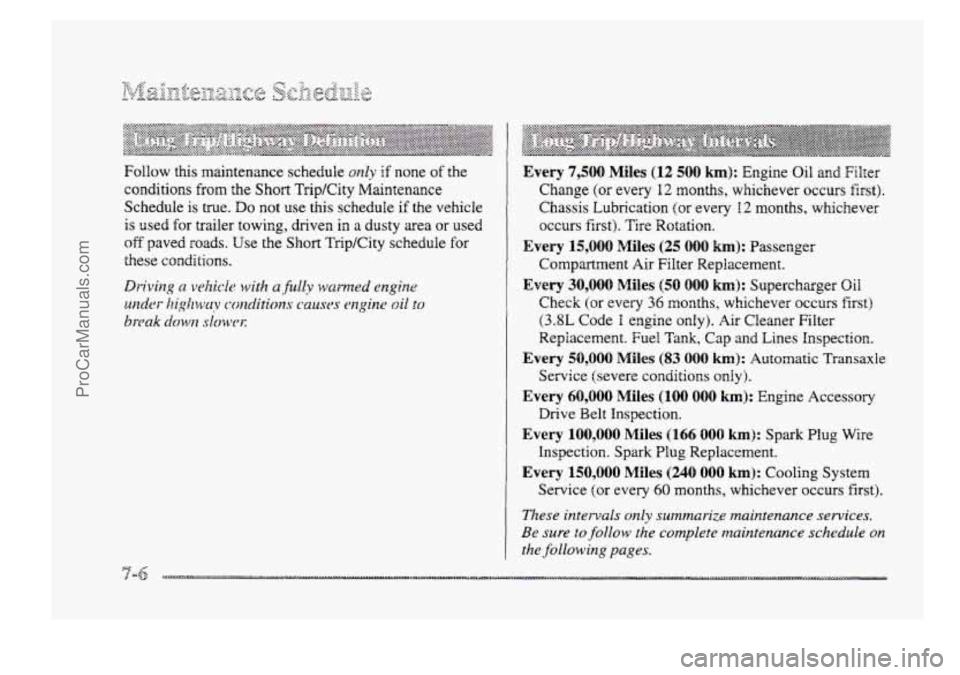
Follow this maintenance schedule only if none of the
conditions
from the Short Trip/City Maintenance
Schedule is true.
Do not use this schedule if the vehicle
is used for trailer towing, driven in a dusty area or used
of€ paved roads. Use the Short TripKity schedule for
these conditions.
Driving a veizicie with a,fulky warnzed engine
utzckQ~ hig/wctv cwatclition.,s causm C~I~~JW oil to
brcnk down S~OM~GP:
Every 7,500 Miles (12 500 km): Engine Oil and Filter
Change (or every 12 months, whichever occurs first).
Chassis Lubrication (or every
22 months, whichever
occurs first). Tire Rotation.
Every 15,000 Miles (25 000 km): Passenger
Compartment Air Filter Replacement.
Every 30,000 Miles (50 000 km): Supercharger Oil
Check
(or every 36 months, whichever occurs first)
(3.8L Code I engine only). Air Cleaner Filter
Repiacernent. Fuel Tank,
Cap ad Lines Inspection.
Every 50,000 Miles (83 000 km): Automatic Transaxle
Service (severe conditi~ns oniy).
Every 60,QOO Miles (100 000 km): Engine Accessory
Drive Belt Inspection.
Every 100,000 Miles (166 QOO km): Spark Plug Wire
Inspection.
Spark Plug Replacement.
Every 150,000 Miles (240 000 km): Cooling System
Service
(or every 60 months, whichever occurs first).
These intervals only summarize maintenance services.
Be sure to follow the complete maintenance schedule on
the following pages.
ProCarManuals.com
Page 357 of 426
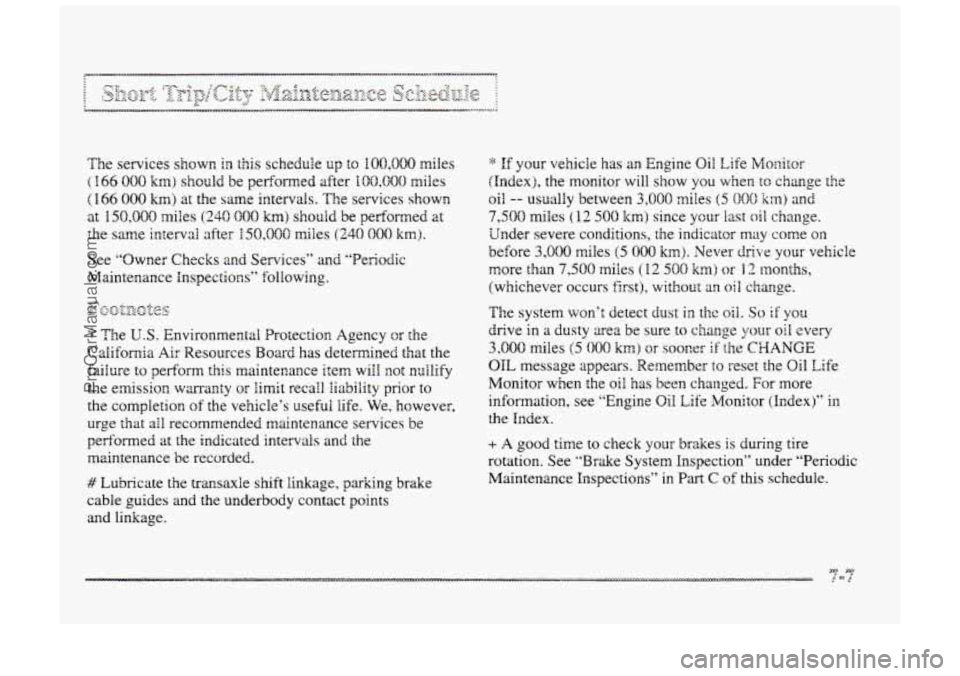
m. B he services shown in this schedule up to IOO,QQ0 miles
( 166 000 am) should be performed after 100,800 miles
( I. 66 008 km) at the same intervals. The services shown
at 150,000 miles (240 GOO km) shouid be performed at
the same interval after
150,000 riles (240 000 km).
See “Owner Checks and Services” md “Periodic
Maintenance inspections” following.
* The U.S. Environmental Protection Agency or the
California Air Resources
Boxd has determined that the
failure
to perform this maintenance item will not nuIli€y
the elmission wmanty or
limit recall liability prior to
the completion
of the vehicle’s useful life. We, however,
urge
that ail recommended maintenance services be
performed at the indicated intervals
and the
maintenance be recorded.
# Lubricate the transaxle shift linkage, parking brake
cable guides and the underbody contact points
and
linkage.
* If your vehicle has an Engine Oil Life Monitor
(Index), the monitor will show you when to change the
oil
-- usually between 3,000 miles (5 CIOC) kn) and
7,500 miles ( 12 500 lmj since your last oil change.
Under severe conditions, the indicator may come on
before 3,000 wiles (5 000 h). Never drive your vehicle
more than
7,500 miles (12 508 am> or i 2 months,
(whichever occurs first), without an oil change.
Tne
system won‘: detect dust in thc oil. So if you
drive in a dusty area be sure to change pur oil every
3,000 miles (5 008 km) or sooner if: the CHANGE
OIL message appears. Remember to reset the Oil Life
‘Monitor
when the oil has been changed. For more
information, see “Engine
Oil Life ,Monitor (Index)” in
the Index.
+ A good time to check your brakes is during tire
rotation. See
“Brake System Inspection” under “Periodic
Maintenance Inspections” in
Part C of this schedule.
ProCarManuals.com