Page 226 of 426
]Is there actually such a ~~nrdition as “highway
hypnosis”? Or is it just plain falling asleep at the wheel?
Call it highway hypnosis, lack of awareness,
or whatever.
mere
is something about an easy stretch of road with
the same scenery, dong with the hum of the tires on the
road, the &one
of the engine, and the msh of the wind
against the vehicle
that can make you sleepy. Don’t let it
happen to you! If it does, your vehicle can leave the
road in less than a secondy and you could crash agld
be injured.
@ Keep YQW eyes moving. Scan the road ahead and to
the sides. Check YOLK rearview ~~II-QI-S and your
instruments frequently.
@ If you get sleepy, pull off the road into a rest, service
or parking area and take a nap, get some exercise, or
both. For safety, treat drowsiness on the highway as
an emergency.
ProCarManuals.com
Page 227 of 426
HE you drive regdarly in steep country, or if you're
planning to visit there, here are some tips that can make
your trips safer and more enjoyable.
Keep yoas vehicle in
good shape. Check all fluid
Bevels
and also the brkes, tires, cooling system
and transaxle. These par"cs can work had on
mountain
roads.
8 Know how to go down hills. "he most imp~rtmt
thing to how is this: le: your engine do some of the
slowing ~QWII. Shift to a lower gear whm YOU go
down a steep or long hill.
b
If you ddt shift down, your brakes coddl get so
hot that they wouldn't work wel. YQU would then
have poor braking or even none going down a
hill. You could crash. Shift down to Bet your
engine assist YOW brakes on a steep
downhill slope.
8
a,
Know how to go uphill. Drive in the highest
geX pOSSibke.
Stay in your own lane when driving an two-lane
roads in hills or mountains. Don't swing wide GT cut
across the center of the road. Drive at speeds tha': let
you stay in your own lane.
As yo.^ go over the top of a -hill, be dert. There could be
somettzlng h you- lane, %e a stailed car or m accident.
You may see highway signs on mountains that wanz of
specid problems. Examples ae H~ng grades, passing or
no-passing zones, a falling rocks area or winding
roads. Be alert to these and take appropriate zction.
ProCarManuals.com
Page 245 of 426
6. Check that the jumper cables don’t have loose or
missing insulation. If they do, you could get a shock
and the vehicles could be damaged.
Before
you connect the cables, here are SOW basic
things
you should know. Positive (9) will go to
positive (+) and negative (-) will go to a metal
engine
pa. Don’t connect positive (+) to negative
(-1 or you’ll get a short that would damage the
battery
and maybe other parts, too.
7. Connect the red positive (9) cable to the positive (+>
terminal of the vehicle with the dead battery. Use a
remote positive
(+) terminal if the vehicle has one.
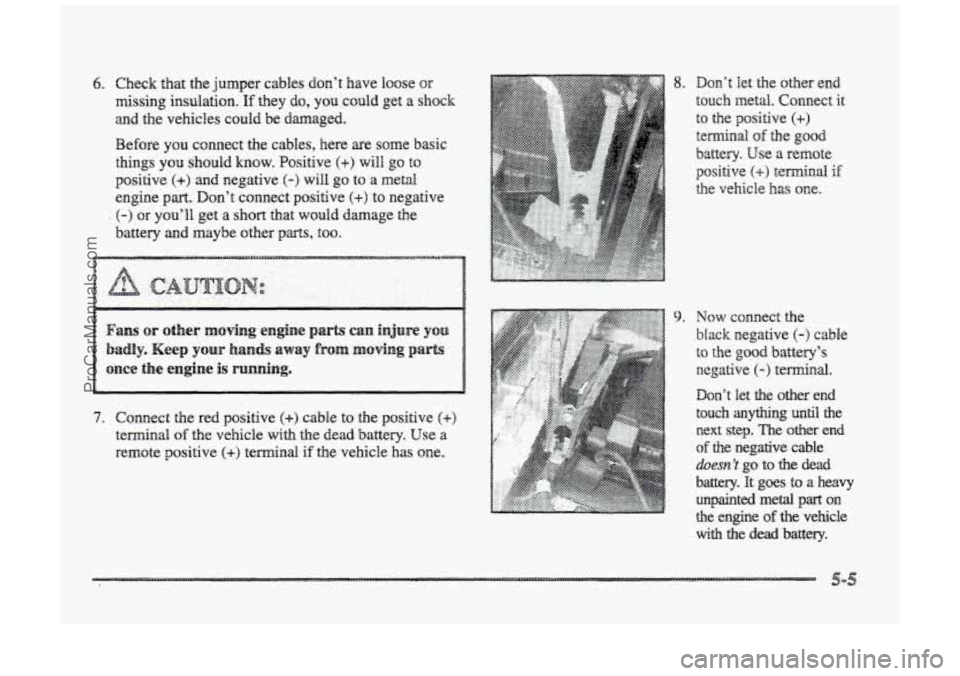
8. Don’t let the other end
t~~h metal. Connect it
to the positive (+)
terminal of the good
battery. Use a remote
positive
(9) terminal if
the vehicle has one.
NOW connect the
black negative (-) cable
to the good battery’s
negative (-) terminal.
Don’t let the other end
touch anytkzng
until the
next
step. The other end
of the negative cable
doem Z go to the dead
battery.
It goes to a heavy
unpainted metal
part on
the engine of the vebcle
with the dead battery.
ProCarManuals.com
Page 255 of 426
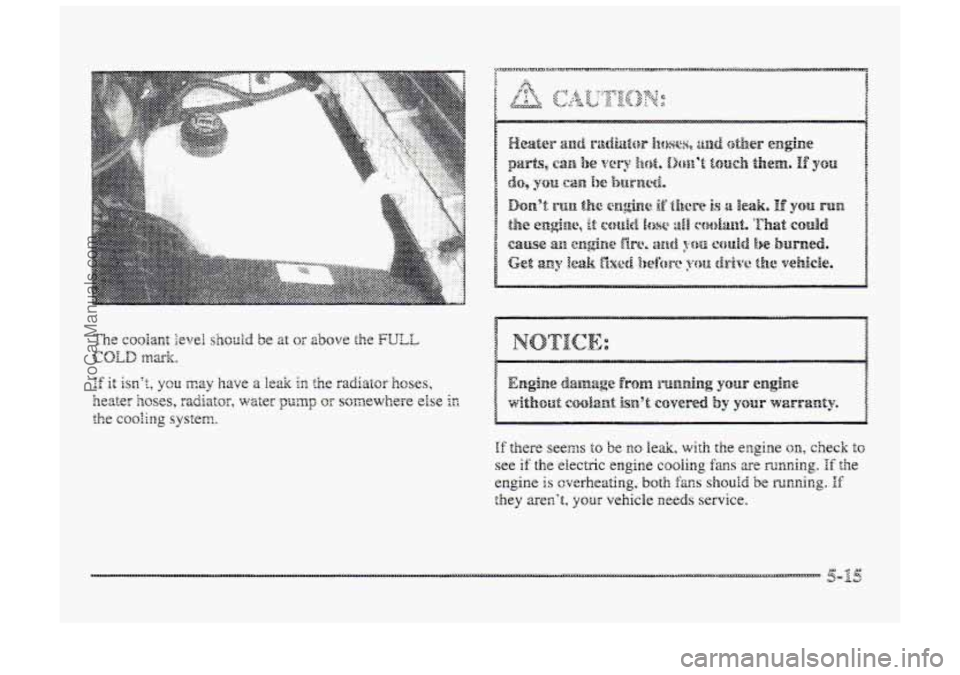
If there seem to be no leak, with the engine on, check io
see if the electric engiap,e cooling fans are mnning. If the
engine is cverkeating, both fm.s shouici be marning. If
they aren't, your vehicle needs service.
ProCarManuals.com
Page 275 of 426
6-2
6- 3
4-9
6-12
4-17
6- 19
4-20
6-23
5-27
6-28
6-29
4-32
6-33
6-45
6-46
Service
Fuel
Checking Things Under the Hood
Engine Oil
Air Cleaner
Supercharger
Oil
Automatic Transaxle Fluid
Engine Coolant
Radiator Bressure Cap
VVindskieTd Washes Fluid
Br&es
3 attery
Bulb Replacement
Windshield Wiper Blade Replacement
Tires Appearance
Care
Cleaning the Inside QE Y(.w VehicEe
Cleaning
the Outside of Your Vehicle
Underbody Maintenance
Chemical
Paint Spotting
Appearance Care Materials Chart
Vehicle icientifkation Number (VIN)
Electrical System
Removing the Rear Seat Cushion
Replacement Bulbs
Capacities and Specifications
Air Conditioning Re€rigerants
Engine Specifications
Vehicle Dimensions
Normal Maintenance Replacement 'Parts
ProCarManuals.com
Page 277 of 426
Things you might add to the outside of your vehicle can
affect
the airdaow around it. This may cause wind noise
and affect windshield washer performance. Check with
your dealer before adding equipment to the outside
of
your vehicle. The
8th digit sf your vehicle
identification number
(Vm) shows the code lettee for your engine. You will
find the VIN at the top left of your instmment panel.
(See “Vehicle Identifkation Number’’ in the Endex.)
If you have the 3800 engine (VIN Code use regula
unleaded gasoline rated
at 87 octane or higher. If you’re
using fuel rated
at the recommended octane or higher
and
you hear heavy knocking, your engine needs
service. But don’t
worry if YOU hear a little pinging
noise when you’re accelerating or driving
up a hill.
That’s normal, and YOU don’t have to buy a higher
octane fuel
to get rid of pinging. It’s the heavy, constant
knock
that means you have a problem.
If you have the 3800 Supercharged engine (VHN
Code I), use premium unleaded gasoline rated at
91 octane or higher. With the 3800 Supercharged
engine, in
an emergency, you may be able to use a
lower QC~XE -- as low as 87 -- if heavy knocking does
not occur. If you are using 91 cx higher octane unleaded
gasoline and
YOU hear heavy knocking, your engine
needs service.
6-3
ProCarManuals.com
Page 286 of 426

Your vehicle may have 2 3800 Sqercharged engine.
Supercharging, rather
than turbocharging, emphasizes
smooth, refined power.
The supercharger is a device which is designed to pump
more ais into the engine than it would normally use.
This air mixed with fuel creates increased engine power.
Since the supercharger
is a pump and is driven from an
engine
accessory drive belt, iwreased pressure is
available at all driving conditions.
The Powertrain Control Module (PCM) works with a
vacuum control to regulate the increased pressure
required during specific driving conditions. When this
increased pressure or boost is not desired, such as during
idling and light tfarsttIe cruising, the excess air that the
supercharger is pumping is routed through a bypass.
AB1 sf these controk working together provide high
performance character and fuel efficiency in the
3800 V6 Supercharged engine.
The power steering pump and reservoir are mounted on
the rear (driver’s side) sf the engine biock. See
“Maintenance Schedule”
in the Index for when you
should check the fluid.
c
ENGINE OIL LOW CHECK LEVEL HMBHBMrn
Ef you have the Driver Infcmation Center, an ENGINE
OIL LOW-CHECK LEVEL message will appear when
the engine oil is approximately I quart (fL) Isw. 11 the
message is displayed, check the dipstick level and add
oil as needed.
7r
ProCarManuals.com
Page 294 of 426
Check oil only when the engine is cold. Allow the
engine
to cool two to three hours after running.
I. Clean tke area around the oil fill plug before
removing it.
2. Remove the G~H fill plug wing a 3/26 inch
Allen
wrench.
3. The oil level is correct when it just reaches efre
bottom of the threads of the inspection hole.
4. Replace the oil plug with the O-ring in place.
Torque
to 88 bin ( IO N-m).
A good time to check your automatic transaxle fluid
level is wherr the engine oil is changed.
Change
both the fluid a.nd filter every 50,000 miles
(83 080 Ian) if the vehicle is mainly driven rander one
or more of these conditions:
8 In heavy city traffic where the outside temperature
regularly reaches
90°F (32°C) or higher.
0 Uses such as found in taxi, police QT delivery service.
If you do not use your vehicle under any sf these
conditions, the fluid and filter do not reqwie changing.
See “Scheduled Maintenance Services” in the Index.
ProCarManuals.com
![BUICK PARK AVENUE 1998 Owners Manual ]Is there actually such a ~~nrdition as “highway
hypnosis”? Or is it just plain falling asleep at the wheel?
Call it highway hypnosis, lack of awareness,
or whatever.
mere
is something abou](/manual-img/43/57690/w960_57690-225.png "BUICK PARK AVENUE 1998 Owners Manual ]Is there actually such a ~~nrdition as “highway
hypnosis”? Or is it just plain falling asleep at the wheel?
Call it highway hypnosis, lack of awareness,
or whatever.
mere
is something abou")