1998 BMW CONVERTIBLE tow
[x] Cancel search: towPage 93 of 179
92
Air supply
Draft-free ventilation
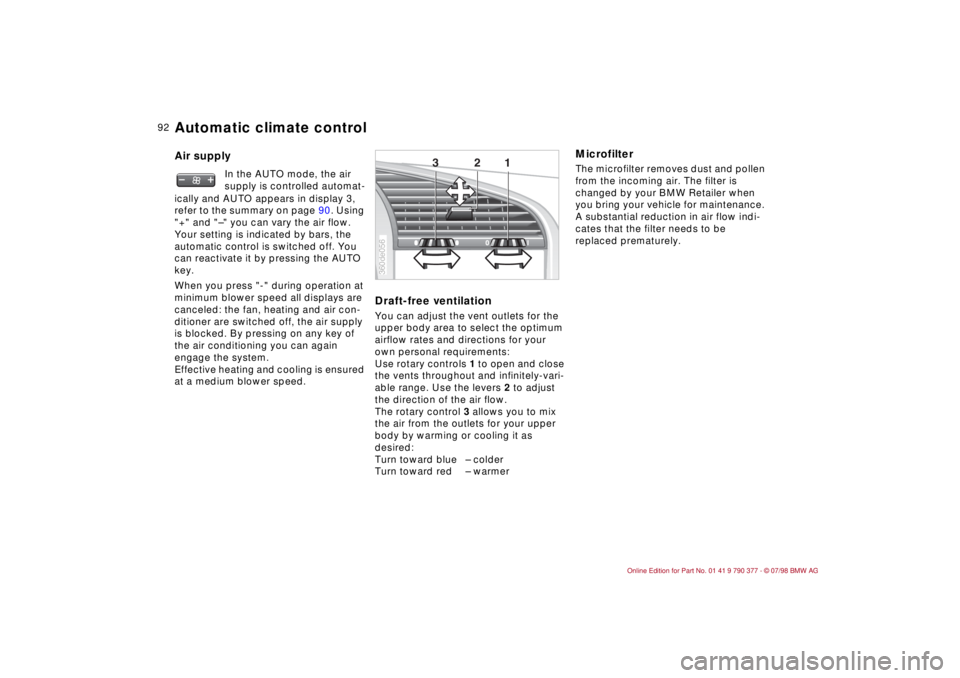
You can adjust the vent outlets for the
upper body area to select the optimum
airflow rates and directions for your
own personal requirements:
Use rotary controls 1 to open and close
the vents throughout and infinitely-vari-
able range. Use the levers 2 to adjust
the direction of the air flow.
The rotary control 3 allows you to mix
the air from the outlets for your upper
body by warming or cooling it as
desired:
Turn toward blue Ð colder
Turn toward red Ð warmer
MicrofilterThe microfilter removes dust and pollen
from the incoming air. The filter is
changed by your BMW Retailer when
you bring your vehicle for maintenance.
A substantial reduction in air flow indi-
cates that the filter needs to be
replaced prematurely. In the AUTO mode, the air
supply is controlled automat-
ically and AUTO appears in display 3,
refer to the summary on page 90. Using
"+" and "Ð" you can vary the air flow.
Your setting is indicated by bars, the
automatic control is switched off. You
can reactivate it by pressing the AUTO
key.
When you press "-" during operation at
minimum blower speed all displays are
canceled: the fan, heating and air con-
ditioner are switched off, the air supply
is blocked. By pressing on any key of
the air conditioning you can again
engage the system.
Effective heating and cooling is ensured
at a medium blower speed.
1 2 3
360de056
Automatic climate control
Page 97 of 179
96
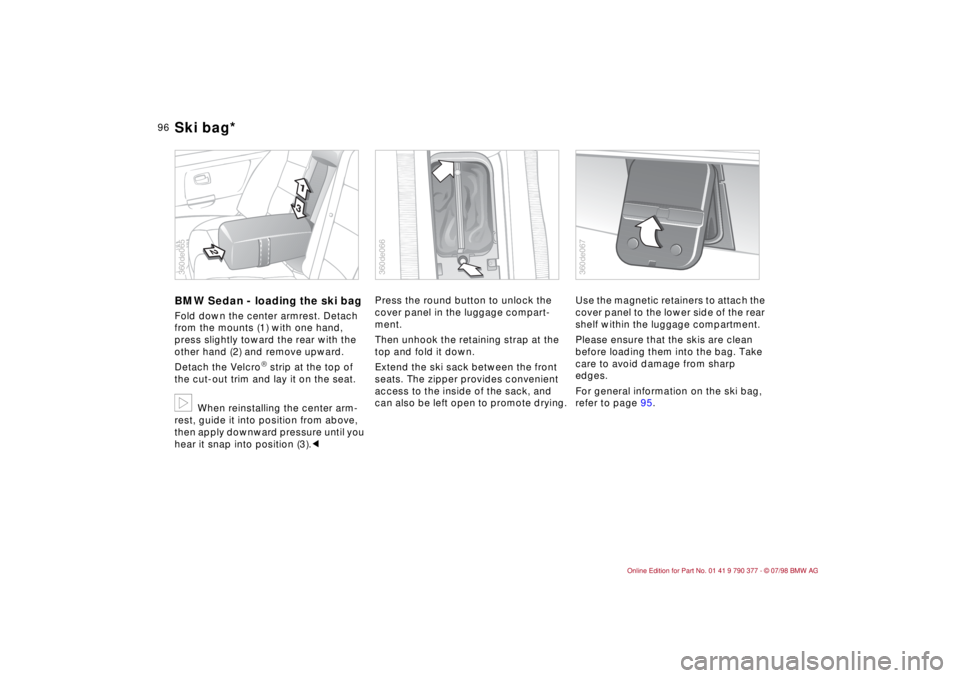
BMW Sedan - loading the ski bagFold down the center armrest. Detach
from the mounts (1) with one hand,
press slightly toward the rear with the
other hand (2) and remove upward.
Detach the Velcro
â strip at the top of
the cut-out trim and lay it on the seat.
b
When reinstalling the center arm-
rest, guide it into position from above,
then apply downward pressure until you
hear it snap into position (3).cPress the round button to unlock the
cover panel in the luggage compart-
ment.
Then unhook the retaining strap at the
top and fold it down.
Extend the ski sack between the front
seats. The zipper provides convenient
access to the inside of the sack, and
can also be left open to promote drying.Use the magnetic retainers to attach the
cover panel to the lower side of the rear
shelf within the luggage compartment.
Please ensure that the skis are clean
before loading them into the bag. Take
care to avoid damage from sharp
edges.
For general information on the ski bag,
refer to page 95.
3
2
1
360de065
360de066
360de067
Ski bag*
Page 99 of 179
98
Stowing a loadIf you are transporting a load in your
BMW
dStow a heavy load as far forward as
possible - directly behind the back-
rests or the front wall of the luggage
compartment - and on the ßoor.
dCover sharp edges and corners.
dDo not pile objects higher than the
top edge of the backrest.
dIf the load is heavy and the rear seat
is unoccupied, put the outer safety
belt in its lock.
Securing loaddSecure smaller, lighter items with
retaining straps or draw straps (refer
to page 34).
dFor large, heavy items, see your
BMW Retailer for load-securing
devices
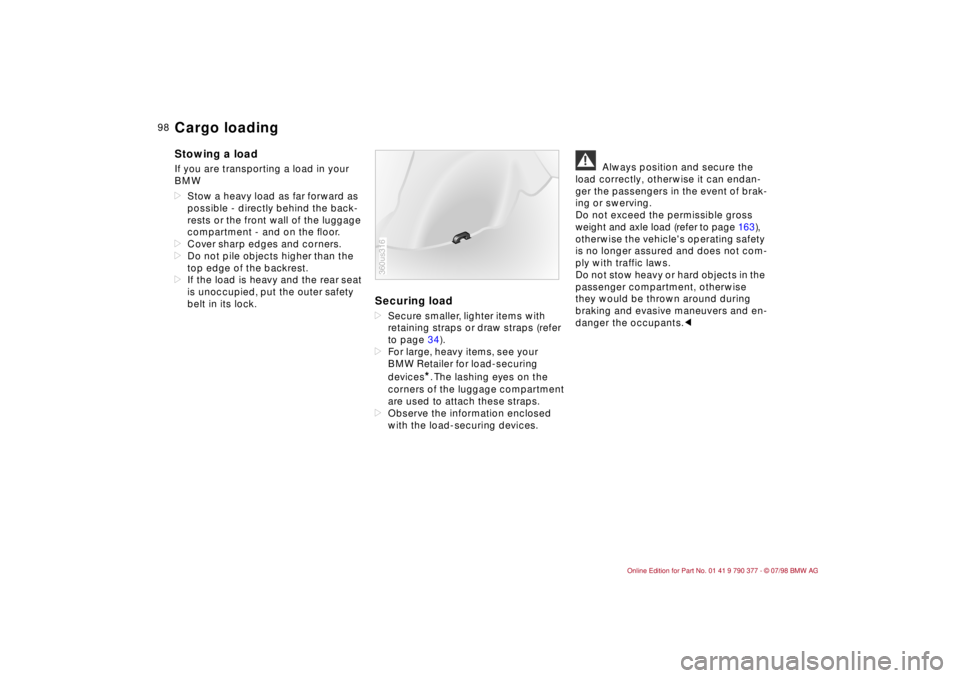
*. The lashing eyes on the
corners of the luggage compartment
are used to attach these straps.
dObserve the information enclosed
with the load-securing devices.
a
Always position and secure the
load correctly, otherwise it can endan-
ger the passengers in the event of brak-
ing or swerving.
Do not exceed the permissible gross
weight and axle load (refer to page 16 3),
otherwise the vehicle's operating safety
is no longer assured and does not com-
ply with traffic laws.
Do not stow heavy or hard objects in the
passenger compartment, otherwise
they would be thrown around during
braking and evasive maneuvers and en-
danger the occupants.c
360us316
Cargo loading
Page 103 of 179

10 2
The catalytic converter reduces harmful
exhaust emissions.
It is designed for use with unleaded fuel
only.
Even minute quantities of lead would be
enough to permanently damage both
the catalytic converter and the system's
oxygen sensor.
To ensure efficient, trouble-free engine
operation and avoid potential damage:
dAlways have your car serviced in
accordance with maintenance
instructions.
dNever continue driving until the fuel
tank is empty.
dRespond to engine miss by switching
off the engine at once.
dNever tow-start the car unless the
engine is cold, or else unburned fuel
may reach the catalytic converter.
Better yet: use jumper cables!
dAvoid other situations in which the
fuel would not be (completely)
burned, for instance:
Frequent, extended, or repeated
starting attempts during which the
engine fails to start. (Switching off
and restarting a healthy engine
causes no damage).
Never let the engine run with any of
the spark-plug cables disconnected.
a
Always observe the above points
to prevent unburned mixture from
entering the catalytic converter. This
could result in overheating, leading to
serious damage.
High temperatures occur on all vehicles
equipped with a catalytic converter.
Heat shields are installed adjacent to
some sections of the exhaust system.
Never remove these shields; do not
apply undercoating to their surfaces.
When driving, standing at idle or park-
ing the vehicle, take care to avoid con-
tact between the exhaust system and
flammable materials (e.g., grass, hay,
leaves, etc.). Such contact could lead to
a fire, resulting in personal injury and
property damage.c
Traveling abroadAlways make sure that unleaded fuel
meeting your engineÕs octane require-
ments will be available when planning
trips outside the country. The use of
fuel failing to meet the official octane
requirements could result in engine
damage.
If you are considering traveling to a
country in which unleaded fuel is not
readily available, please remember that
leaded fuel will destroy the lambda oxy-
gen sensor and the catalytic converter
on your BMW. After operation on
leaded fuel, your vehicle will no longer
meet American and Canadian exhaust
emission standards, and there will also
be a loss of fuel economy. Upon your
return to the US or Canada, you will be
expected to comply with legal ordi-
nances requiring that you replace both
the oxygen sensor and the catalytic
converter, and to have the fuel system
flushed to remove any traces of leaded
fuel.
Catalytic converter
Page 112 of 179
111
At a glanceControlsCar careRepairsTechnicalDataIndex
Information for your safetyThe factory-approved radial tires have
been selected to provide optimum
safety and driving comfort on your vehi-
cle.
In a very real sense, both tire life and
your own safety are riding on correct
tire specifications and inflation pres-
sures.
Incorrect inflation pressures are a fre-
quent cause of tire damage. To a great
extent it also influences the ability of
your BMW to hold the road.a
Check the tire pressures Ð also in
the spare tire Ð at least every two weeks,
and before every extended trip.
Incorrect inflation pressures can also
lead to tire damage and accidents.c
Tire tread - tire damageInspect your tires frequently for tread
wear, signs of damage and for foreign
objects lodged in the tread. Check the
tread depth.
The tread depth should not be less than
0.12 in (3 mm). Otherwise there is an
increased risk of aquaplaning, even at
relatively moderate speeds and with
only small amounts of water on the
road.
We recommend that you always replace
the tires once the tread wears to 0.12 in
(3 mm). Once the tread has worn to
0.063 in (1.6 mm), tread depth indica-
tors appear.a
Never continue driving on a deflat-
ed (flat) tire. A flat tire greatly impairs
steering and braking response, and can
lead to complete loss of control over the
vehicle.
Avoid overloading the vehicle so that the
permitted load on the tires is not ex-
ceeded. This can cause overheating and
gradual internal damage. The ultimate
result can assume the form of a sudden
air loss.Unusual vibrations encountered during
normal vehicle operation can indicate
tire failure or some other vehicle defect,
as can variations in normal vehicle
response, such as a pronounced ten-
dency to pull to the left or right. Should
this occur, you should respond by
immediately reducing your speed and
carefully proceeding to the nearest
BMW Retailer or professional tire cen-
ter, or having the vehicle towed in to
have it and its tires inspected.
Tire damage (up to and including blow-
outs) can endanger the lives of both the
vehicle occupants and other road
users.c
Tire inflation pressures Tire tread
Page 140 of 179

At a glance
Controls and featuresCare and maintenanceAdvanced technology
Technical data
Owner service procedure
At a glanceControlsCar careRepairsTechnicalDataIndex
Index
13 9
Replacement procedures:
Onboard tool kit140
Windshield wiper blades140
Lamp and bulbs141
Master key with battery lamp145
Changing tires146
Battery149
Fuses151
In case of electrical
malfunction:
Fuel filler door 152
Sliding/tilt sunroof 152
Assistance, giving and receiving:
Jump-starting153
Towing the vehicle154
Towing154
Page 143 of 179
14 2
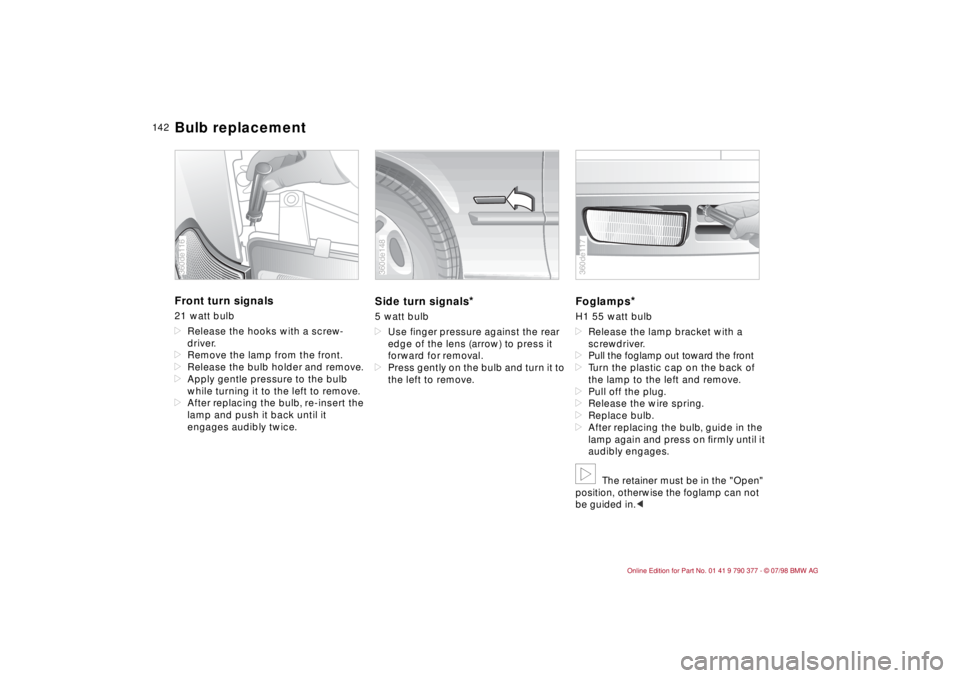
Front turn signals 21 watt bulb
dRelease the hooks with a screw-
driver.
dRemove the lamp from the front.
dRelease the bulb holder and remove.
dApply gentle pressure to the bulb
while turning it to the left to remove.
dAfter replacing the bulb, re-insert the
lamp and push it back until it
engages audibly twice.
Side turn signals
*
5 watt bulb
dUse finger pressure against the rear
edge of the lens (arrow) to press it
forward for removal.
dPress gently on the bulb and turn it to
the left to remove.
Foglamps
*
H1 55 watt bulb
dRelease the lamp bracket with a
screwdriver.
dPull the foglamp out toward the front
dTurn the plastic cap on the back of
the lamp to the left and remove.
dPull off the plug.
dRelease the wire spring.
dReplace bulb.
dAfter replacing the bulb, guide in the
lamp again and press on Þrmly until it
audibly engages.b
The retainer must be in the "Open"
position, otherwise the foglamp can not
be guided in.c
360de116
360de148
360de117
Bulb replacement
Page 155 of 179
15 4
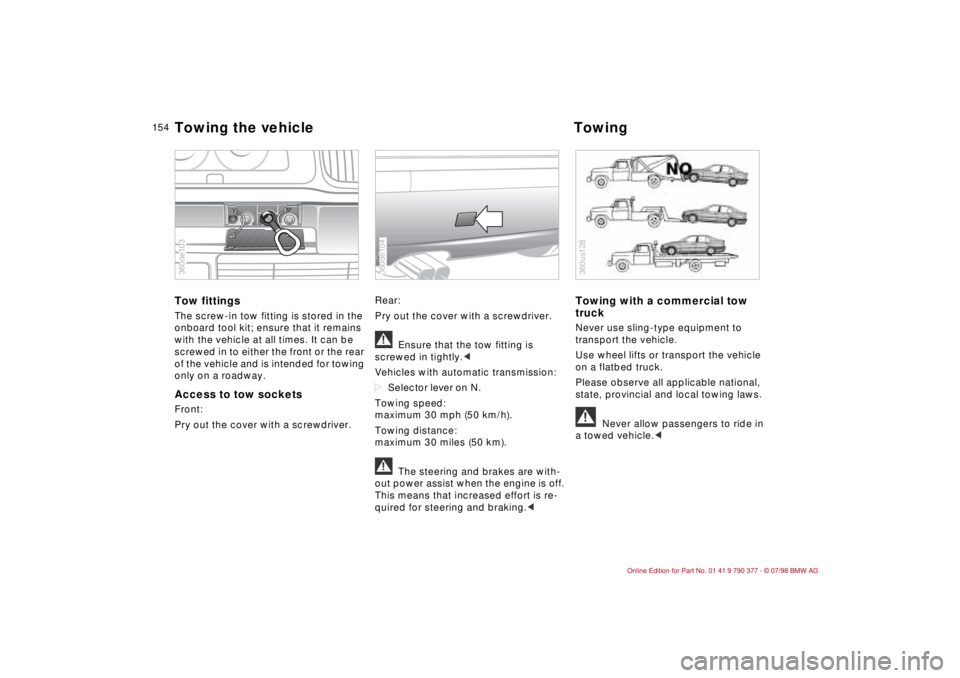
Tow fittingsThe screw-in tow fitting is stored in the
onboard tool kit; ensure that it remains
with the vehicle at all times. It can be
screwed in to either the front or the rear
of the vehicle and is intended for towing
only on a roadway. Access to tow socketsFront:
Pry out the cover with a screwdriver.Rear:
Pry out the cover with a screwdriver.
a
Ensure that the tow fitting is
screwed in tightly.c
Vehicles with automatic transmission:
dSelector lever on N.
Towing speed:
maximum 30 mph (50 km/h).
Towing distance:
maximum 30 miles (50 km).
a
The steering and brakes are with-
out power assist when the engine is off.
This means that increased effort is re-
quired for steering and braking.c
Towing with a commercial tow
truckNever use sling-type equipment to
transport the vehicle.
Use wheel lifts or transport the vehicle
on a flatbed truck.
Please observe all applicable national,
state, provincial and local towing laws.a
Never allow passengers to ride in
a towed vehicle.c
360de103
360de104
360us128
Towing the vehicle Towing