1997 PONTIAC GRAND AM tow
[x] Cancel search: towPage 271 of 371
I A
CAUTION:
-
Rust or dirt on a wheel, or on the parts to which
it is fastened, can make wheel nuts become loose
after
a time. The wheel could come off and cause
an accident. When you change
a wheel, remove
any rust or dirt from places where the wheel
attaches to the vehicle. In an emergency, you can
use
a cloth or a paper towel to do this; but be
sure to use
a scraper or wire brush later, if you
need to, to get
all the rust or dirt off. (See
“Changing
a Flat Tire” in the Index.) When
It’s Time for New Tires
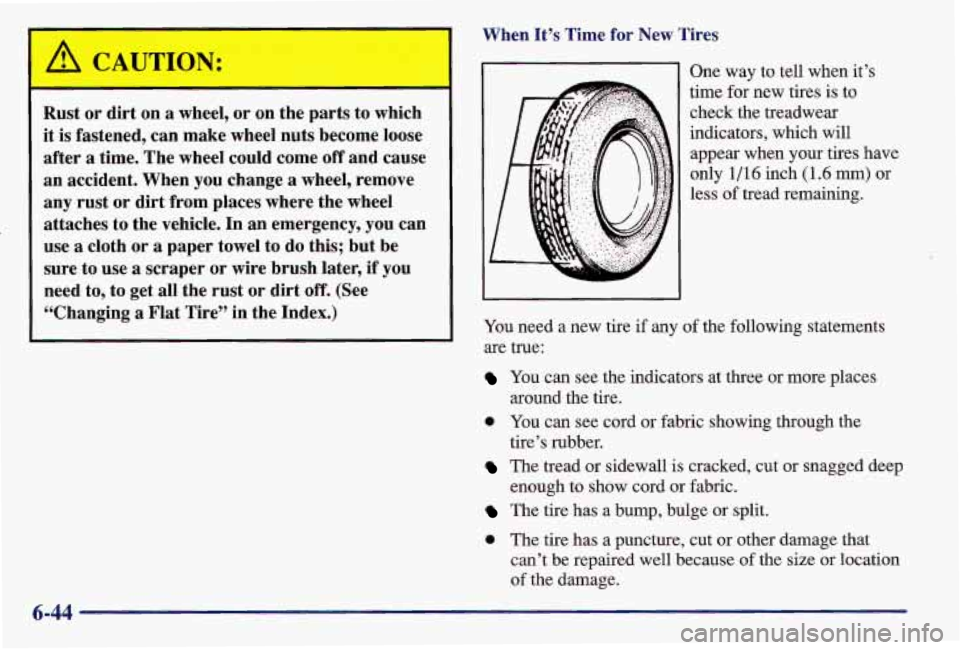
One way to tell when it’s
time for new tires is to
check the treadwear
indicators, which will
appear when your tires have
only
1/16 inch (1.6 mm) or
less of tread remaining.
YOU need a new tire
if any of the following statements
are true:
You can see the indicators at three or more places
around the tire.
0 You can see cord or fabric showing through the
tire’s rubber.
The tread or sidewall is cracked, cut or snagged deep
enough to show cord or fabric.
The tire has a bump, bulge or split.
0 The tire has a puncture, cut or other damage that
can’t be repaired well because of the size or location
of the damage.
6-44
Page 277 of 371
Don’t use any of these unless this manual says you can.
In many uses, these will damage your vehicle:
Alcohol
Laundry Soap
Bleach
Reducing Agents
Cleaning the Inside of Your Pontiac
Use a vacuum cleaner often to get rid of dust and loose
dirt. Wipe vinyl or leather with a clean, damp cloth.
Your Pontiac dealer has two cleaners, a solvent-type
spot lifter and a foam-type powdered cleaner. They will
clean normal spots and stains very well.
Do not use
them on vinyl or leather.
Here are some cleaning tips:
1. Always read the instructions on the cleaner label.
2. Clean up stains as soon as you can -- before they set.
3. Use a clean cloth or sponge, and change to a clean
area often. A soft brush may be used if stains
are stubborn.
4. Use solvent-type cleaners in a well-ventilated area
only.
If you use them, don’t saturate the stained area.
5. If a ring forms after spot cleaning, clean the entire
area immediately or it will set.
Using Foam-Type Cleaner on Fabric
1. Vacuum and brush the area to remove any loose dirt.
2. Always clean a whole trim panel or section. Mask
surrounding trim along stitch or welt lines.
3. Mix Multi-Purpose Powdered Cleaner following the
directions on the container label.
4. Use suds only and apply with a clean sponge. Don’t
saturate the material and don’t rub
it roughly.
5. As soon as you’ve cleaned the section, use a sponge
to remove the suds.
6. Rinse the section with a clean, wet sponge.
7. Wipe off what’s left with a slightly damp paper towel
or cloth.
8. Dry it immediately with a blow dryer.
9. Wipe with a clean cloth.
6-50
Page 278 of 371
Using Solvent-Type Cleaner on Fabric
First, see if you have to use solvent-type cleaner at all.
Some spots and stains will clean off better with just
water and mild soap.
If you need to use a solvent:
1. Gently scrape excess soil from the trim material with
a clean, dull knife or scraper.
2. Use very little cleaner, light pressure and clean cloths
(preferably cheesecloth). Cleaning should start at the
outside of the stain, “feathering” toward the center.
3. Keep changing to a clean section of the cloth.
4. When you clean a stain from fabric, immediately dry
the area with a blow dryer to help prevent a
cleaning ring.
Special Cleaning Problems
Greasy or Oily Stains
Stains caused by grease, oil, butter, margarine, shoe
polish, coffee with cream, chewing gum, cosmetic
creams, vegetable oils, wax crayon, tar and asphalt can
be removed as follows:
1. Carefully scrape off excess stain. Shoe
polish, wax crayon, tar and asphalt will stain if left
on a vehicle’s seat fabric. They should be removed as
soon as possible. Be careful, because the cleaner will
dissolve them and may cause them to spread.
Non-Greasy Stains
Stains caused by catsup, coffee (black), egg, fruit, fruit
juice, milk, soft drinks, wine, vomit, urine and blood can
be removed as follows:
1. Carefully scrape off excess stain, then sponge the
soiled area with cool water.
2. If a stain remains, follow the foam-type instructions
described earlier.
3. If an odor lingers after cleaning vomit or urine, treat
the area with a waterbaking soda solution:
1 teaspoon (5 ml) of baking soda to 1 cup (250 ml)
of lukewarm water.
I.. If needed, clean lightly with solvent-type cleaner.
2. Follow the solvent-type instructions described earlier.
6-51
Page 281 of 371
Cleaning the Outside of Your Pontiac
The paint finish on your vehicle provides beauty, depth
of color, gloss retention and durability.
Washing Your Vehicle
The best way to preserve your vehicle’s finish is to keep it
clean by washing it often with lukewarm or cold water.
Don’t wash your vehicle in the direct rays of the sun.
Don’t use strong soaps or chemical detergents. Use
liquid hand, dish or car washing (mild detergent) soaps.
Don’t use cleaning agents that are petroleum based, or that contain acid or abrasives. All cleaning agents
should be flushed promptly and not allowed
to dry on
the surface, or they could stain. Dry the finish with a
soft, clean chamois or an all-cotton towel to avoid
surface scratches and water spotting.
High pressure car washes may cause water to enter
your vehicle.
Cleaning Exterior Larnpshenses
Use lukewarm or cold water, a soft cloth and a liquid
hand, dish or car washing (mild detergent) soap to clean
exterior lamps and lenses. Follow instructions under
“Washing Your Vehicle.”
Finish Care
Occasional waxing or mild polishing of your Pontiac by
hand may be necessary to remove residue from the paint
finish. You can get GM-approved cleaning products
from your dealer. (See “Appearance Care and Materials”
in the Index.)
Your Pontiac has a “basecoat/clearcoat” paint finish.
The clearcoat gives more depth and gloss to the colored
basecoat. Always use waxes and polishes that are
non-abrasive and made for a basecoatklearcoat
paint finish.
I I
NOTICE:
Machine compounding or aggressive polishing on
a basecoatklearcoat paint finish may dull the
finish
or leave swirl marks.
6-54
Page 282 of 371
Foreign materials such as calcium chloride and other salts, ice melting agents, road oil and tar, tree sap, bird
droppings, chemicals from industrial chimneys, etc., can
damage your vehicle’s finish if they remain on painted
surfaces. Wash the vehicle as soon as possible. If
necessary, use non-abrasive cleaners that are marked
safe for painted surfaces to remove foreign matter.
Exterior painted surfaces are subject to aging, weather and chemical fallout that can take their toll over a period
of years. You can help to keep the paint finish looking
new by keeping your Pontiac garaged or covered
whenever possible.
Cleaning Aluminum Wheels
(If Equipped)
Keep your wheels clean using a soft clean cloth with
mild soap and water. Rinse with clean water. After
rinsing thoroughly,
dry with a soft clean towel. A wax
may then be applied.
The surface
of these wheels is similar to the painted
surface of your vehicle. Don’t use strong soaps,
chemicals, abrasive polishes, abrasive cleaners or
abrasive cleaning brushes on them because
you could
damage the surface. Don’t take
your vehicle through an automatic car wash
that has silicon carbide tire cleaning brushes. These
brushes can also damage the surface of these wheels.
Cleaning Tires
To clean your tires, use a stiff brush with a tire cleaner.
NOTICE:
When applying a tire dressing always take care to
wipe off any overspray or splash from all painted
surfaces
on the body or wheels of the vehicle.
Petroleum-based products may damage the
paint finish.
Sheet Metal Damage
If your vehicle is damaged and requires sheet metal
repair
or replacement, make sure the body repair shop
applies anti-corrosion material to the parts repaired or
replaced to restore corrosion protection.
6-55
Page 298 of 371
Maintenance Schedule
Short Trip/City Definition
Follow the Short Trip/City Maintenance Schedule if any
one of these conditions is true for your vehicle:
Most trips are less than 5 to 10 miles (8 to 16 km).
This is particularly important when outside
temperatures are below freezing.
0 Most trips include extensive idling (such as frequent
driving in stop-and-go traffic).
0 Most trips are through dusty areas.
You frequently tow a trailer or use a carrier on top of
your vehicle. (With some models, you should never
tow a trailer. See “Towing a Trailer” in the Index.)
If the vehicle is used for delivery service, police, taxi
or other commercial application.
One of the reasons you should follow this schedule
if you operate your vehicle under any of these
conditions is that these conditions cause engine oil
to break down sooner.
Short Trip/City Intervals
Every 3,000 Miles (5 000 km): Engine Oil and Filter
Change (or
3 months, whichever occurs first).
Every 6,000 Miles (10 000 km): Chassis Lubrication
(or
6 months, whichever occurs first). Tire Rotation.
Every 15,000 Miles (25 000 km): Air Cleaner Filter
Inspection, if driving in dusty conditions.
Every 30,000 Miles (50 000 km): Air Cleaner Filter
Replacement. Fuel Tank, Cap and Lines Inspection.
Every 50,000 Miles (83 000 km): Automatic Transaxle
Service (severe conditions only).
Every 60,000 Miles (100 000 km): Engine Accessory
Drive Belt Inspection.
Every 100,000 Miles (166 000 km): Spark Plug Wire
Inspection. Spark Plug Replacement.
Every 150,000 Miles (240 000 km): Cooling System
Service (or every
60 months, whichever occurs first).
These intervals only summarize maintenan.ce services.
Be sure to follow
the complete maintenance schedule on
the following pages.
7-5
Page 299 of 371
Maintenance Schedule
Long Trip/Highway Definition Long TriplHighway Intervals
Follow this maintenance schedule only if none of the
conditions from the Short Trip/City Maintenance
Schedule is true. Do not use this schedule if the vehicle
is used for trailer towing, driven in a dusty area or used
off paved roads. Use the Short Trip/City schedule for
these conditions.
Driving a vehicle with a fully warmed engine
under highway conditions causes engine oil to
break down slower.
Every 7,500 Miles (12 500 km): Engine Oil and Filter
Change (or every
12 months, whichever occurs first).
Chassis Lubrication
(or every 12 months, whichever
occurs first). Tire Rotation.
Every 30,000 Miles (50 000 km): Air Cleaner Filter
. Replacement. Fuel Tank, Cap and Lines Inspection.
Every 50,000 Miles (83 000 km): Automatic Transaxle
Every 60,000 Miles (100 000 km): Engine Accessory
Every 100,000 Miles (166 000 km): Spark Plug Wire
Every 150,000 Miles (240 000 km): Cooling System
These intervals only summarize maintenance services.
Be sure
to follow the complete maintenance schedule ov
the following pages.
Service (severe conditions only).
Drive Belt Inspection.
Inspection. Spark Plug Replacement. Service (or every
60 months, whichever occurs first).
7-6
Page 310 of 371
I Short Trip/City Maintenance Schedule I
- When doing frequent trailer towing.
- Uses such as found in taxi, police or
delivery service.
If you do not use your vehicle under any of
these conditions, the fluid and filter do not
require changing.
Manual transaxle fluid doesn’t
require change.
DATE
SERVICED BY ACTUAL MILEAGE
51,000 Miles (85 000 km)
0 Change engine oil and filter (or every
3 months, whichever occurs first).
An Emission Control Service.
DATE ACTUAL MILEAGE
SERVICED BY
7-17