1997 PONTIAC GRAND AM tow
[x] Cancel search: towPage 105 of 371
Storage Compartments
Glove Box
Use one of the vehicle’s keys to lock and unlock
the glove box.
To open, pull the glove box handle
toward you.
Center Console Storage Area Sunglasses
Storage
Place your sunglasses in the open area located above
you in the overhead console, or front compartment in
the center console.
Center Console Cupholder
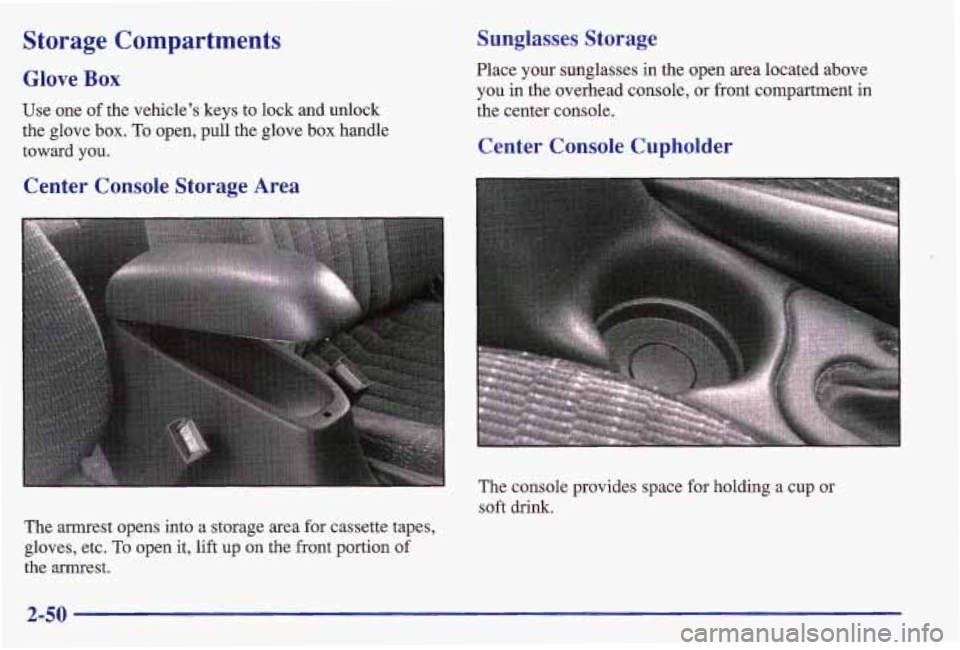
The armrest opens into a storage area for cassette tapes,
gloves, etc.
To open it, lift up on the front portion of
the armrest. The console provides space
for holding a cup or
soft drink.
2-50
Page 116 of 371
If the light comes on while you are driving, pull off the
road and stop carefully. You may notice that the pedal is
harder to push. Or, the pedal may go closer to the floor.
It may take longer to stop.
If the light is still on, have the
vehicle towed for service. (See “Towing Your Vehicle”
in the Index.)
A CAUTION:
Your brake system may not be working properly
if the brake system warning light is
on. Driving
with the brake system warning light on can lead
to an accident. If the light is still on after you’ve
pulled off the road and stopped carefully, have
the vehicle towed for service.
When the ignition is on, the brake system warning light
will also come on when you set your parking brake. The
light will stay on
if your parking brake doesn’t release
fully. If it stays on after your parking brake is fully
released, it means you have a brake problem.
Anti-Lock Brake System Warning Light
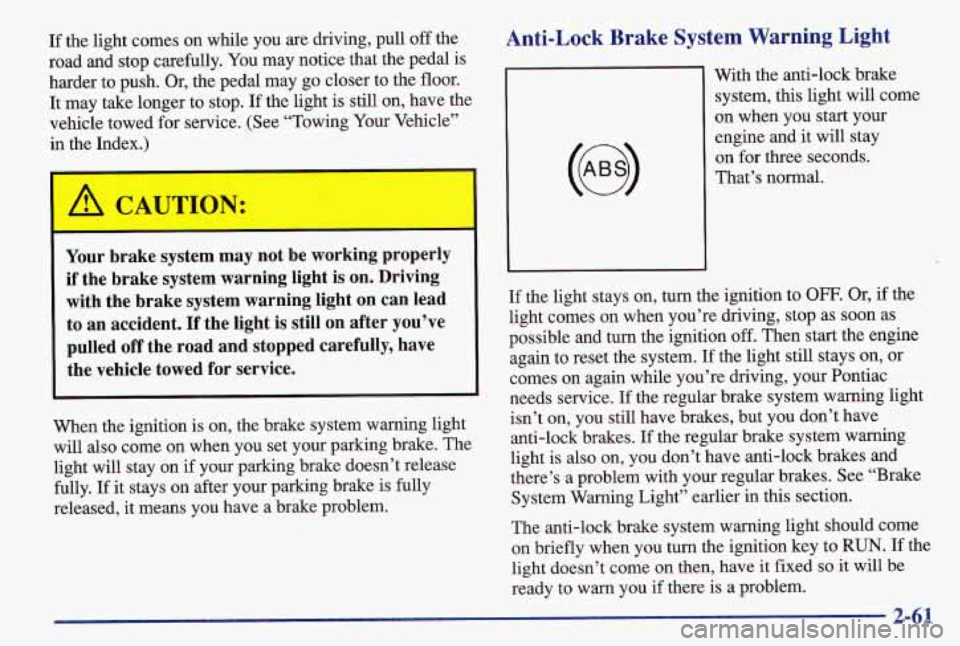
With the anti-lock brake
system, this light will come
on when you start your
engine and it will stay
on for three seconds.
That’s normal.
If the light stays on, turn the ignition to OFF. Or, if the
light comes on when you’re driving, stop as soon as
possible and turn the ignition off. Then start the engine
again to reset the system. If the light still stays on, or
comes on again while you’re driving, your Pontiac
needs service.
If the regular brake system warning light
isn’t on, you still have brakes, but you don’t have
anti-lock brakes.
If the regular brake system warning
light is also on, you don’t have anti-lock brakes and
there’s a problem with your regular brakes. See “Brake
System Warning Light” earlier in this section.
The anti-lock brake system warning light should come on briefly when you turn the ignition key to
RUN. If the
light doesn’t come on then, have
it fixed so it will be
ready to warn you
if there is a problem.
2-61
Page 120 of 371

NOTICE:
If you keep driving your vehicle with this light
on, after a while, your emission controls may not
work as well, your fuel economy may not be as
good and your engine may not run as smoothly.
This could lead
to costly repairs that may not be
covered by your warranty.
This light should come on, as a check to show you it is
working, when the ignition is on and the engine is not
running. If the light doesn’t come on, have it repaired.
This light will also come on during a malfunction in one
of
two ways:
0 Light Flashing -- A misfire condition has been
detected. A misfire increases vehicle emissions and
may damage the emission control system on your
vehicle. Dealer or qualified service center diagnosis
and service is required.
Light On Steady -- An emission control system
malfunction has been detected on your vehicle.
Dealer or qualified service center diagnosis and
service may be required.
If the Light Is Flashing
The following may prevent more serious damage to
your vehicle:
0 Reducing vehicle speed.
0 Avoiding hard accelerations.
0 Avoiding steep uphill grades.
0 If you are towing a trailer, reduce the amount of
cargo being hauled as soon as it is possible.
If the light stops flashing and remains on steady, see “If
the Light
Is On Steady” following.
If the light continues to flash, when it is safe to do
so,
stop the vehicle. Find a safe place to park your vehicle.
Turn the key off, wait at least 10 seconds and restart the
engine.
If the light remains on steady, see “If the Light
Is On Steady” following. If the light is still flashing,
follow the previous steps, and drive the vehicle to your
dealer or qualified service center for service.
2-65
Page 123 of 371
Check Oil Light (If Equipped)
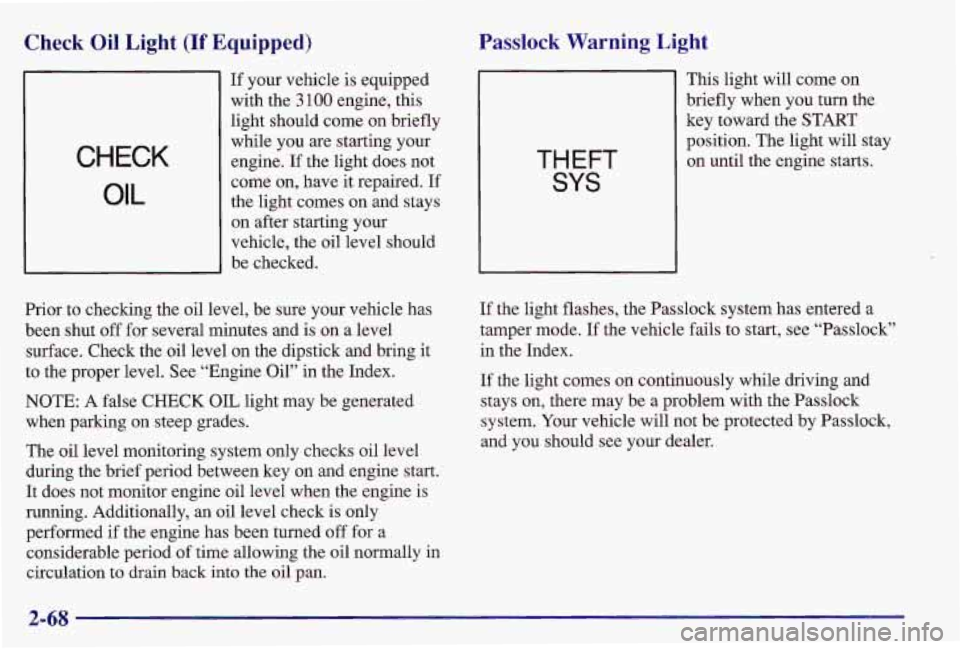
CHECK
OIL
If your vehicle is equipped
with the
3 100 engine, this
light should come on briefly
while you are starting your engine.
If the light does not
come on, have it repaired. If
the light comes on and stays on after starting your
vehicle, the oil level should
be checked.
Prior to checking the oil level, be sure your vehicle has been shut off for several minutes and is on a level
surface. Check the oil level on the dipstick and bring it
to the proper level. See “Engine Oil” in the Index.
NOTE: A false
CHECK OIL light may be generated
when parking on steep grades.
The oil level monitoring system only checks oil level
during the brief period between key on and engine start.
It does not monitor engine oil level when the engine is
running. Additionally,
an oil level check is only
performed if the engine has been turned
off for a
considerable period
of time allowing the oil normally in
circulation
to drain back into the oil pan.
Passlock Warning Light
THEFT
SYS
This light will come on
briefly when you turn the
key toward the START
position. The light will stay
on until the engine starts.
If the light flashes, the Passlock system has entered a
tamper mode. If the vehicle fails to start, see “Passlock”
in the Index.
If the light comes on continuously while driving and
stays
on, there may be a problem with the Passlock
system. Your vehicle will not be protected by Passlock,
and
you should see your dealer.
2-68
Page 130 of 371
Air Conditioning Heating
Turning
the right control knob to HEATER and the
center control knob clockwise sends some heated air
through the heater ducts toward your feet, and some
through the defroster vents.
On very
hot days, open the windows long enough to let
hot, inside air escape. This reduces the time
it takes for
your vehicle to cool down, which should help fuel
economy.
For quick cool-down on very hot days, use MAX with
the temperature knob all the way in the blue area.
If the
setting is used for long periods of time, the air in your
vehicle may become too dry.
For normal cooling on hot days, use
NC with the
temperature knob in the blue area. The system will bring
in outside air and cool it.
On cool but sunny days, the sun may warm your upper
body, but your lower body may not be warm enough. You
can use
BI-LEVEL with the temperature knob in the
middle. The system will bring in outside air and direct
it
to your upper body, while sending slightly warmed air to
your lower body. You may notice this temperature
difference more at some times than at others. VENT
and HEATER are economical positions because
the air conditioner compressor doesn’t run in these
two settings. This reduces engine load, resulting in
improved fuel economy.
If either setting fails to keep
you comfortable, or causes your windows to fog up, turn
the right control knob to one of the air conditioning
positions, or to DEFROST.
If you have the optional engine coolant heater
(engine block heater) and use
it during cold weather,
0 “F (- 18 O C) or lower, your heating system will more
quickly provide heat because the engine coolant is
already warmed. See “Engine Coolant Heater” in
the Index.
3-5
Page 131 of 371
Defrosting and Defogging
To defrost the windshield, turn all three control knobs to
the far right.
The DEFROST setting directs air through the defroster
vents located on top
of the instrument panel.
To warm passengers while keeping the windows clean,
use BLEND.
To defog the side windows, turn the right control knob
to BI-LEVEL and the fan control
knob to HIGH. Aim
the side vents toward the side windows. For increased
aifflow to the side vents, close the center vents.
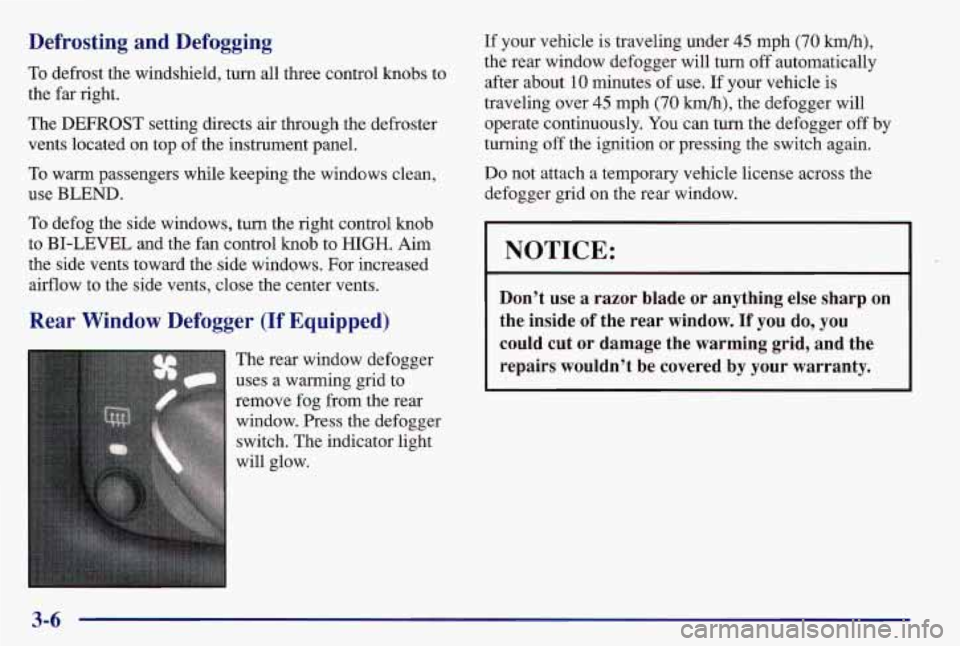
Rear Window Defogger (If Equipped)
The rear window defogger
uses
a warming grid to
remove fog from the rear
window. Press the defogger
switch. The indicator light
will glow.
If your vehicle is traveling under 45 rnph (70 km/h),
the rear window defogger will turn off automatically
after about
10 minutes of use. If your vehicle is
traveling over
45 mph (70 km/h), the defogger will
operate continuously.
You can turn the defogger off by
turning off the ignition or pressing the switch again.
Do not attach a temporary vehicle license across the defogger grid on the rear window.
I NOTICE:
Don’t use a razor blade or anything else sharp on
the inside
of the rear window. If you do, you
could cut
or damage the warming grid, and the
repairs wouldn’t be covered by your warranty.
3-6
Page 152 of 371
7 Section 4 Your Driving and the Road
Here you’ll find information about driving on different kinds of roads and in varying weather conditions. We’ve also
included many other useful tips on driving.
4-2
4-3
4-6
4-6 4-11
4-13
4-13
4- 15
4-16
4-18 Defensive Driving
Drunken Driving
Control
of a Vehicle
Braking Steering
Off-Road Recovery
Passing
Loss of Control
Driving at Night
Driving in Rain and on Wet Roads 4-2
1
4-22
4-23
4-24
4-24
4-26
4-30
4-33
4-35 City Driving
Freeway Driving
Before Leaving on a Long Trip
Highway Hypnosis
Hill and Mountain Roads
Winter Driving Recreational Vehicle Towing
Loading Your Vehicle
Towing a Trailer
Page 181 of 371
Run your engine only as long as you must. This saves
fuel. When you run the engine, make it go a little faster
than just idle. That
is, push the accelerator slightly. This
uses less fuel for the heat that
you get and it keeps the
battery charged. You will need a well-charged battery to
restart the vehicle, and possibly for signaling later on
with your headlamps. Let the heater run for awhile.
Then, shut the engine off and close the window almost
all the way to preserve the heat. Start the engine again
and repeat this only when you feel really uncomfortable
from the cold. But do it
as little as possible. Preserve the
fuel as long as you can.
To help keep warm, you can get
out
of the vehicle and do some fairly vigorous exercises
every half hour or
so until help comes.
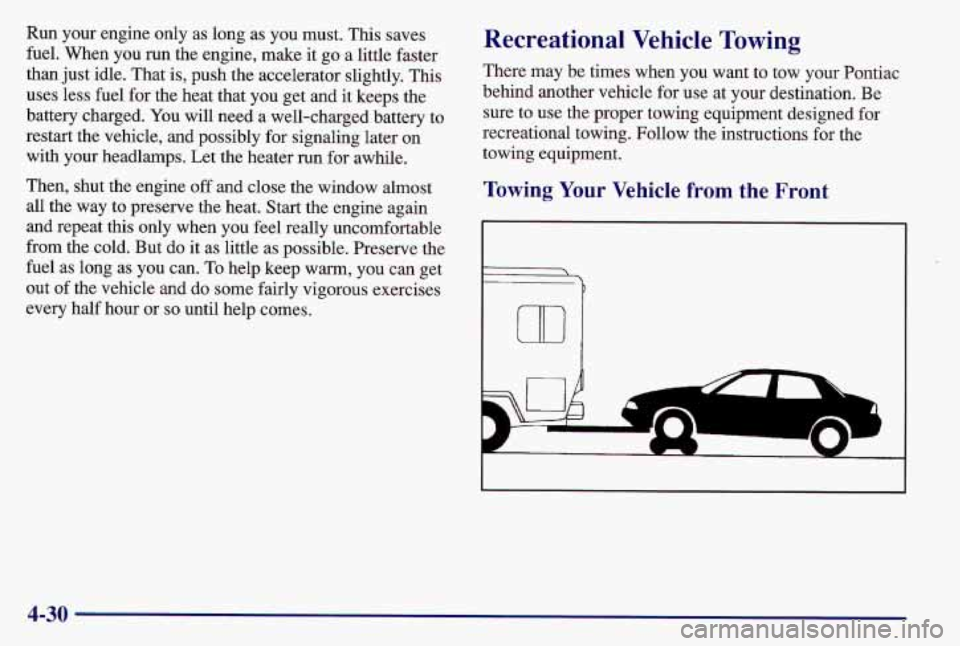
Recreational Vehicle Towing
There may be times when you want to tow your Pontiac
behind another vehicle for use at your destination. Be
sure to use the proper towing equipment designed for
recreational towing. Follow the instructions for the
towing equipment.
Towing Your Vehicle from the Front
4-30