Page 194 of 371
Section 5 Problems on the Road
Here you’ll find what to do about some problems that can occur on the road.
5-2 Hazard Warning Flashers
5-2 Other Warning Devices
5-3 Jump Starting
5- 8 Towing Your Vehicle
5- 14 Engine Overheating
5-22
5-23
5-33
5-34
If a Tire Goes Flat
Changing a Flat Tire
Compact Spare Tire
If You’re Stuck: In Sand, Mud,
Ice or Snow
5-1
Page 201 of 371
Towing Your Vehicle
Try to have a Pontiac dealer or a professional towing
service tow your Grand Am. They can provide the right
equipment and know how to tow your vehicle without
damage. See “Roadside Assistance’’ in the Index.
If your vehicle has been changed or modified since it
was factory new by adding aftermarket items like
fog
lamps, aero skirting, or special tires and wheels, these
instructions and illustrations may not be correct.
Before you do anything, turn on the hazard
warning flashers. When you
call, tell the towing service:
That your vehicle cannot be towed from the front or
rear with sling-type equipment, as described later in
this section.
0 That your vehicle has front-wheel drive.
The make, model and year of your vehicle.
Whether you can still move the shift lever.
If there was an accident, what was damaged.
When the towing service arrives, let the tow operator
know that this manual contains detailed towing
instructions and illustrations. The operator may want to
see them.
Page 202 of 371
I a CAUTION:
To help avoid injury to you or others:
0 Never let passengers ride in a vehicle that is
Never tow faster than safe or posted speeds.
Never tow with damaged parts not
fully secured.
0 Never get under your vehicle after it has
been lifted by the tow truck.
0 Always secure the vehicle on each side with
separate safety chains when towing
it.
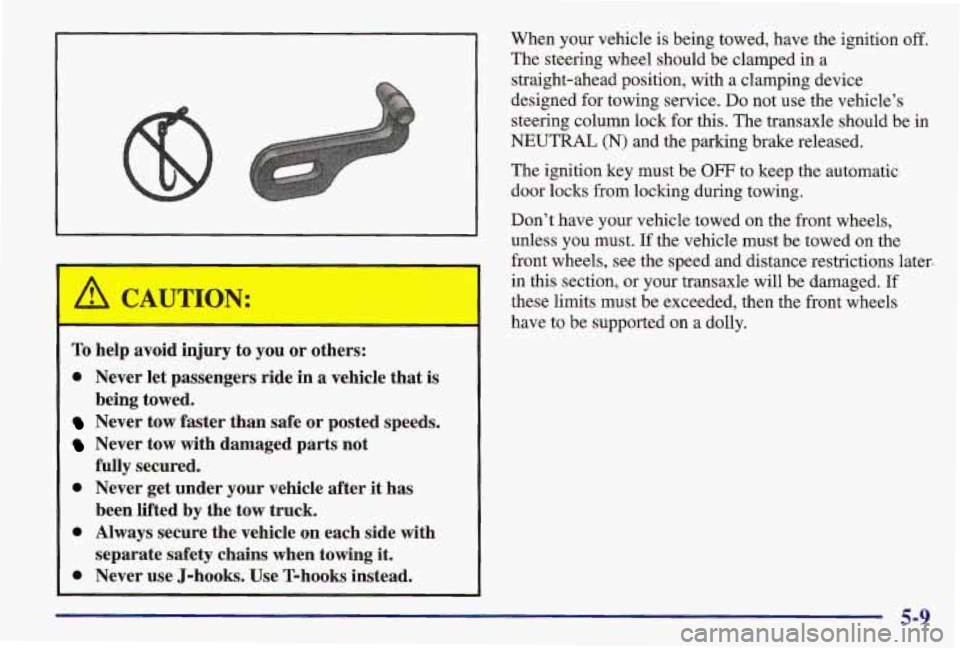
0 Never use J-hooks. Use T-hooks instead.
being
towed. When your
vehicle is being towed, have the ignition off.
The steering wheel should be clamped in a
straight-ahead position, with a clamping device
designed for towing service.
Do not use the vehicle’s
steering column lock for this. The transaxle should be in
NEUTRAL (N) and the parking brake released.
The ignition key must be
OFF to keep the automatic
door locks from locking during towing.
Don’t have your vehicle towed on the front wheels,
unless you must. If the vehicle must be towed on the
front wheels, see the speed and distance restrictions later-
in this section, or your transaxle will be damaged. If
these limits must be exceeded, then the front wheels
have to be supported on a dolly.
5-9
Page 203 of 371
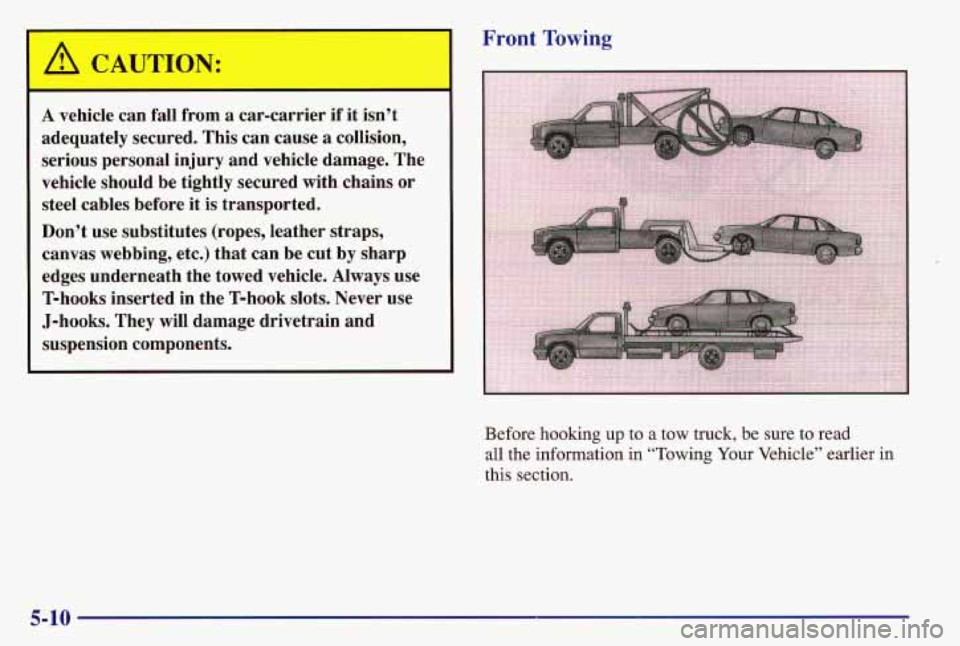
Front Towing
A vehicle can fall from a car-carrier if it isn’t
adequately secured. This can cause a collision,
serious personal injury and vehicle damage. The
vehicle should be tightly secured with chains or
steel cables before it is transported.
Don’t use substitutes (ropes, leather straps,
canvas webbing, etc.) that can be cut
by sharp
edges underneath the towed vehicle. Always use
T-hooks inserted in the T-hook slots. Never use
J-hooks. They will damage drivetrain and
suspension components.
Before hooking
up to a tow truck, be sure to read
all the information in “Towing Your Vehicle” earlier in
this section.
5-10
Page 204 of 371
NOTICE:
Do not tow with sling-type equipment or
fascia/fog light damage will occur. Use wheel-lift
or car-carrier equipment. Additional ramping
may be required for car-carrier equipment.
NOTICE:
Towing a vehicle over rough surfaces could
damage
a vehicle. Damage can occur from vehicle
to ground or vehicle to wheel-lift equipment. To
help avoid damage, install
a towing dolly and
raise the vehicle until adequate clearance is
obtained between the ground and/or
wheel-lift equipment.
Do not attach winch cables or J-hooks to
suspension components when using car-carrier
equipment. Always use T-hooks inserted in the
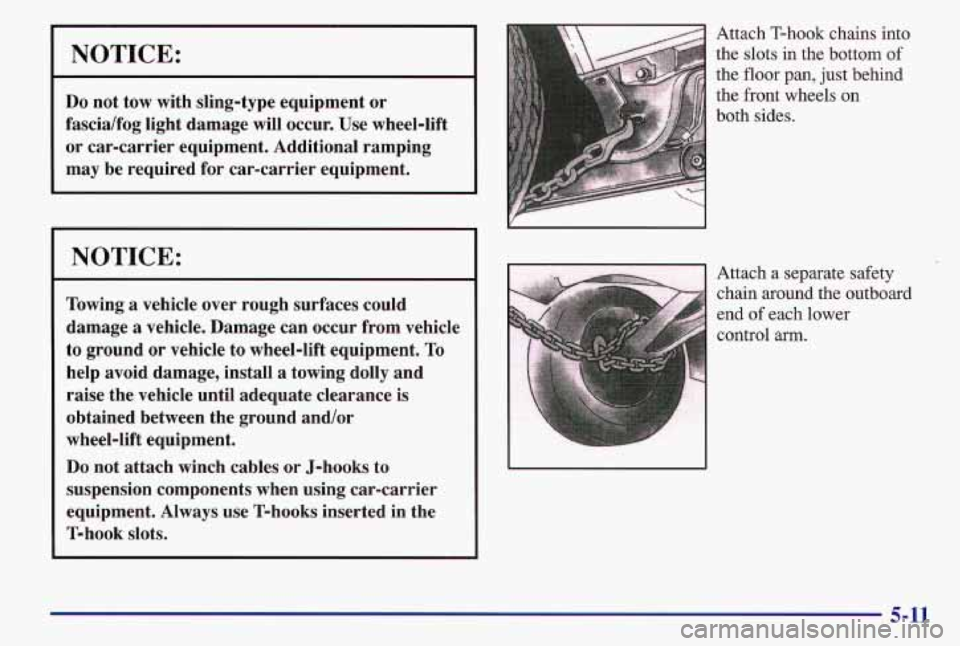
T-hook slots. Attach
T-hook chains into
the slots in the bottom
of
the floor pan, just behind
the front wheels on
both sides.
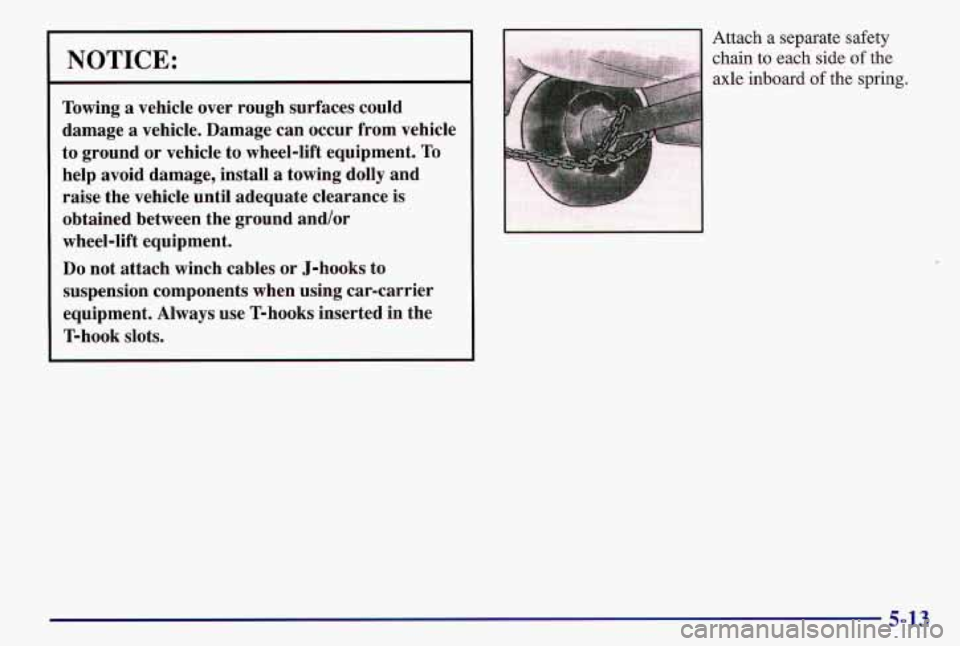
Attach
a separate safety
chain around the outboard
end
of each lower
control
arm.
5-11
Page 205 of 371
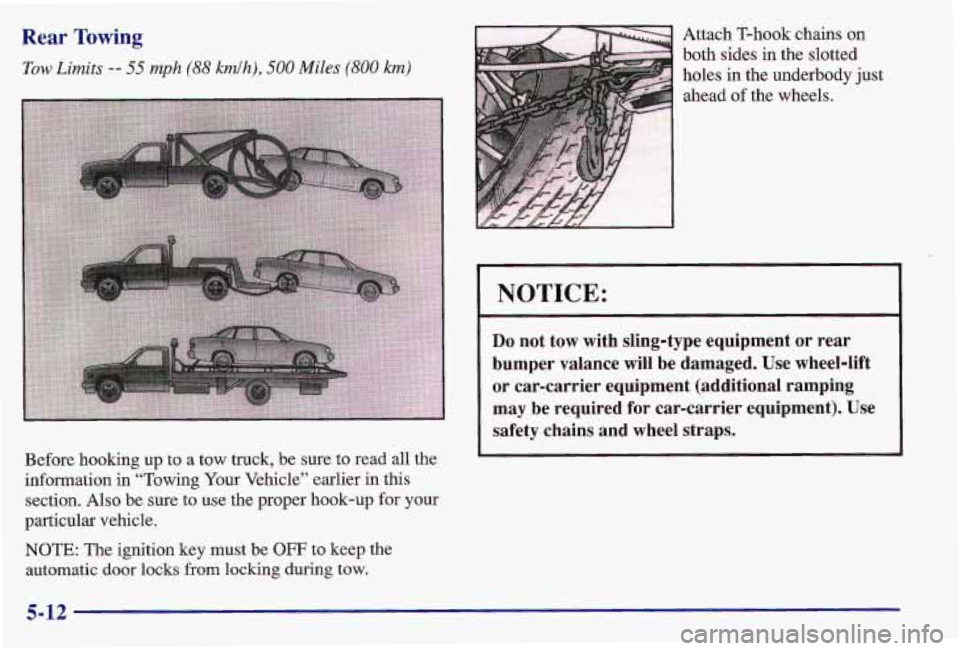
Rear Towing
Tow Limits -- 55 mpn (88 kmf h), 500 Miles (8UU km)
Attach T-hook chains on
both sides in the slotted
holes in the underbody just
ahead
of the wheels.
Before hooking up to a tow truck, be sure to read all the
information in “Towing Your Vehicle’’ earlier in this
section. Also be sure
to use the proper hook-up for your
particular vehicle.
NOTE: The ignition key must be
OFF to keep the
automatic
door locks from locking during tow.
NOTICE:
Do not tow with sling-type equipment or rear
bumper valance will be damaged. Use wheel-lift
or car-carrier equipment (additional ramping
may be required for car-carrier equipment). Use safety chains and wheel straps.
5-12
Page 206 of 371
NOTICE:
Towing a vehicle over rough surfaces could
damage
a vehicle. Damage can occur from vehicle
to ground or vehicle to wheel-lift equipment.
To
help avoid damage, install a towing dolly and
raise the vehicle until adequate clearance is
obtained between the ground and/or
wheel-lift equipment.
Do not attach winch cables or J-hooks to
suspension components when using car-carrier
equipment. Always use T-hooks inserted in the
~ T-hook slots.
5-13
Page 208 of 371
If No Steam Is Coming From Your Engine
If you get the overheat warning but see or hear no
steam, the problem may not be too serious. Sometimes
the engine can get a little too hot when you:
0 Climb a long hill on a hot day.
Stop after high-speed driving.
0 Idle for long periods in traffic.
0 Tow a trailer.
If you get the overheat warning with no sign of steam,
try this for a minute or
so:
1. If you have an air conditioner, turn it off.
2. Turn on your heater to full hot at the highest fan
speed and open the window as necessary.
3. If you’re in a traffic jam, shift to NEUTRAL (N);
otherwise, shift to the highest gear while
driving
-- AUTOMATIC OVERDRIVE (@) or
DRIVE (D) for automatic transaxles.
If you no longer have the overheat warning, you can
drive. Just to be safe, drive slower for about
10 minutes.
If the warning doesn’t come back on, you can
drive normally.
If the warning continues, pull over, stop, and
park your
vehicle right away.
If there’s still no sign of steam, you can idle the engine
for two or three minutes while you’re parked, to see if
the warning stops. But then,
if you still have the
warning,
turn ofSthe engine and get everyone out of the
vehicle
until it cools down.
You may decide not to lift the hood but to get service
help right away.
5-15