1997 PONTIAC GRAND AM tow
[x] Cancel search: towPage 182 of 371
Follow these steps:
1. Put the front wheels on a dolly.
NOTICE:
Do not tow your vehicle with the front wheels in
contact with the
ground, or the automatic
transaxle could be damaged.
2.
3.
4.
5.
6.
Set the parking brake.
Open the fuse panel on the driver’s side of the
instrument panel. Remove the fuse labeled
PRNDL.
This will keep your battery from draining
while towing.
Turn the ignition key to
OFF to unlock the steering
wheel. See “Ignition Positions” in the Index.
Clamp the steering wheel
in a straight-ahead position,
with a clamping device designed for towing.
Release the parking brake.
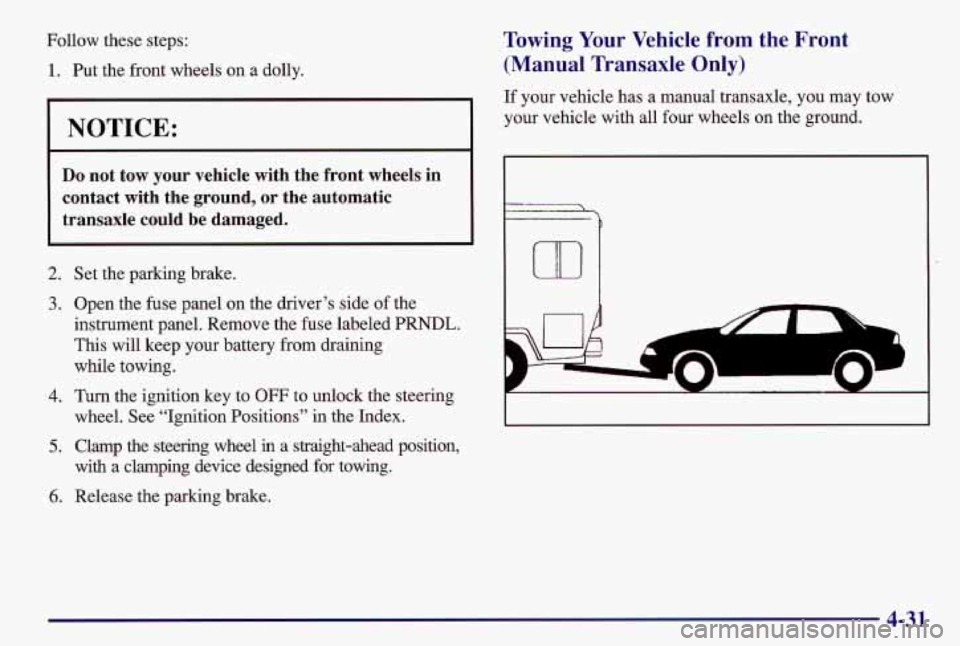
Towing Your Vehicle from the Front
(Manual Transaxle Only)
If your vehicle has a manual transaxle, you may tow
your vehicle with all four wheels on the ground.
4-31
Page 183 of 371
Follow these steps:
1.
2.
3.
4.
5.
Set the parking brake.
Open the fuse panel on the driver's side
of the
instrument panel. Remove the fuse labeled PRNDL.
This will keep your battery from draining
while towing.
Turn the ignition key to
OFF to unlock the
steering wheel.
Shift your manual transaxle to NEUTRAL (N).
Release the parking brake.
I NOTICE:
Make sure that the towing speed does not exceed
55 mph (90 km/h), or your vehicle could be
badly damaged.
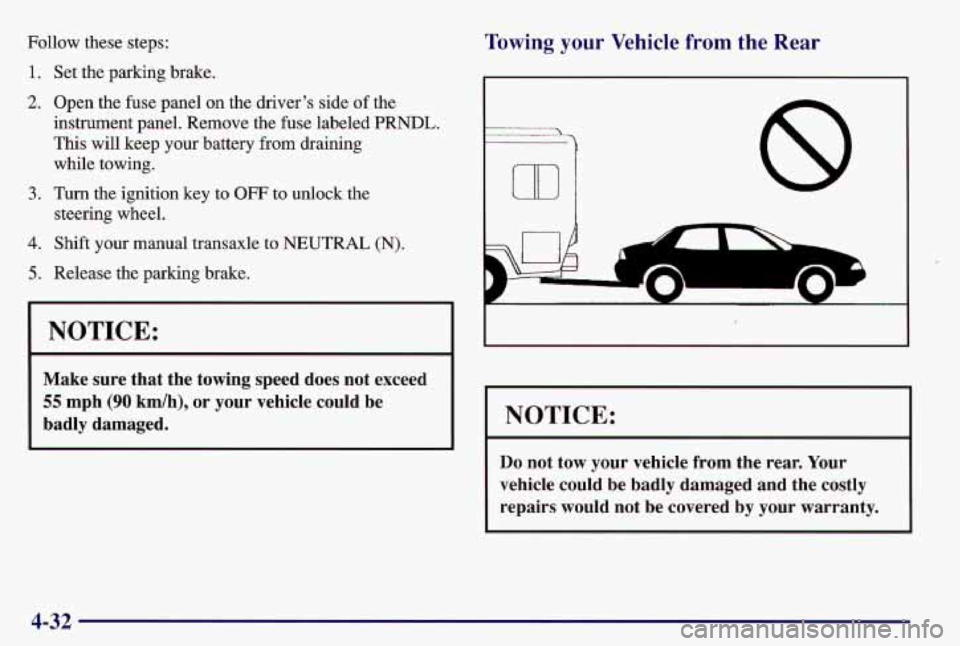
Towing your Vehicle from the Rear
cID 8
n
NOTICE:
Do not tow your vehicle from the rear. Your
vehicle could be badly damaged'and the costly
repairs would not be covered by your warranty.
4-32
Page 186 of 371
Towing a Trailer
If you don’t use the correct equipment and drive
properly, you can lose control when you pull
a
trailer. For example, if the trailer is too heavy, the
brakes may not work well
-- or even at all. You
and your passengers could be seriously injured.
Pull
a trailer only if you have followed all the
steps in this section. Ask your Pontiac dealer for
advice and information about towing
a trailer
with your vehicle.
NOTICE:
Pulling a trailer improperly can damage your
vehicle and result in costly repairs not covered by
your warranty.
To pull a trailer correctly, follow
the advice in
this part, and see your Pontiac
dealer for important information about towing
a
trailer with your vehicle.
Do not tow a trailer if your vehicle is equipped with a
2.4L (Code T) engine.
Your vehicle can tow a trailer if
it is equipped with a
3 100 (Code M) engine and proper trailer towing
equipment.
To identify what the vehicle trailering
capacity
is for your vehicle, you should read the
information in “Weight
of the Trailer’’ that appears later
in this section. But trailering is different than just
driving your vehicle
by itself. Trailering means changes
in handling, durability and fuel economy. Successful,
safe trailering takes correct equipment, and it has to be
used properly.
4-35
Page 187 of 371
That’s the reason for this part. In it are many
time-tested, important trailering tips and safety rules.
Many of these are important for your safety and that of
your passengers.
So please read this section carefully
before you pull a trailer.
Load-pulling components such as the engine, transaxle,
wheel assemblies and tires
are forced to work harder
against the drag of the added weight. The engine is
required to operate at relatively higher speeds and under
greater loads, generating extra heat. What’s more, the
trailer adds considerably to wind resistance, increasing
the pulling requirements.
If You Do Decide To Pull A Trailer
If you do, here are some important points:
0
0
There are many different laws, including speed limit
restrictions, having to do with trailering. Make sure
your rig will be legal, not only where you live but
also where you’ll be driving. A good source for this
information can be state or provincial police.
Consider using a sway control.
You can ask a hitch
dealer about sway controls.
Don’t tow a trailer at all during the first
1,000 miles
(1 600 km) your new vehicle is driven. Your engine.
axle or other parts could be damaged.
0
0
Then, during the first 500 miles (800 km) that you
tow a trailer, don’t drive over
50 mph (80 h/h) and
don’t make starts at full throttle. This helps your
engine and other parts of your vehicle wear in at the
heavier loads.
Obey speed limit restrictions when towing a trailer.
Don’t drive faster than the maximum posted speed
for trailers (or no more than
55 mph (90 km/h)) to
save wear on your vehicle’s parts.
Three important considerations have to do with weight:
0 the weight of the trailer,
the weight of the trailer tongue
and the total weight on your vehicle’s tires.
Weight of the Trailer
How heavy can a trailer safely be?
It should never weigh more than 1,000 lbs. (450 kg). But
even that can be too heavy.
It depends on how you plan to use your rig. For
example, speed, altitude, road grades, outside
temperature and how much your vehicle is used to pull a
trailer are all important. And,
it can also depend on any
special equipment that you have
on your vehicle.
4-36
Page 188 of 371
You can ask your dealer for our trailering information or
advice, or you can write us at:
Pontiac Customer Services Department One Pontiac Plaza
Pontiac, Michigan 48340-2952
In Canada, write to:
General Motors
of Canada Limited
Customer Communication Centre 1908 Colonel
Sam Drive
Oshawa, Ontario L1H 8P7
Weight of the Trailer Tongue
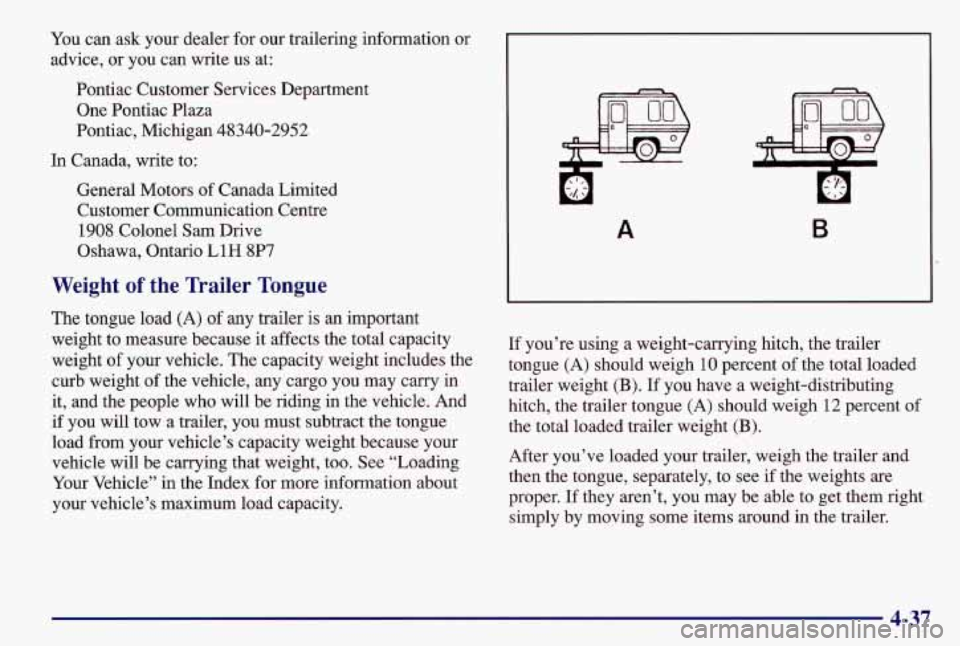
The tongue load (A) of any trailer is an important
weight to measure because it affects the total capacity
weight of your vehicle. The capacity weight includes the
curb weight
of the vehicle, any cargo you may carry in
it, and the people who will be riding in the vehicle. And
if you will tow a trailer, you must subtract the tongue
load from your vehicle’s capacity weight because your
vehicle will be carrying that weight, too. See “Loading
Your Vehicle” in the Index for more information about
your vehicle’s maximum load capacity.
A B
If you’re using a weight-carrying hitch, the trailer
tongue
(A) should weigh 10 percent of the total loaded
trailer weight
(B). If you have a weight-distributing
hitch, the trailer tongue
(A) should weigh 12 percent of
the total loaded trailer weight (B).
After you’ve loaded your trailer, weigh the trailer and
then the tongue, separately, to see if the weights are
proper.
If they aren’t, you may be able to get them right
simply by moving some items around in the trailer.
4-37
Page 190 of 371
Driving with a Trailer
Towing a trailer requires a certain amount of experience.
Before setting out for the open road, you’ll want to get
to know your rig. Acquaint yourself with the feel of
handling and braking with the added weight of the
trailer. And always keep in mind that the vehicle you are
driving is now a good deal longer and not nearly as
responsive as your vehicle is by itself.
Before you start, check the trailer hitch and platform
(and attachments), safety chains, electrical connector,
lamps, tires and mirror adjustment. If the trailer has
electric brakes, start your vehicle and trailer moving and
then apply the trailer brake controller by hand to be sure
the brakes are working. This lets you check your
electrical connection at the same time.
During your trip, check occasionally to be sure that the load is secure, and that the lamps and any trailer brakes
are still working.
Following Distance
Stay at least twice as far behind the vehicle ahead as you
would when driving your vehicle without a trailer. This
can help you avoid situations that require heavy braking
and sudden turns.
Passing
You’ll need more passing distance up ahead when
you’re towing a trailer. And, because you’re a good deal
longer, you’ll need to go much farther beyond the
passed vehicle before you can return to your lane.
Backing Up
Hold the bottom of the steering wheel with one hand.
Then, to move the trailer to the left, just move that hand
to the left. To move the trailer to the right, move your
hand to the right. Always back up slowly and, if
possible, have someone guide you.
4-39
Page 191 of 371
Making Turns
I NOTICE: 1
Making very sharp turns while trailering could cause the trailer to come in contact with the vehicle. Your vehicle could be damaged. Avoid
making very sharp turns while trailering.
1
When you’re turning with a trailer, make wider turns
than normal.
Do this so your trailer won’t strike soft
shoulders, curbs, road signs, trees or other objects.
Avoid jerky or sudden maneuvers. Signal well
in advance.
Turn Signals When Towing a Trailer
The green arrows on your instrument panel will flash
whenever you signal a turn or lane change. Properly
hooked up, the trailer lamps will also flash, telling other
drivers you’re about to turn, change lanes
or stop. When
towing a trailer, the green arrows on your
instrument panel will flash for turns even
if the bulbs on
the trailer are burned out. Thus, you may think drivers
behind you are seeing your signal when they are not. It’s
important
to check occasionally to be sure the trailer
bulbs are still working.
Driving On Grades
Reduce speed and shift to a lower gear before you start
down a long or steep downgrade.
If you don’t shift
down, you might have to use your brakes
so much that
they would get hot and no longer work well.
On a long uphill grade, use the highest gear possible. If
you cannot maintain posted speeds, driving at a lower
speed may help avoid overheating your engine
and transaxle.
If you have a manual transaxle with FIFTH
(5) gear,
it’s better not to use FIFTH
(5) gear. Just drive in
FOURTH
(4) gear (or, as you need to, a lower gear).
4-40
Page 192 of 371
Parking on Hills
You really should not park your vehicle, with a trailer
attached, on a hill.
If something goes wrong, your rig
could start to move. People can be injured, and both
your vehicle and the trailer can be damaged.
But if you ever have to park your
rig on a hill, here’s
how to do it:
1. Apply your regular brakes, but don’t shift into
PARK
(P) yet, or into a gear for a manual transaxle.
2. Have someone place chocks under the trailer wheels.
3. When the wheel chocks are in place, release the
regular brakes until the chocks absorb the load.
4. Reapply the regular brakes. Then apply your parking
brake, and then shift to PARK
(P), or REVERSE (R)
for a manual transaxle.
5. Release the regular brakes.
When You Are Ready to Leave After
Parking
on a Hill
1. Apply your regular brakes and hold the pedal down
while you:
0 Start your engine;
Shift into a gear; and
0 Release the parking brake.
2. Let up on the brake pedal.
3. Drive slowly until the trailer is clear of the chocks.
4. Stop and have someone pick up and store the chocks.
Maintenance When Trailer Towing
Your vehicle will need service more often when you’re
pulling a trailer. See the Maintenance Schedule for more
on this. Things that are especially important in trailer
operation are automatic transaxle fluid (don’t overfill),
engine oil, belt, cooling system and brake adjustment.
Each
of these is covered in this manual, and the Index
will help you find them quickly.
If you’re trailering, it’s
a good idea to review these sections before you start
your trip.
Check periodically to see that all hitch nuts and bolts
are tight.
4-41