Rear Seats
Folding the Rear Seat (If Equipped)
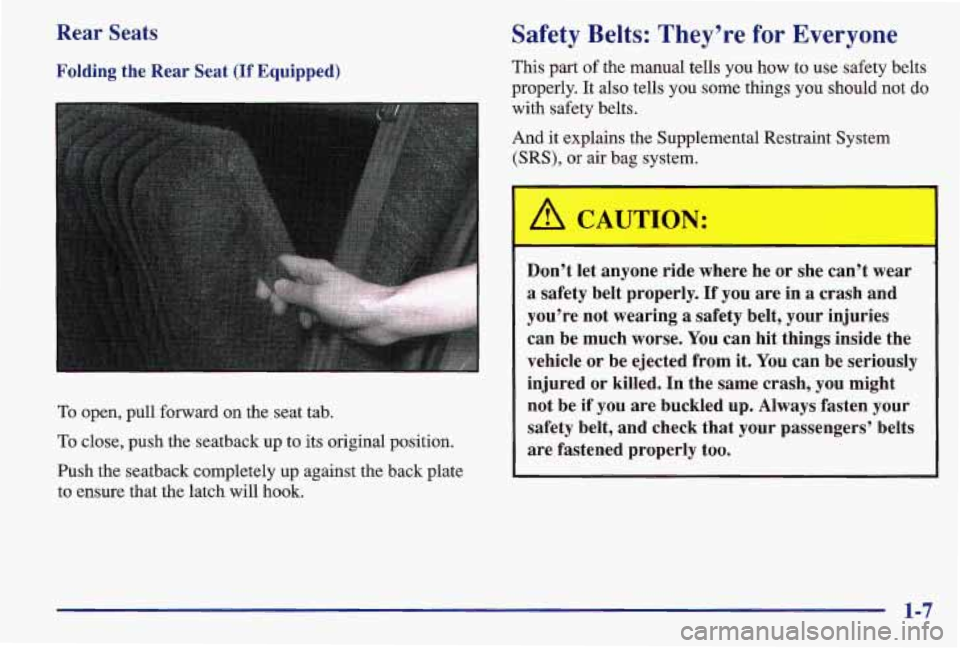
To open, pull forward on the seat tab.
To close, push the seatback up to its original position.
Push the seatback completely up against the back plate
to ensure that the latch will hook.
Safety Belts: They’re for Everyone
This part of the manual tells you how to use safety belts
properly. It also tells you some things you should not
do
with safety belts.
And it explains the Supplemental Restraint System
(SRS), or air bag system.
A CAUTION:
Don’t let anyone ride where he or she can’t wear
a safety belt properly, If you are in a crash and
you’re not wearing
a safety belt, your injuries
can be much worse.
You can hit things inside the
vehicle or be ejected from it. You can be seriously
injured or killed, In the same crash, you might
not be
if you are buckled up. Always fasten your
safety belt, and check
that your passengers’ belts
are fastened properly too.
1-7
A CAUTION:
Do not load your vehicle any heavier than the
GVWR, or either the maximum front or rear
GAWR. If you do, parts on your vehicle can
break, or it can change the way your vehicle
handles. These could cause you to lose control.
Also, overloading can shorten the life of
your vehicle.
NOTICE:
Your warranty does not cover parts or
components
that fail because of overloading.
If you put things inside your vehicle- like suitcases,
tools, packages,
or anything else-they will go as fast as
the vehicle goes. If you stop or turn quickly, or
if there
is a crash, they’ll keep going. Things
you put inside your vehicle can strike and
injure people in
a sudden stop or turn, or in
a crash.
Put things in the trunk of your vehicle. In a
trunk, put them as far forward as you can.
Try to spread the weight evenly.
Never stack heavier things, like suitcases,
inside the vehicle
so that some of them are
above the tops
of the seats.
Don’t leave an unsecured child restraint in
your vehicle.
When you carry something inside the
vehicle, secure it whenever you can.
Don’t leave a seat folded down unless you
need
to.
4-34