Compact Spare Tire
Your car has a compact spare tire that takes up less space. Use thisspare tire as a temporary replace-
ment only. Get your regular tire
repaired or replaced and put back on
your car as soon as you can.
Check the inflation pressure of the
compact spare tire every time you
check the other tires. It should be
inflated to:
60 psi (420 kPa, 4.2 kgf/cm2) Follow these precautions whenever
you are using the compact spare tire:
Do not exceed 50 mph (80 km/h)
under any circumstances.
This tire gives a harsher ride and less traction on some road sur-
faces than the regular tire. Use
greater caution while driving on
this tire.
Do not mount snow chains on the
compact spare.
The wheel of the compact spare tire is designed especially to fit
your car. Do not use your spare tire on another car unless it is the same make and model. The compact spare tire has a shorter
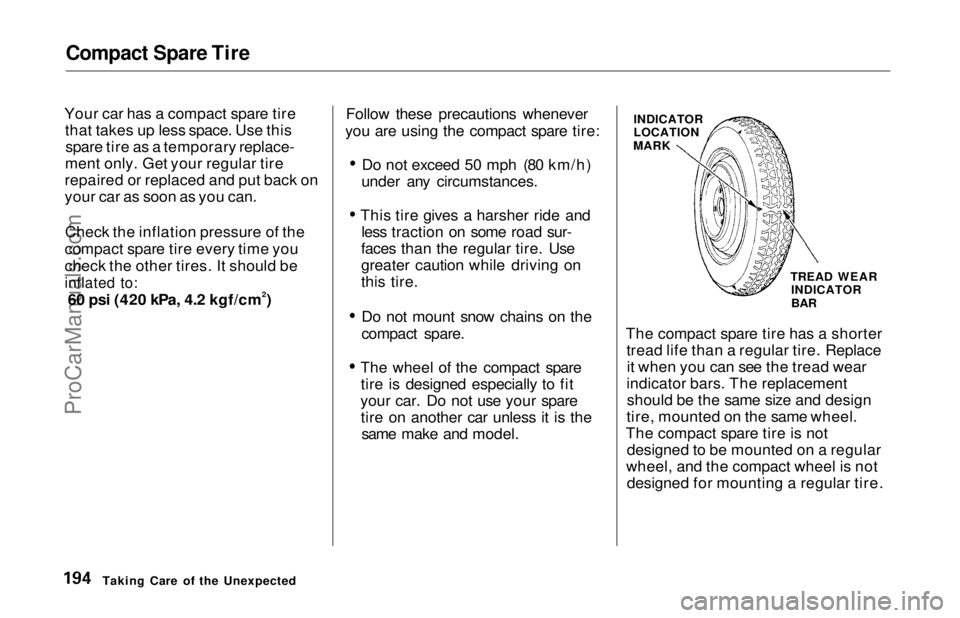
tread life than a regular tire. Replaceit when you can see the tread wear
indicator bars. The replacement should be the same size and design
tire, mounted on the same wheel.
The compact spare tire is not designed to be mounted on a regular
wheel, and the compact wheel is not designed for mounting a regular tire.
Taking Care of the Unexpected INDICATOR
LOCATION
MARK
TREAD WEARINDICATOR
BARProCarManuals.comMain Menu Table of Contents s t
Tire Information
Tire Size Designation
A tire's sidewall is marked with a tire size designation. You will need this
information when selecting replace-
ment tires for your car. The follow-
ing explains what the letters and
numbers in the tire size designation
mean.
(Example tire size designation)
P205/65R15 92S
P —
Applicable vehicle type (tires
marked with the prefix "P" are
intended for use on passenger cars;
however, not all tires have this
marking).
205 —
Tire width in millimeters.
65 —
Aspect ratio. The tire's section
height as a percentage of its width.
R —
Tire construction code (Radial).
15 —
Rim diameter in inches. 92
—
Load Index, a numerical code
associated with the maximum load
the tire can carry.
S —
Speed Rating Symbol. See the
speed rating chart in this section for
additional information.
Wheel Size Designation
Wheels are also marked with important information that you needif you ever have to replace one. The
following explains what the letters and numbers in the wheel size
designation mean.
(Example wheel size designation)
15
x
6
JJ
15 —
Rim diameter in inches.
6 —
Rim width in inches.
JJ —
Rim contour designation.
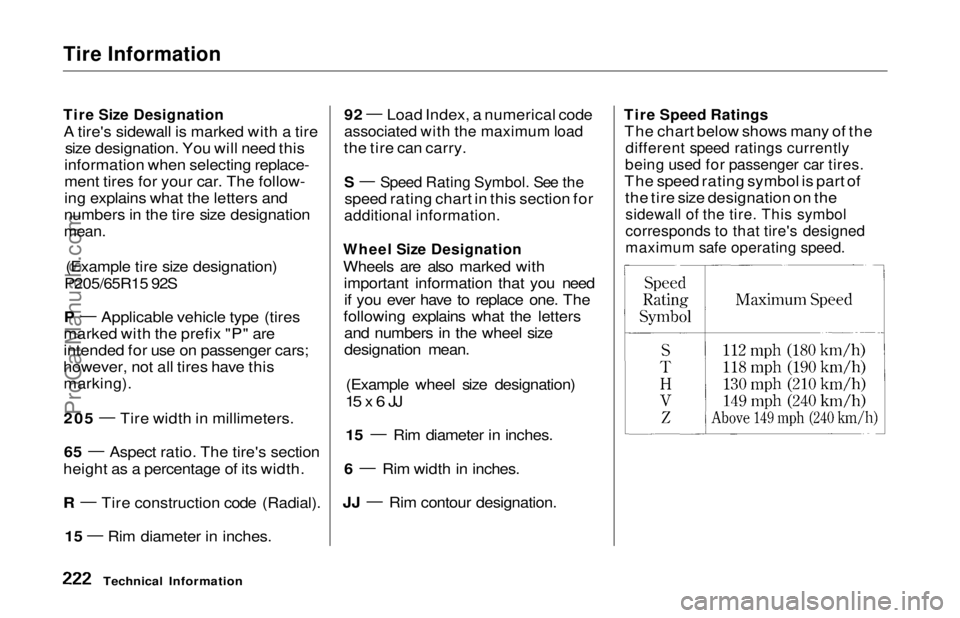
Tire Speed Ratings
The chart below shows many of the
different speed ratings currently
being used for passenger car tires.
The speed rating symbol is part of the tire size designation on the
sidewall of the tire. This symbol
corresponds to that tire's designed
maximum safe operating speed.
Technical InformationProCarManuals.comMain Menu Table of Contents s t
Tire Information
Traction
The traction grades, from highest to lowest, are A, B, and C, and they
represent the tire's ability to stop on
wet pavement as measured under controlled conditions on specified
government test surfaces of asphalt and concrete. A tire marked C may
have poor traction performance.
Warning: The traction grade as- signed to this tire is based on brak-
ing (straight ahead) traction tests
and does not include cornering (turning) traction.
Temperature
The temperature grades are A (the highest), B, and C, representing the
tire's resistance to the generation of
heat and its ability to dissipate heat
when tested under controlled conditions on a specified indoor
laboratory test wheel. Sustained high
temperature can cause the material of the tire to degenerate and reduce
tire life, and excessive temperature can lead to sudden tire failure. The
grade C corresponds to a level of
performance which all passenger car
tires must meet under the Federal Motor Vehicle Safety Standard No. 109. Grades B and A represent
higher levels of performance on the
laboratory test wheel than the
minimum required by law.
Warning: The temperature grade for
this tire is established for a tire that
is properly inflated and not over-
loaded. Excessive speed, underinfla-
tion, or excessive loading either
separately or in combination, can
cause heat build-up and possible tire
failure.
Technical InformationProCarManuals.comMain Menu Table of Contents s t