Page 24 of 436
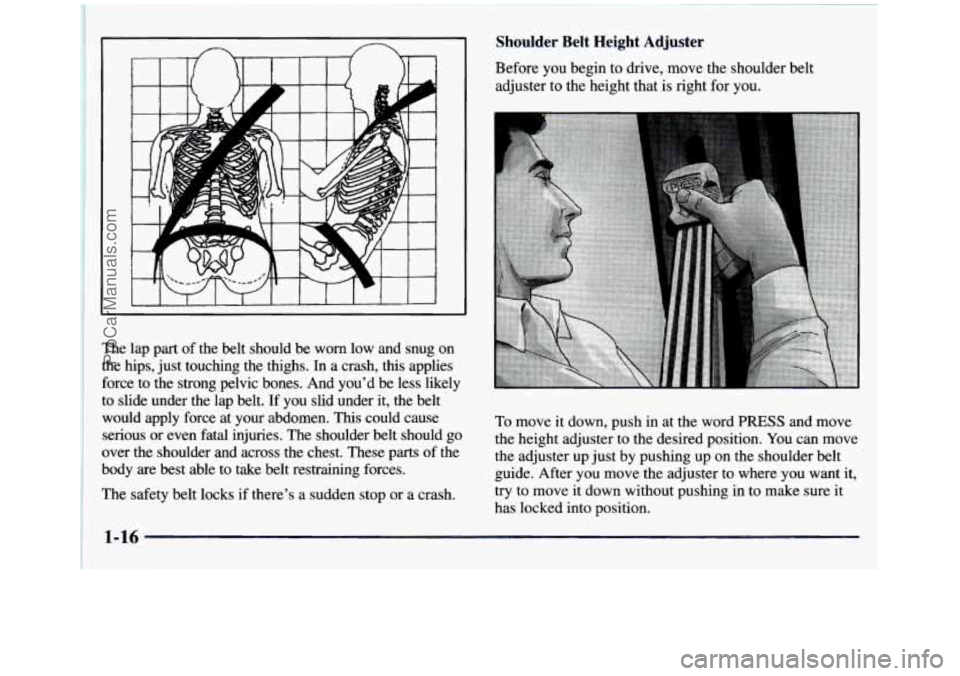
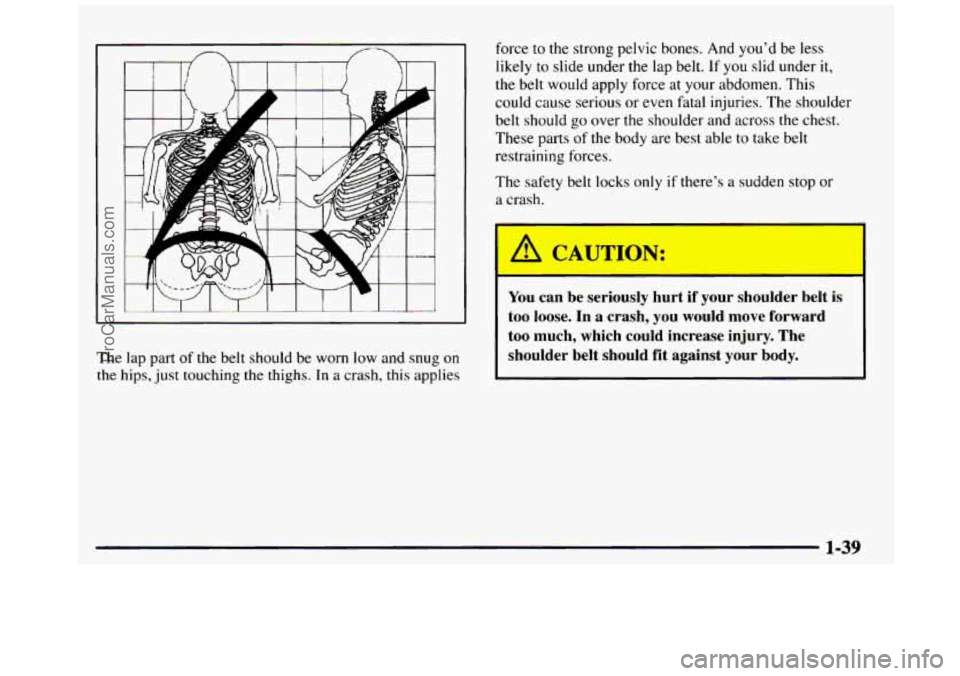
The lap part of the belt should be worn low and snug on
the hips, just touching the thighs.
In a crash, this applies
force to the strong pelvic bones. And you’d be less likely
to slide under the lap belt. If you slid under it, the belt
would apply force at your abdomen. This could cause
serious
or even fatal injuries. The shoulder belt should go
over the shoulder and across the chest. These parts of the
body are best able to take belt restraining forces.
The safety belt locks if there’s a sudden stop or a crash.
Shoulder Belt Height Adjuster
Before you begin to drive, move the shoulder belt
adjuster to the height that
is right for you.
To move it down, push in at the word
PRESS and move
the height adjuster to the desired position. You can move
the adjuster up just by pushing up on the shoulder belt
guide. After you move the adjuster to where you want it,
try to move it down without pushing in to make sure it
has locked into position.
1-16
ProCarManuals.com
Page 31 of 436
The best way to protect the fetus is to protect the
mother. When a safety belt is worn properly, it’s more
likely that the fetus won’t be hurt in a crash. For
pregnant women, as for anyone, the key to making
safety belts effective is wearing them properly.
Right Front Passenger Position
The right front passenger’s safety belt works the same
way as the driver’s safety belt. See “Driver Position”
earlier in this section.
Wheri the lap belt is pulled out all the way, it will lock.
(This is the child restraint locking feature working
normally.) If the belt locks, let it
go back all the way
and start again.
Supplemental Inflatable
Restraint System
This part explains the Supplemental Inflatable Restraint
system or air bag system.
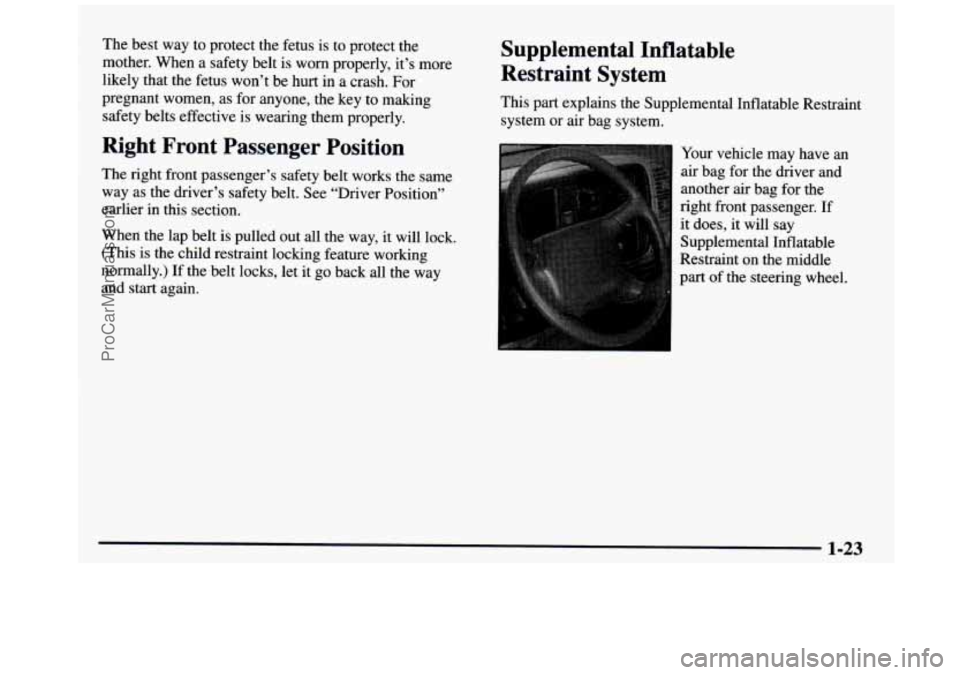
Your vehicle may have an
air bag for the driver and
another air bag for the
right front passenger. If
it does, it will say
Supplemental Inflatable
Restraint
on the middle
part of the steering wheel.
1-23
ProCarManuals.com
Page 44 of 436
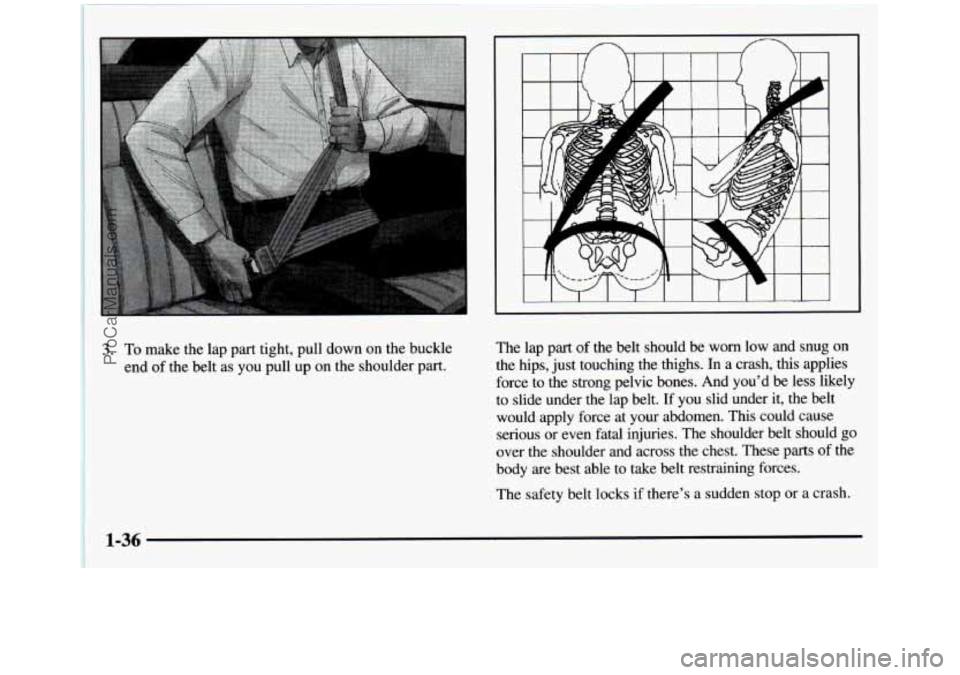
3. To make the lap part tight, pull down on the buckle
end of the belt as you pull up on the shoulder
part.
The lap part of the belt should be worn low and snug on
the hips, just touching the thighs. In a crash, this applies
force to the strong pelvic bones. And you'd be less likely
to slide under the lap belt. If you slid under it, the belt
would apply force at your abdomen. This could cause serious or even fatal injuries. The shoulder belt should go
over the shoulder and across the chest. These parts of the
body are best able to take belt restraining forces.
The safety belt locks
if there's a sudden stop or a crash.
1-36
ProCarManuals.com
Page 46 of 436
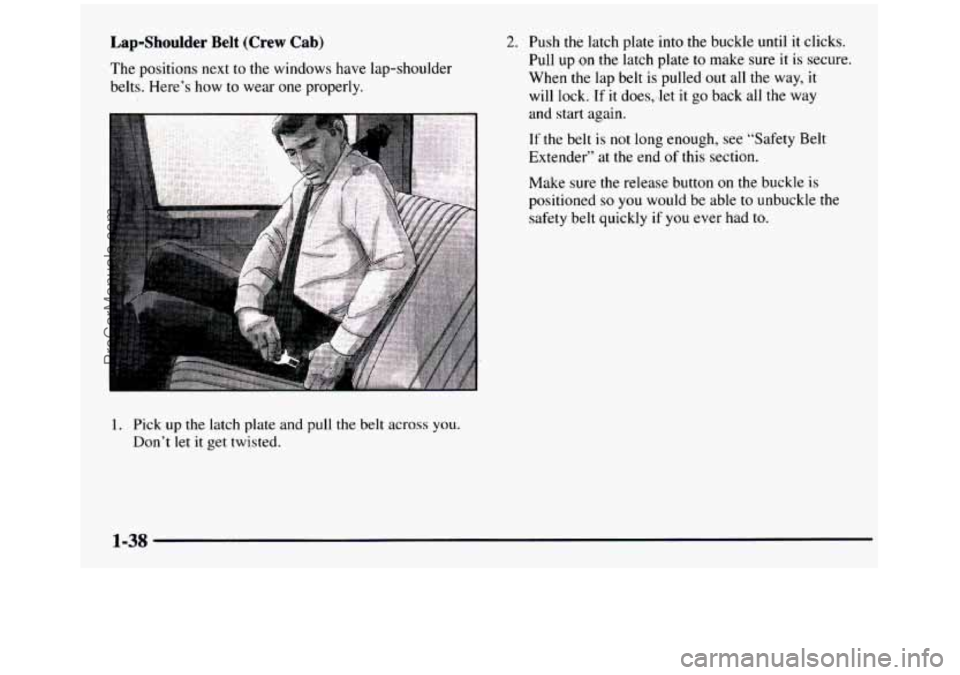
Lap-Shoulder Belt (Crew Cab)
The positions next to the windows have lap-shoulder
belts. Here’s how to wear one properly.
2. Push the latch plate into the buckle until it clicks.
Pull up on the latch plate to make sure it is secure.
When
the lap belt is pulled out all the way, it
will lock. If it does,,.let it go back all the way
and start again.
If the belt
is not long enough, see “Safety Belt
Extender” at
the end of this section.
Make sure the release button
on the buckle is
positioned
so you would be able to unbuckle the
safety belt quickly if
you ever had to.
1, Pick up the latch plate and pull the belt across you.
Don’t let it get twisted.
1-38
ProCarManuals.com
Page 47 of 436
The lap part of the belt should be worn low and snug on
the hips, just touching the thighs. In a crash, this applies force
to the strong pelvic bones. And you’d be less
likely
to slide under the lap belt. If you slid under it,
the belt would apply force at your abdomen. This
could cause serious or even fatal injuries. The shoulder
belt should
go over the shoulder and across the chest.
These parts of the body are best able
to take belt
restraining forces.
The safety belt locks
only if there’s a sudden stop or
a crash.
You can be seriously hurt if your shoulder belt is
too loose. In a crash, you would move forward
too much, which could increase injury. The shoulder belt should fit against your body.
=1
ProCarManuals.com
Page 59 of 436
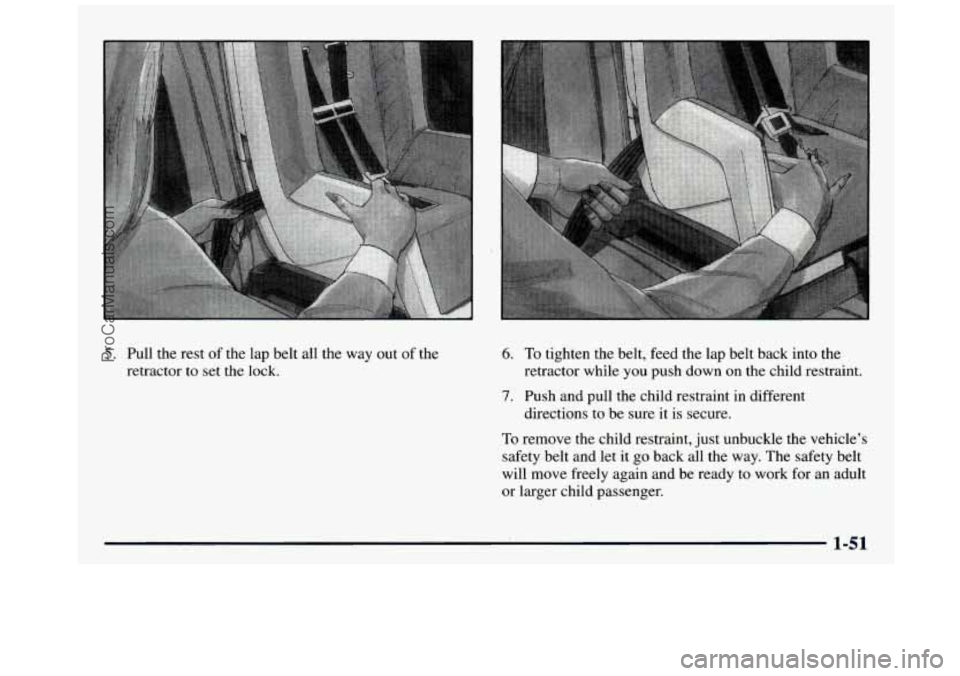
5. Pull the rest of the lap belt all the way out of the
retractor to set the lock. 6. To tighten the belt, feed the lap belt back into the
retractor while you push down on the child restraint.
7. Push and pull the child restraint in different
directions
to be sure it is secure.
To remove the child restraint, just unbuckle the vehicle’s
safety belt and let it go back all the way. The safety belt
will move freely again and be ready to work for an adult
or larger child passenger.
1-51
ProCarManuals.com
Page 64 of 436
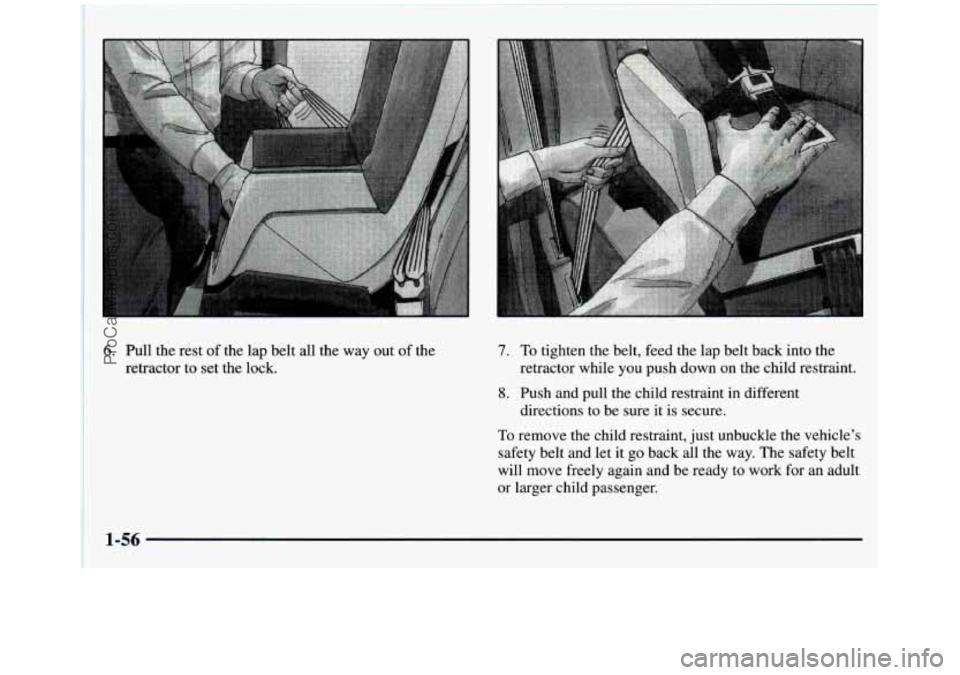
6. Pull the rest of the lap belt all the way out of the
retractor to set the lock. 7. To tighten the belt, feed the lap belt back into the
retractor while you push down on the child restraint.
8. Push and pull the child restraint in different
directions to be sure it is secure.
To remove the child restraint, just unbuckle the vehicle's
safety belt and let it go back all the way. The safety belt
will move freely again and be ready to work for an adult
or larger child passenger.
1-56
ProCarManuals.com
Page 68 of 436
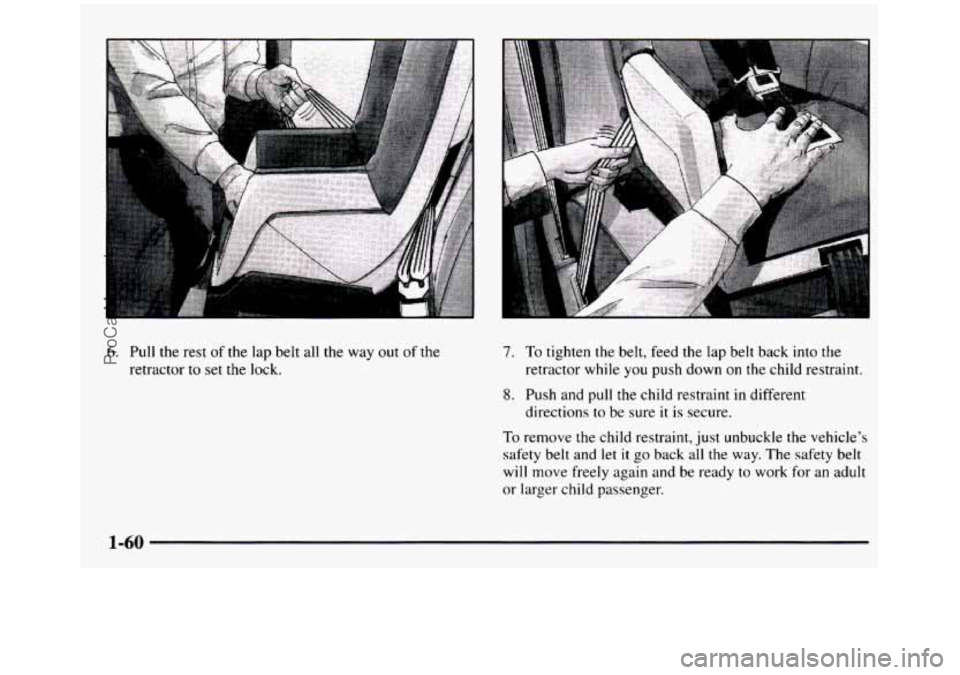
6. Pull the rest of the lap belt all the way out of the
retractor to set the lock.
7. To tighten the belt, feed the lap belt back into the
8. Push and pull the child restraint in different
retractor while
you push down
on the child restraint.
directions to be sure
it is secure.
To remove the child restraint, just unbuckle the vehicle’s
safety belt and let it go back all the way. The safety belt
will move freely again and be ready to work for an adult
or larger child passenger.
1-60
ProCarManuals.com