Page 7 of 436
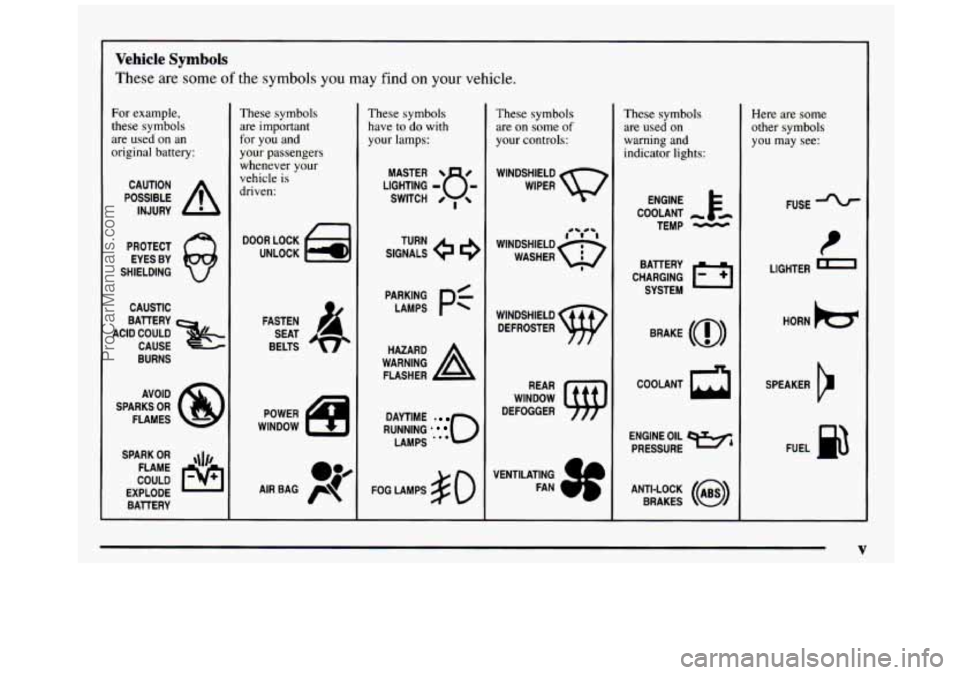
Vehicle Symbols
These are some of the symbols you may find on your vehicle.
For example,
these symbols
are used on an
original battery:
POSSIBLE A
CAUTION
INJURY
PROTECT EYES BY
SHIELDING
Q
CAUSTIC
ACID COULD BAllERY
CAUSE
BURNS
SPARK
OR qJ/,
COULD FLAME
EXPLODE BAllERY
These symbols
are important
for you and
your passengers
whenever your
vehicle is
driven:
DOOR LOCK
UNLOCK
FASTEN SEAT
BELTS
POWER
WINDOW
These symbols have to
do with
your lamps:
SIGNALS e
TURN
WARNING
A
HAZARD
FLASHER
RUNNING
* 0
DAYTIME -
LAMPS **'
FOG LAMPS $0
These symbols
are on
some of
your controls:
WINDSHIELD
WIPER
WINDSHIELD DEFROSTER
WINDOW
DEFOGGER
VENTILATING FAN
c
These symbols
are used on
warning and
indicator lights:
COOLANT -
TEMP -
CHARGING I-1
BAllERY
SYSTEM
BRAKE
(a)
COOLANT a
ENGINE OIL e,
PRESSURE
ANTI-LOCK
(@)
BRAKES
Here are some
other symbols you may see:
FUSE
LIGHTER
e
HORN )cr
SPEAKER
b
FUEL la
V
ProCarManuals.com
Page 10 of 436
Seats and Seat Controls
This section tells you about the seats -- how to adjust
them, and fold them
up and down. It also tells you about
reclining front seatbacks and head restraints.
Manual Front Seat
A CAUTION:
-
You can lose control of the vehicle if you try to
adjust a manual driver’s seat while the vehicle
is
moving. The sudden movement could startle and
confuse you, or make you
push a pedal when you
don’t want to. Adjust the driver’s seat only when
the vehicle is not moving.
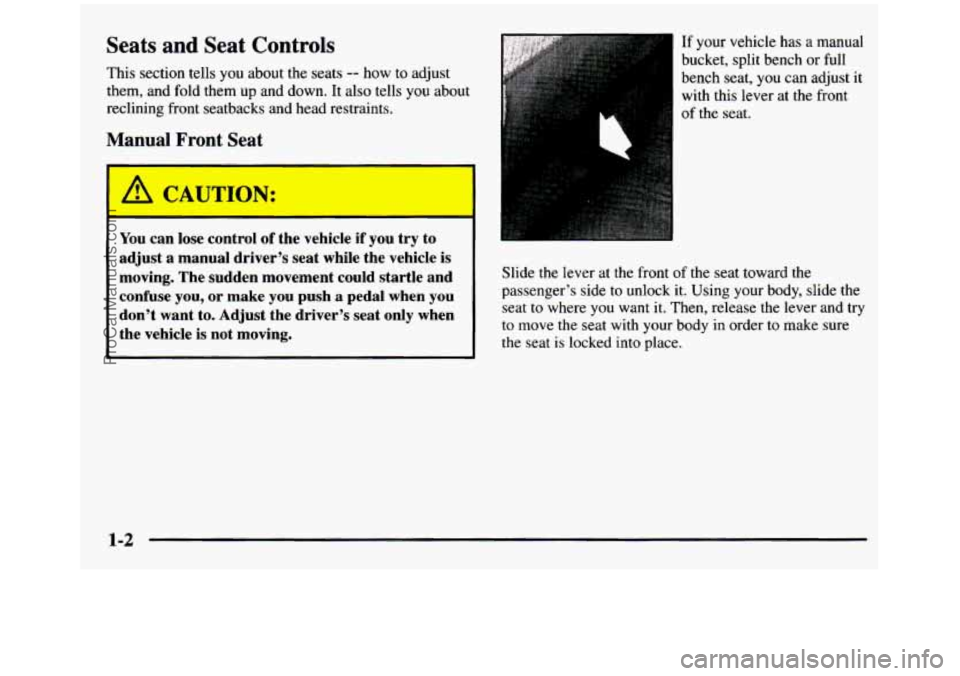
If your vehicle has a manual
bucket, split bench
or full
bench seat, you can adjust it
with this lever at the front
of the seat.
Slide the lever at the front
of the seat toward the
passenger’s side to unlock it. Using your body, slide the
seat to where
you want it. Then, release the lever and try
to move the seat with your body in order to make sure
the seat is locked into place.
1-2
ProCarManuals.com
Page 12 of 436
Power Lumbar Control
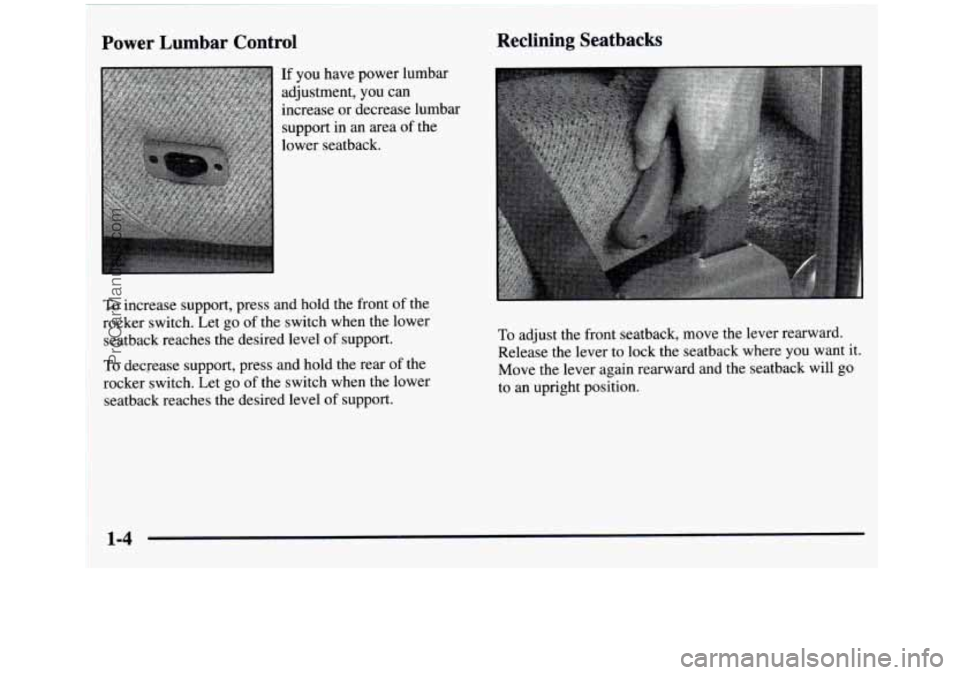
If you have power lumbar
adjustment, you can
increase or decrease lumbar support in an area of the
lower seatback.
Reclining Seatbacks
To increase support, press and hold the front of the
rocker switch. Let go
of the switch when the lower
seatback reaches the desired level
of support.
To decrease support, press and hold the rear of the
rocker switch. Let
go of the switch when the lower
seatback reaches the desired level of support.
To adjust the front seatback, move the lever rearward.
Release the lever to lock the seatback where you want it.
Move the lever again rearward and the seatback will
go
to an upright position.
1-4
ProCarManuals.com
Page 14 of 436
Head Restraints
Slide the head restraint up or down so that the top of the
restraint is closest
to the top of your ears. This position
reduces the chance of a neck injury in a crash.
Seatback Latches
The front seatback of the base level bench seat folds
forward to let you access the rear of the cab. Your
seatback will move back and forth freely, unless you
come to a sudden stop. Then it will lock into place. If
you have
a Crew Cab, your front seatback is designed
not to fold forward. Access to the rear of the cab is
available by using the rear doors.
The front seatback
of split bench seat and bucket seats
fold forward to let you access the rear of the cab.
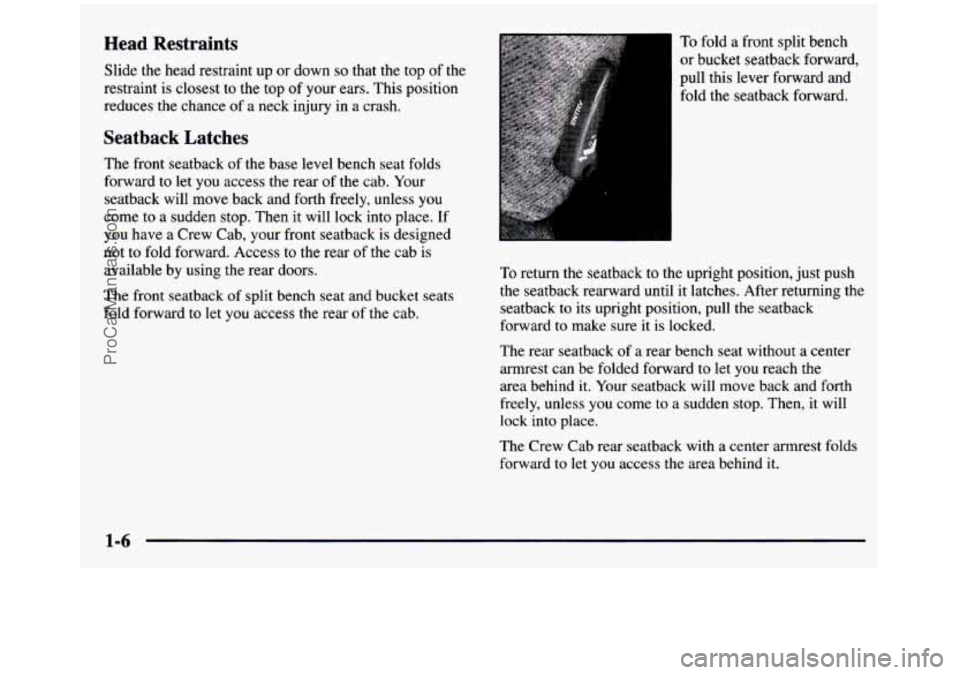
To fold a front split bench
or bucket seatback forward,
pull this lever forward and
fold the seatback forward.
To return the seatback to the upright position, just push
the seatback rearward until it latches. After returning the
seatback to its upright position, pull
the seatback
forward to make sure
it is locked.
The rear seatback of a rear bench seat without a center
armrest can be folded forward to let you reach the
area behind
it. Your seatback will move back and forth
freely, unless you come to
a sudden stop. Then, it will
lock into place.
The Crew Cab rear seatback
with a center armrest folds
forward to let you access
the area behind it.
1-6
ProCarManuals.com
Page 15 of 436
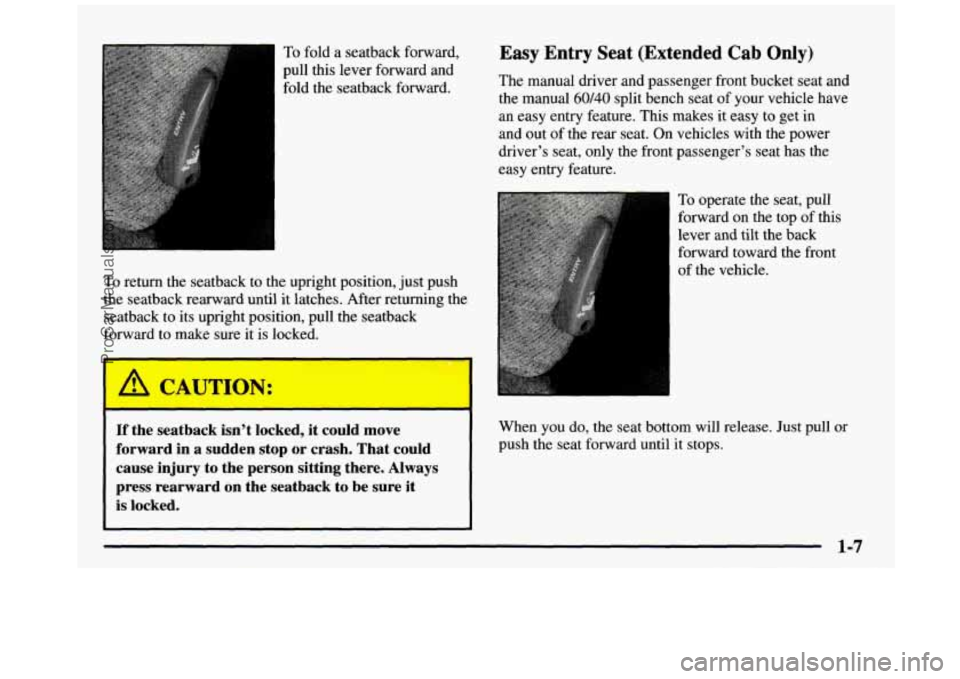
To fold a seatback forward,
pull this lever forward and
fold the seatback forward.
To return the seatback to the upright position, just push
the seatback rearward until it latches. After returning the
seatback to its upright position, pull the seatback
forward to make sure it is locked.
A CAUTION:
If the seatback isn’t locked, it could move
forward in a sudden stop or crash. That could
cause injury to the person sitting there. Always
press rearward
on the seatback to be sure it
is locked.
Easy Entry Seat (Extended Cab Only)
The manual driver and passenger front bucket seat and
the manual
60/40 split bench seat of your vehicle have
an easy entry feature. This makes it easy to get in
and out of the rear seat. On vehicles with
the power
driver’s seat, only the front passenger’s seat has the
easy entry feature.
I”
To operate the seat, pull
forward on the top
of this
lever and tilt the back
forward toward the front
of the vehicle.
When you do, the seat bottom will release. Just pull or
push the seat forward until it stops.
1-7
ProCarManuals.com
Page 16 of 436
To return the seat to its regular position, return the
seatback to its upright position, then push the whole seat
rearward until it latches.
After returning the seat to its regular position, try to
move the seat with your body
in order to make sure the
seat
is locked into place.
If any easy entry seat isn’t locked, it can move. In
a sudden stop or crash, the person sitting there
could be injured. And, even
if there is no crash or
sudden stop, a driver sitting in an unlocked
easy
entry seat could be startled by the sudden
movement and hit the wrong control or pedal,
causing an accident. After you’ve used it, be sure
to push rearward
on any easy entry seat to be
sure it is locked.
Rear Seat (Extended Cab)
Folding the Rear Seat
The extended cab may have a rear folding seat
which can be folded open for more seating space.
To use the seat:
1. Pull the entire seat forward until it is flat.
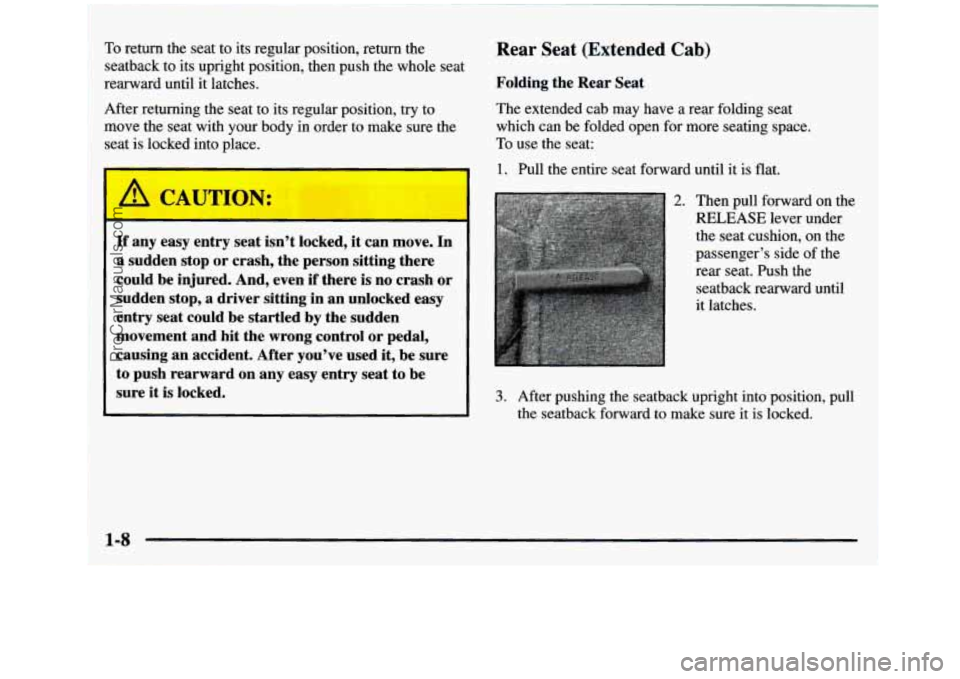
2. Then pull forward on the
RELEASE lever under
the seat cushion, on the
passenger’s side of the
rear seat. Push the
seatback rearward until
it latches.
3. After pushing the seatback upright into position, pull
the seatback forward to make sure it
is locked.
1-8
I
ProCarManuals.com
Page 17 of 436
The extended cab's rear seat can also be folded up to
provide more cargo space. To
fold the seat:
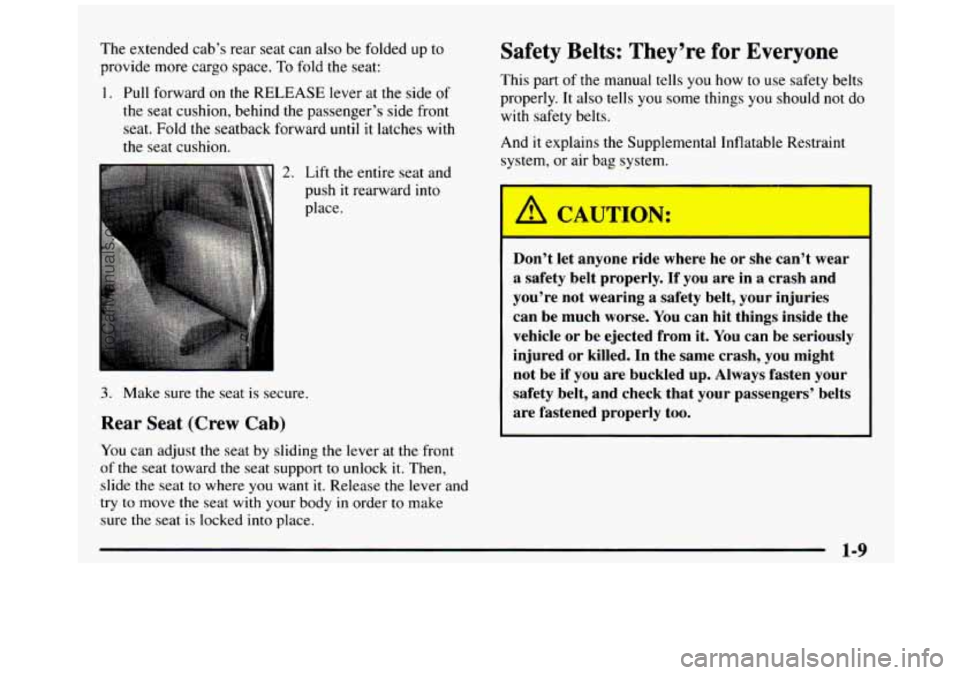
1. Pull forward on the RELEASE lever at the side of
the seat cushion, behind the passenger's side front
seat. Fold the seatback forward
until it latches with
the seat cushion.
2. Lift the entire seat and
push
it rearward into
place.
3. Make sure the seat is secure.
Rear Seat (Crew Cab)
You can adjust the seat by sliding the lever at the front
of the seat toward the seat support to unlock it. Then,
slide the seat to where you want
it. Release the lever and
try to move the seat with your body
in order to make
sure the seat
is locked into place.
Safety Belts: They're for Everyone
This part of the manual tells you how to use safety belts
properly. It also tells you some things you should not do
with safety belts.
And
it explains the Supplemental Inflatable Restraint
system, or air bag system.
A CAUTION:
- -
Don't let anyone ride where he or she can't wear
a safety belt properly. If you are in a crash and
you're not wearing
a safety belt, your injuries
can be much worse. You can hit things inside the
vehicle or be ejected from it.
You can be seriously
injured or killed. In the same crash, you might
not be
if you are buckled up. Always fasten your
safety belt, and check that your passengers' belts
are fastened properly too.
1-9
ProCarManuals.com
Page 23 of 436
How to Wear Safety Belts Properly
Adults
This part is only for people of adult size.
Be aware that there are special things to know about
safety belts and children. And there are different rules
for smaller children and babies.
If a child will be riding
in your vehicle, see the part of this manual called
“Children.” Follow those rules for everyone’s
protection.
First, you’ll want to know which restraint systems
your vehicle has.
We’ll start with the driver position.
Driver Position
This part describes the driver’s restraint system.
Lap-Shoulder Belt
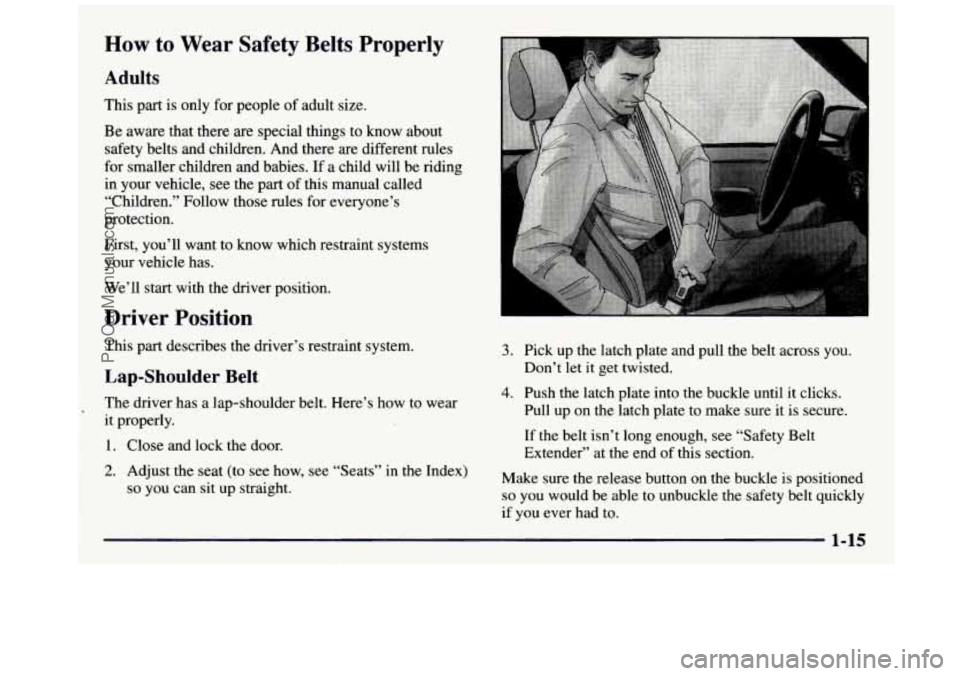
The driver has a lap-shoulder belt. Here’s how to wear
it properly.
1. Close and lock the door.
2. Adjust the seat (to see how, see “Seats” in the Index)
so you can sit up straight.
. ..
P‘
, :: hl
3. Pick up the latch plate and pull the belt across you.
Don’t let it get twisted.
4. Push the latch plate into the buckle until it clicks.
Pull up on the latch plate to make sure it is secure.
If the belt isn’t long enough, see “Safety Belt
Extender” at the end of this section.
Make sure the release button on the buckle is positioned
so you would be able to unbuckle the safety belt quickly
if you ever had to.
1-15
ProCarManuals.com