Page 45 of 167

Replacing the batteries
The transmitter is powered by two coin type
three-volt lithium batteries. A decrease in operating
range can be caused by:
²battery failure
²weather conditions
²structures around the vehicle
To replace the batteries:
1. Twist a thin coin between the two halves of the
transmitter. DO NOT TAKE THE FRONT PART OF
THE TRANSMITTER APART.
2. Place the positive (+) side of new batteries down.
3. Snap the two halves back together.
Replacing lost transmitters
Take all your vehicle's transmitters to your dealer for
programming if:
²a transmitter is lost or
²you want to purchase additional transmitters (up
to four)
ILLUMINATED ENTRY SYSTEM
The interior lamps
illuminate when:
²the remote entry
system is used to
unlock the door or
sound the personal
alarm.
The system
automatically turns off after 25 seconds or when the
ignition is turned to the START or ACC position.
The inside lights will not turn off if:
²they have been turned on with the dimmer
control or
LOCKUN
LOCK
PANIC
Seating and safety restraints
46
ProCarManuals.com
Page 61 of 167

extended. Do not use extensions to change the fit of
the shoulder belt across the torso.
Safety belt warning light and indicator chime
The seat belt warning light illuminates in the
instrument cluster and a chime sounds to remind
the occupants to fasten their safety belts.
Conditions of operation
If... Then...
The driver's safety
belt is not buckled
before the ignition
key is turned to ON...The safety belt indicator
illuminates for one to two
minutes and the warning
chime sounds for four to
eight seconds.
The driver's side
safety belt is buckled
while the indicator
light is illuminated
and the warning
chime is sounding...The safety belt indicator
light and warning chime
turn off.
The driver's safety
belt is buckled before
the ignition key is
turned to ON...The safety belt warning
light and indicator chime
remain off.
Safety belt maintenance
Check the safety belt systems periodically to make
sure they work properly and are not damaged.
Check the safety belts to make sure there are no
nicks, wears or cuts. All safety belt assemblies,
including retractors, buckles, front seat belt buckle
assemblies (slide bar)(if equipped), shoulder belt
height adjusters (if equipped), child safety seat
tether bracket assemblies (if equipped), and
attaching hardware, should be inspected after a
collision. Ford recommends that all safety belt
assemblies used in vehicles involved in a collision be
Seating and safety restraints
62
ProCarManuals.com
Page 64 of 167

wrong with the system. Rather, it means the forces
were not of the type sufficient to cause activation.
The air bags inflate and
deflate rapidly upon
activation.
After air bag
deployment, it is
normal to notice a
smoke-like, powdery
residue or smell the
burnt propellant. This
may consist of
cornstarch, talcum
powder (to lubricate
the bag) or sodium compounds (e.g., baking soda)
that result from the combustion process that inflates
the air bag. Small amounts of sodium hydroxide may
be present which may irritate the skin and eyes, but
none of the residue is toxic.
Several air bag system components get hot
after inflation. Do not touch them after
inflation.
If the air bag is inflated,the air bag will
not function again and must be replaced
immediately. If the air bag is not replaced, the
unrepaired area will increase the risk of injury in a
collision.
The SRS consists of:
²driver and passenger air bag modules (which
include the inflators and air bags),
²one or more impact and safing sensors,
²a readiness light and tone
Seating and safety restraints
65
ProCarManuals.com
Page 65 of 167

²and the electrical wiring which connects the
components.
The diagnostic module monitors its own internal
circuits and the supplemental air bag electrical
system readiness (including the impact sensors), the
system wiring, the air bag system readiness light, the
air bag back up power and the air bag ignitors.
DETERMINING IF THE SYSTEM IS
OPERATIONAL
The SRS uses a readiness light in the instrument
cluster or a tone to indicate the condition of the
system. Refer to theAir bag readinesssection in
theInstrumentationchapter. Routine maintenance
of the air bag is not required.
A difficulty with the system is indicated by one or
more of the following:
²The readiness light
will either flash or
stay lit.
²The readiness light
will not illuminate immediately after ignition is
turned on.
²A group of five beeps will be heard. The tone
pattern will repeat periodically until the problem
and light are repaired.
If any of these things happen, even intermittently,
have the SRS serviced at your dealership or by a
qualified technician immediately. Unless serviced,
the system may not function properly in the event of
a collision.
DISPOSAL OF AIR BAGS AND AIR BAG
EQUIPPED VEHICLES
For disposal of air bags or air bag equipped vehicles,
see your local dealership or qualified technician. Air
bags MUST BE disposed of by qualified personnel.
Seating and safety restraints
66
ProCarManuals.com
Page 78 of 167

Make sure the corresponding lights illuminate
briefly. If a light fails to illuminate, have the vehicle
serviced.
²If the driver's safety belt is fastened, the
light
does not illuminate.
Important safety precautions
A computer system controls the engine's idle
revolutions per minute (RPM). When the engine
starts, the idle RPM runs faster to warm the engine.
CRUISE
RPMx1000
0 1234
5
6
7EFC H
FUEL DOOR>
SERVICE
ENGINE
SOON1020304050 60
70
80
90
100
110
00 20406080100
120
140
160
180P R N D D 1MPH km/h
00
122
00013
P!
BRAKEABS
+ –
UNLEADED FUEL ONLY
THEFT LOW
COOLANTO/D
OFFREAR
LAMP
OUT
EFC H
FUEL DOOR>
SERVICE
ENGINE
SOONTHEFT102030405060
70
80
90
100
1202060100
140
180
P R N D 2 1MPH km/h
00
000
00000
P!
BRAKELOW
COOLANT
+ –
110CRUISE
RPMx1000
ABSO/D
OFFREAR
LAMP
OUTPREMIUM UNLEADED
FUEL RECOMMENDED0 1234
5
6
78
RPMx1000
0 1234
5
6
7EFC H
FUEL DOOR>
SERVICE
ENGINE
SOON1020304050607080
90
100
110
00 204080
60100120
140
160
180
220
240P R N 2 1
DMPH
km/h
00
000
00000
P!
BRAKEABSO/D
OFF
+ –
8
120
130
140
150
CRUISELOW
COOLANTTHEFT
200PREMIUM UNLEADED
FUEL RECOMMENDED
Starting
79
ProCarManuals.com
Page 86 of 167
Do not drive your vehicle until you verify
that the brakelamps are working.
If your vehicle gets stuck in mud or snow it may be
rocked out by shifting from forward and reverse
gears in a steady pattern. Press lightly on the
accelerator in each gear. Do not rock the vehicle for
more than a few minutes, because it could damage
the vehicle.
Always set the parking brake fully and make
sure the gearshift is latched in P (Park).
Turn off the ignition whenever you leave your
vehicle.
Driving with an automatic overdrive transaxle
(column gearshift without O/D off switch)
Your automatic overdrive transaxle provides fully
automatic operation in either
(Overdrive) or D
(Drive). Driving with the shift selector in
gives
the best fuel economy for normal driving conditions.
For manual control start in 1 (First) and then shift
manually.
To put your vehicle in gear, start the engine, depress
the brake pedal, then move gearshift out of P
(Park).
Hold the brake pedal down while you move
the gearshift lever from position to position.
If you do not hold the brake pedal down, your
vehicle may move unexpectedly and injure
someone.
Driving
87
ProCarManuals.com
Page 90 of 167
If the O/D OFF indicator light (if equipped) is
flashing on and off when the vehicle is started or
does not come on when the O/D OFF switch is
pressed, it means there is a malfunction in your
transaxle's electronic system. Contact your dealer as
soon as possible or damage to the transaxle may
occur.
When to use D (Drive) or press the O/D OFF
switch (if equipped)
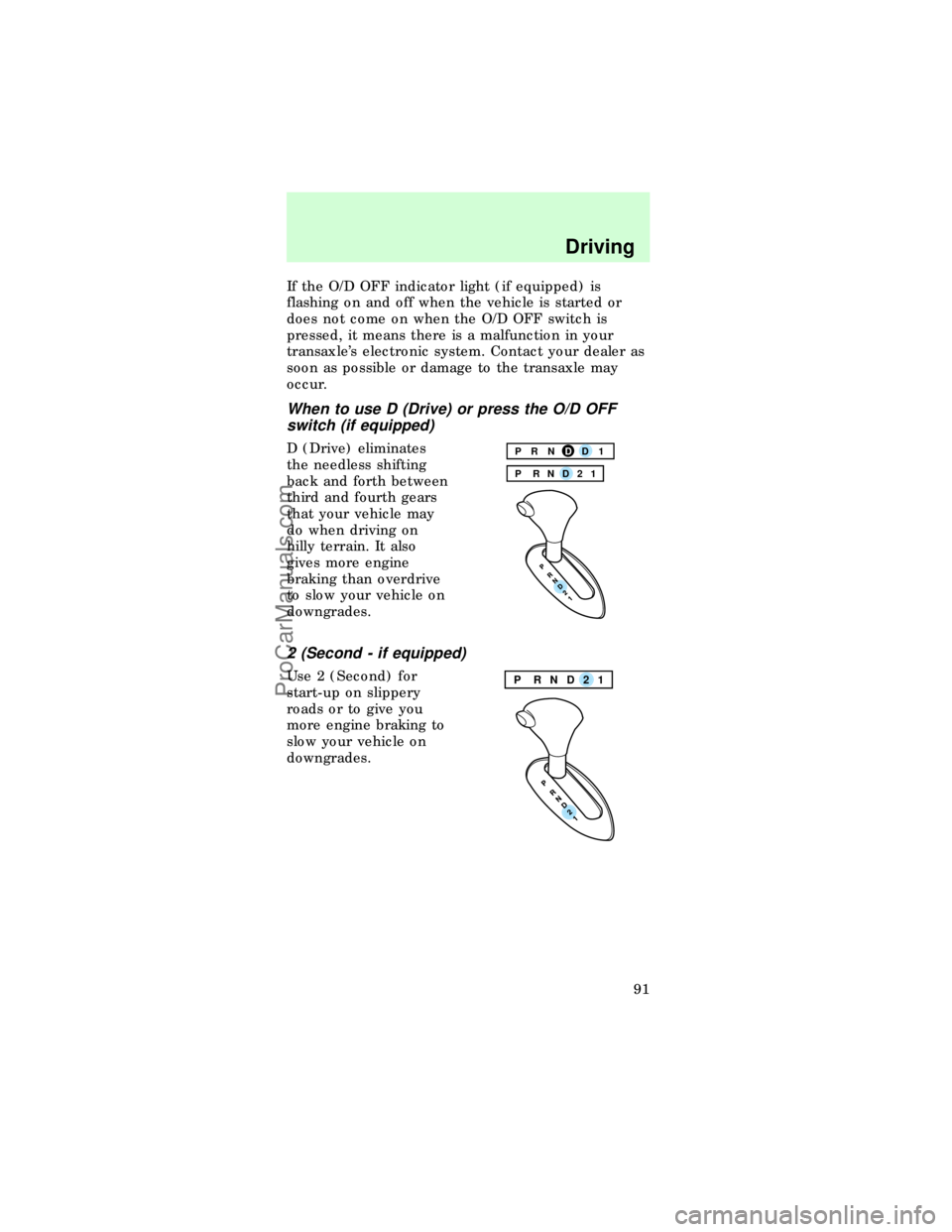
D (Drive) eliminates
the needless shifting
back and forth between
third and fourth gears
that your vehicle may
do when driving on
hilly terrain. It also
gives more engine
braking than overdrive
to slow your vehicle on
downgrades.
2 (Second - if equipped)
Use 2 (Second) for
start-up on slippery
roads or to give you
more engine braking to
slow your vehicle on
downgrades.
PRNDD1
P RND21
P RND21
Driving
91
ProCarManuals.com
Page 93 of 167
Do not exceed the GVWR or the GAWR
specified on the Safety Compliance
Certification Label.
Do not use replacement tires with lower weight
capacities than the originals because they may lower
the vehicle's GVWR and GAWR limitations.
Replacement tires with a higher weight limit than
the originals do not increase the GVWR and GAWR
limitations.
TRAILER TOWING
Your vehicle is classified as a light duty towing the
vehicle. The amount of weight you can safely tow
depends on the type of engine you have in your
vehicle. Your vehicle does not come from the factory
fully equipped to tow. No towing packages are
available through Ford or Mercury/Lincoln dealers.
Do not tow a trailer until your vehicle has been
driven at least 800 km (500 miles). If towing with a
station wagon, inflate the rear tires to 35 psi.
Towing a trailer places an additional load on your
vehicle's engine, transaxle, brakes, tires and
suspension. Inspect these components carefully after
towing.
The amount of weight that you can tyow depends on
the type of engine in your vehicle. See the following
charts:
3.0L 2-Valve Vulcan Engine
Model Passenger
Load #/kg
(lbs.)Luggage
Load kg
(lbs.)Max Trailer
Wt. kg
(lbs.)
Sedan 5/340 (750) 0 365 (800)
4/270 (600) 70 (150) 365 (800)
2/135 (300) 70 (150) 500 (1100)
2/135 (300) 0 565 (1250)
Driving
94
ProCarManuals.com