Page 142 of 167
The Scheduled Maintenance Services listed in the
Service Guideare required because they are
considered essential to the life and performance of
your vehicle and to its emissions system.
Ford strongly recommends the use of genuine Ford
replacement parts. If other than Ford or Motorcraft
parts or Ford authorized parts are used for
maintenance replacements or for the service of
components affecting emission control, such
non-Ford parts should be equivalent to genuine Ford
Motor Company parts in performance and durability.
It is the owner's responsibility to determine the
equivalency of such parts. Please consult your
Warranty Information Booklet for complete warranty
information.
Do not park, idle, or drive your vehicle in
dry grass or other dry ground cover. The
emission system heats up the engine compartment
and exhaust system, which can start a fire.
Watch for fluid leaks, strange odors, smoke, loss of
oil pressure, the charging system warning light, the
service engine soon light or the temperature warning
light. These sometimes indicate that the emissions
system is not working properly.
Do not make any unauthorized changes to your
vehicle or engine. Changes that cause more
unburned fuel to reach the exhaust system can
increase the temperature of the engine or exhaust
system.
By law, anyone who manufactures, repairs, services,
sells, leases, trades vehicles, or supervises a fleet of
vehicles is not permitted to intentionally remove an
emission control device or prevent it from working.
In some of the United States and Canada, vehicle
owners may be liable if their emission control device
is removed or prevented from working.
Maintenance and care
143
ProCarManuals.com
Page 143 of 167

Never use a metal exhaust collector when you
service your vehicle. If the metal collector contacts
any of your vehicle's plastic trim or bumper parts
they could melt or deform.
Do not drive your vehicle if it does not operate
properly. See your dealer if the engine runs on for
more than five seconds after you shut it off or if it
misfires, surged, stalls or backfires.
Information about your vehicle's emission system is
on the Vehicle Emission Control Information decal
located on or near the engine. This decal identifies
engine displacement and gives some tune up
specifications.
Readiness for inspection/maintenance testing
In some localities, it may become a legal
requirement to pass an Inspection/Maintenance (I/M)
test of the On-board Diagnostic (OBD) II system. If
the vehicle's powertrain system or its battery has
just been serviced, the OBD II system is reset to a
not ready for I/M testing condition. To prepare for
I/M testing, the law specifies that additional mixed
city and highway driving is required to complete the
check of the OBD II system.
The driving modes required to reach the ready
condition consist of a minimum of 30 minutes of city
and highway driving as described below:
²At least twenty minutes driving in stop and go,
city type traffic with at least four idle periods.
²At least ten minutes of driving on an expressway
or highway.
Before completing the above driving modes, the
engine must be warmed up and at operating
temperature. Once started, the vehicle must not be
turned off during these driving modes.
EXTERIOR LAMPS
It is a good idea to check the operation of the
following lights frequently:
Maintenance and care
144
ProCarManuals.com
Page 146 of 167
Function Trade Number
Dome lamp/moon roof 208
Visor vanity lamp
(passenger/driver)74-194
Door courtesy lamp 168
Floor console 194
Luggage compartment lamp 906
Glove compartment 194
Instrument courtesy lamps 168
I/P ashtray lamp 194
Radio illuminationGo to Ford
authorized radio
service center
ClockGo to Ford
authorized
dealer
Warning indicator lights (except
THEFT)Go to Ford
authorized
dealer
THEFT warningGo to Ford
authorized
dealer
Cluster illuminationGo to Ford
authorized
dealer
Heater-A/CGo to Ford
authorized
dealer
Automatic climate controlGo to Ford
authorized
dealer
Rear window defrost switchGo to Ford
authorized
dealer
Maintenance and care
147
ProCarManuals.com
Page 150 of 167
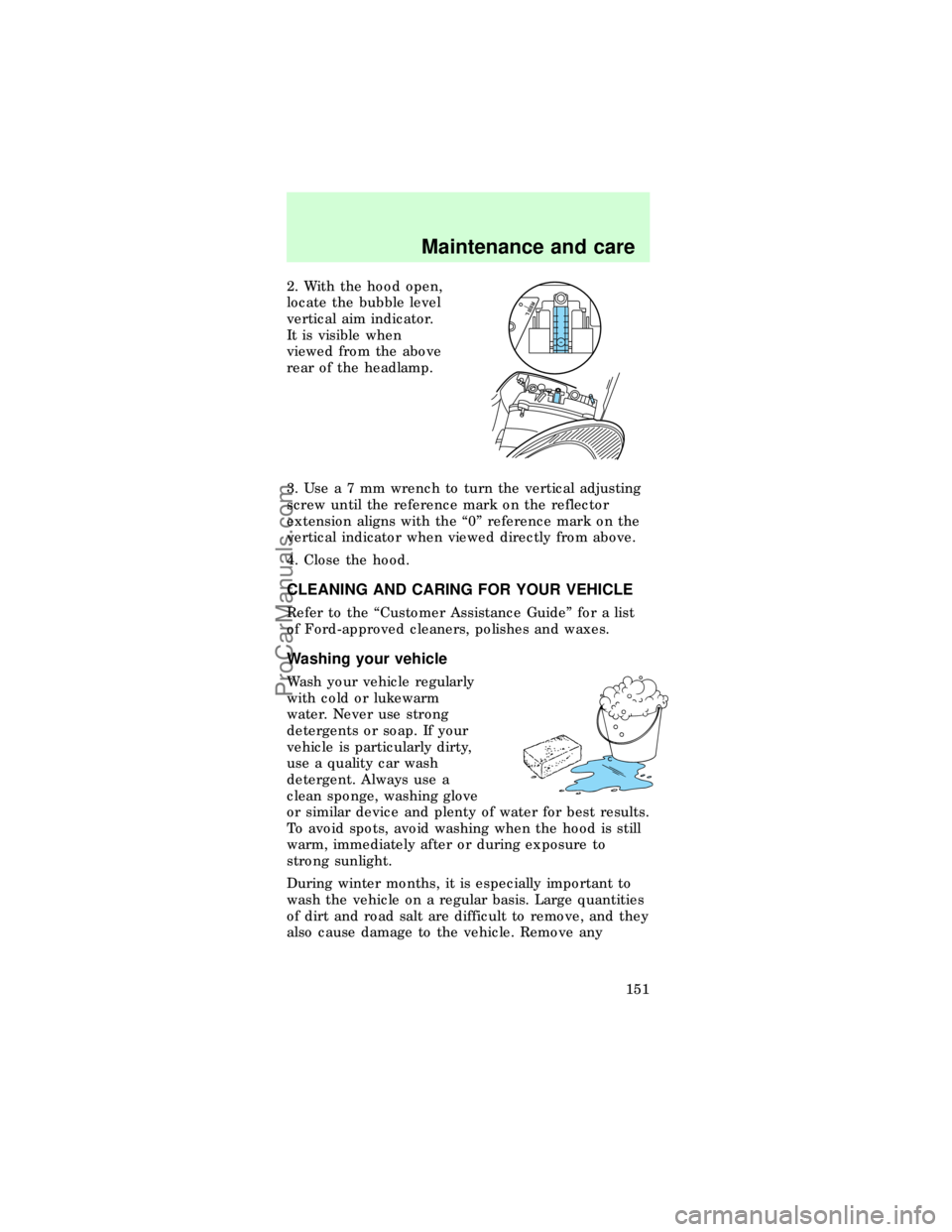
2. With the hood open,
locate the bubble level
vertical aim indicator.
It is visible when
viewed from the above
rear of the headlamp.
3.Usea7mmwrench to turn the vertical adjusting
screw until the reference mark on the reflector
extension aligns with the ª0º reference mark on the
vertical indicator when viewed directly from above.
4. Close the hood.
CLEANING AND CARING FOR YOUR VEHICLE
Refer to the ªCustomer Assistance Guideº for a list
of Ford-approved cleaners, polishes and waxes.
Washing your vehicle
Wash your vehicle regularly
with cold or lukewarm
water. Never use strong
detergents or soap. If your
vehicle is particularly dirty,
use a quality car wash
detergent. Always use a
clean sponge, washing glove
or similar device and plenty of water for best results.
To avoid spots, avoid washing when the hood is still
warm, immediately after or during exposure to
strong sunlight.
During winter months, it is especially important to
wash the vehicle on a regular basis. Large quantities
of dirt and road salt are difficult to remove, and they
also cause damage to the vehicle. Remove anyR L
O
Maintenance and care
151
ProCarManuals.com
Page 152 of 167
²Take care when using a power washer to clean
the engine. The high pressure fluid could
penetrate the sealed parts and cause damage.
²Do not spray with cold water to avoid cracking
the engine block.
²Cover the
highlighted areas to
prevent water
damage when
cleaning the engine.
²Never wash or rinse the engine while it is
running; water in the running engine may cause
internal damage.
Cleaning plastic exterior parts
Use a vinyl cleaner for routine cleaning of plastic.
Clean with a tar remover if necessary. Do not clean
plastic parts with thinners, solvents or
petroleum-based cleaners.
Cleaning the exterior lamps
Wash the exterior
lamps with the same
detergent you used to
wash the exterior of
your vehicle. Use glass
cleaner or tar remover
if necessary.
To avoid scratching the
lamps, do not use a dry paper towel, chemical
solvents or abrasive cleaners to clean the lamps.
Maintenance and care
153
ProCarManuals.com