Page 96 of 167
Driving while you tow
Do not drive faster than 72 km/h (45 mph) with any
weight on the trailer while towing on a hot day or in
hilly country.
Cruise control may shut off if you are towing on
long, steep grades.
When towing a trailer:
²Use 2 (Second) (if equipped) or 1 (First) when
towing up or down steep hills. This will eliminate
excessive downshifting and upshifting for
optimum fuel economy and transaxle cooling.
²Anticipate stops and brake gradually.
Servicing after towing
If you tow a trailer for long distances, your vehicle
will require more frequent service intervals. Refer to
theService Guidefor more information.
Trailer towing tips
²Practice turning, stopping and backing up in an
area before starting on a trip to get the feel of the
vehicle trailer combination. When turning, drive
slightly beyond the normal turning point so the
trailer wheels will clear curbs and other obstacles.
²Allow more room for stopping with a trailer
attached.
²The trailer tongue weight should be 10±15% of
the loaded trailer weight.
²After you have traveled 80 km (50 miles),
thoroughly check your hitch, electrical
connections and trailer wheel lug nuts.
²When stopped in traffic for long periods of time in
hot weather, place the gearshift in P (Park) and
increase idle speed. This aids engine cooling and
air conditioner efficiency.
²Vehicles with trailers should not be parked on a
grade. If you must park on a grade, place wheel
chocks under the trailer's wheels.
Driving
97
ProCarManuals.com
Page 98 of 167
HAZARD LIGHTS CONTROL
Use only in an
emergency to warn
traffic of vehicle
breakdown,
approaching danger,
etc. Depress to activate
all indicators
simultaneously.
Depress again to switch
off. The warning lights
can be operated when
the ignition is off.
FUEL PUMP SHUT-OFF SWITCH
If the engine cranks but does not start after a
collision, the fuel pump shut-off switch may have
been activated. The shut-off switch is a device
intended to stop the electric fuel pump when your
vehicle has been involved in a substantial jolt.
1. Turn the ignition switch to the OFF position.
2. Check the fuel system for leaks.
3. If no fuel leak is apparent, reset the fuel pump
shut-off switch by pushing in the button on the
switch.
4. Turn the ignition switch to the ON position. Pause
for a few seconds and return the key to the OFF
position.
5. Make a further check for leaks in the fuel system.
Roadside emergencies
99
ProCarManuals.com
Page 100 of 167
Standard fuse amperage rating and color
Fuse rating Color
10 amp Red
15 amp Blue
20 amp Yellow
30 amp Light Green
30 amp fuse link Pink
40 amp Amber
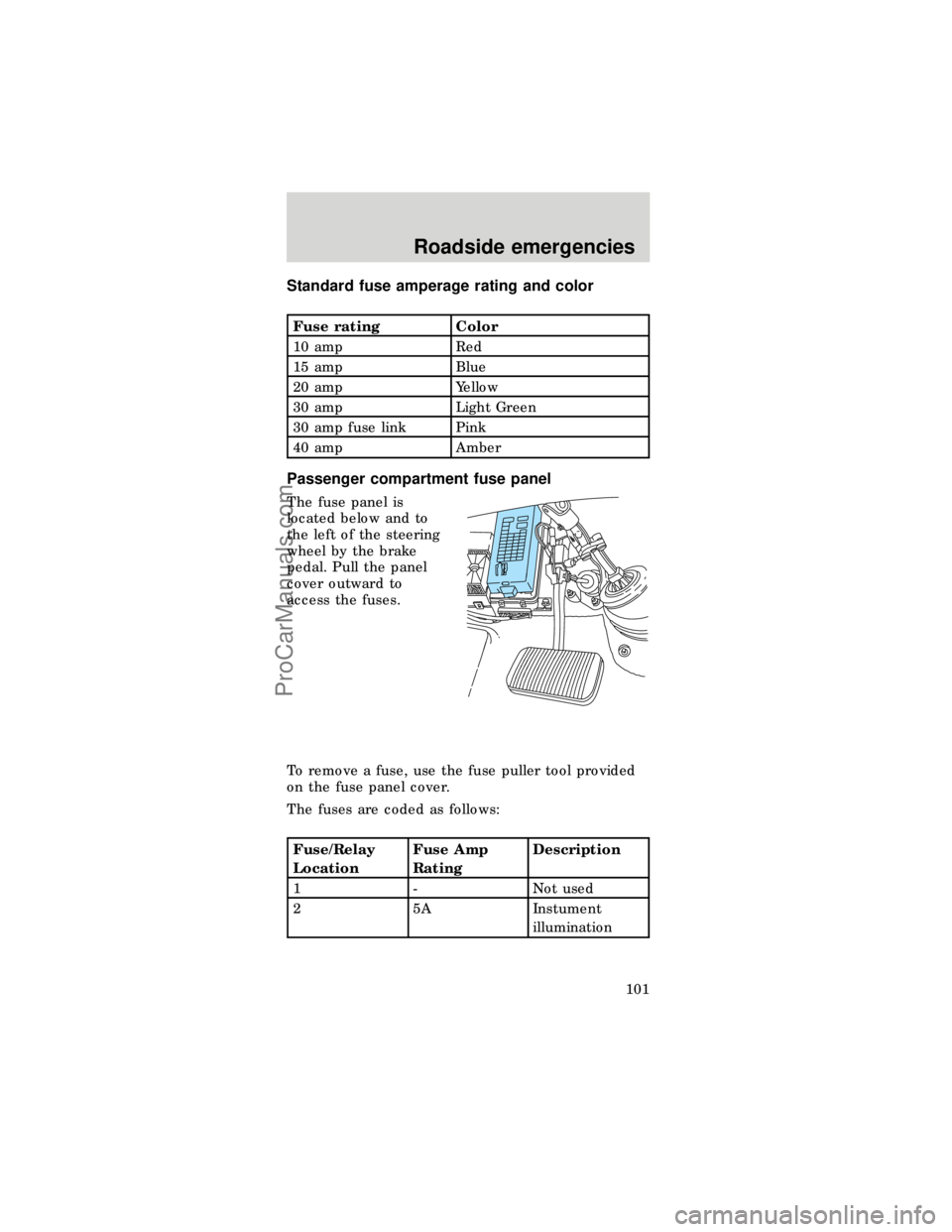
Passenger compartment fuse panel
The fuse panel is
located below and to
the left of the steering
wheel by the brake
pedal. Pull the panel
cover outward to
access the fuses.
To remove a fuse, use the fuse puller tool provided
on the fuse panel cover.
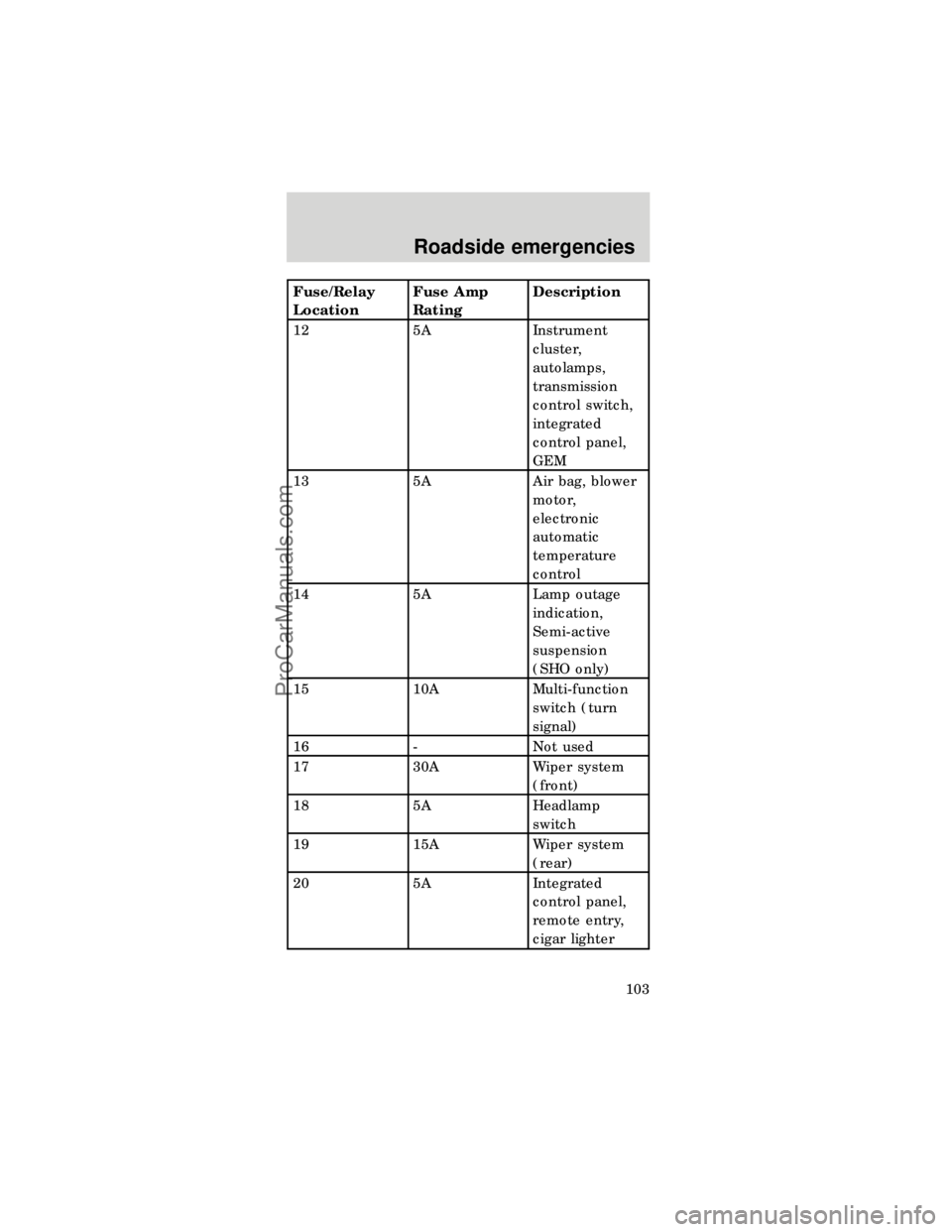
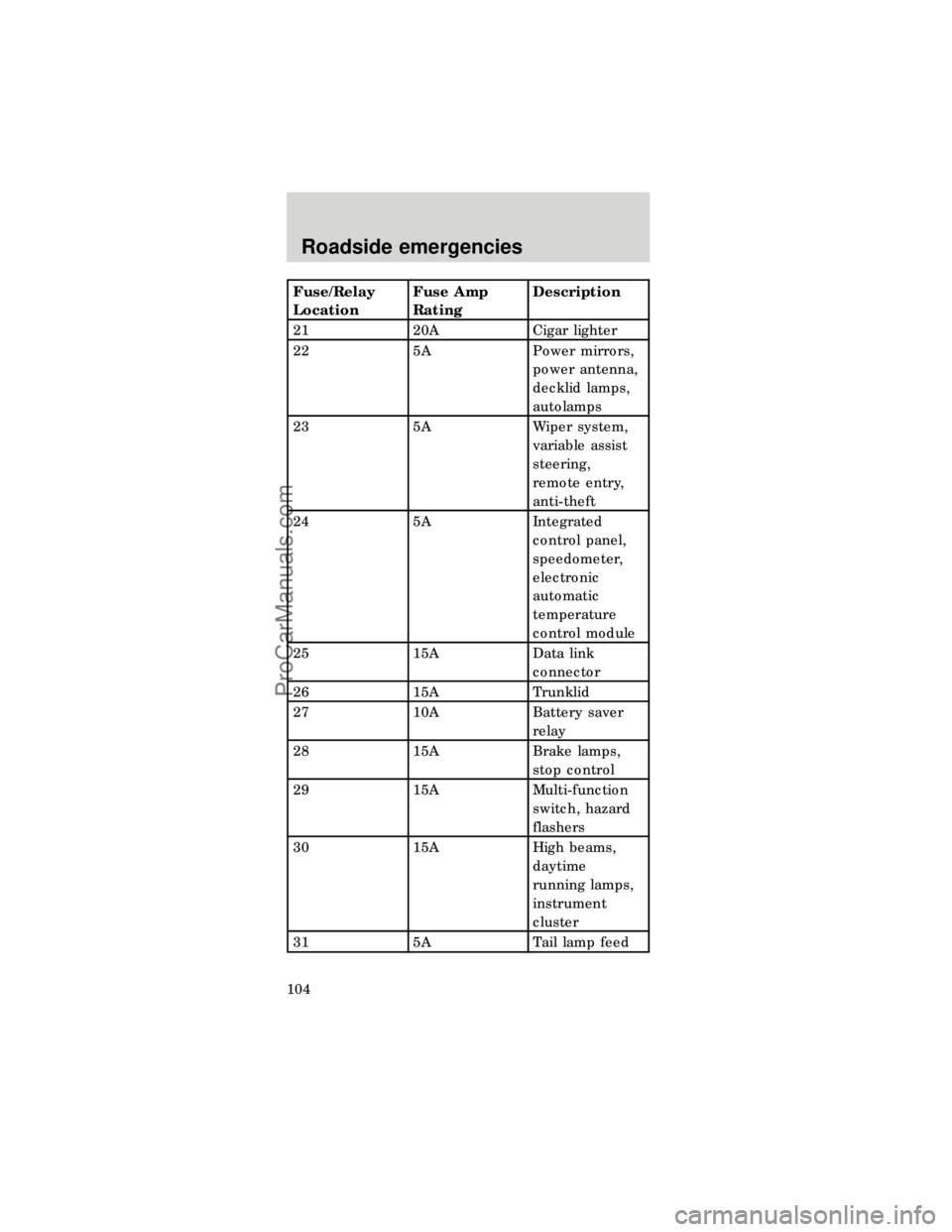
The fuses are coded as follows:
Fuse/Relay
LocationFuse Amp
RatingDescription
1 - Not used
2 5A Instument
illumination
Roadside emergencies
101
ProCarManuals.com
Page 102 of 167
Fuse/Relay
LocationFuse Amp
RatingDescription
12 5A Instrument
cluster,
autolamps,
transmission
control switch,
integrated
control panel,
GEM
13 5A Air bag, blower
motor,
electronic
automatic
temperature
control
14 5A Lamp outage
indication,
Semi-active
suspension
(SHO only)
15 10A Multi-function
switch (turn
signal)
16 - Not used
17 30A Wiper system
(front)
18 5A Headlamp
switch
19 15A Wiper system
(rear)
20 5A Integrated
control panel,
remote entry,
cigar lighter
Roadside emergencies
103
ProCarManuals.com
Page 103 of 167
Fuse/Relay
LocationFuse Amp
RatingDescription
21 20A Cigar lighter
22 5A Power mirrors,
power antenna,
decklid lamps,
autolamps
23 5A Wiper system,
variable assist
steering,
remote entry,
anti-theft
24 5A Integrated
control panel,
speedometer,
electronic
automatic
temperature
control module
25 15A Data link
connector
26 15A Trunklid
27 10A Battery saver
relay
28 15A Brake lamps,
stop control
29 15A Multi-function
switch, hazard
flashers
30 15A High beams,
daytime
running lamps,
instrument
cluster
31 5A Tail lamp feed
Roadside emergencies
104
ProCarManuals.com
Page 117 of 167
SERVICE RECOMMENDATIONS
To help you service your vehicle:
²We highlight do-it-yourself items in the engine
compartment for easy location.
²As possible, we design parts that can be replaced
without tools.
²We provide you with a ªService Guideº which
makes tracking routine service for your vehicle
easy.
If your vehicle requires professional service, your
dealership can provide necessary parts and service.
Check your ªWarranty Information Bookletº to find
out which parts and services are covered.
Use only recommended fuels, lubricants, fluids and
service parts conforming to specifications. Motorcraft
parts are designed and built to provide the best
performance in your vehicle.
Precautions when servicing your vehicle
Be especially careful when inspecting or servicing
your vehicle. Here are some general precautions for
your safety:
²Do not work on a hot engine.
The cooling fan is automatic and may come
on at any time. Always disconnect the
negative terminal of the battery before working
near the fan.
²If you must work with the engine running, avoid
wearing loose clothing or jewelry that could get
caught in moving parts. Take precautions with
long hair.
²Do not work on a vehicle with the engine running
in an enclosed space, unless you are sure you
have enough ventilation.
Maintenance and care
118
ProCarManuals.com
Page 125 of 167
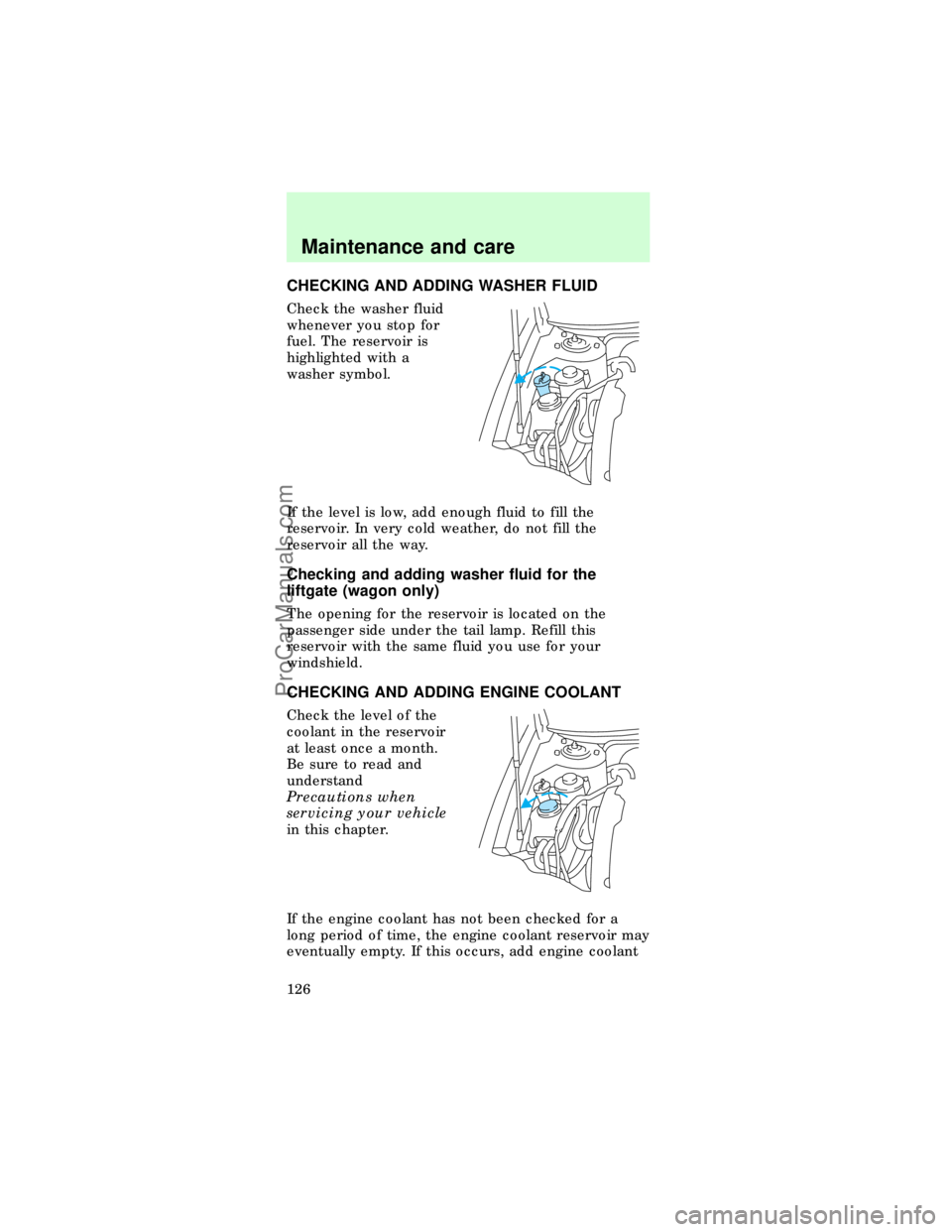
CHECKING AND ADDING WASHER FLUID
Check the washer fluid
whenever you stop for
fuel. The reservoir is
highlighted with a
washer symbol.
If the level is low, add enough fluid to fill the
reservoir. In very cold weather, do not fill the
reservoir all the way.
Checking and adding washer fluid for the
liftgate (wagon only)
The opening for the reservoir is located on the
passenger side under the tail lamp. Refill this
reservoir with the same fluid you use for your
windshield.
CHECKING AND ADDING ENGINE COOLANT
Check the level of the
coolant in the reservoir
at least once a month.
Be sure to read and
understand
Precautions when
servicing your vehicle
in this chapter.
If the engine coolant has not been checked for a
long period of time, the engine coolant reservoir may
eventually empty. If this occurs, add engine coolant
Maintenance and care
126
ProCarManuals.com
Page 139 of 167
²Be particularly careful if you are taking
ªAntabuseº or other forms of disulfiram for the
treatment of alcoholism. Breathing gasoline vapors
or skin contact could cause an adverse reaction.
Consult a physician immediately.
Choosing the right fuel
Use only UNLEADED FUEL. The use of leaded fuel
is prohibited by law and could damage your vehicle.
The damage may not be covered by your warranty.
Your vehicle was not designed to use fuel containing
manganese-based additives such as MMT.
Additionally, vehicles certified to California emission
standards (indicated on the underhood Vehicle
Emissions Control Information label) are designed to
operate on California reformulated gasolines. If
California reformulated gasoline is not available
when you refuel, your vehicle can be operated on
non-California fuels. However, even though your
engine will perform adequately on other gasolines,
the performance of the emission control devices and
systems may be adversely affected. Repair of
damage caused by using a fuel that your vehicle was
not designed for may not be covered by your
warranty.
Octane recommendations
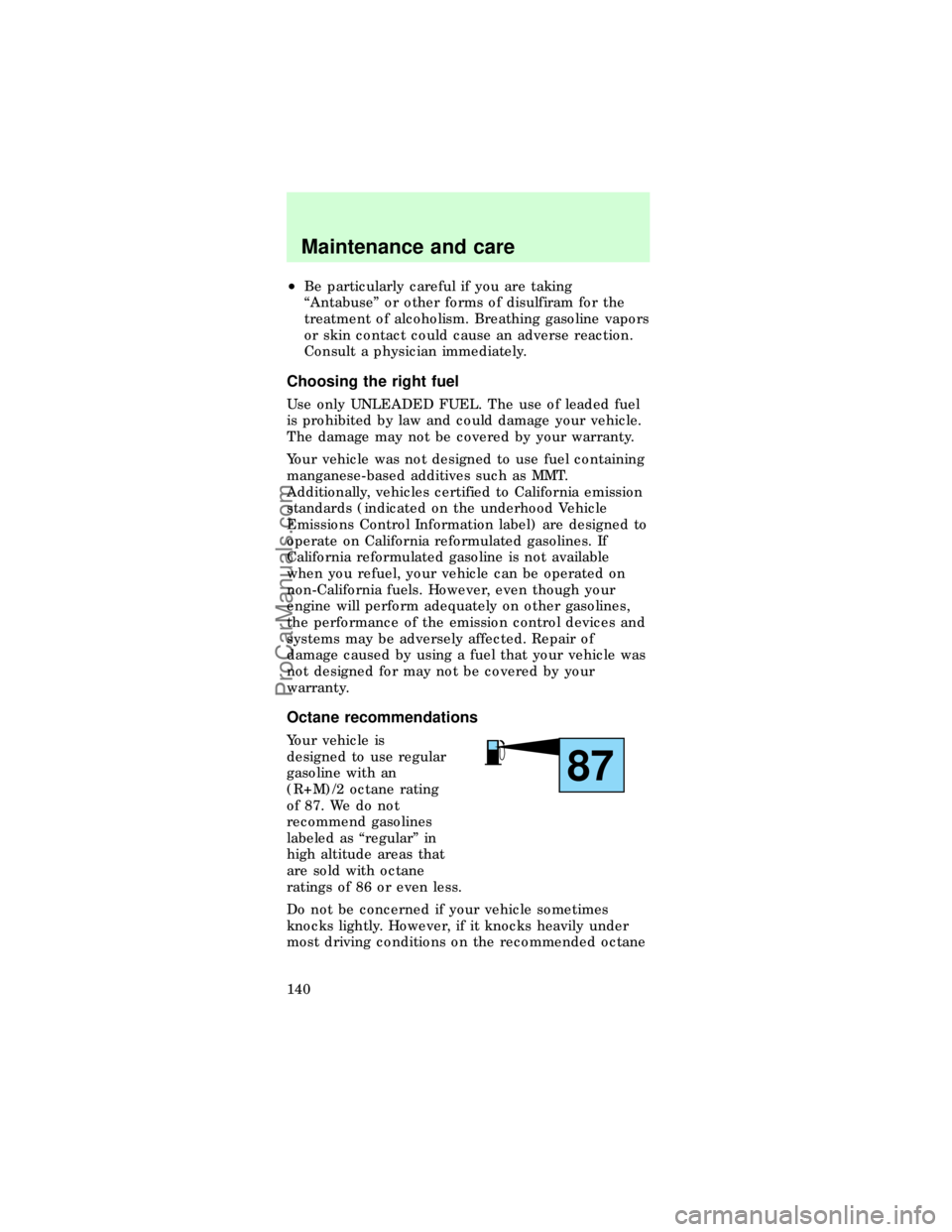
Your vehicle is
designed to use regular
gasoline with an
(R+M)/2 octane rating
of 87. We do not
recommend gasolines
labeled as ªregularº in
high altitude areas that
are sold with octane
ratings of 86 or even less.
Do not be concerned if your vehicle sometimes
knocks lightly. However, if it knocks heavily under
most driving conditions on the recommended octane
87
Maintenance and care
140
ProCarManuals.com