Page 122 of 236

towing a trailer or heavy loads
through heavy terrain.
To return to
D(Overdrive)
mode, press the transmission
control switch.
O/D
OFFwill remain off.
When starting your vehicle, the
transmission will automatically
return to normal
D(Overdrive)
mode.
2 SecondUse the 2 (Second)
position to start-up on slippery
roads or to provide additional
braking on downgrades.
Transmission operates in gears one
and two.
1 LowUse the 1 (Low) position to
provide maximum engine braking
on steep downgrades. Upshifts may
be made by shifting to the 2
(Second) position or to
D(Overdrive). Selecting the 1
(Low) position at higher speeds
causes the transmission to
downshift through the gears and
will shift to 1 (Low) after the
vehicle decelerates to the proper
speed.
Driving (5R55E
transmission-4.0L engines only)
DOverdriveThe normal driving
position for the best fuel economy.
Transmission operates in gears one
through five.
Dcan be deactivated by pressing
the transmission control switch on
the selector lever. The
O/D
OFFwill
illuminate.
uno_5r55e
Driving
123
Page 123 of 236

D DriveNot shown on the display.
Activate by pressing the
transmission control switch.
O/D
OFFwill illuminate in the
instrument cluster. Transmission
operates in gears one through four.
D (Drive) provides more engine
braking than
D(Overdrive) and
is useful when towing a trailer or
heavy loads through heavy terrain.
To return to
D(Overdrive)
mode, press the transmission
control switch.
O/D
OFFwill turn off.
When starting your vehicle, the
transmission will automatically
return to normal
D(Overdrive)
mode.
2 SecondUse the 2 (Second)
position to start-up on slippery
roads or to provide additional
braking on downgrades.
Transmission operates in third
gear.
1 LowUse the 1 (Low) position to
provide maximum engine braking
on steep downgrades. Upshifts may
be made by shifting to the 2
(Second) position or to
D(Overdrive). Selecting the 1
(Low) position at high speeds
causes the transmission to
downshift through the gears and
will shift to 1 (Low) after the
vehicle decelerates to the proper
speed.
uno_driving_manual_trans
Driving
124
Page 124 of 236
Driving a manual transmission
(if equipped)
Using the clutch
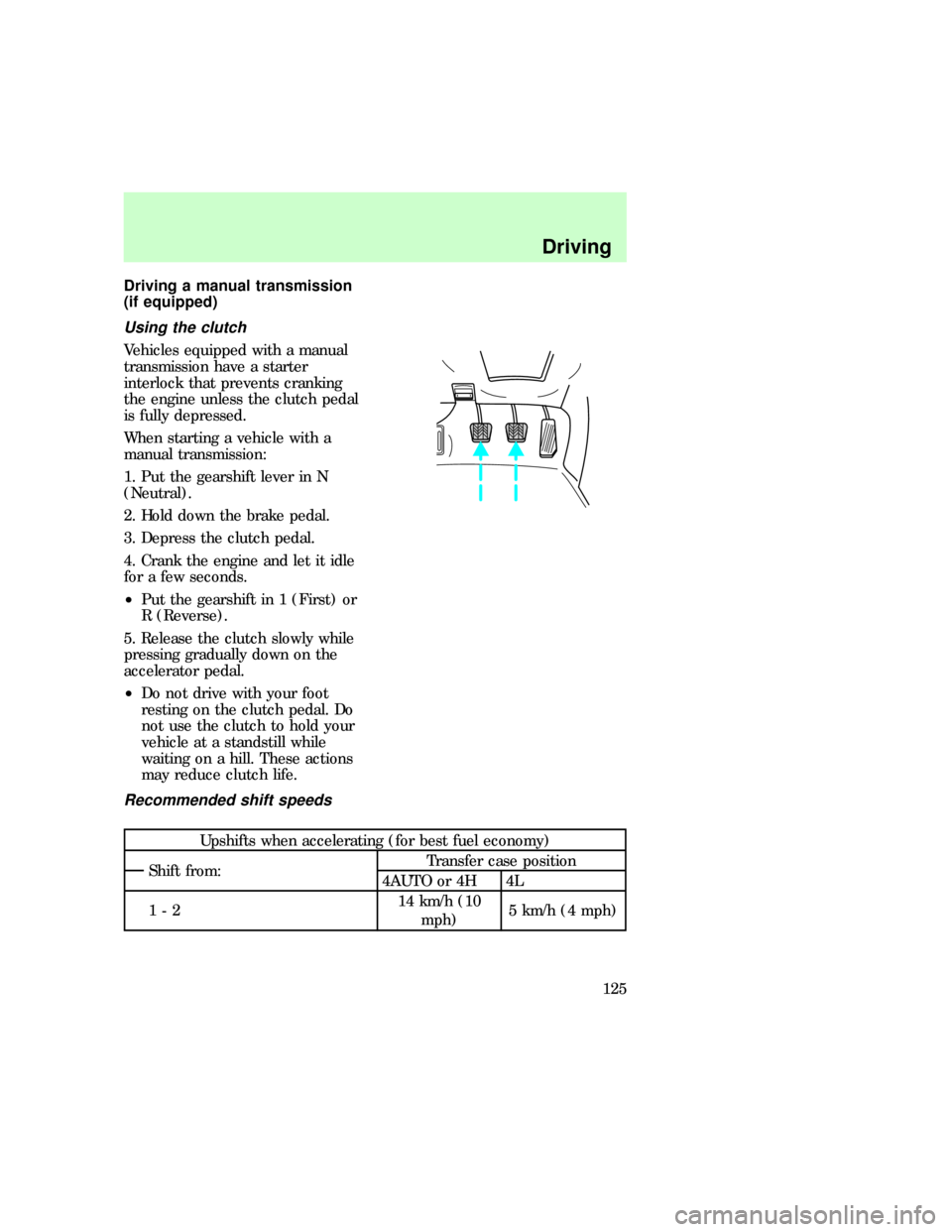
Vehicles equipped with a manual
transmission have a starter
interlock that prevents cranking
the engine unless the clutch pedal
is fully depressed.
When starting a vehicle with a
manual transmission:
1. Put the gearshift lever in N
(Neutral).
2. Hold down the brake pedal.
3. Depress the clutch pedal.
4. Crank the engine and let it idle
for a few seconds.
²Put the gearshift in 1 (First) or
R (Reverse).
5. Release the clutch slowly while
pressing gradually down on the
accelerator pedal.
²Do not drive with your foot
resting on the clutch pedal. Do
not use the clutch to hold your
vehicle at a standstill while
waiting on a hill. These actions
may reduce clutch life.
Recommended shift speeds
Upshifts when accelerating (for best fuel economy)
Shift from:Transfer case position
4AUTO or 4H 4L
1-214 km/h (10
mph)5 km/h (4 mph)
uno_using_clutch
uno_shift_speeds
Driving
125
Page 131 of 236

Driving Through Water
Do not drive quickly through
standing water, especially if the
depth is unknown. Traction or
brake capability may be limited
and if the ignition system gets wet,
your engine may stall. Water may
also enter your engine's air intake
and severely damage your engine.
If driving through deep or standing
water is unavoidable, proceed very
slowly. Never drive through water
that is higher than the bottom of
the hubs (truck) / wheel rims
(car).
Once through the water, always try
the brakes. Wet brakes do not stop
the vehicle as effectively as dry
brakes. Drying can be improved by
moving your vehicle slowly while
applying light pressure on the
brake pedal.
Driving on hill or slope terrain
When driving on a hill, avoid
driving crosswise or turning on
steep slopes. You could lose
traction and slip sideways. Drive
straight up, straight down or avoid
the hill completely. Know the
conditions on the other side of a
hill before driving over the crest.
When climbing a steep hill, start in
a lower gear rather than
downshifting to a lower gear from
a higher gear once the ascent has
started. This reduces strain on the
engine and the possibility of
stalling.
Driving
132
Page 133 of 236

Allow more stopping distance and
drive slower than usual. Consider
using one of the lower gears.
Control trac system indicator
lights
4WD and 4WD LOW indicator
lights are located in the instrument
cluster. If either light flashes, see
your dealer or qualified service
technician.
The indicator lights will also
illuminate under the following
conditions:
²4WD AUTO modeÐ Neither
light will illuminate.
²4WD HIGH modeÐ Only the
4WD high light illuminates.
²4WD LOW modeÐ The 4WD
LOW light illuminates.
ALL WHEEL DRIVE (AWD)
SYSTEM (5.0L ENGINES ONLY)
Your vehicle is equipped with an
all wheel drive (AWD) transfer
case. Power is constantly supplied
to all four wheels through the
transfer case. The AWD system is
full time and has no external
controls.
Like all utility type vehicles, your
AWD vehicle has special design
and equipment features that make
it capable of performing in a
variety of off-road applications.
Specific design characteristics give
these vehicles higher centers of
gravity than ordinary passenger
cars.
4WD
4WD
LOW
uno_indicator_lights
uno_awd
Driving
134
Page 135 of 236

²GAWR (Gross Axle Weight
Rating) ÐCarrying capacity
for each axle system (front and
rear). The GAWR is specific to
each vehicle and is listed on the
Safety Compliance Certification
Label on the driver door pillar.
²GCW (Gross Combined
Weight) ÐThe GCW is the
maximum combined weight of
the towing vehicle (including
passengers and cargo) and the
loaded trailer. The GCW is
specified by the manufacturer to
indicate the combined maximum
loaded weight that the vehicle is
designed to tow.
Payload = GVWR minus Base
curb weight
To obtain the correct weights for
your vehicle, try taking your
vehicle to a shipping company or
an inspection station for trucks.
Do not use replacement tires with
lower weight capacities than the
originals because they might lower
the vehicle's GVWR and GAWR.
(Replacement tires with a higher
weight limit than the originals do
not increase the GVWR or the
GAWR limitations.)
In high altitudes, engines will lose
power at a rate of 3% power per
300 m (1000 ft) increase in
elevation. A reduction in GVW and
GCW is recommended for
maximum vehicle performance.
Driving
136
Page 137 of 236

TRAILER TOWING
Trailer towing with your vehicle
may require the use of a trailer
tow option package.
Trailer towing puts additional loads
on your vehicle's engine,
transmission, axle, brakes, tires,
and suspension. For your safety
and to maximize vehicle
performance, be sure to use the
proper equipment while towing.
Follow these guidelines to ensure
safe towing procedure:
²Stay within your vehicle's load
limits.
²Thoroughly prepare your vehicle
for towing. Refer toPreparing
to towin this chapter.
²Use extra caution when driving
while trailer towing. Refer to
Driving while towingin this
chapter.
²Service your vehicle more
frequently if you tow a trailer.
Refer to the severe duty
schedule in the ªService Guideº.
²Do not tow a trailer until your
vehicle has been driven at least
800 km (500 miles).
²Refer to the instructions
included with towing accessories
for the proper installation and
adjustment specifications.
²Speed control may shut off if
you are towing on long, steep
grades.
Driving
138
Page 138 of 236
Do not exceed the maximum loads
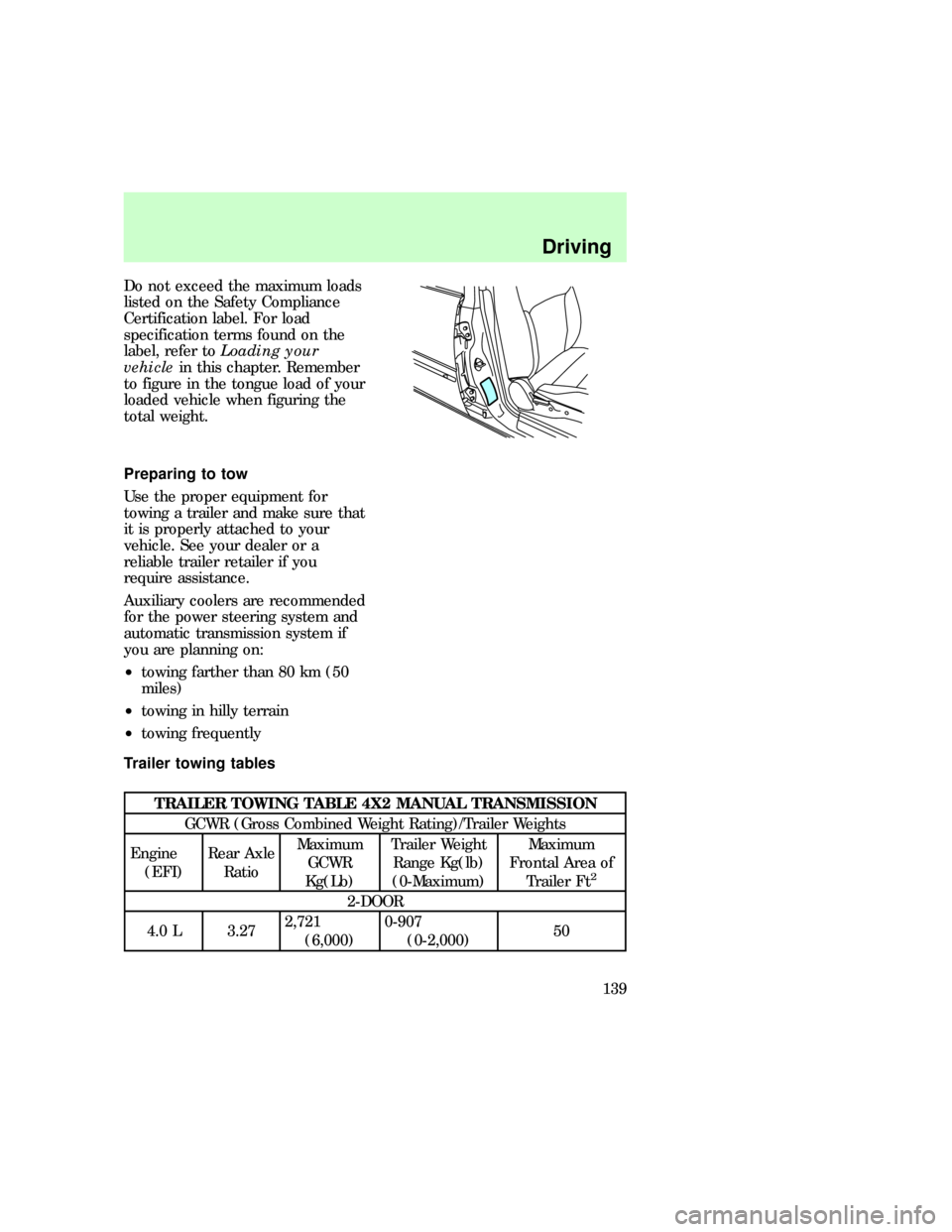
listed on the Safety Compliance
Certification label. For load
specification terms found on the
label, refer toLoading your
vehiclein this chapter. Remember
to figure in the tongue load of your
loaded vehicle when figuring the
total weight.
Preparing to tow
Use the proper equipment for
towing a trailer and make sure that
it is properly attached to your
vehicle. See your dealer or a
reliable trailer retailer if you
require assistance.
Auxiliary coolers are recommended
for the power steering system and
automatic transmission system if
you are planning on:
²towing farther than 80 km (50
miles)
²towing in hilly terrain
²towing frequently
Trailer towing tables
TRAILER TOWING TABLE 4X2 MANUAL TRANSMISSION
GCWR (Gross Combined Weight Rating)/Trailer Weights
Engine
(EFI)Rear Axle
RatioMaximum
GCWR
Kg(Lb)Trailer Weight
Range Kg(lb)
(0-Maximum)Maximum
Frontal Area of
Trailer Ft
2
2-DOOR
4.0 L 3.272,721
(6,000)0-907
(0-2,000)50
uno_preparing_to_tow_title
uno_tables_towing
Driving
139