Page 190 of 236
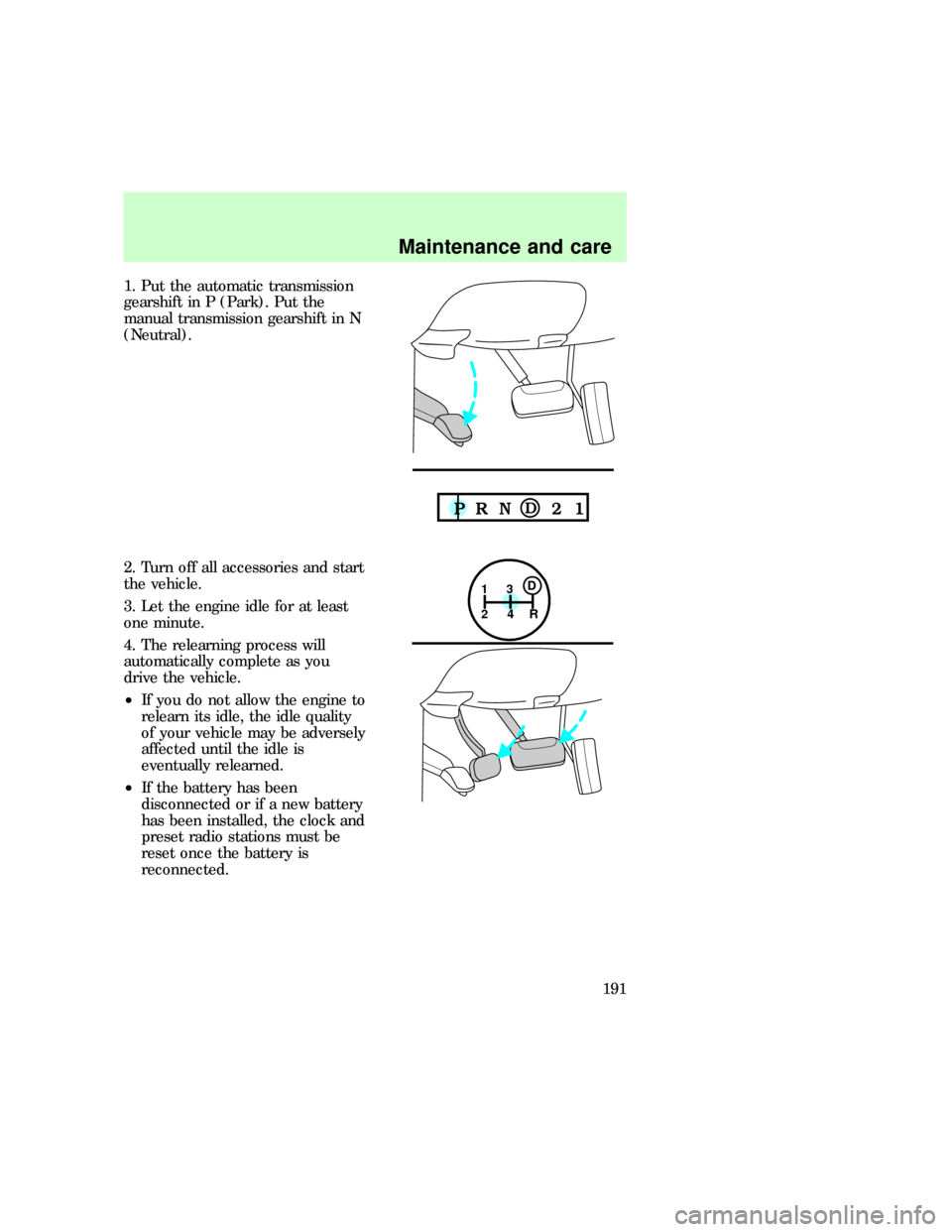
1. Put the automatic transmission
gearshift in P (Park). Put the
manual transmission gearshift in N
(Neutral).
2. Turn off all accessories and start
the vehicle.
3. Let the engine idle for at least
one minute.
4. The relearning process will
automatically complete as you
drive the vehicle.
²If you do not allow the engine to
relearn its idle, the idle quality
of your vehicle may be adversely
affected until the idle is
eventually relearned.
²If the battery has been
disconnected or if a new battery
has been installed, the clock and
preset radio stations must be
reset once the battery is
reconnected.
1
24R3D
Maintenance and care
191
Page 191 of 236
Always dispose of automotive
batteries in a responsible manner.
Follow your community's local
standards for disposal. Call your
local recycling center to find out
more about recycling automotive
batteries.
Battery saver control feature
Your vehicle is equipped with a
battery saver control feature
designed to prevent your battery
from accidental wear down due to
doors left ajar. For information on
the system and its function, refer
to theControls and features
chapter.
AIR CLEANER FILTER
MAINTENANCE
Refer to the ªService Guideº for
the appropriate intervals for
changing the air cleaner filter.
Do not start your engine
with the air cleaner
removed and do not remove it
while the engine is running.
uno_saver_battery_feature
uno_air_filter_maint
uno_changing_air_filter
Maintenance and care
192
Page 192 of 236
Changing your air cleaner filter
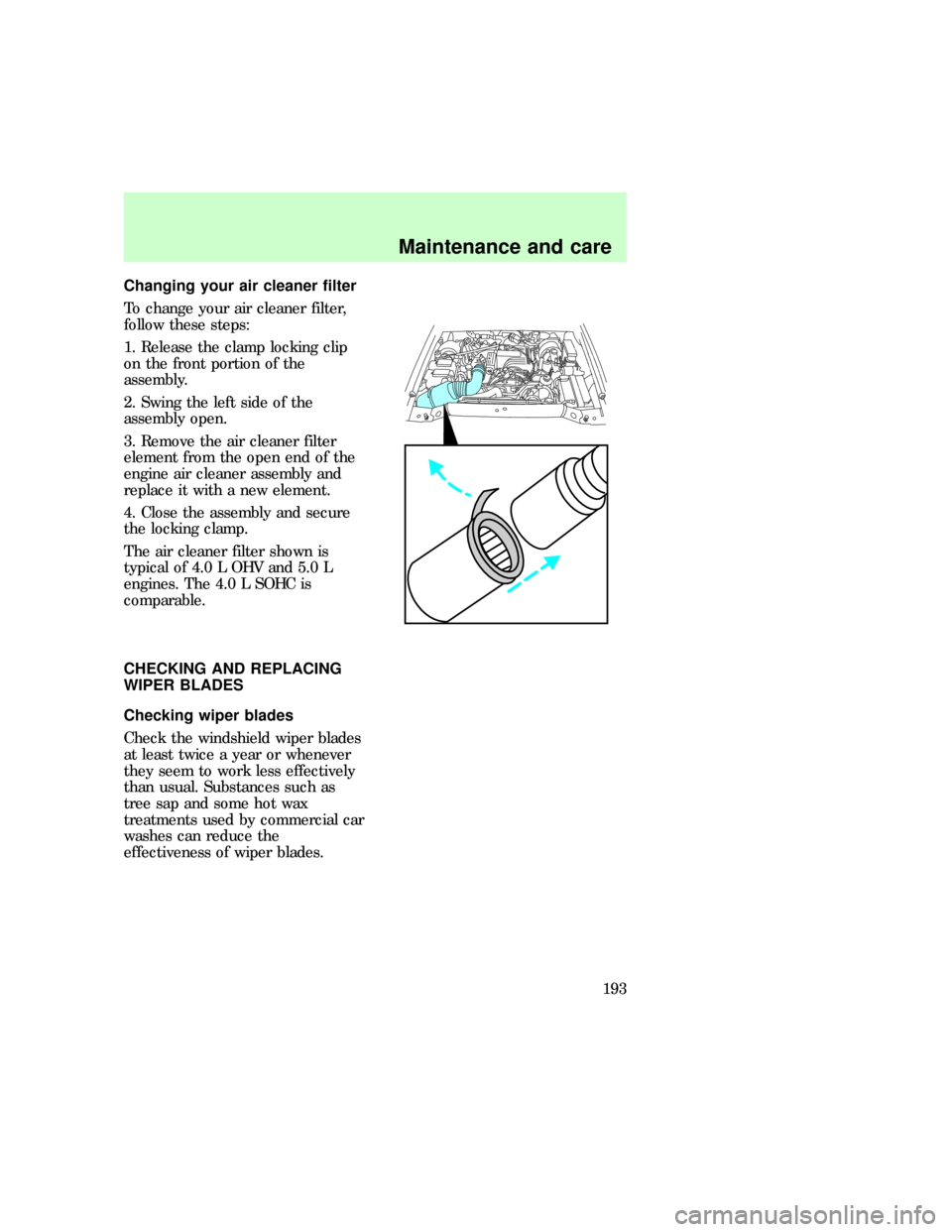
To change your air cleaner filter,
follow these steps:
1. Release the clamp locking clip
on the front portion of the
assembly.
2. Swing the left side of the
assembly open.
3. Remove the air cleaner filter
element from the open end of the
engine air cleaner assembly and
replace it with a new element.
4. Close the assembly and secure
the locking clamp.
The air cleaner filter shown is
typical of 4.0 L OHV and 5.0 L
engines. The 4.0 L SOHC is
comparable.
CHECKING AND REPLACING
WIPER BLADES
Checking wiper blades
Check the windshield wiper blades
at least twice a year or whenever
they seem to work less effectively
than usual. Substances such as
tree sap and some hot wax
treatments used by commercial car
washes can reduce the
effectiveness of wiper blades.
uno_wipers_title
uno_checking_wipers
Maintenance and care
193
Page 203 of 236
forms of disulfiram for the
treatment of alcoholism.
Breathing gasoline vapors or
skin contact could cause an
adverse reaction. Consult a
physician immediately.
Cleaner air
Ford approves the use of gasolines
to improve air quality, including
reformulated gasolines, that
contain oxygenates such as a
maximum of 10% ethanol or 15%
MTBE. There should be no more
than 5% methanol with cosolvents
and additives to protect the fuel
system.
Octane recommendations
Your vehicle is designed to use
regular gasoline with an (R+M)/2
octane rating of 87. We do not
recommend gasolines labeled as
ªregularº in high altitude areas that
are sold with octane ratings of 86
or even less.
Do not be concerned if your
vehicle sometimes knocks lightly.
However, if it knocks heavily under
most driving conditions on the
recommended octane fuel, see
your dealer or a qualified service
technician to prevent any engine
damage.
87
com_cleaner_air.01
com_octane_recommendations.01
com_fuel_quality.01
Maintenance and care
204
Page 205 of 236

though your engine will perform
adequately on other gasolines, the
performance of the emission
control devices and systems may
be adversely affected. Repair of
damage caused by using a fuel that
your vehicle was not designed for
may not be covered by your
warranty.
Calculating fuel economy
To accurately calculate your
vehicle's fuel economy:
1. Fill the tank completely and
record the initial odometer
reading.
2. Each time you fill the tank,
record the amount of fuel added
(in liters or gallons).
3. After at least three to five fuel
tank fill-ups, fill the fuel tank and
record the current mileage
reading.
4. Use one of the following
equations to calculate fuel
economy.
Liters used x 1004Total
kilometers traveled
Total miles traveled4Total
gallons used
Keep a record for at least one
month. This will provide an
accurate estimate of the vehicle's
fuel economy.
EMISSION CONTROL SYSTEM
Your vehicle is equipped with
various emission control
com_calculating_economy.01
com_emission.ses
Maintenance and care
206
Page 206 of 236
components and a catalytic
converter which will enable your
vehicle to comply with applicable
exhaust emission standards. To
make sure that the catalytic
converter and other emission
control components continue to
work properly:
²Use only unleaded fuel.
²Avoid running out of fuel.
²Do not turn off the ignition
while your vehicle is moving,
especially at high speeds.
²Have the services listed in your
ªService Guideº performed
according to the specified
schedule.
The Scheduled Maintenance
Services listed in the ªService
Guideº are required because they
are considered essential to the life
and performance of your vehicle
and to its emissions system.
If other than Ford, Motorcraft or
Ford authorized parts are used for
maintenance replacements or for
service of components affecting
emission control such non-Ford
parts should be equivalent to
genuine Ford Motor Company
parts in performance and
durability.
Do not park, idle, or drive
your vehicle in dry grass
or other dry ground cover. The
emission system heats up the
engine compartment and exhaust
system, which can start a fire.
Maintenance and care
207
Page 207 of 236
Watch for fluid leaks, strange
odors, smoke, loss of oil pressure,
the charging system warning light,
the ªService Engine Soonº light or
the temperature warning light.
These events could indicate that
the emission control system is not
working properly.
If you smell exhaust fumes
of any kind inside your
vehicle, have the dealer inspect
and fix your vehicle immediately.
Do not drive if you smell exhaust
fumes. These fumes are harmful
and could kill you.
Do not make any unauthorized
changes to your vehicle or engine.
By law, vehicle owners and anyone
who manufactures, repairs,
services, sells, leases, trades
vehicles, or supervises a fleet of
vehicles are not permitted to
intentionally remove an emission
control device or prevent it from
working. Information about your
vehicle's emission system is on the
Vehicle Emission Control
Information Decal located on or
near the engine. This decal
identifies engine displacement and
gives some tune up specifications.
Please consult your ªWarranty
Guideº for complete emission
warranty information.
Readiness for
inspection/maintenance testing
In some localities, it may be a legal
requirement to pass an I/M test of
com_ready-test
Maintenance and care
208
Page 208 of 236

the on-board diagnostic (OBD-II)
system. If your ªcheck
engine/service engine soonº light is
on, reference the applicable light
description in theWarning Lights
and Gaugessection of your
owners guide. Your vehicle may
not pass the I/M test with the
ªcheck engine/service engine soonº
light on.
If the vehicle's powertrain system
or its battery has just been
serviced, the OBD-II system is
reset to a ªnot ready for I/M testº
condition. To ready the OBD-II
system for I/M testing, a minimum
of 30 minutes of city and highway
driving is necessary as described
below:
²First, at least ten minutes of
driving on an expressway or
highway.
²Next, at least twenty minutes
driving in stop and go, city type
traffic with at least four idle
periods.
Allow the vehicle to sit for at least
8 hours without starting the
engine. Then, start the engine and
complete the above driving cycle.
The engine must warm up to it's
normal operating temperature.
Once started, do not turn off the
engine until the above driving
cycle is complete.
Maintenance and care
209