Page 177 of 236

During normal operation, the fluid
level in the clutch fluid reservoir
will slowly rise. If the fluid level
drops, maintain the fluid level at
the reservoir indicator.
Use only DOT 3 brake fluid
designed to meet Ford
specifications. Refer to the
Capacities and specifications
chapter.
1. Clean the reservoir cap before
removal to prevent contaminants
from entering the reservoir.
2. Remove the cap.
3. Add fluid until the level reaches
the FULL line.
CHECKING AND ADDING
WASHER FLUID
Important information about
washer fluid
In freezing weather (temperatures
below 0ÉC [32ÉF]), washer fluid
containing a small amount of
antifreeze is to be used. State or
local regulations on volatile organic
compounds may restrict the use of
methanol, a common antifreeze
additive. Use a non-methanol
antifreeze in freezing weather only
if the fluid does not damage the
paint finish, wiper blades or
washer system.
Windshield washer fluid
contains methanol which is
poisonous.
uno_washer_fluid_title
uno_what_you_should_know
uno_reservoir_washer_fluid
Maintenance and care
178
Page 192 of 236
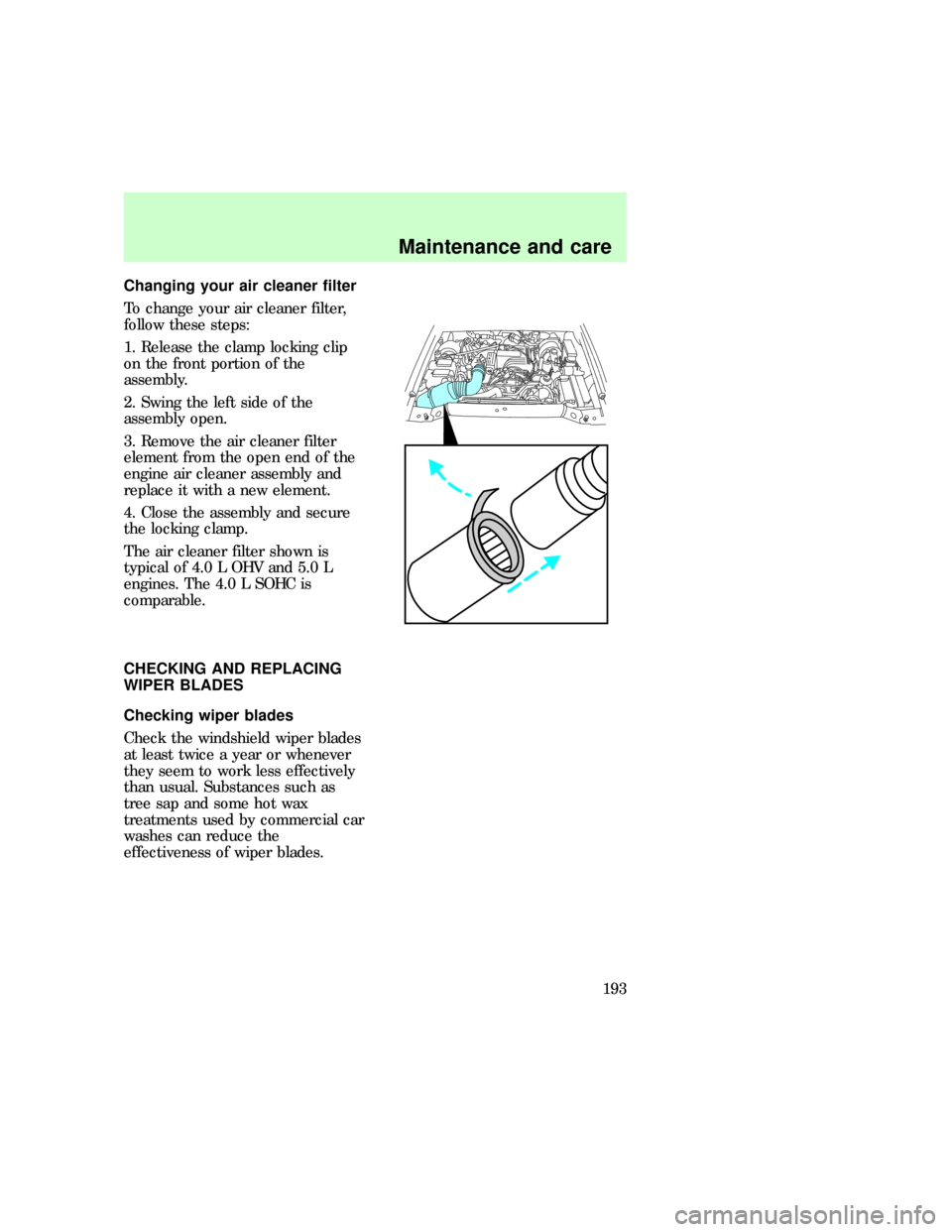
Changing your air cleaner filter
To change your air cleaner filter,
follow these steps:
1. Release the clamp locking clip
on the front portion of the
assembly.
2. Swing the left side of the
assembly open.
3. Remove the air cleaner filter
element from the open end of the
engine air cleaner assembly and
replace it with a new element.
4. Close the assembly and secure
the locking clamp.
The air cleaner filter shown is
typical of 4.0 L OHV and 5.0 L
engines. The 4.0 L SOHC is
comparable.
CHECKING AND REPLACING
WIPER BLADES
Checking wiper blades
Check the windshield wiper blades
at least twice a year or whenever
they seem to work less effectively
than usual. Substances such as
tree sap and some hot wax
treatments used by commercial car
washes can reduce the
effectiveness of wiper blades.
uno_wipers_title
uno_checking_wipers
Maintenance and care
193
Page 193 of 236
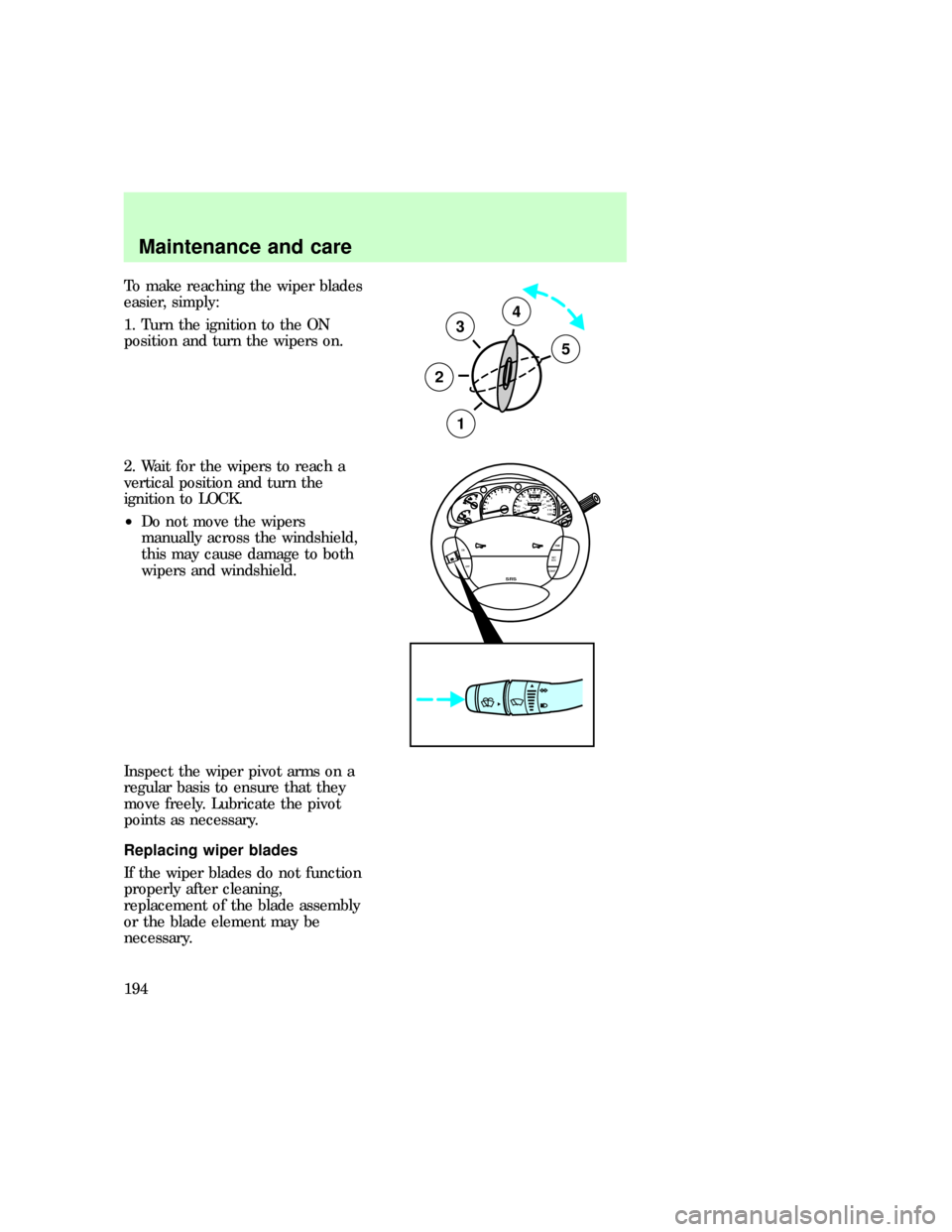
To make reaching the wiper blades
easier, simply:
1. Turn the ignition to the ON
position and turn the wipers on.
2. Wait for the wipers to reach a
vertical position and turn the
ignition to LOCK.
²Do not move the wipers
manually across the windshield,
this may cause damage to both
wipers and windshield.
Inspect the wiper pivot arms on a
regular basis to ensure that they
move freely. Lubricate the pivot
points as necessary.
Replacing wiper blades
If the wiper blades do not function
properly after cleaning,
replacement of the blade assembly
or the blade element may be
necessary.
3
2
1
5
4
0P RND21RPM x 100012345
6H
C
F
E
RSM
SET
ACC
COAST OFF ON
SRS
- +H
H
L L020
1030405060
70
80
90
110
120000000oooo
km/h10020406080100
120
140
160
180
uno_replacing_wipers
Maintenance and care
194
Page 194 of 236
The blade lengths for your vehicle
are as follows:
²Windshield wiper blades Ð 56
cm (16 in)
²Liftgate wiper blades Ð 41 cm
(22 in)
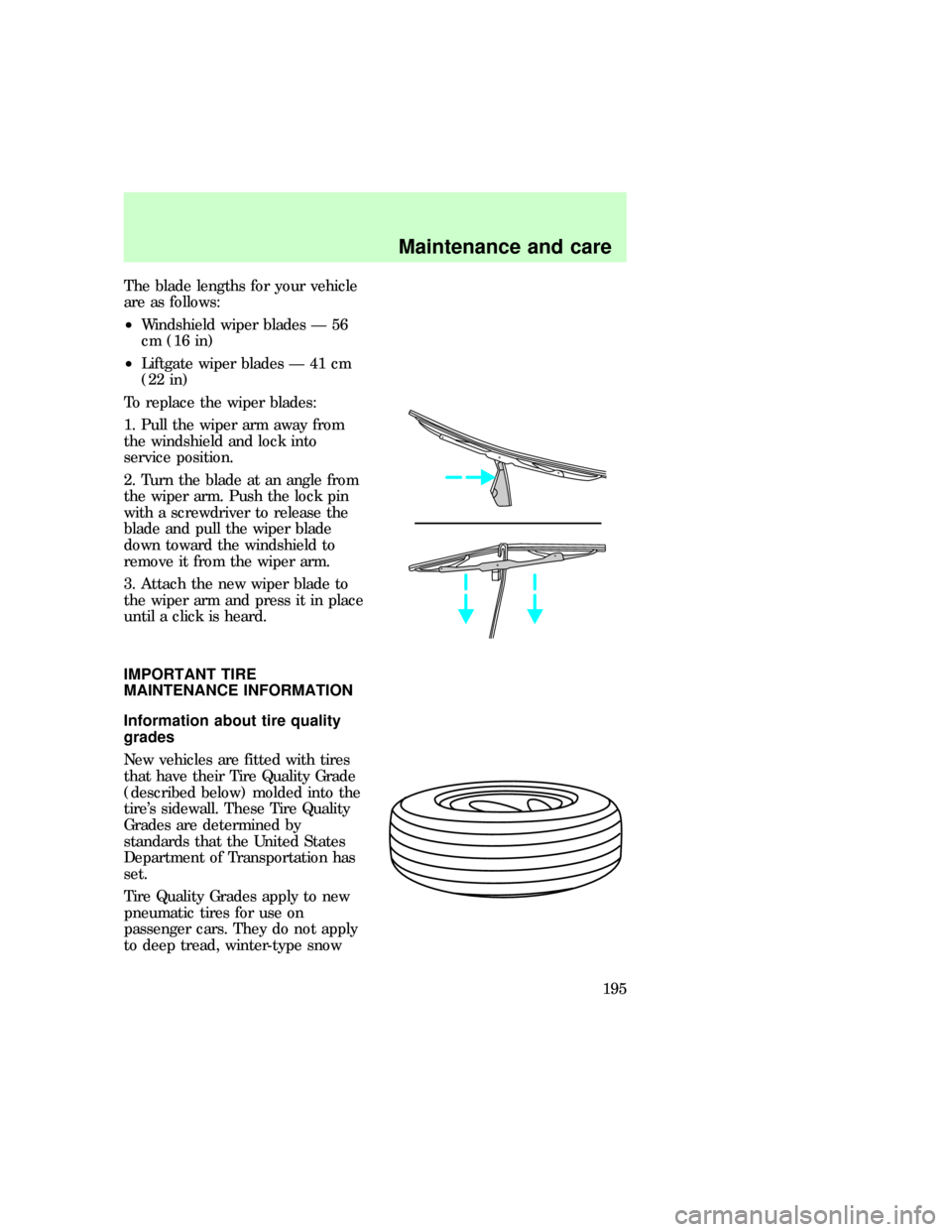
To replace the wiper blades:
1. Pull the wiper arm away from
the windshield and lock into
service position.
2. Turn the blade at an angle from
the wiper arm. Push the lock pin
with a screwdriver to release the
blade and pull the wiper blade
down toward the windshield to
remove it from the wiper arm.
3. Attach the new wiper blade to
the wiper arm and press it in place
until a click is heard.
IMPORTANT TIRE
MAINTENANCE INFORMATION
Information about tire quality
grades
New vehicles are fitted with tires
that have their Tire Quality Grade
(described below) molded into the
tire's sidewall. These Tire Quality
Grades are determined by
standards that the United States
Department of Transportation has
set.
Tire Quality Grades apply to new
pneumatic tires for use on
passenger cars. They do not apply
to deep tread, winter-type snow
uno_title_tires
com_about_tire_grades.01
Maintenance and care
195
Page 217 of 236
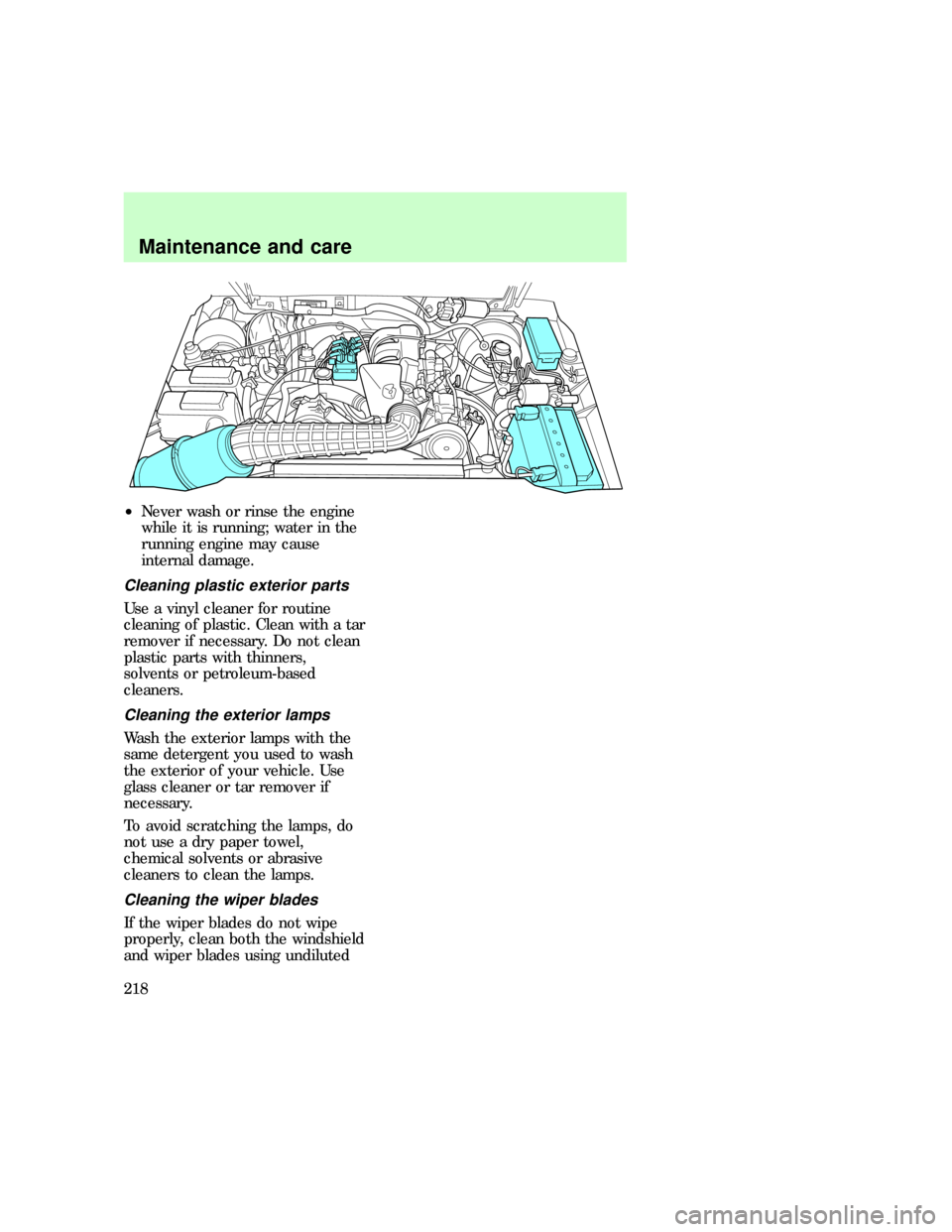
²Never wash or rinse the engine
while it is running; water in the
running engine may cause
internal damage.
Cleaning plastic exterior parts
Use a vinyl cleaner for routine
cleaning of plastic. Clean with a tar
remover if necessary. Do not clean
plastic parts with thinners,
solvents or petroleum-based
cleaners.
Cleaning the exterior lamps
Wash the exterior lamps with the
same detergent you used to wash
the exterior of your vehicle. Use
glass cleaner or tar remover if
necessary.
To avoid scratching the lamps, do
not use a dry paper towel,
chemical solvents or abrasive
cleaners to clean the lamps.
Cleaning the wiper blades
If the wiper blades do not wipe
properly, clean both the windshield
and wiper blades using undiluted
com_plastic_exterior.01
uno_exterior_lamps
uno_wiper_cleaning
Maintenance and care
218
Page 218 of 236
windshield wiper solution or a mild
detergent. Rinse thoroughly with
clean water. To avoid damaging the
blades, do not use fuel, kerosene,
paint thinner or other solvents.
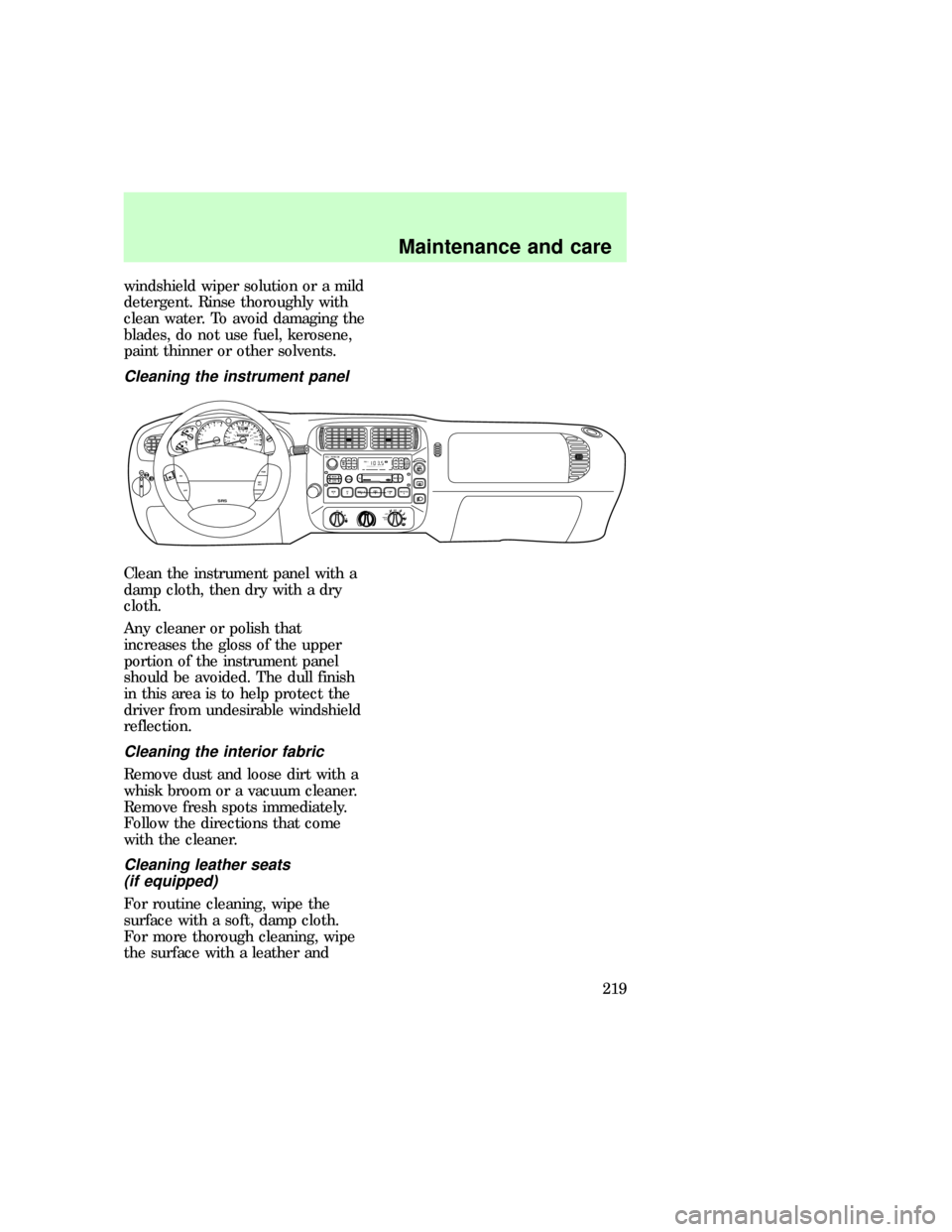
Cleaning the instrument panel
Clean the instrument panel with a
damp cloth, then dry with a dry
cloth.
Any cleaner or polish that
increases the gloss of the upper
portion of the instrument panel
should be avoided. The dull finish
in this area is to help protect the
driver from undesirable windshield
reflection.
Cleaning the interior fabric
Remove dust and loose dirt with a
whisk broom or a vacuum cleaner.
Remove fresh spots immediately.
Follow the directions that come
with the cleaner.
Cleaning leather seats
(if equipped)
For routine cleaning, wipe the
surface with a soft, damp cloth.
For more thorough cleaning, wipe
the surface with a leather and
0P RND21RPM x 100012345
6H
C
EF
RSM
SET
ACC
COAST OFF ONOFF
SRS
HI LOOFF*A/C*MAX
A/C
REW
1FF
2SIDE 1-2
3
FM 1STVOL – PUSH ON
AM
FMBASS TREBBAL FADE
AUTO
SET CLK
SEEKTUNE
DISCSSCAN4DOLBY SYSTEMEJTAPE CDCOMP5SHUFFLE
6
PUSH
020
1030405060
70
80
90
110
120000000oooo
km/h10020406080100
120
140
160
180
uno_instru-panel_cleaning
com_int_fabric_cleaning.01
com_leather_seats_cleaning.01
Maintenance and care
219
Page 235 of 236
Voltmeter (see Battery voltage
gauge) ..........................................15
Warning chimes
headlamps on ............................11
key in ignition ...........................12
safety belt .................................12
Washer fluid
reservoir ..................................179
Windows
power windows, operating .......56Windshield washer fluid and
wipers ........................................193
checking and adding fluid .....178
checking and replacing wiper
blades ...............................193,194
liftgate reservoir .....................179
operation ...................................46
specifications ..........................178
Wrecker towing .........................163
236