Page 150 of 402
Downloaded from www.Manualslib.com manuals search engine * Check your mirrors, glance over your shoulder and.
start your left lane change
signal before-moving out
of the right.lane to pass. When you are far enough
ahead
of the passe.d vehicle to see its front in your
inside -01, activate your right lane change sigmd
and-move back into the.
ri,ght lane. (Remember that
your-right outside ,mirror is convex. The vehicle you
juslpassed may
seem to be farther away from y6u
than it really is.)
Tfy not co p.ass mufe ,than one vehicle ,at a time
on two-lane’roads. Reconsider before passing the
next vehicle.
D.on’:t overtake-.a slowly moving vehi-de too rapidly.
Even though
the brake -1amp.s are not flashing, it m.a.y
be slowing down or starting to, turn.
Qi If+ you’re being .passed, make it easy- for the
fallowing driver to
get..ahead .of you. Perh,aps you
can ease.&
little to the right.
Let’s review what driving expmts s-ay about what
happens when the thre.e
con.trol systems- (brakes., steering,
and,acceleration) don’t
have enough friction where the
tifes ”meet the road to do what the drivt?r has asked..
In any emergency, don’t give up Keep trying to
steer and constantly seek
an escape route-or aea of
less danger.
In a. skid, a driver cn lose control of .the vehicle, Defensive
drivers .avoid
most skids by taking reasonable care suited t9
existing conditiolrs, and by not “overdriving” those
conditions.. But- ,&ids
are always -pa.ssible.
The three typcis of skids correspond to your vehicle’s
three
c’0ntro1 syst,erns. In. the. brakifig skid, y0.m whe.eIs
aren’t rpl.ling. Ln the steering or- cornering skid, too
much speed or steering in a curve causes tires: to slip and
lase cornehg, foxce,. And. in the acceleration skid, too
much throttle causes the driving wheels- to spin.
4-13
Page 151 of 402
Downloaded from www.Manualslib.com manuals search engine A cornering skid and an acceleratioa skid .are best
hand1e.d by easing your foot off the accelerator pedal.
Driving Guidelines.
Off-IC0a.d Driving with Your
Four-Wheel-Drive Vehicle..
This off-road guide is for vehicles that have
.four-wheel drive.
Also, see “Anti-Lock Brakes” in the Index;
If your vehicle doesn’t have :four-wheel drive, you
shouldn’t drive off-road unl.es.s-you”re on a letel,
solid surface.
Off-road driving can be great fun. But it does have
some definite hazards. The greatest of these is the
terrain itself,
“Off-roading” means
.you’ ve left .the great North
American road system behind. Traffic. lanes arerft
marked. Curves aren.’t.Ij;znked. There are no road -sigm.
Surfaces can be slip-pery, rouqh, uphill or &~wnMl. In
-short, you’ve gone. ri.ght ba to nature.
off-road driving involves soni new skills. Aad tbat.’s-
why it’s very important that you read this guide. You’ll
find many driving tips and suggestions. These will help
make your off-rbad driving safer and more enjoyable.
4-14
Page 155 of 402
Downloaded from www.Manualslib.com manuals search engine Whe.n y0.U drive over obstacles .or rough terrain, keep a.
firm..gkill .on the steering wheel; Ruts, troughs or ather
-surfaace’featu?es- %a~l jerk-the wheel out of your hands if
you’re not prepaced,
.When YOU drive oTt.er humps, rock.; .or other obstades,
YOW wheels can leave the gr.ound. Ifthis happens, e-ven
with. one or tw~ wheels, you cdt co.ntrol the vehicle as
well or-at all.
Eecaus-e you will be on an un-paved surface, it’s.
.espe&dly importmt to avoid :sudden acceleration,
sudden:.tums
of sudden. braking.
In a way, .off-.road driving requires a diffkrent. kind of
:alertfie$s fmm driving on paved roads :and highw-ays.
There are no road signs, pastdspeed limits or signal
lights.
-You have to. use your own good judgment abaut
.what &-..safe and what- isa’t.
Drinkiagmd driving can be very dangerous on any
mad.
And’this. is -certainly trclcfor off-road driving. At
‘the very ‘time you need special alertness and driving
skills., y-owr-x&kx&$-, pefcepions and judgmen-t can be
affected by even a small amount of -alc30hol. You .c:ould
have a serid;us- -- 01- even fatal -- ciccident if you drink
and. drive wride with ,a driver- who has. been drinking.
See ‘“Drunk@n Driviy” in the Index.
Driving _. . on Off-Road Hills
Off-road driving often- takes you up, dswn.~~ acr0s.s a
hill, Driving safely on. hills requires good judgment and
.an tl.nderstanding of what your vehicle can and can’t-do.
There are some h.ills that simply cadt .b&, driven, ‘no
mattee how well built ,the vehicle.
Many hills are simply too steep for, any vehicIe. If
you drive up them, you will stall. If you drive
down them, you can’t control your speed. If you
drive across .them, you will roll over. ‘You could be
seriously injured
or killed. If you have any doubt
about
the steepness, don’t drive the hill.
4-18
Page 161 of 402
Downloaded from www.Manualslib.com manuals search engine Q.’ Are there some things-I should notdo when
A: Yes! These are important because if you
.driving ’down a hill?
ignore them you could lose control .and have a
serious accident,.
0 When driving downhill, avoid turns that take you
across the incline of the hill. A .hill that’s nut too
steep to drive down may be too steep tQ drive acro:ss.
You could roll over if you don’t drive straight down.
NEUTW (N),.or- with the clutch pedal dep&ssed
in a .manuai~ shift. This is called “free-wheeling.”
Your brakes will. have to do all the work and could
overhe’at and. fade.
0 Never go down-hill with the transmission in:
.Q: Am I likely to stall when going downhill?
A: It’s much more likely to happen ,going uphill. But if
it.happens
going downhill, here’s: what to do.
0 Stop your vehicle by applying the- regular brakes.
Apply the parking brake.
Shift to
PARK. (P) (.or to NEUTRAL (N) with the
manual transmission) and, while still
braking, restart
the engine. ..
S.hift back to a 1.0w gear, release the parking brake,
and drive straight down.
If the engine- won’t start, get out and get. help.
4-24
Page 164 of 402
Downloaded from www.Manualslib.com manuals search engine Driving in Mnd, Sand, Snow or Ice
When you dxive in mu.d, snow or sarsd, your wheels
won’t get good traction. You can’t accelemte as
quickly, turning i.s more dif€icult, and you’ll need
longer braking distances.
It’s best .to use a low..gear when you’re in mud -- the
,deeper the mud, the lower the gear: In really ,deep mud,
$he idea is to keep your vehicle- moving s.0 you don’t
.!get stuck.
When
you drive on sand, yo-u’ll sensg a change- in wheel
traction, But St will &pmd upon how looseiypacked the
,sand is. On loosely packed sand (as on. beaches or sand
dunes)
your tires will tend to sink into the sand. This has
an effect on steering, accelefating and braking. You may
,w.ant to reduce the air pressure in your tires slightly
when driving on :sand. ‘This. will improve traction,
Hard packed mow ;sad ice. oEer the wofWtire’tractioa.
On thes~e s-Urfac.e.s, it’s very easy to lase c.on!Td, On wet
ice, for example, the traction i.s so paor that you will
h,ave diffic-ulty
accelerating, And if you d:o gkt movi.ng,
poor sleeting and difficult braking- can cause you to slide
out of control.
Driving on frozen lakes, ponds or rivers can be
dangerom. Undewater sprirmgs, currents under
the ice, or
sudden thaws can weaken the ice, Your
vehicle could fall through the ice and you and ,
your passengers could drown. Drive your vehicle
on -safe-surfaces only.
Page 165 of 402
Downloaded from www.Manualslib.com manuals search engine Driving in Water
Light rain causes no specialaff-road driving problems.
But .ke.avy rain
can .mean flash flooding, and flood
waters demand extreme caution.
+Find- out how deep the water is before you drive through
it. If it’s deep enough to cover your wheel hubs, axles or
exhaust pipe, don’t
‘try it -- you probably won’t g-et
through. Also, water that deep
can damage your axle
and
other vehicle parts.
If the water isn’t too deep, then drive through it slowly.
At fast speeds, water splashes on your ignition system
and your vehicle
can st-dl. Stalling.can also occur if you
get your tailpipe under water. And, as long as your
:.. . tailpipe is ,under water, .you’ll never be able to start your
..;;&I
engine. When you gp through water, remember that
--.
. ,. , when your brakes get wet; it may take you longer
to stop. -‘a:i <,..,..?, ,
Driving through rushing water can be dangerous.
Deep water can
sweep your vehicle downstream
and you
and your passengers could drown. If it’s
only shallow water,
it can still wash away the
ground
from under your tires, and you could lose
traction and roIl the vehicle over.
Don’t drive
through
rushing water.
See “Driving Throagh Water” in the Index f6TmGE
infoination on driving through water,
4-28
Page 166 of 402
Downloaded from www.Manualslib.com manuals search engine After Off-Road Driving
Remove .any brush. or debris th.at has collected an. the-
underbQdy, chassis
or under the hood. These
accu.mulation-s
can be a fire hazard.
After
operation in mud or. sand, have the br&e linings-
cleaned -and checked. These substances can cause
glazing- and uneven braking,. C,heck tihe, body struc.ture,
steerbig, su$pensioonj
wheels, tires .-and exhaust system
for damage, Also, check the file1 lines and cooling
system for any leakage.
Your vehicle will req.uire more frequent service due to
aff-rrrad
use.. Refer to the Maintenance Schedule fo,r
additional infofmation.
.Driving at Night
Night driving is more dangerous th-an day driving. One
reason is that some drivers are likely to be impaire-d -.- by
alcohol or drugs, with nieht vision broblems, or by fatigue.
4-29
Page 174 of 402
Downloaded from www.Manualslib.com manuals search engine Highway Hypnosis
:,Is there actually such a condtion as “highway hypnosis”?
“Or is it just plain falling asleep at the wheel? .Call it
highway hypnosis, lack of awareness; or whatevm.
There is something. about an easy stretch of road with the
same scenery, along with the hum of the tires on th.e road,
the drone
of the engine, and the rush of the wind :against
.the vehcle that cai~ ~ake you sleepy. Don’t let it happen
.?to
you! If it does, your vehicle can leave the soad h.Eess
tlzan a second, and you could crash and be injured.
What can you
do about h.ighway hypnosis? First, be
aware that it can .happen.
Then
here a-e some tips:
0 Make sure. your vehicle: is well ventilated; with a
comfortably cool interior.
0 Keep your eyes moving. Scan -the road ahead
and to
the sides. Cheek y-our mirrors and your
imtruine’nts frequently.
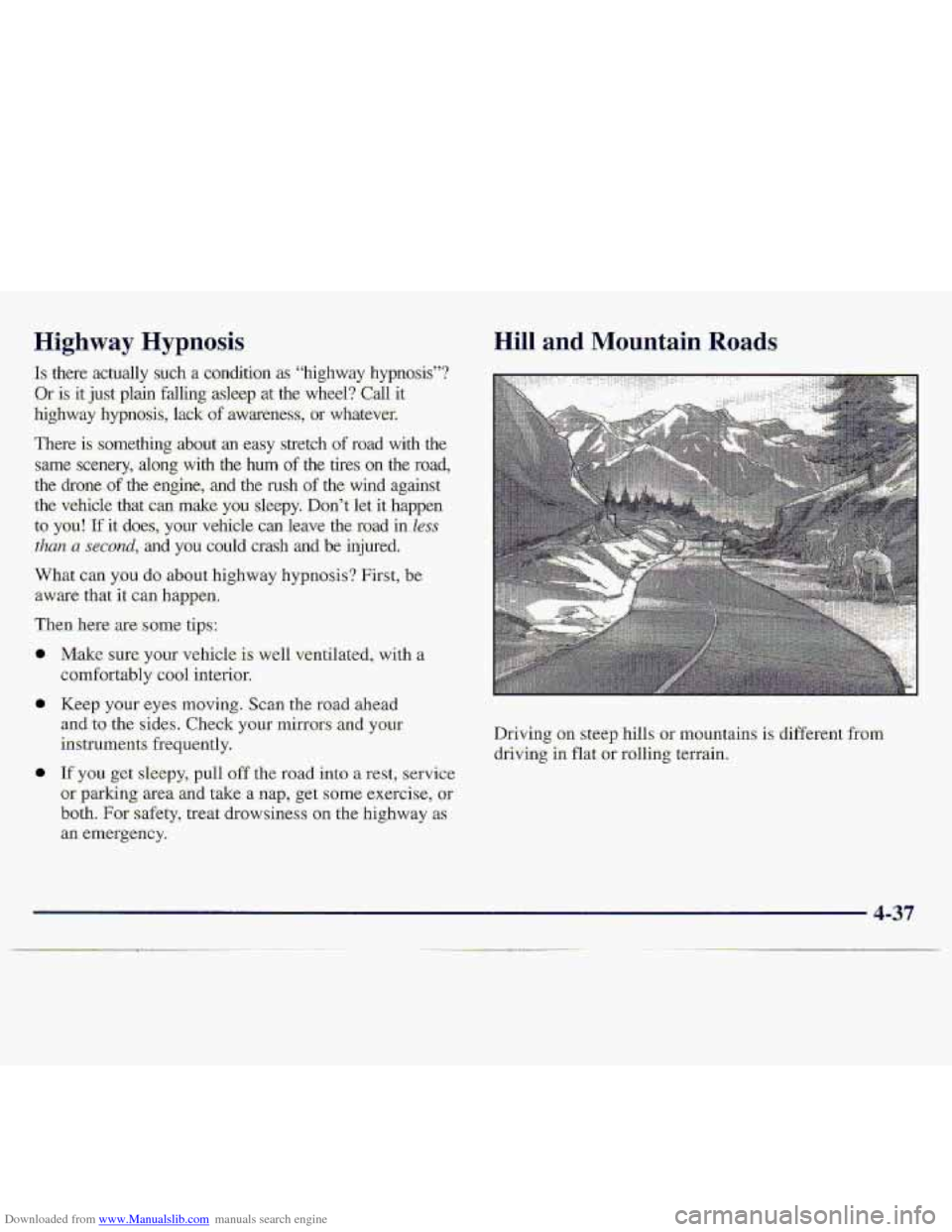
Hill and Mountain Roads-
Driving on steep hills or mountains is different from
drivjng .in
flat or.ro1ling terrain.
0. If-you get sleepy, p.ull off-the road into a rest, service
or-par.king- area and take
a asp, get some exercise, or
both. For safety, treat drowsiness on the highway as
an emergency.
4-37