Page 231 of 402
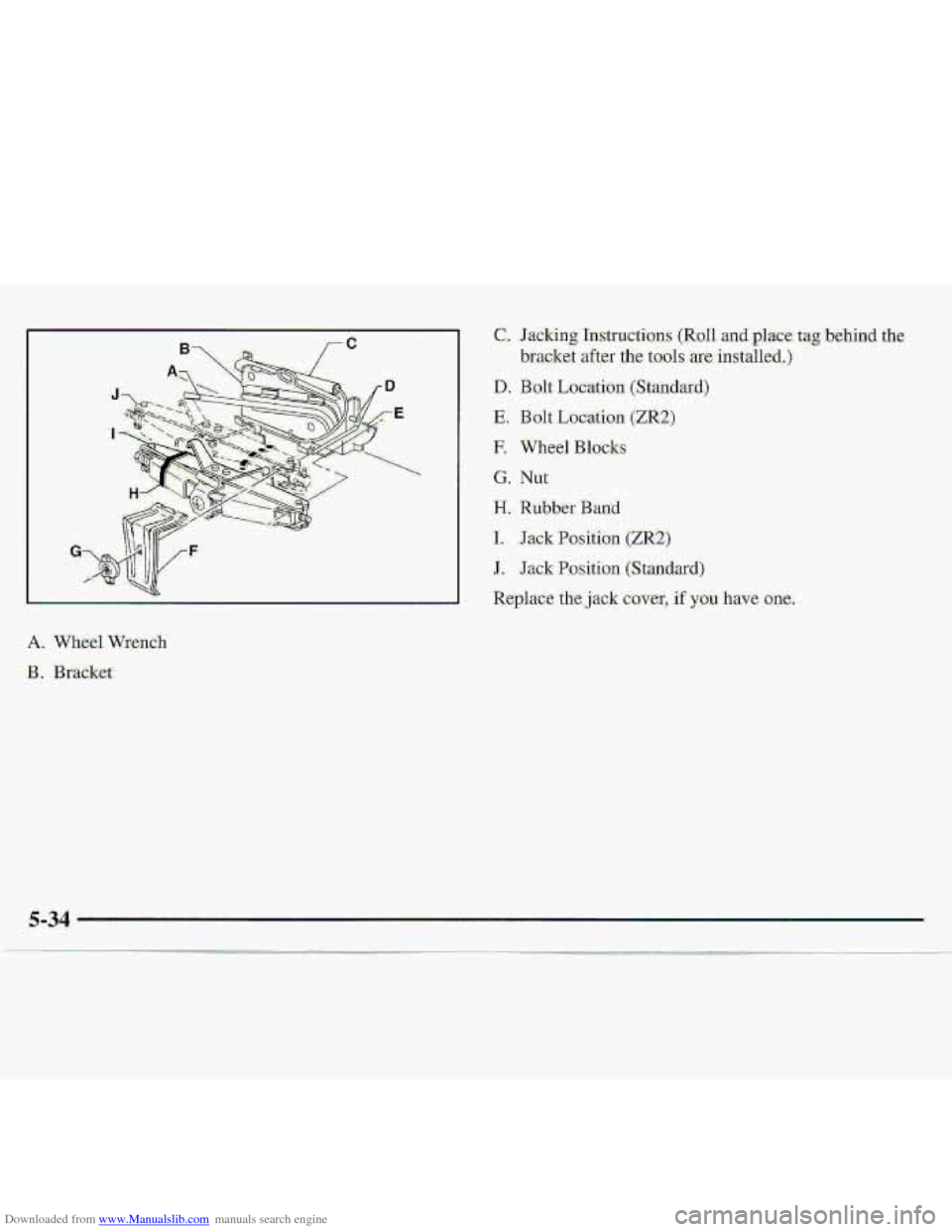
Downloaded from www.Manualslib.com manuals search engine A. Wheel Wxensh
3. Bracket:
C..
D..
E.
E
G.
H,
1.
J.
Repl.ace the. j-ack cover, -if -you have one.
Page 232 of 402
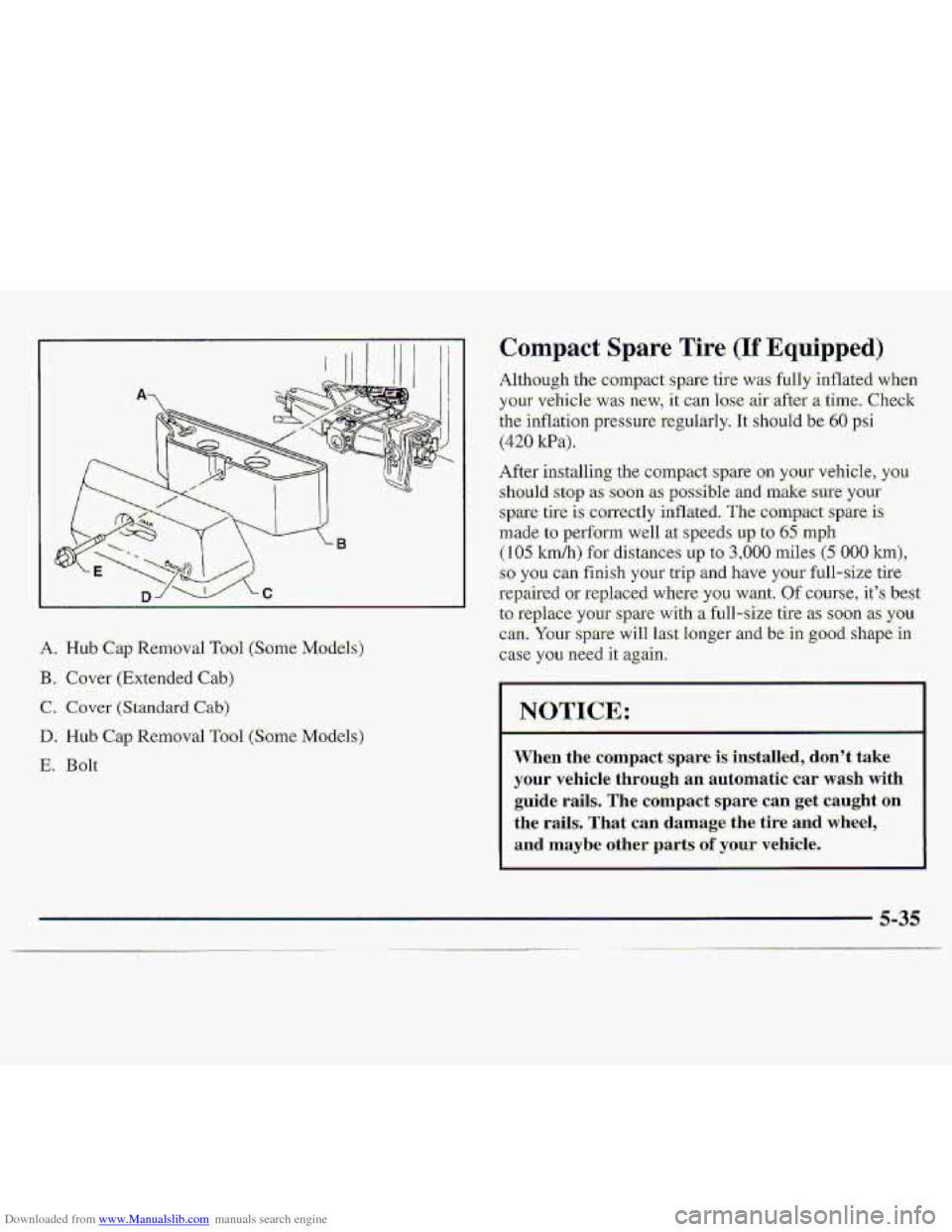
Downloaded from www.Manualslib.com manuals search engine A, Hub Cap Removal Tool (Some Mmiels)
E. Cover (Extended Cab)
%. Cover (Stand,ard Cab)
D. Hub Cap Removal Tool (Some Models)
E. Bdt
Compact Spare Tire (If Equippe.d)
Although the compact spare-tire was fully inflated when
your vehicle w.as new, it can lose air after a time. Check
the. inflation pressure regularly. It should be 60 psi
(420 kPa).
After installing the compact spare on your vehicle, you
should stop as 'soon as possible and 'm.ake-. sure your
spare tire
is cor-rec.tly inflated. The compact spare is
made to perform well at speeds up to 65 :mph
(I 05 krn/h) for distances up to 3,000 miles (5.000 km),
so you can finish your trip and have your full-size tire
repaired or replaceid where.you
want. Of course, it's best
to replace y0.w spare with a full-size tire as soon as you
can. Your spare will last longer and be: in .good shape in
case you-need it again.
I NOTICE: I
When the compact 'spare: is installed, don't ta.ke
your vehicle through
an automatic car wash with
guide rails, The compact spare can get caught on
the rails; That can damage the tire and wheel,
-and maybe other-parts of your vehicle.
Page 233 of 402
Downloaded from www.Manualslib.com manuals search engine Dan’t use your. campacl. spare .on othex vehicle-s,
And don’t mix .yoat cumpact c spa^. tirem-wheel with
:olher-whe;els-ar tk~. They won’t fit. Keep yirur. spare
tire and its whd together.
NOTICE.:
Tire chains: won’t - fit your xornpact .spare. Using
th.em can damage.yaur ve~hicle .and can damage:
the chains
too-. Don’t use :tire chains an your
CaPnpact.-spaPe.
If You’re .Stuck.: In
Ice or Snow
What: you d.on”t want to .do when yo.t~e vehcle is sty& i.~
t.0 spin your wheels too fast. Tlie melhod known as
‘:rocking” can heIp you. g-et out whm you’re: stack, but
you must use: caution.
explode.,. and you or oth-ers could be.injure& And,
the tran3mission or other pqrts of the. .vehicle. cm.
,overheatc That :could cause an engine
compartment fire
:or other damage. When yo.u’re.
.stuck, .spin the wheels as little-as passsble. Dan%
spin the- wheels above 35 mph (55 kmh) as shown
‘on the speedometer.
Page 234 of 402
Downloaded from www.Manualslib.com manuals search engine NOTICE:
Spinning your wheels can destroy parts of your
vehicle as we11 as the tires. If you spin the wheels
too fast while shifting your transmission back
and forth, you can destroy your- transmission.
For information about using tire chains on your vehicle,
see “Tire Chains” in the Index.
Rocking Your Vehicle To Get It Out
First, turn your steering wheel left and right. That will
;clear the area around your front wheels. Then
shift back
,;and forth between REVERSE (R) and a forward gear (or
*with
a manual transmission, between FIRST (1) or
SECOND (2) and REVERSE(R)), spinning the wheels
as little
as possible. Release the accelerator pedal while
you shift, and press lightly on the accelerator pedal
when the transmission is in g,ear. If that doesn’t get
you
out after a few tries,. you may need to be towed out. Or,
you c.an use.your recovery hooks if your vehicle. has
::them. IT you do need
to be tawed out, see “Towing Your
”Vehicle” in the
Index,.
U-sing the Recovery Hooks
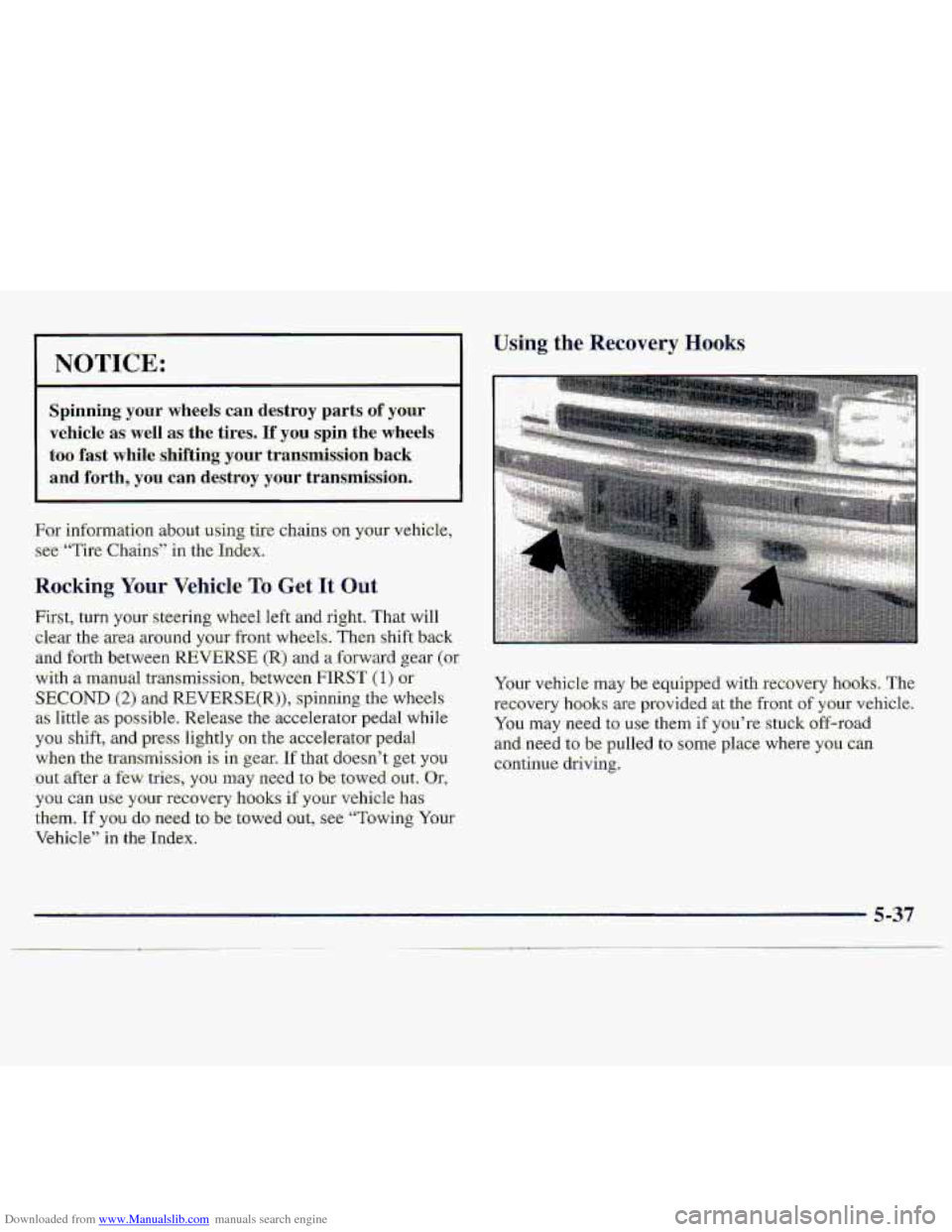
Tour vihilfe may be equipped with recovery hooks. The
recovery
hooks are pmvided at the front of yo-ur vehicle.
You may need to use them if you’re stuck off-road
and need to be pulled to some place where you can
wntinue driving.
5-37
____
Page 238 of 402
Downloaded from www.Manualslib.com manuals search engine Section 6 Service and. Appearance Care
Here:you will find inf6frriatisn about 'the care of your vehicle. This section begins with Service and fuel information,,
and then it.shows how to check important fluid and lubriean~.Ievz=ls.. There is a1s.o technical informatkm &;gut your
vehicle, and a pmt devoteft to itsappearance c.are.
Fuel
Fuels in Foreign Countrks
Filling
Your Tank
Checking Things Ugdgr lhs Hood
Engine Oil
Air Cleaner
Autam-atic Trans-missi-on Fluid.
Manual Transmission Fluid..
Hy.draulk Clutch
Rear Axle
Four-wheel Drive
Engine' Coolant
Radiator Pressare- Cap
'Thermg-sgat
P6we.r. Steering Fluid
..
6-29
6-3.1
6- 3-5.
6 -3 5
-6-42
6-44
-6-53
6-53
6-57
6-6.1
6-62
'6-63
6-67
6-68
&'70
Windshield. Washer Fluid
Brakes
Battery
Bulb Replacement
Windshield;
Wiper Blade Rephement
Tires
Appearance Care
Cleaning the Inside of Your Vehicle
Cleaning the Outside
of Your Vehicle
Appearance Care Materids Chat
Vehicle Identification Number (VIN)
Electrical Sptem
Replacement Bulbs
Capacities -and Specificztions
Air Conditioning Refrigerants
6" 1
Page 260 of 402
Downloaded from www.Manualslib.com manuals search engine What to Use
Refkr to the Mainteriance Schedule to determine- what
kind
of lubricant to use., See “Remmmended Fluids and
Lubricants” in the Index.
Four- Wheel Drive
Most lubricant checks in this section also apply to
four-wheel-drive vehicles. However, they have
two additional systems that need lubrication.
Transfer Case
When to Check Lubricant
Refer to the Maintenance Schedule to determine how
often to check the lubricant.
See “Periodic Maintenance
Inspections” in the Index.
How to Check Lubrimnt
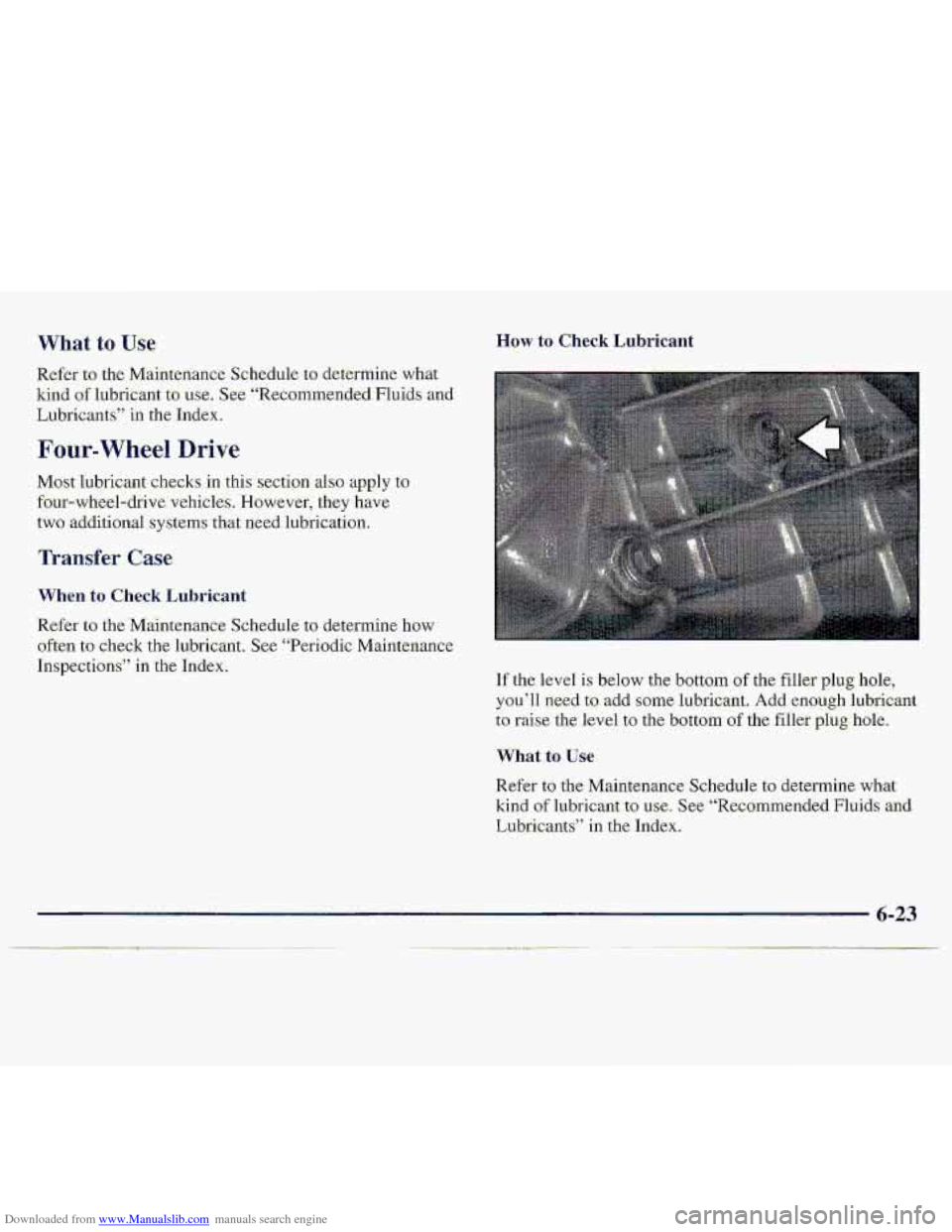
If the level is below the bottom of the. filler plug hole,
you’ll need to add some lubricant. Add enough lubricant
to raise the level to the bottom of the filler plug hole.
What to Use
Refer to the Maintenance Schedule to determine what
kind
of lubrican-t-to use. See “Recommended Fluids and
Lubricants” in the Index.
Page 271 of 402
Downloaded from www.Manualslib.com manuals search engine Some driving conditions or cljrnates may cause-a brake
squeal when. the brakes are first app1ie.d or li,ghtly
;ipplied. This; does.laot mean something is- wrong with
your brakes,
Propeiiy torqued wheel nuts axnecessary to h:elp
prevent. brake pulsation. When tirm are rotated, inspect
-brake pads for wear and evenly ‘torque wheel nuts in the
-proper sequence to GM specifications.
You rea dnm brakes. don’t’h-ave wear irdicators, but- if
you ever hear a rex brake rubbing noise, have the rear
-brake- linings inspected. Also, the .rear brake drums should
be removed and inspected each time the tit-& are removed
-for rotatimar
changing, When you have the &ant brakes
replaced, have the rear bp&m inspected, too,
.Brake linings should alw-ays be replaced as complete
axle -sets.
See, “Brake System I-nspection” ixl Section 7 of this manual
under Part C “Pexiodic Maintenance Inspections.”
.Brake P.edaL Travel
S-ee your dealer if the brake pedal does .not return to
normal hei-ht,, or if there is a rapid increase in pedal
,travel. This cau1.d I be a sign :qf brake troubk,
Brake Adjustment
Every time you make a brace s~op, your disc brakes
adjust for wear.
If your brake pedal goes down farthcr than normal., your
rear drum brakes may need-:adjustrnent. Adjust them by
backing up and firmly applying the brakes a few times.
Replacing B:rake System Pats
6-34
Page 283 of 402
Downloaded from www.Manualslib.com manuals search engine Tire Inspection and Rotation
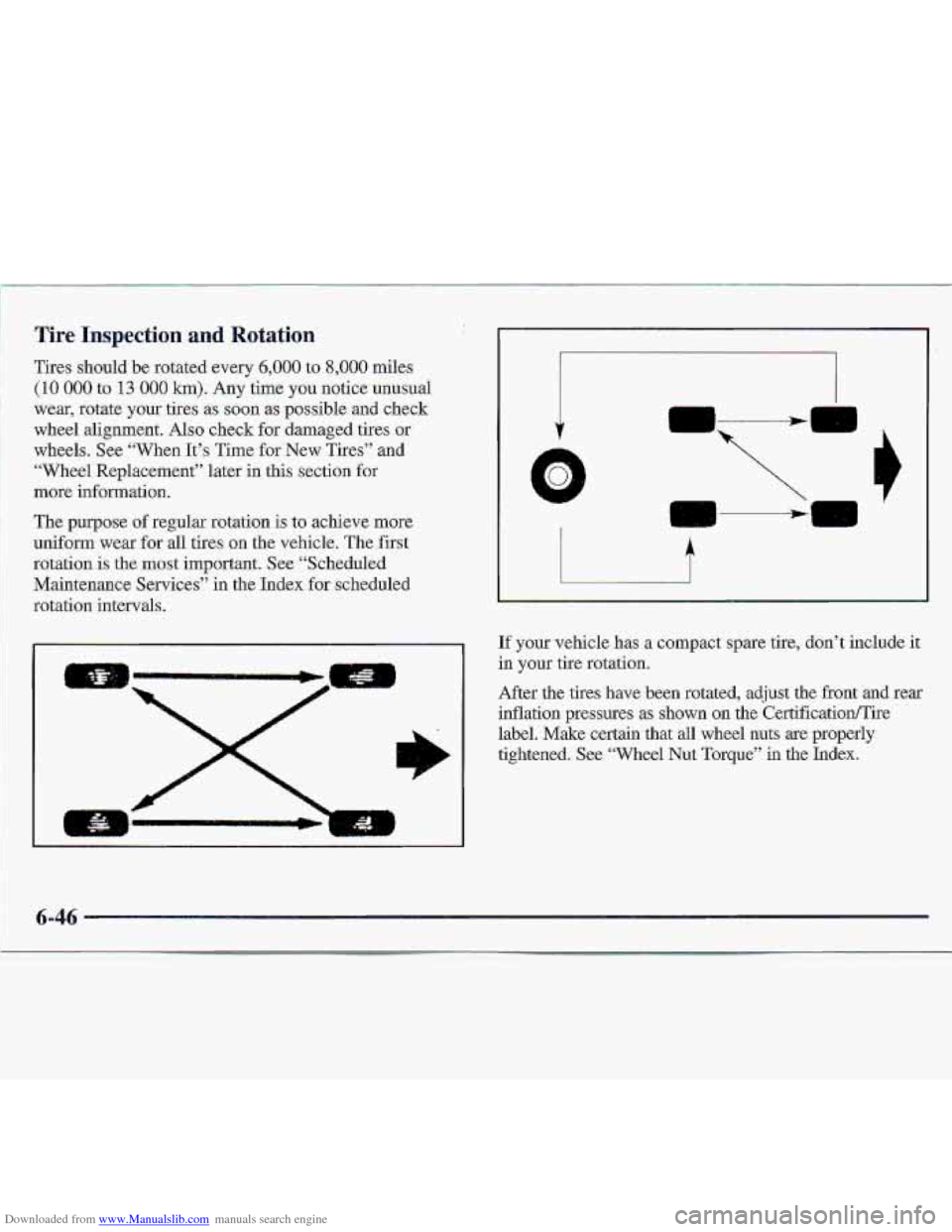
Tires should be rotated every 6,000 to 8,000 miles
(10 QOO. to 13 0.00 km). Any time you notice unusual
wear, rotate your tires
as soon as possible and check
wheel alignment. Also check for damaged tires or
wheels. See “When
It’s Time for New Tires” and
“Wheel Replacement” later in this section for
more information.
The purpose
of regular rotation. is to achieve more
uniform wear for
all tires on the vehicle. The first
rotation is the mast important. See “Scheduled
Maintenance Services”
in the Index for scheduled
rotation intervals.
If your vehicle has a compact spare tire, don’t include it
in your tire rotation.
After the tires have bea rotated, adjust the front
and rear
inflation. pressures
as shown on the Certificatioflire
label. Make certain that all wheel nuts
are. properly
tightened. See “Wheel Nut Torque” in the Index.
6-46 ,,,. .. -~I