Page 65 of 402
Downloaded from www.Manualslib.com manuals search engine NOTICE:
-Shifting tu REVERSE (R) wh’ilcrymr whide is
moving
forward codd damage your
tran&issio.n. Shift to REVERa (,R) only -after
your vehicle is stopped.
NEUTRAL (N): In this position, your-engme doesn’t.
connect- with the wheels. To restart when you’rcyalready
moving, use NE.UTRAL CN) only.
I
Shifting out of PARK (I?) or NEUTRAL (N) while.
your engine is “racing” (running at high speed) is
dangerous, Unless your foot is’firrmly on the
brake pedal, your vehicle. ,could move. very
rapidly. You could luse control and- hit people
or objects. Don’t shift out of PARK (P) or
NEUTRAL (N) while you-r- errgin& rac-hg.
NOTICE:
2-18
Page 69 of 402
Downloaded from www.Manualslib.com manuals search engine When this light CoLmries on, you can shift to the next
higher
gear if weather;-road and, :traffic conditions let
you. Fa; the best fuel economy, accelerate slowly and
-:shift when the light..come,s on..
-Whil.e you accelerate, it is normal for the bght to go ,on
and off -if you quickly change the pwition of the
accelerator. Ignore
the-SHIFT .light when you downshift.
I
If you. skip more I in one gear when you
downshift, you could lose control of your vehicle.
;And y.ou could injure yourself or others. Don't shift
down more than om gear when you downshift.
If your vehicle has four-wheel drive and is equipped
with a
~znanual transmissim, disregard the shift light
when the- transfer
case is in 4LO.
Locking Rear Axle
If you. have this feature, your 1acking.rear axle- can give
you additional tracfim ~n snow, mud," ice, sand or
gravel. It. works like a standard axlemost ofthe the,
but when one
of the rear wheels- has no tractimand the
other
does, this €eatwe will allow the wheel with
traction to move .the vehicle.
Four-wheel Drive (If Equipped)
If your vehicle has. four-wheel drive, you-can send your
engine's dwi.ving power to all four wheels for extra
traction.
To shift QUt of tw-o-wheel drive and into
four-wheel drive, move the transfer case shift lever to
4HI or 4LO. You should use, 2HI-fix.xnost normal
driving conditions.
NOTICE:
~~~~ ~~~ ~~
Driving in the 4HI or 4L.O pusitions for a Icing.
time 0.n dry or wet pavement .could shorten the
life of. your vehicle's drivetrain.
2-22
Page 70 of 402
Downloaded from www.Manualslib.com manuals search engine Manual Transfer Case
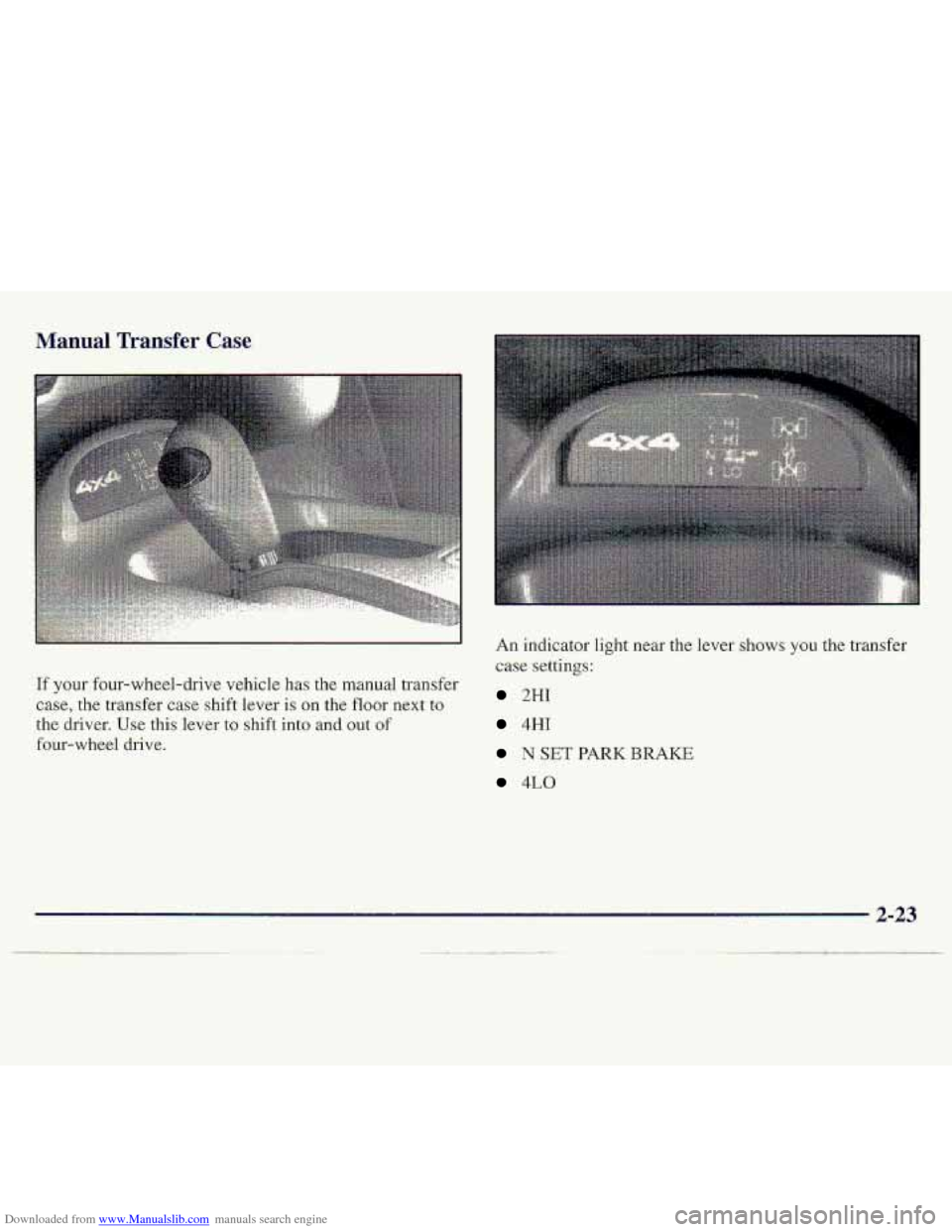
If your four-whd-.drive vehicle has the manual transfer
case, the transfer case
sh.ift lever is on the floor next to
the driver. Use this lever to shift into and out -of
four-wheel drive. An
indicator
light near the
case
,settings:
2HI
4HI
N SET PARK BRAKE
4LO
2-23
Page 72 of 402
Downloaded from www.Manualslib.com manuals search engine TO shift into or mt. of 4LQ:
1. The-vehicle myst be movingless than 3 mph
(4.8 h) with the tfansrnissi-on in NEUTRAL (N)
fa an automatic transmisSion. Fm a n~anual.
transmission, the clutch pedal must
.be engaged. The
p-referred method for shi€tin.g into 4LO is to have
your vehicle moving
1 to 2 mph (1.5 to 3.2 Wh).
2. Press the trans€er case s:hi€t buttan .and shift in one
continuous motion.
Don't pausejn
N SET PARIK;BRAKE as y-ou shift into
or out of 4L0, or your gears could clash.
Remember that driving in 4HI ur 4LO may reduce fuel
ec-onomy.
Also, driving in fo.ur-whee1 drive:on dry
pavement could cause your tires to wear faster and
make your transfer case harder to shift and-reduce
powertrain longevity.
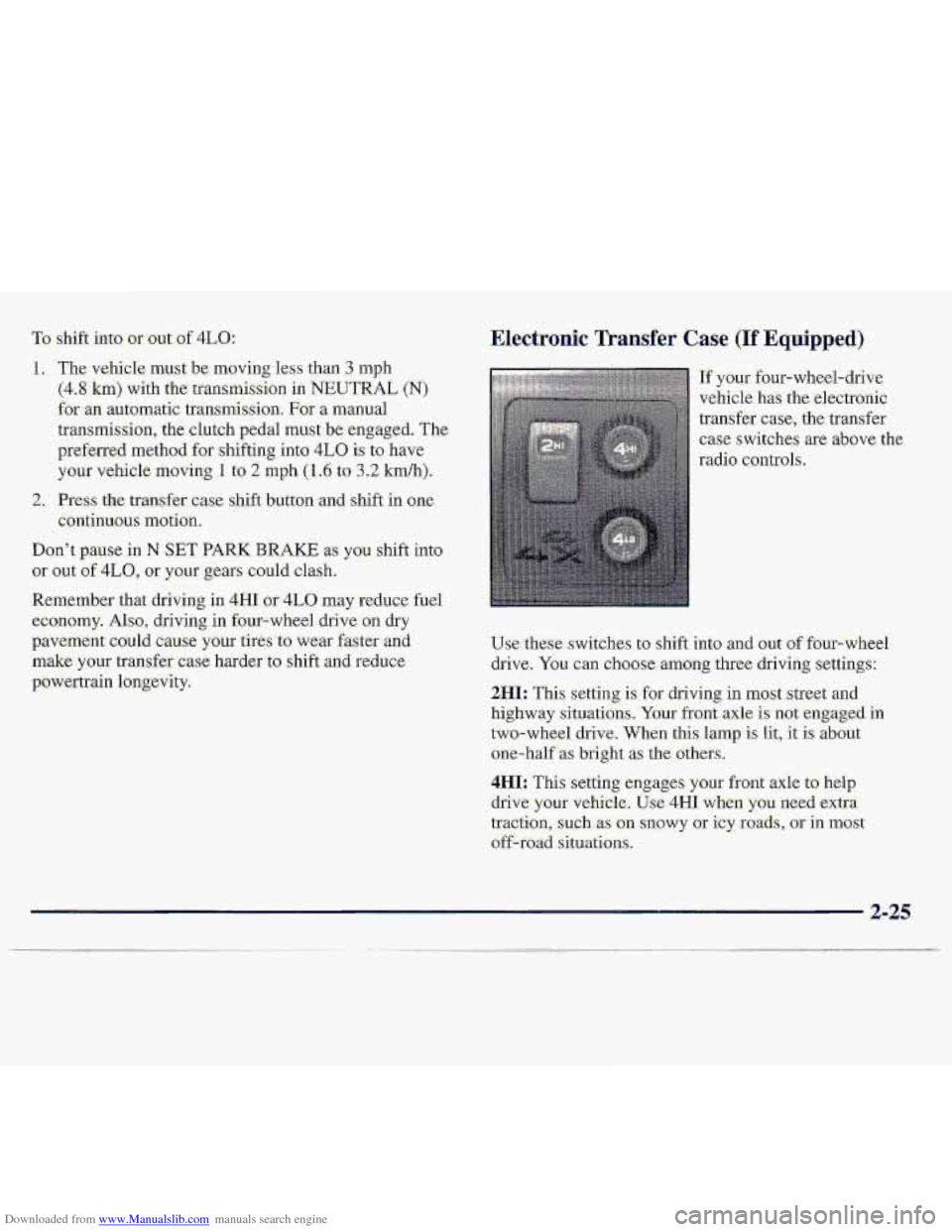
Electronic Transfer. Case (KEquipped)
I~y~~~-four-wheel-drive
vehicle
has the electrofiic
transfer
case, the transfer
case switches are above the,
radio controls.
Use these switches to shift into and out of four-wheel
drive.
You can choosea-rmng three driving settings:
2M[: This setting- is for driving in most .street and
highway situatibns ... Your front axle is not engaged in
two-wheel drive. When this. lamp is lit, it is about
orre-half as bright as the Others.
4HI: This setting engages your front axle ta- help
drive,
your vehitk. Use 4Hi when YOU. need extra
traction, such as
on snowy or icy rcmds, or in mast
off-road situations-.
Page 76 of 402
Downloaded from www.Manualslib.com manuals search engine Shifting Into PARK (P) (Automatic
Transmission Models Only)
It can be dangerous to get out of your vehicle if
the shift lever is not fd1y in PARK (P) with the
parking brake firmly set. Your vehicle can roll.
If you have left the engine- running, the vehicle
can move suddenly. You or others could be
injured.
To be sure your vehicle won’t move, even
when you’re on fairly level ground, use the steps
that follow.
If you have four-wheel drive with
a manual transfer case-shift lever and your
transfer case
is in NEUTRAL (N), your vehicle
wiIl be free to roll, even if your shift lever is in
PARK (P). So, b.e sure the trans€er case is in a
drive gear -- not in NEUTRAL (N). If you’re
pulling
a trailer, see CLTowing a Trailer’’ in
the Index.
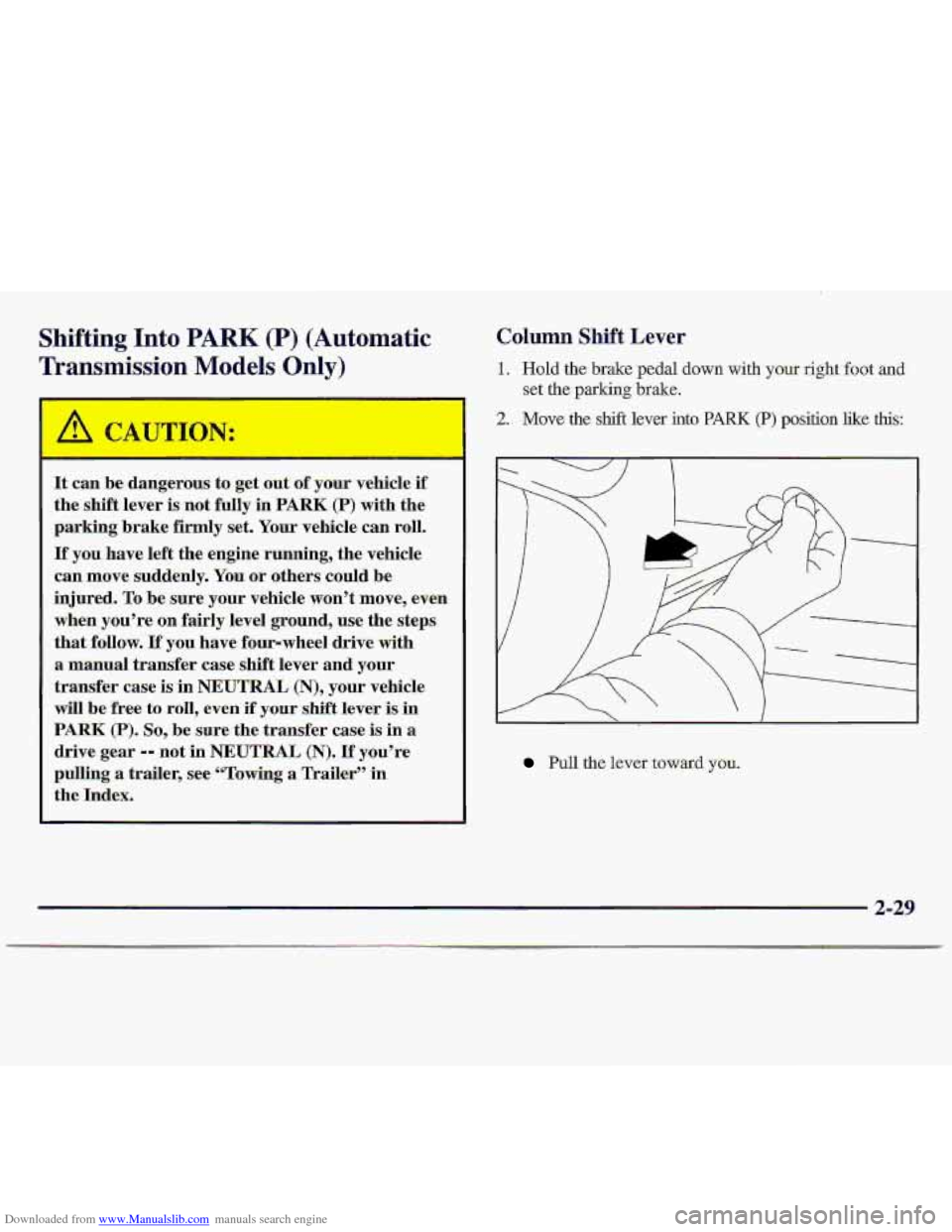
Column Shift Lever
1. Hold the brake pedal down with your right,foot and
2. Move the SM lever into PARK (P) position like this:
set the parking brake.
1 I
Pull the lever toward you.
2-29
Page 77 of 402
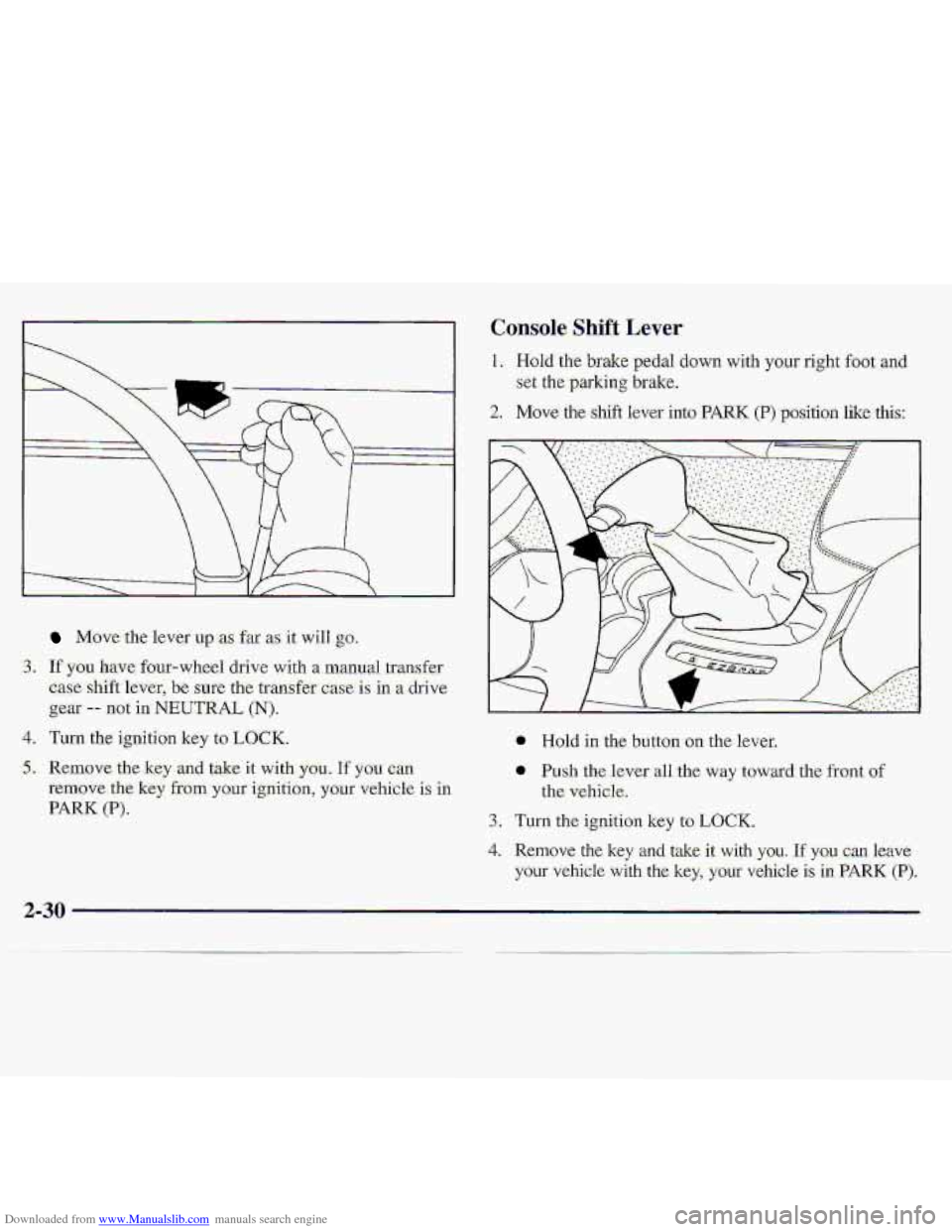
Downloaded from www.Manualslib.com manuals search engine Move the lever rjp as far as it will ga:
.3. If you have four-wheel drive with a manual .transfer
case shiftleverj be sure the transfer case is in a drive.
gear
-- not in NEUTRAL (N).
4. Turn the ignition key to LO-CK.
5. Remove the key and take it with you. Fyou c.an
remove the key from your ignitibn, your vehicle is in
PARK (P),
Console Shift Lever
1. Hold the bvake pedal dawn with your ri,ght foot and
2. Move the -shift .lever into PARK (PI position like this:
set the ,parking brake.
0 Hold in the button on the lever.
0 Push the lever abbe way towd the front of
t-he. vehicle.
3. Turn the ignition key to LOCK.
4. Remove the key and take it with you. If y0.u can leave
your vehicle
with the key, your vehicle is in PARK (P).
2-30
Page 78 of 402
Downloaded from www.Manualslib.com manuals search engine Leaving Your Vehicle With the Engine
Ru-ming (Auto,matic Tra mission
Models Only]
It can be dangerous to leave ; LXF -vehicle with the
engine- runnin.g. Your vehicle could move: suddenly
if
the shift lever is 'not fuUy in PARR (P) with the
parking brake. firmly set. If you: have fo-ur-wheel
drive
w.ith a manual transfer case shift lever and
your transfer caseis in
NEUTRAL (N), your
vehicle. will be free to roll, even if your shift lever
is-in PARK (P). So be sure- the transfer ,case.is in a
drive .gear -- not in NEUTRAL (N). And, E you
leave. the .vehicle with the engine running; it could.
overheat and even catch fire. You or others could.
be injured. Don'? leave your vehicle with the
engine rummg. unless you have to.
Page 79 of 402
Downloaded from www.Manualslib.com manuals search engine Shifting Out of PARK (.P)
(Automatic Transmission)
Your vehick has a brake-transmission shift biterlock.
You have to fully apply your regular brake before. you
can :.shift from PARK (P) when the i-gnitlon is in the
RUN position. See- “Automatic Transmission Operation”
in the Index,
If you cannot shift out of PARK (P), ease pressure on
the shift lever -- push the shift lever all the way into
PARK (PI as you maintain brake application. Then
move the shift lever into the gear you want (you must
pms the shift lever button if you have the. console
shift lever).
If you ever ho1.d the brake pedal down but still can’t
shift out
of PARK- (P), try this:
Par g, Your Vehicle (M-anual
Transmi,ssion Models Only)
Before you-get out of your vehicle, turn off your engine,
put
y.0~11- manual transmission in REVERSE-(R) and
firmly .apply the parking bzakei
If you have four-wheel drive with a manual transfer case
.shift lever, be sure
your transfer case is in a drive gear.
Your vehic1.e
could roll if it i.sn’t.
If you are parking on a hill or pulling a trailer, see
“Towing a Trailer” in the Index.
I. Turn the key to OFF.
2. Apply and ho-18 the brake until the end of Step 4.
3. Sliiffto NEUTRAL (N).
4. Start. the vehicle and then shift to the drive gear
5. Have the vehide fixed as soon as you can.
you want.
2-32
![CHEVROLET S10 1997 2.G Owners Manual Downloaded from www.Manualslib.com manuals search engine Leaving Your Vehicle With the Engine
Ru-ming (Auto,matic Tra mission
Models Only]
It can be dangerous to leave ; LXF -vehicle with the
e](/manual-img/24/8269/w960_8269-77.png "CHEVROLET S10 1997 2.G Owners Manual Downloaded from www.Manualslib.com manuals search engine Leaving Your Vehicle With the Engine
Ru-ming (Auto,matic Tra mission
Models Only]
It can be dangerous to leave ; LXF -vehicle with the
e")