1997 CHEVROLET CORVETTE recommended oil
[x] Cancel search: recommended oilPage 135 of 356
Downloaded from www.Manualslib.com manuals search engine Average Speed
Press the TRIP button until the average speed is
displayed, such as:
AVERAGE SPEED 62 MPH or
AVERAGE SPEED 100 km/h
Press reset in this mode to start calculating the average
speed. Press and hold RESET to clear.
Engine Oil Life
Press the TRIP button until the engine oil life is
displayed, such as OIL LIFE REMAIN
89%.
This is an estimate of the engine oil’s remaining useful
life. It will show
99% when the system is reset after
an oil change. It will alert you to change your oil
on
a schedule consistent with your driving conditions.
When the remaining oil life is low, the system will
alert you with a message CHANGE
OIL SOON.
When the oil life is down to zero, you will receive the
message CHANGE OIL NOW. To
reset the OIL LIFE reminder after an oil change:
1. With the ignition on, press the TRIP button so the
OIL LIFE percentage is displayed.
2. Press RESET and hold for two seconds. The word
RESET will appear, then
OIL LIFE 99%.
Remember, you must reset the OIL LIFE yourself after
each oil change. It will not reset itself. Also, be careful
not to reset the
OIL LIFE accidentally at any time other
than when the oil has just been changed. It can’t be reset
accurately until the next oil change.
The DIC does not replace the need to maintain your
vehicle as recommended in the Maintenance Schedule
in this manual. Also, the oil change reminder will not
detect dusty conditions or engine malfunctions that may
affect the oil. If you drive in dusty areas, change your
oil after every
3,000 miles (5 000 km) or three months,
whichever occurs first, unless the DIC instructs you to
do
so sooner. Also, the oil change reminder does not
measure how much
oil you have in your engine, so be
sure to check your oil level often. See “Engine Oil” in
the Index.
2-86
Page 202 of 356
Downloaded from www.Manualslib.com manuals search engine Once you are moving on the freeway, make certain you
allow a reasonable following distance. Expect
to move
slightly slower at night.
When you want to leave the freeway, move to the proper
lane well in advance. If you miss your exit, do not,
under any circumstances, stop and back up. Drive on
to
the next exit.
The exit ramp can be curved, sometimes quite sharply.
The exit speed
is usually posted.
Reduce your speed according to your speedometer, not to your sense of moti0.n. After driving for any distance
at higher speeds, you may tend to think you are going
slower than you actually
are.
Before Leaving on a Long Trip
Make sure you’re ready. Try to be well rested. If you
must start when you’re not fresh
-- such as after a day’s
work
-- don’t plan to make too many miles that first part
of the journey. Wear comfortable clothing and shoes you
can easily drive in.
Is your vehicle ready for a long trip? If you keep it
serviced and maintained, it’s ready to go. If it needs
service, have it done before starting out. Of course,
you’ll find experienced and able service experts in
Chevrolet dealerships all across
North America. They’ll
be ready and willing to help if you need it.
Here are some things you can check before a trip:
0
0
0
0
0
0 0
Windshield Washer Fluid: Is the reservoir full? Are
all windows clean inside and outside?
Wiper Blades: Are they in good shape?
Fuel, Engine Oil, Other Fluids: Have you checked
all levels?
Lamps: Are they all working? Are the lenses clean?
Tires: They are vitally important to a safe,
trouble-free trip. Is the tread good enough for
long-distance driving?
Are the tires all inflated to the
recommended pressure?
Weather Forecasts: What’s the weather outlook
along your route? Should you delay your trip a short
time to avoid a major storm system?
Maps: Do you have up-to-date maps?
4-23
Page 230 of 356

Downloaded from www.Manualslib.com manuals search engine 1 A CAUTION:
~ Adding only plain water to your cooling system
can be dangerous. Plain water, or some other
liquid like alcohol, can boil before the proper
coolant mix will. Your vehicle’s coolant warning
system is set for the proper coolant mix. With
plain water or the wrong mix, your engine could
get too hot but you wouldn’t get the overheat
warning. Your engine could catch fire and you or
others could be burned. Use
a 50150 mix of clean
water and DEX-COOL@ coolant.
NOTICE:
~
In cold weather, water can freeze and crack the
engine, radiator, heater core and other parts.
So
use the recommended coolant.
A CAUTIOK
You can be burned if you spill coolant on hot
engine parts. Caolant contains ethylene glycol
and it will burn if the engine parts are hot
enough. Don’t spill coolant on a hot engine.
5-19
Page 240 of 356

Downloaded from www.Manualslib.com manuals search engine Fuels in Foreign Countries
If you plan on driving in another country outside the
United States or Canada, the proper
fuel may be hard to
find. Never use leaded gasoline or any other fuel not
recommended in the previous text on fuel. Costly repairs
caused by use of improper fuel wouldn’t be covered by
your warranty.
To check on fuel availability, ask an auto club, or
contact a major oil company that does business in the
country where you’ll be driving.
You can also write us at the following address for
advice. Just tell us where you’re going and give your
Vehicle Identification Number (VIN).
General Motors International Product Center
1908 Colonel Sam Drive
Oshawa, Ontario
L 1 H 8P7
Filling Your Tank
The fuel fill door is on the driver’s side of the vehicle. The
fuel cap
is attached by a tether for your convenience.
I
Gasoline vapor is highly flammable. It burns
violently, and that can cause very bad injuries.
Don’t smoke if you’re near gasoline or refueling
your vehicle. Keep sparks, flames and smoking
materials away from gasoline.
6-5
Page 249 of 356
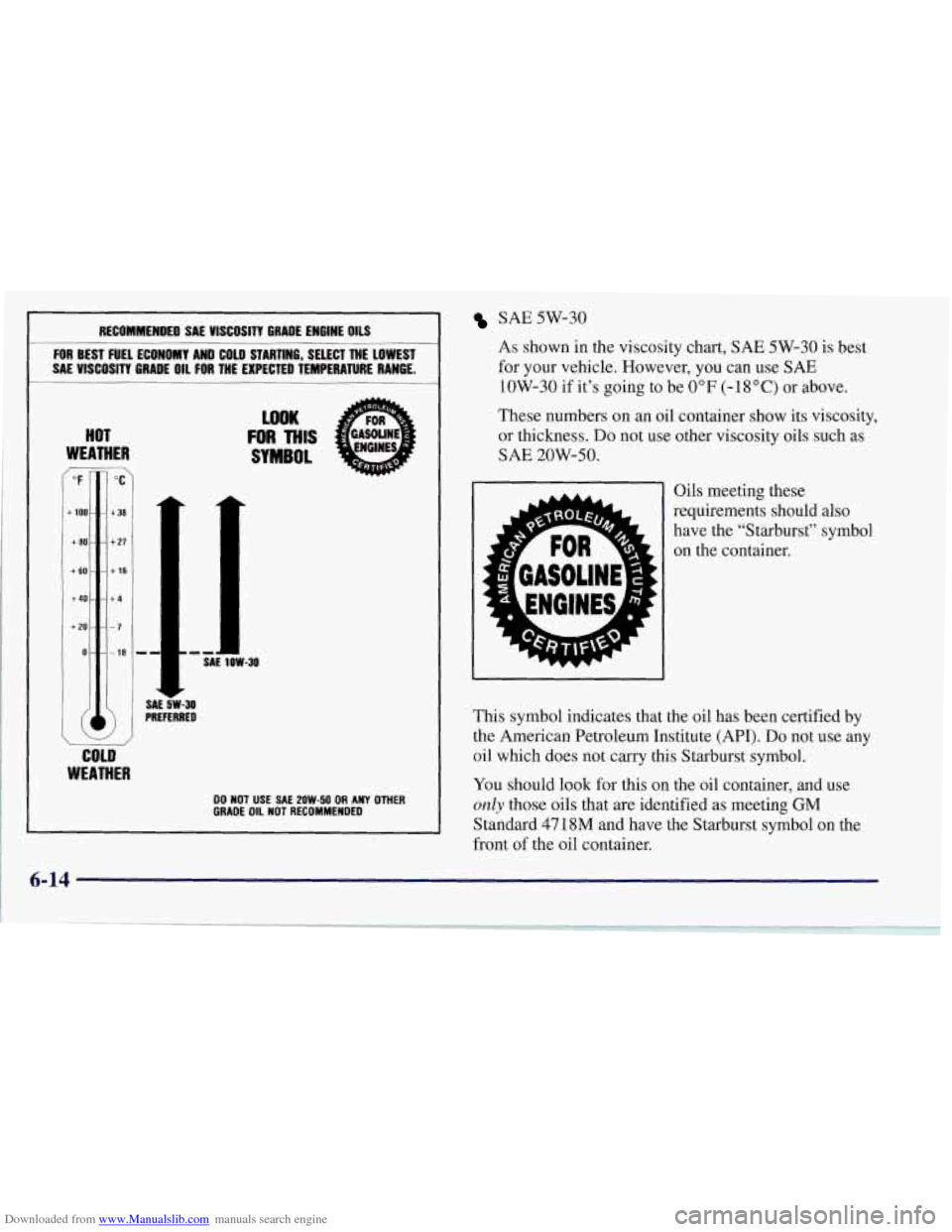
Downloaded from www.Manualslib.com manuals search engine RECOMMENDED SAE VISCOSITY GRADE ENGINE OILS
FOR BEST FUEL ECONOMY AND COLD STARTING, SELECT THE LOWEST
SAE VISCOSITY GRADE OIL
FOR THE EXPECTED TEMPERATURE RANGE.
I
HOT
WEATHER
COLD
WEATHER
LOOK
FOR MIS
SYMBOL
DO NOT USE SAE 2OW-50 OR ANY OTHER
GRADE OIL NOT RECOMMENDED
SAE 5W-30
As shown in the viscosity chart, SAE 5W-30 is best
for your vehicle. However, you can use
SAE
1OW-30 if it’s going to be 0°F (-18°C) or above.
These numbers on an oil container show its viscosity,
or thickness.
Do not use other viscosity oils such as
SAE 20W-50.
Oils meeting these
requirements should also
have the “Starburst” symbol
on the container.
This symbol indicates that the oil has been certified by
the American Petroleum Institute
(API). Do not use any
oil which does not carry this Starburst symbol.
You should look for this on the oil container, and use
only those oils that are identified as meeting GM
Standard
47 18M and have the Starburst symbol on the
front
of the oil container.
Page 294 of 356

Downloaded from www.Manualslib.com manuals search engine Appearance Care Materials Chart
1052918** 8 oz. (0.237 L) Armor All Protector
Protects vinyl, leather and rubber
1052925 16
oz. (0.473 L) Multi-Purpose Powdered Cleaner Cleans vinyl, cloth, tires and mats
1052929 16 oz. (0.473
L) Wheel Cleaner
Spray on wheel cleaner
1052930
8 oz. (0.237 L)
Capture Dry Spot Remover
Attracts and absorbs soils
12345002** 16
oz. (0.473 L) Armor All TM Cleaner Cleans vinyl, leather and rubber
12345725 12
oz. (0.354 L) Silicone Tire Shine Shines tires
12377964 16
oz. (0.473 L) Cleaning Wax
Protects finish and removes fine scratches
12377966 16
oz. (0.473 L) Finish
Enhancer
Spot cleans paint and gives high luster
See your General Motors Parts Department for these products. **Not recommended for
use on instrument panel vinyl.
See “Fluids and Lubricants’’ in the Index.
6-59
Page 309 of 356

Downloaded from www.Manualslib.com manuals search engine IMPORTANT:
KEEP ENGINE OIL
AT THE PROPER
LEVEL AND CHANGE AS I
RECOMMENDED
I
Introduction
Your Vehicle and the Environment
Proper vehicle maintenance not only helps to keep your
vehicle
in good working condition, but also helps the
environment. All recommended maintenance procedures
are important. Improper vehicle maintenance can even
affect the quality
of the air we breathe. Improper fluid
levels or the wrong tire inflation can increase the level
of emissions from your vehicle. To help protect our
environment, and to keep your vehicle in good
condition, please maintain your vehicle properly.
Have you purchased the GM Protection Plan? The Plan
supplements
your new vehicle warranties. See your
Warranty and Owner Assistance booklet, or your
Corvette dealer for details.
Page 312 of 356
Downloaded from www.Manualslib.com manuals search engine Maintenance Schedule
The services shown in this schedule up to 100,000 miles
(160
000 km) should be performed after 100,000 miles
(160
000 km) at the same intervals. The services shown
at
150,000 miles (240 000 km) should be performed at
the same interval after 150,000 miles
(240 000 km).
See “Owner Checks and Services” and “Periodic
Maintenance Inspections” following.
Footnotes
f The U.S. Environmental Protection Agency or the
California Air Resources Board has determined that the
failure to perform
this maintenance item will not nullify
the emissions warranty
or limit recall liability prior to
the completion of the vehicle’s useful life. We, however,
urge that all recommended maintenance services be
performed at the indicated intervals and the maintenance
be recorded.
* Your Corvette has an Engine Oil Life Monitor. This
monitor will show you when to change the
oil -- usually
between
3,000 miles (5 000 km) and 10,000 miles
(1
6 000 km) since your last oil change. Under
severe conditions, the indicator may come on before
3,000 miles (5 000 km). Never drive your vehicle
more than
10,000 miles (16 000 km) or 12 months
without an oil change. Use engine oil meeting the
GM Standard
GM47 18M.
The Engine Oil Life Monitor won’t detect dust in the
oil.
So if you drive in a dusty area, be sure to change
your oil every
3,000 miles (5 000 km) or sooner if the
CHANGE
OIL light comes on. Remember to reset the
Oil Life Monitor when the oil has been changed. For
more information,
see “Engine Oil Life Monitor” in
the Index.
7-5