1997 CHEVROLET CORVETTE key
[x] Cancel search: keyPage 220 of 356
Downloaded from www.Manualslib.com manuals search engine I
’
A CAUTION:
I
To help avoid injury to you or others:
Never let passengers ride in a vehicle that is
Never tow faster than safe or posted speeds.
Never tow with damaged parts not fully
Never get under your vehicle after it has
Always secure the vehicle on each side with
Use only R-hooks. being towed.
secured.
been lifted by the tow truck.
separate safety chains when towing it.
A vehicle can fall from a car carrier if it isn’t
adequately secured. This can cause
a collision,
serious personal injury and vehicle damage. The
vehicle should be tightly secured with chains or
steel cables before it is transported.
Don’t use substitutes (ropes, leather straps,
canvas webbing, etc.) that can be cut by sharp
edges underneath the towed vehicle. Always use
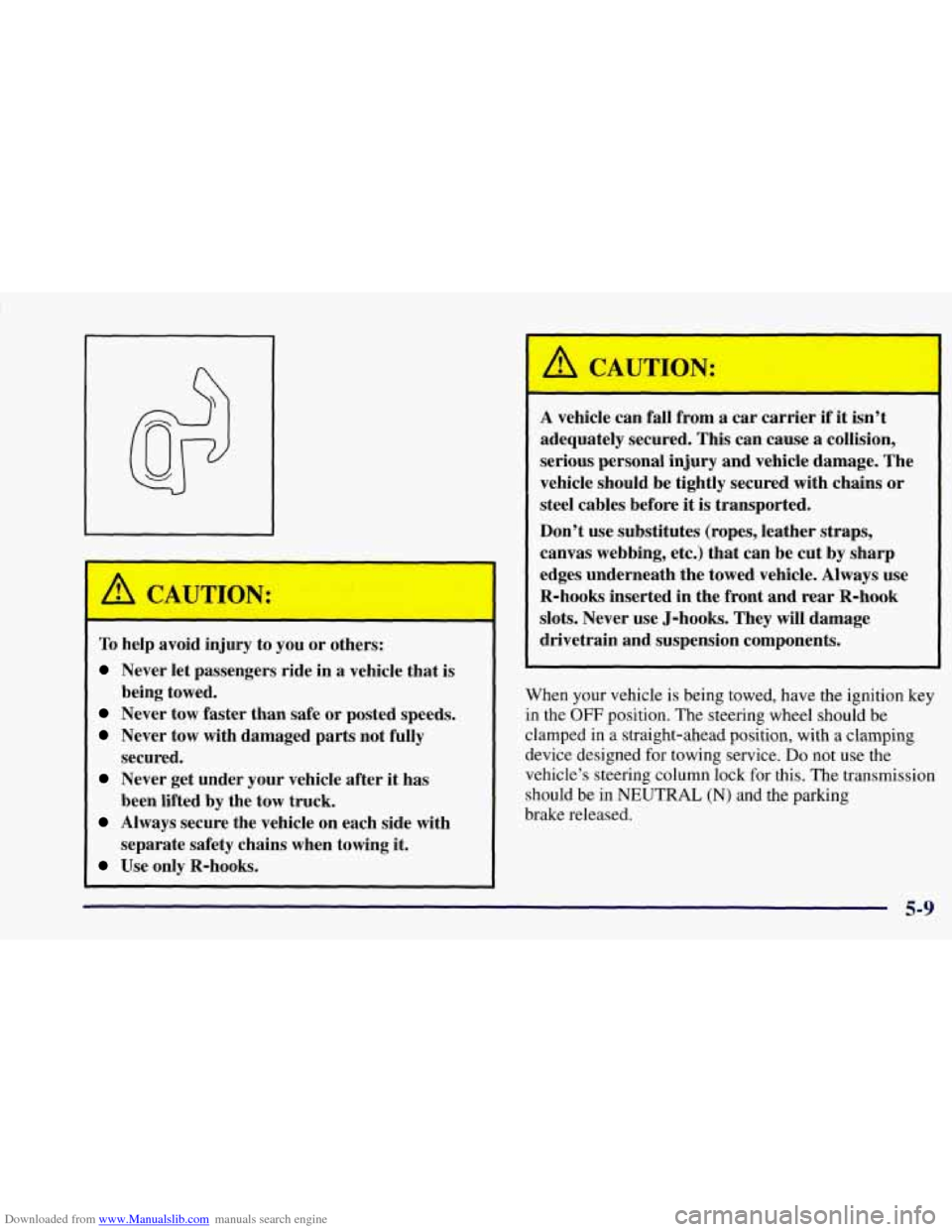
R-hooks inserted
in the front and rear R-hook
slots. Never use J-hooks. They will damage
drivetrain and suspension components.
When your vehicle is being towed, have the ignition key
in the
OFF position. The steering wheel should be
clamped in
a straight-ahead position, with a clamping
device designed for towing service.
Do not use the
vehicle’s steering column lock for this. The transmission
should be in
NEUTRAL (N) and the parking
brake released.
5-9
Page 285 of 356
Downloaded from www.Manualslib.com manuals search engine Used Replacement Wheels
Putting a used wheel on your vehicle is
dangerous. You can’t know how
it’s been used or
how far
it’s been driven. It could fail suddenly
and cause an accident.
If you have to replace a
wheel, use a new
GM original equipment wheel.
Using the Wheel Lock Key
The wheel lock key sits in a small depression in
the trunk rail directly under the left-hand rear
compartment cover.
Your vehicle wheel lock key has a unique registration
number. The registration number is printed on a card
included
in your lock nut package. Also on this card is
lost key replacement information. This number is not
recorded by
GM or your dealer, so be sure not to lose
this card. You will need the information if you ever lose
your wheel lock key.
If you or someone else is going to remove the wheels on
your vehicle, make sure that the special wheel nut socket
and wheel lock key are being used.
NOTICE:
Your wheels could be damaged if the wheel
nut socket is not used
to remove your
vehicle’s wheels.
The wheel nut socket can be used with an air wrench or
a torque wrench. The wheel lock key can
be used with a
torque wrench, but not with an air or impact wrench.
NOTICE:
Your wheel lock key or lock nuts could be
damaged if an
air or impact wrench is used with
this key.
6-50
Page 321 of 356
Downloaded from www.Manualslib.com manuals search engine At Least *ice a Year
Restraint System Check
Make sure the safety belt reminder light and all your
belts, buckles, latch plates, retractors and anchorages are
working properly. Look for any other loose or damaged
safety belt system parts. If you see anything that might
keep a safety belt system from doing its job, have it
repaired. Have any torn or frayed safety belts replaced.
Also look for any opened or broken air bag coverings,
and have them repaired or replaced. (The air bag system
does not need regular maintenance.)
Wiper Blade Check
Inspect wiper blades for wear or cracking. Replace blade
inserts that appear worn or damaged or that streak or
miss areas of the windshield. Also see “Wiper Blades,
Cleaning’’
in the Index.
Manual Transmission Check
Check the transmission fluid level; add if needed. See
“Manual Transmission” in the Index. Check for leaks. A
fluid
loss may indicate a problem. Have the system
inspected and repaired if needed.
Automatic Transmission Inspection
It is not necessary to check the transmission fluid level.
A transmission fluid leak is the only reason for fluid
loss. Check for leaks. If a leak occurs, take the vehicle to
your Chevrolet dealership Service Department and have
it repaired as soon as possible.
At Least Once a Year
Key Lock Cylinders Service
Lubricate the key lock cylinders with the lubricant
specified in Part D.
Body Lubrication Service
Lubricate all body door hinges. Also lubricate all hinges
and latches, including those for the hood, rear
compartment, console door and any folding seat
hardware. Part
D tells you what to use. More frequent
lubrication may be required when exposed to a
corrosive environment.
Page 322 of 356
Downloaded from www.Manualslib.com manuals search engine Starter Switch Check
m
Brake-Transmission Shift Interlock (BTSI) Check (Automatic Transmission)
When you are doing this check, the vehicle could
move suddenly. If it does, you or others could be
injured. Follow the steps below.
1. Before you start, be sure you have enough room
around the vehicle.
2. Firmly apply both the parking brake (see “Parking
Brake” in the Index if necessary) and the regular brake.
NOTE:
Do not use the accelerator pedal, and be
ready to turn off the engine immediately if it starts.
3. On automatic transmission vehicles, try to start the
engine in each gear. The starter should work only in
PARK (P) or NEUTRAL
(N). If the starter works in
any other position, your vehicle needs service.
On manual transmission vehicles, put the shift lever
in NEUTRAL (N), push the clutch down halfway
and try to start the engine. The starter should work
only when the clutch is pushed down all the way to
the floor. If the starter works when the clutch isn’t
pushed all the way down, your vehicle needs service.
A CAUTION:
When you are doing this check, the vehicle could
move suddenly. If it does, you or others could be
injured. Follow the steps below.
1.
2.
3.
Before you start, be sure you have enough room
around the vehicle. It should be parked on a
level surface.
Firmly apply the parking brake
(see “Parking Brake”
in the Index if necessary).
NOTE: Be ready to apply the regular brake
immediately
if the vehicle begins to move.
With the engine off, turn the key to the
ON position,
but don’t start the engine. Without applying the
regular brake, try to move the shift lever out
of
PARK (P) with normal effort. If the shift lever
moves out of PARK (P), your vehicle’s
BTSI
needs service.
7-15
Page 323 of 356
Downloaded from www.Manualslib.com manuals search engine Ignition Automatic Transmission Lock Check
While parked, and with the parking brake set, try to
turn the ignition key
to OFF in each shift lever position.
The key should turn to
OFF only when the shift lever is
in PARK (P).
On all vehicles, the key should come out only in
OFF.
Parking Brake and Automatic Transmission
PP-K(P)” .mCt k
A CAUTION:
When you are doing this check, your vehicle
could begin to move. You or others could be
injured and property could be damaged. Make
sure there
is room in front of your vehicle in case
it begins to roll. Be ready to apply the regular
brake at once should the vehicle begin to move.
Park on a fairly steep hill, with the vehicle facing
downhill. Keeping your foot on the regular brake, set the
parking brake.
To check the parking brake’s holding ability:
With the engine running and transmission in
NEUTRAL
(N), slowly remove foot pressure from
the regular brake pedal.
Do this until the vehicle is
held by the parking brake only.
To check the PARK (P) mechanism’s holding ability:
With the engine running, shift to PARK (P). Then
release all brakes.
Underbody Flushing Service
At least every spring, use plain water to flush any
corrosive materials from the underbody. Take care to
clean thoroughly any areas where mud and other debris
can collect.
Page 326 of 356

Downloaded from www.Manualslib.com manuals search engine USAGE
Key Lock
Cylinders
Rear Axle
(Limited-Slip
Differential)
Windshield Washer Solvent
FLUIDLUBRICANT
Multi-Pur ose lubricant,
Superlube (GM Part
No. 12346241 or equivalent).
Axle Lubricant (GM Part
No. 12345977) and
4 ounces
(1 18 ml) of Limited-Slip
Differential Lubricant Additive (GM Part No. 1052358 or
equivalent) where required. See “Rear Axle” in the Index.
GM Optikleen@ Washer
Solvent (GM Part No. 105
15 15)
or equivalent.
I USAGE
Hood Latch
Assembly,
Pivots, Spring Anchor and
Release Pawl
Hood and Door Hinges
Weatherstrip Conditioning
FLUIDLUBRICANT
Lubriplate lubricant aerosol (GM
Part No. 12346293 or equivalent)
or lubricant meeting requirements
of NLGI
## 2, Category LB or
GC-LB.
Multi-purpose lubricant,
Superlube@ (GM Part
No. 12346241 or equivalent).
Dielectric Silicone Grease (GM
Part
No. 12345579 or equivalent).
See “Replacement Parts” in the Index for recommended
replacement filters and spark plugs.
7-19
Page 334 of 356
Downloaded from www.Manualslib.com manuals search engine ChevroletIGeo Roadside
Assistance Program
To enhance Chevrolet’s strong commitment to customer
satisfaction, Chevrolet is excited to announce the
establishment of the Chevrolet/Geo Roadside Assistance
Center. As the owner of a
1997 ChevroletlGeo,
membership in Roadside Assistance is free. Roadside Assistance is available 24 hours
a day,
365 days a year, by calling 1-800-CHEV-USA
(1 -800-243-8872). This toll-free number will provide
you over-the-phone roadside assistance with minor
mechanical problems. If your problem cannot be
resolved over the phone, our advisors have access to a
nationwide network of dealer recommended service
providers. Roadside membership is free, however some
services may incur costs.
Roadside offers two levels of service to the customer,
Basic Care and Courtesy’” Care:
Toll-free number, 1 -800-CHEV-USA
0 Free towing for warranty repairs
0 Basic over-the-phone technical advice
Available dealer services at reasonable costs (ie.,
wrecker services, locksmithkey service, glass
repair, etc.)
8-5
Page 335 of 356
Downloaded from www.Manualslib.com manuals search engine ROADSIDE Courtesy TM Care PROVIDES:
e
e
e
a
e
Roadside Basic Care services (as outlined above)
Plus:
FREE Non-Warranty Towing (to the closest dealer
from a legal roadway)
FREE Locksmith/Key Service (when keys are lost
on the road or locked inside)
FREE Jump Start (at home or on the road)
FREE Fuel Delivery
($5 of fuel delivered on
the road) Chevrolet/Geo offers
Courtesy Transportation for
customers needing warranty service. Courtesy
Transportation will be offered in conjunction with
the coverage provided by the Bumper to Bumper
New Vehicle Limited Warranty to eligible purchasers
of 1997 Chevrolet/Geo passenger car and light duty
trucks. (Please see your selling dealer for details.)
Note:
Courtesy Care is available to Retail and Retail Lease
Customers operating 1997 and newer ChevroletlGeo
vehicles for a period
of 3 years/36,000 miles (60 OOO km),
whichever occurs first. All Courtesy Care services must
be pre-arranged by Chevrolet Roadside or dealer
Service Management.
Basic Cure and Courtesy Care are not part of or
included in the coverage provided by the New Vehicle
Limited Warranty. Chevrolet reserves the right to
modify or discontinue
Basic Care and Courtesy Care
at any time.