1997 CHEVROLET CAVALIER climate control
[x] Cancel search: climate controlPage 89 of 388
Downloaded from www.Manualslib.com manuals search engine Running Your Engine While You’re
Parked (Automatic Transaxle)
It’s better not to park with the engine running. But if you
ever have to, here
are some things to know.
/r CAUTION:
Idling the engine with the climate control
system
off could allow dangerous exhaust into
your vehicle (see the earlier Caution under
“Engine Exhaust”).
Also, idling in a closed-in place: can let deadly
carbon monoxide
(CO) into your vehicle even if
the fan switch is at the highest setting. One place
this can happen
is a garage. Exhaust -- with
CO
-- can come in easily. NEVER park in a
garage with the engine running.
Another closed-in place can be a blizzard.
(See “Blizzard” in the Index.)
A CAUTION:
t can be dangerous to get out of your vehicle if
the shift lever is not fully in PARK
(P) with the
parking brake firmly set. Your vehicle can roll.
Don’t leave your vehicle when the engine is
running unless you have to.
If you’ve left the
engine running, the vehicle can move suddenly.
You or others could be injured.
To be sure your
vehicle won’t move, even when you’re on fairly
level ground, always set your parking brake and
move the shift lever to
PARK (P).
Follow the proper steps to be sure your vehicle won’t
move.
See “Shifting Into PARK (P)” in the Index.
If you are parking on a hill and if you’re pulling a
trailer, also see “Towing
a Trailer’’ in the Index.
Page 121 of 388
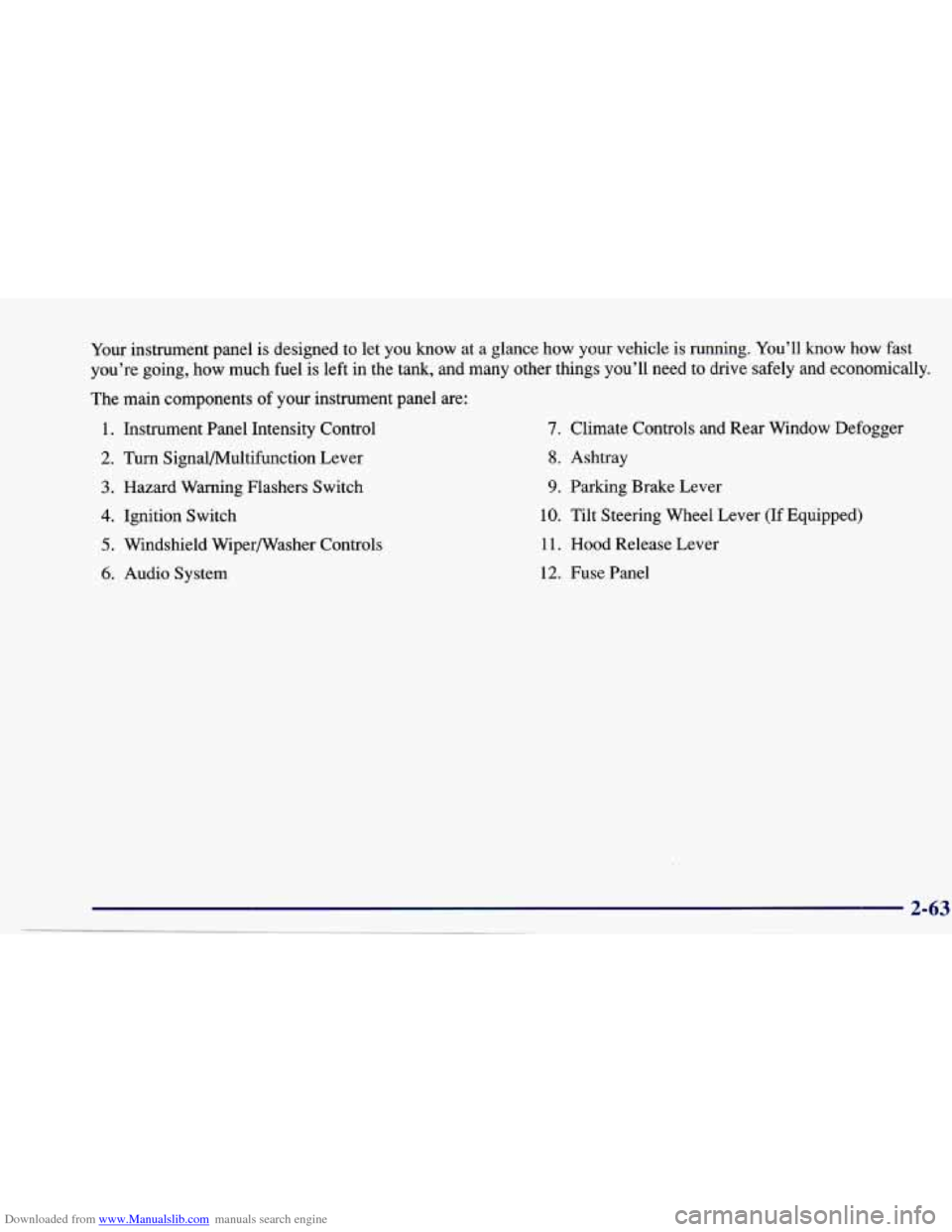
Downloaded from www.Manualslib.com manuals search engine Your instrument panel is designed to let you know at a glance how your vehicle is running. You’ll know how fast
you’re going, how much fuel is left
in the tank, and many other things you’ll need to drive safely and economically.
The main components
of your instrument panel are:
1. Instrument Panel Intensity Control
2. Turn Signal/Multifunction Lever
3. Hazard Warning Flashers Switch
4. Ignition Switch
5. Windshield Wipermasher Controls
6. Audio System
7. Climate Controls and Rear Window Defogger
8. Ashtray
9. Parking Brake Lever
10. Tilt Steering Wheel Lever (If Equipped)
1 1. Hood Release Lever
12. Fuse Panel
Page 138 of 388
Downloaded from www.Manualslib.com manuals search engine Comfort Controls
This section tells you how to make your air system work
for you. The optional climate control system with air
conditioning uses ozone-friendly
R- 134a refrigerant.
With these systems, you can control the ventilation and heating in your vehicle. Your vehicle also has the
flow-through ventilation system described later in
this section.
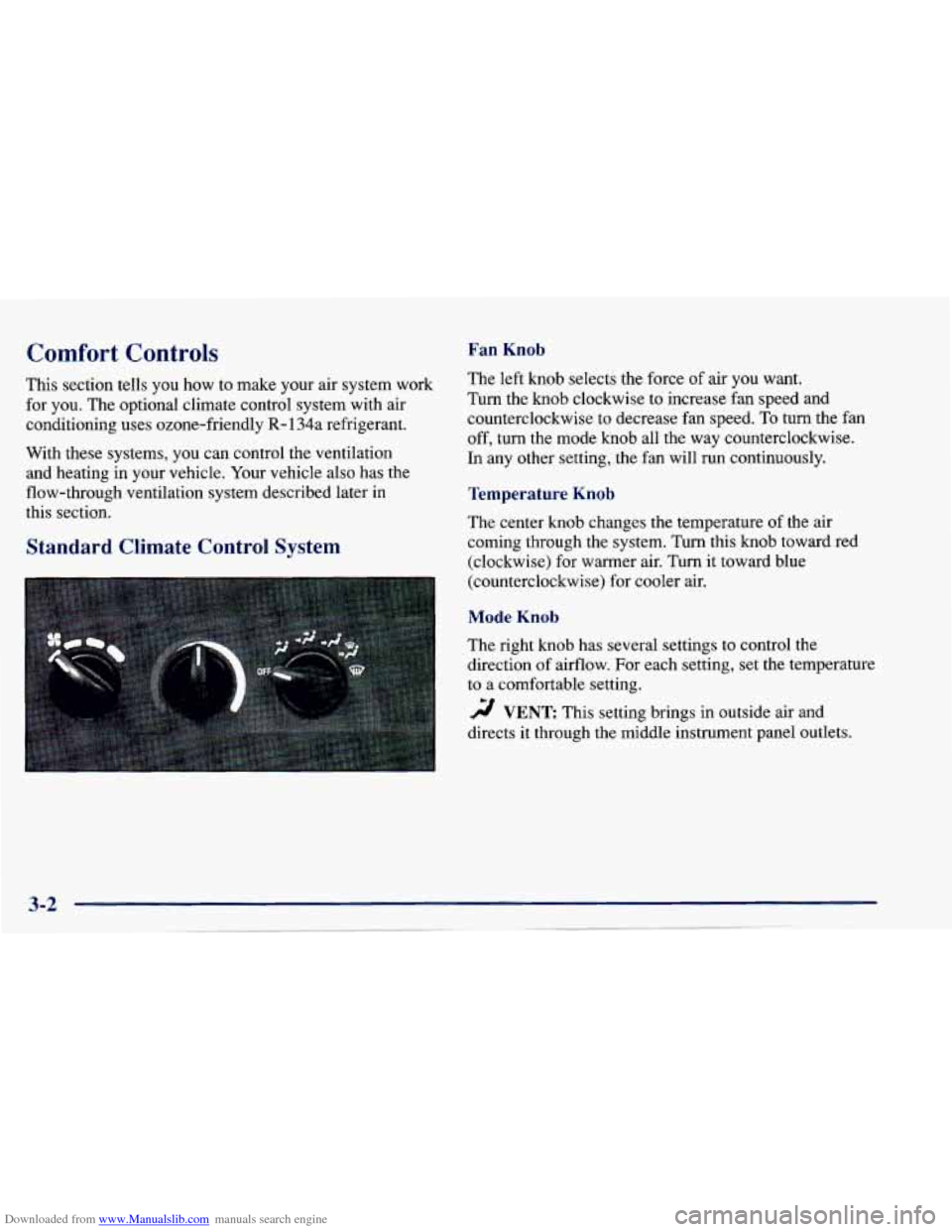
Fan Knob
The left knob selects the force of air you want.
Turn the
knob clockwise to increase fan speed and
counterclockwise to decrease fan speed.
To turn the fan
off, turn the mode knob all the way counterclockwise.
In any other setting, the fan will run continuously.
Temperature Knob
The center knob changes the temperature of the air
coming through the system. Turn this knob toward red
(clockwise) for warmer air. Turn it toward blue
(counterclockwise) for cooler air.
Standard Climate Control System
Mode Knob
The right knob has several settings to control the
direction of airflow. For each setting, set the temperature
to a comfortable setting.
2 VENT This setting brings in outside air ana
directs
it through the middle instrument panel outlets.
Page 139 of 388
Downloaded from www.Manualslib.com manuals search engine '!! BI-LEVEL: This setting brings in outside air and
directs it two ways. Some air is directed through the
instrument panel outlets. Most of the air is directed
through the floor ducts and a little to the defrost and side
window vents.
'!! FLOOR: This setting sends most of the air through
the ducts near the
floor. The rest comes out of the
defroster and side window vents.
9 DEFOG: This setting allows half of the air to go
to the floor ducts and half to the defroster and side
window vents.
DEFROST This setting directs most of the air
through the defroster and side window vents. Some of
the air goes to the floor ducts.
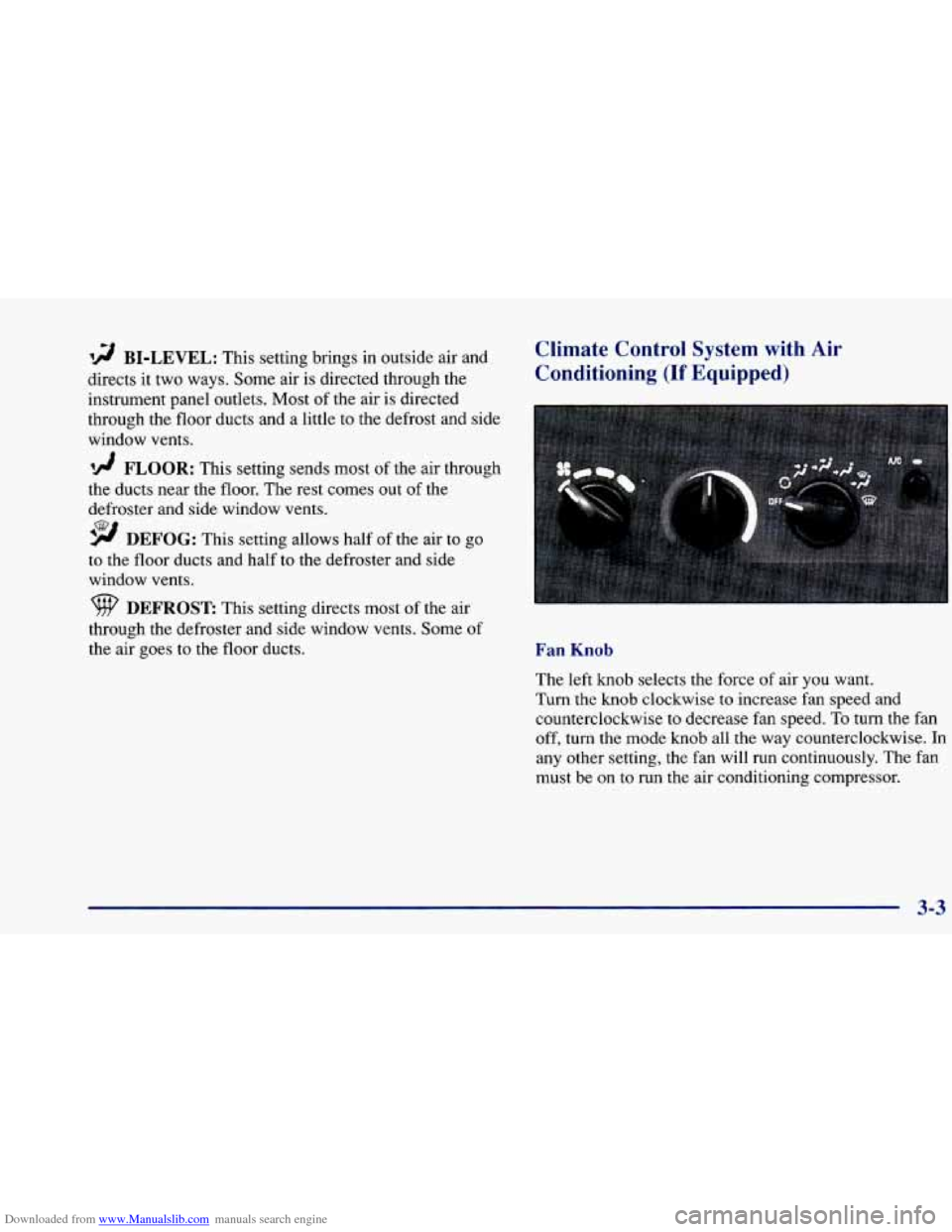
Climate Control System with Air
Conditioning (If Equipped)
Fan Knob
The left knob selects the force of air you want.
Turn the knob clockwise to increase fan speed and
counterclockwise to decrease fan speed.
To turn the fan
off, turn the mode knob all the way counterclockwise.
In
any other setting, the fan will run continuously. The fan
must be on
to run the air conditioning compressor.
3-3
Page 287 of 388
Downloaded from www.Manualslib.com manuals search engine Uniform Tire Quality Grading
The following information relates to the system
developed by the United States National Highway
Traffic Safety Administration, which grades tires by
treadwear, traction and temperature performance. (This
applies only
to vehicles sold in the United States.) The
grades are molded on the sidewalls of most passenger
car tires. The Uniform Tire Quality Grading system
does not apply
to deep tread, winter-type snow tires,
space-saver or temporary use spare tires, tires with
nominal rim diameters
of 10 to 12 inches (25 to 30 cm),
or to some limited-production tires.
While the tires available on General Motors passenger
cars and light trucks may vary with respect to these
grades, they must also conform to Federal safety
requirements and additional General Motors Tire
Performance Criteria
(TPC) standards.
Treadwear
The treadwear grade is a comparative rating based on
the wear rate of the tire when tested under controlled
conditions on a specified government test course. For
example, a tire graded 150 would wear one and a half
(1 1/2) times as well on the government course as a tire
graded 100. The relative performance of tires depends
upon the actual conditions
of their use, however, and
may depart significantly from the norm due to variations
in driving habits, service practices and differences in
road characteristics and climate.
Traction -- A, B, C
The traction grades, from highest to lowest, are A, B, and
C, and they represent the tire’s ability to stop on wet
pavement as measured under controlled conditions on specified government test surfaces
of asphalt and concrete.
A tire marked C may have poor traction performance.
Warning: The traction grade assigned to this tire is based
on braking (straightahead) traction tests and does not
include cornering (turning) traction.
- 6-45
Page 296 of 388
Downloaded from www.Manualslib.com manuals search engine Foreign materials such as calcium chloride and other
salts, ice melting agents, road oil and tar, tree sap, bird
droppings, chemicals from industrial chimneys, etc., can
damage your vehicle’s finish if they remain on painted
surfaces. Wash the vehicle as soon as possible. If
necessary, use non-abrasive cleaners that are marked
safe for painted surfaces to remove foreign matter.
Exterior painted surfaces
are subject to aging, weather
and chemical fallout that can take their toll over a period
of years. You can help to keep the paint finish looking
new
by keeping your Chevrolet garaged or covered
whenever possible.
Cleaning Your Convertible Top
Your convertible top should be cleaned often. If you use
an automatic car wash, use one with water jets and
hanging cloths. High pressure car washes may cause
water to enter your vehicle.
When you hand wash the top, do
it in partial shade.
Use a mild soap, lukewarm water and a soft sponge.
A chamois or cloth may leave lint on the top, and a
brush can chafe the threads in the top fabric. Don’t use
detergents, harsh cleaners, solvents or bleaching agents. When you clean the top, put
one hand under
it to
support it. Wet the entire vehicle and wash the top
evenly to avoid
spots or rings. Let the soap remain on
the fabric for a few minutes. When the top is really dirty,
use a mild foam-type cleaner. Thoroughly rinse the
entire vehicle, then let the top dry in direct sunlight.
To protect the convertible top:
0 After you wash the vehicle, make sure the top is
completely dry before you lower it.
0 Don’t get any cleaner on the vehicle’s painted finish;
it could leave streaks.
If you decide to go through an automatic car wash,
ask the manager
if the equipment could damage
your top.
Before entering a car wash, set the climate control to
VENT and the fan control to the highest speed. This will
help to prevent water under high pressure from entering
around the convertible top.
6-54
..
Page 377 of 388
Downloaded from www.Manualslib.com manuals search engine Cleaning ...................................... 6-49
AluminumWheels
............................ 6-55
Convertible Top
.............................. 6-54
Exterior LampLenses
......................... 6-53
Fabric
...................................... 6-49
Glass Surfaces
............................... 6-52
Inside of Your Chevrolet
....................... 6-49
Instrument Panel
............................. 6-51
Outside
of Your Chevrolet ...................... 6-53
Special Problems
............................. 6-50
Stains
...................................... 6-50
Tires
....................................... 6-55
Vinyl
....................................... 6-51
Wheels
..................................... 6-55
Windshield and Wiper Blades ................... 6-52
Climate Control System, Standard
................... 3-2
Climate Control System with Air Conditioning
......... 3-3
Clock, Setting the
................................ 3-8
Clutch Fluid, Hydraulic
.......................... 6-24
Clutch, Hydraulic
............................... 6-24
Comfort Controls
................................ 3 - 1
Compact Disc Adapter Kit ........................ 3-17
Compact Disc Care ............................. 3-25
Player
...................................... 3-17
Theft-Deterrent Feature
........................ 3-21
Compact Spare Tire
............................. 5-34
Control of a Vehicle
.............................. 4-6
Convenience Net
............................... 2-49
Convertible Top
Cleaning
.................................... 6-54
Installing
the Boot ............................ 2-53
Lowering
................................... 2-52
Lowering Manually
........................... 2-59
Operation
................................... 2-5 1
Raising ..................................... 2-58
Raising Manually
............................. 2-59
Removing the Boot
........................... 2-56
Convex Outside Mirror
.......................... 2-48
Coolant
....................................... 6-25
Heater. Engine
............................... 2-17
Surge Tank Pressure Cap ....................... 6-28
Cooling System
................................ 5-16
Courtesy Transportation ........................... 8-8
Cruise Control ................................. 2-38
Cupholders
.................................... 2-48
Customer Assistance for Text Telephone Users
......... 8-4
Customer Assistance Information
................... 8-1
Customer Satisfaction Procedure .................... 8-2
SurgeTank
.................................. 5-16
Damage.
Finish ............................... 6-56
Damage. Sheet Metal
............................ 6-55
Daytime Running Lamps/Automatic Light Control
.... 2-42
Dead Battery
................................... 5-3
Defects. Reporting Safety
........................ 8-10
Defensive Driving
............................... 4-2
Defogger. Rear Window
.......................... 3-7
Defogging
..................................... 3-7
Defrosting
..................................... 3-7
Dolby B Noise Reduction 3-16
Dome Lamp Bulb Replacement
.................... 6-39
DoorLocks
..................................... 2-4
Drive. Automatic Transaxle
....................... 2-21
Driver Position
................................. 1-13
Dimen ions. Vehicle
............................ 6-65 8 .......................
. .