Page 211 of 388
Downloaded from www.Manualslib.com manuals search engine 5. Find the positive (+) and negative (-) terminals on
each battery.
Using a match near a battery can cause battery
gas to explode. People have been hurt doing this,
and some have been blinded. Use
a flashlight if
you need more light.
Be sure the battery has enough water. You don’t
need
to add water to the Delco Freedom@ battery
installed
in every new GM vehicle. But if a battery
has fiiier caps, be
sure the right amount of fluid is
there. If it is low, add water to take care of that
first.
If you don’t, explosive gas could be present.
Battery fluid contains acid that can burn you.
Don’t get it on you.
If you accidentally get it in
your eyes or on your skin, flush the place with
water and get medical help immediately.
6. Check that the jumper cables don’t have loose or
missing insulation.
If they do, you could get a shock.
The vehicles could be damaged, too.
Before you connect the cables, here are some basic
things you should know. Positive
(+) will go to
positive
(+) and negative (-) will go to negative (-)
or a metal engine part. Don’t connect positive (+) to
negative
(-) or you’ll get a short that would damage
the battery and maybe other
parts, too.
Fans or other moving engine parts can injure you
badly. Keep your hands away from moving parts
once
the engine is running.
Page 212 of 388
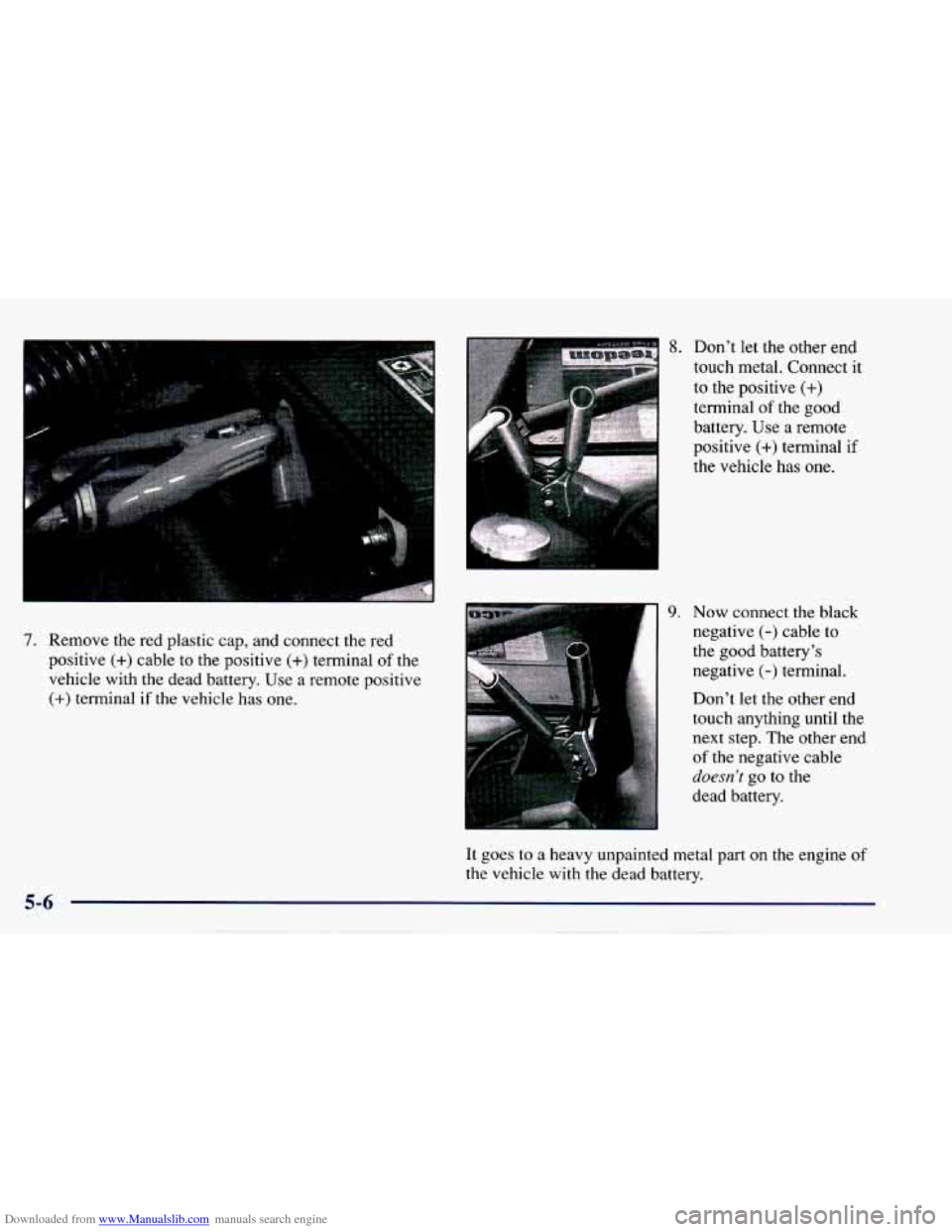
Downloaded from www.Manualslib.com manuals search engine 7. Remove the red plastic cap, and connect the red
positive
(+) cable to the positive (+) terminal of the
vehicle with the dead battery. Use a remote positive
(+) terminal if the vehicle has one.
-
8. Don’t let the other end
touch metal. Connect it
to the positive
(+)
terminal of the good
battery. Use a
remote
positive (+) terminal if
the vehicle has one.
9. Now connect the black
negative
(-) cable to
the good battery’s
negative
(-) terminal.
Don’t let the other end
touch anything until the
next step. The other end
of the negative cable
doesn’t go to the
dead battery.
It goes to a heavy unpainted metal pan on the engine
of
the vehicle with the dead battery.
5-6
Page 213 of 388
Downloaded from www.Manualslib.com manuals search engine 10. Attach the cable at least 18 inches (45 cm) away
from the dead battery, but not near engine parts that
move. The electrical connection
is just as good
there, but the chance
of sparks getting back to the
battery is much less.
11. Now start the vehicle with the good battery and run
12. Try to start the vehicle with the dead battery. If it
the engine for a while.
won't start after a few tries, it probably needs service.
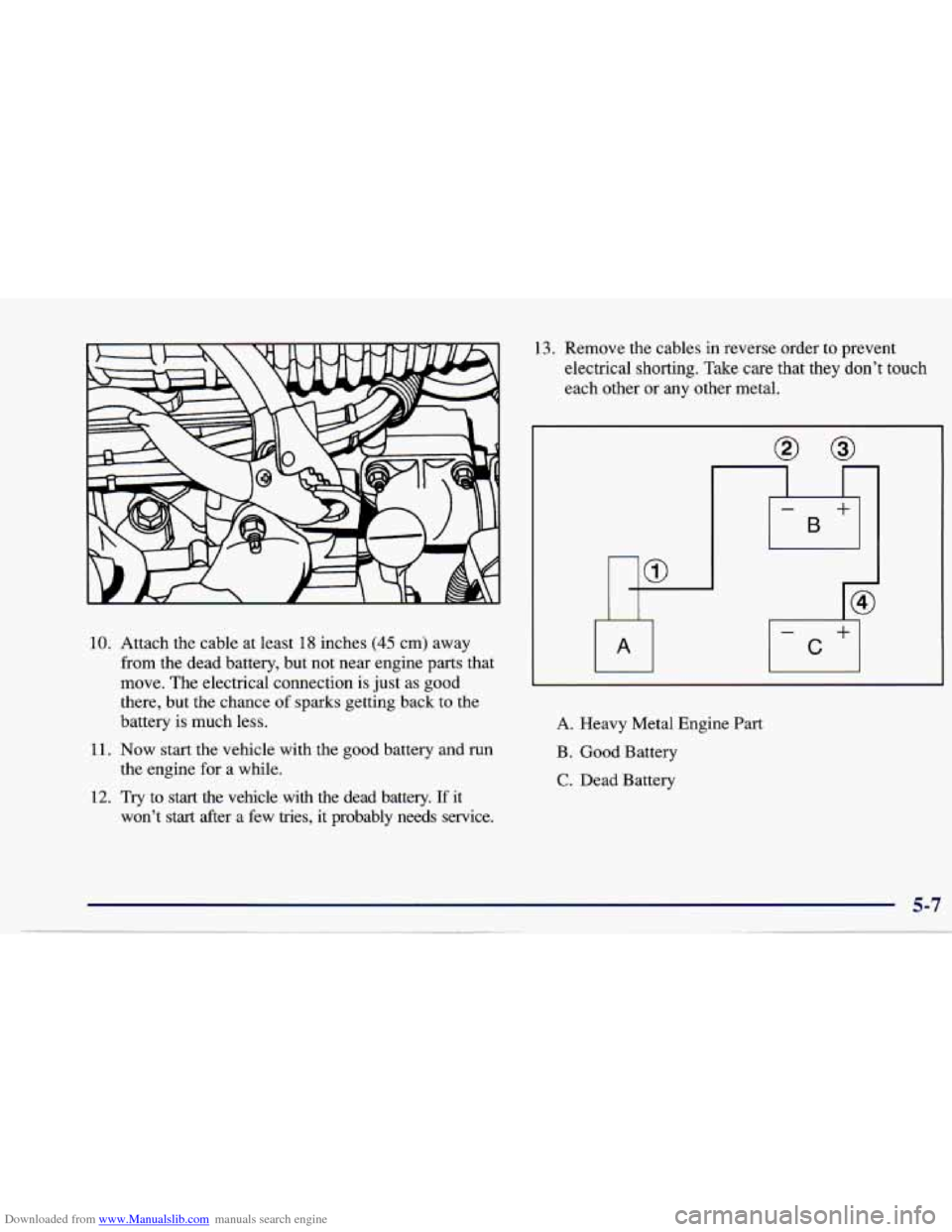
13. Remove the cables in reverse order to prevent
electrical shorting. Take care that they don't touch
each other or any other metal.
A. Heavy Metal Engine Part
B
. Good Battery
C. Dead Battery
Page 243 of 388
Downloaded from www.Manualslib.com manuals search engine Section 6 Service and Appearance Care
Here you will find information about the care of your Chevrolet. This section begins with service and fuel
information, and then it shows how to check important fluid and lubricant levels. There is also technical information
about your vehicle, and a part devoted to its appearance care.
6-3
6-6
6-8
6-12
6-17
6-18
6-2
1
6-22
6-24
6-25
6-28 Fuel
Filling
Your Tank
Checking Things Under the Hood
Engine Oil
Air Cleaner
Automatic Transaxle Fluid
(Except 2.4L Code T Engine)
Automatic Transaxle Fluid
(2.4L Code T Engine Only)
Manual Transaxle Fluid
Hydraulic Clutch
Engine Coolant Surge Tank Pressure Cap 6-29
6-30
6-3
1
6-35
6-35
6-40
6-52
6-55
6-56
6-56
6-58
6-58
6-64 Power Steering Fluid
Windshield Washer Fluid
Brakes
Battery
Halogen Bulbs Tires
Care of Safety Belts
Cleaning Tires
Finish Damage Underbody Maintenance Service Parts Identification Label
Electrical System Air Conditioning Refrigerants
Page 252 of 388
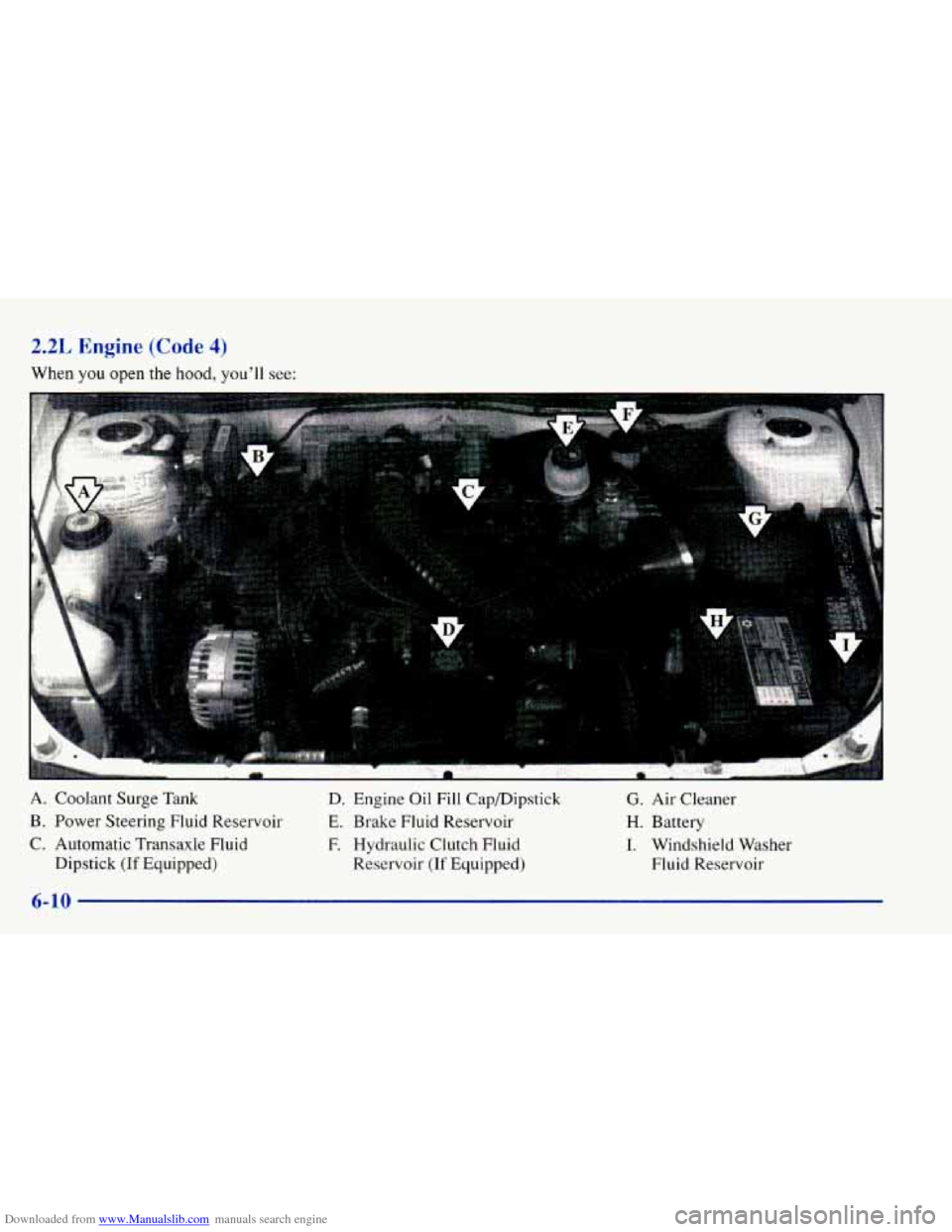
Downloaded from www.Manualslib.com manuals search engine 2.21, Engine (Code 4)
When you open the hood, you’ll see:
A. Coolant Surge Tank D. Engine Oil Fill CapDipstick
G. Air Cleaner
B. Power Steering Fluid Reservoir E. Brake Fluid Reservoir H. Battery
C. Automatic Transaxle Fluid E Hydraulic Clutch Fluid I. Windshield Washer
Dipstick
(If Equipped) Reservoir (If Equipped) Fluid Reservoir
Page 253 of 388
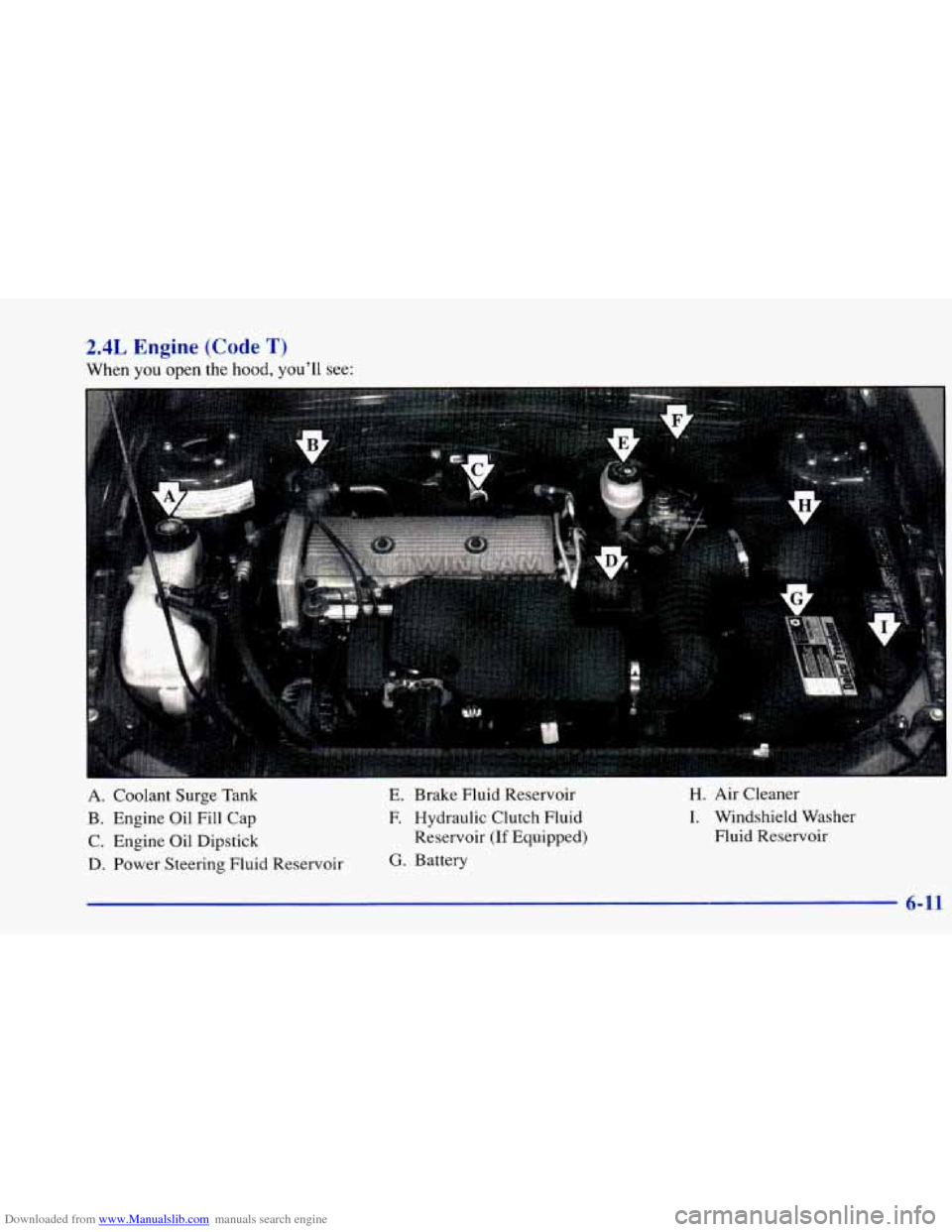
Downloaded from www.Manualslib.com manuals search engine 2.4L Engine (Code T)
A. Coolant Surge Tank E. Brake Fluid Reservoir H. Air Cleaner
B. Engine Oil Fill Cap
F. Hydraulic Clutch Fluid I. Windshield Washer
C. Engine Oil Dipstick Reservoir
(If Equipped) Fluid Reservoir
D. Power Steering Fluid Reservoir
G. Battery
6-11
Page 259 of 388
Downloaded from www.Manualslib.com manuals search engine Air Cleaner
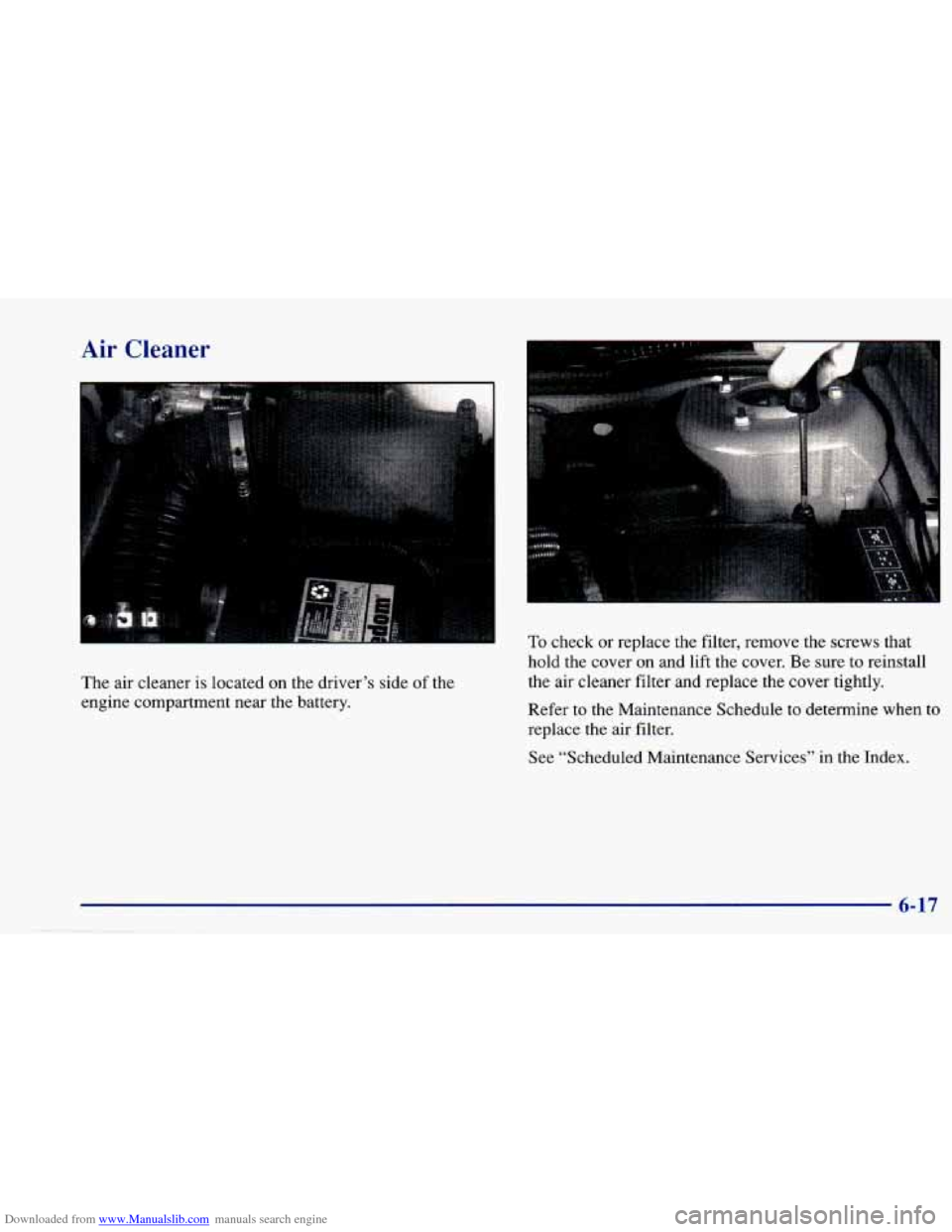
The air cleaner is located on the driver’s side of the
engine compartment near the battery.
To check or replace the filter, remove the screws that
hold the cover on and lift the cover. Be sure to reinstall
the air cleaner filter and replace the cover tightly.
Refer
to the Maintenance Schedule to determine when to
replace the air filter.
See “Scheduled Maintenance Services” in the Index.
6-17
.<
Page 277 of 388
Downloaded from www.Manualslib.com manuals search engine Battery
Every new Chevrolet has a Delco Freedom@ battery.
You never have to add water to one of these. When it’s
time for a new battery, we recommend
a Delco Freedom
battery. Get one that has the replacement number shown
on the original battery’s label.
Vehicle Storage
If you’re not going to drive your vehicle for 25 days or more,
take off the black, negative (-) cable from the battery. This
will help keep your battery from running down. Also, for
your audio system,
see “Theft-Deterrent
Feature’’ in the Index.
Bulb Replacement
For any bulb changing procedure not listed in this
section, contact your Chevrolet dealer’s service
department.
Halogen Bulbs
1
Batteries have acid that can burn you and gas
that can explode. You can be badly hurt if
you
aren’t careful. See “Jump Starting” in the Index
for tips on working around
a battery without
getting hurt.
Contact your dealer to learn how
to prepare your vehicle
for longer storage periods.
1 CAUTION:
I
Halogen bulbs have pressurized gas inside and
can burst if you drop or scratch the bulb. You
or
others could be injured. Be sure to read and
follow the instructions on the bulb package.