Page 352 of 388
Downloaded from www.Manualslib.com manuals search engine Brake-Transaxle Shift Interlock (BTSI) Check (Automatic Transaxle)
When you are doing this check, the vehicle could
move suddenly. If it does, you or others could be
injured. Follow the steps below.
1. Before you start, be sure you have enough room around the vehicle. It should be parked on a
level surface.
2. Firmly apply the parking brake (see “Parking Brake” in the Index
if necessary).
NOTE: Be ready to apply the regular brake
immediately if the vehicle begins to move.
3. With the engine off, turn the key to the RUN
position, but don’t start the engine. Without applying
the regular brake, try to move the shift lever out of
PARK (P) with normal effort. If the shift lever
moves
out of PARK (P), your vehicle’s BTSI
needs service.
Ignition Transaxle Lock Check
While parked, and with the parking brake set, try to turn
the ignition key to LOCK in each shift lever position.
With an automatic transaxle, the key should turn to
LOCK only when the shift
lever is in PARK (P).
0 With a manual transaxle, the key should turn
to LOCK only when the shift lever is in
REVERSE (R).
On vehicles with a key release button, try to turn the key
to LOCK without pressing the button. The key should
turn to LOCK only when you press the key button.
On all vehicles, the key should come out only in LOCK.
Turn the steering wheel to the left and to the right. It
should only lock when turned to the right.
Page 353 of 388
Downloaded from www.Manualslib.com manuals search engine Parking Brake and Automatic Transaxle PARK (P)
Mechanism Check
I A CAUTION:
When you are doing this check, your vehicle
could begin to move.
You or others could be
injured and property could be damaged. Make
sure there is room in front of your vehicle in case
it begins to roll. Be ready to apply the regular
brake at once should the vehicle begin to move. Park on a fairly steep
hill, with the vehicle facing
downhill. Keeping your
foot on the regular brake,
set the parking brake.
To check the parking brake’s holding ability: With
the engine running and transaxle in NEUTRAL (N),
slowly remove foot pressure from the regular brake
pedal.
Do this until the vehicle is held by the parking
brake only.
0 To check the PARK (P) mechanism’s holding ability:
With the engine running, shift
to PARK (P). Then
release all brakes.
Underbody Flushing Service At least every spring, use plain water to flush any
corrosive materials from the underbody. Take care to
clean thoroughly any areas where mud and other debris
can collect.
Page 354 of 388
Downloaded from www.Manualslib.com manuals search engine Part C: Periodic Maintenance
Inspections
Listed below are inspections and services which should
be performed at least twice a year (for instance, each
spring and fall).
You should let your GM dealer’s
service department or other qualified service center do
these jobs. Make sure any necessary repairs are
completed at once.
Proper procedures to perform these services may be
found in a
GM service manual. See “Service and Owner
Publications” in the Index.
Steering, Suspension and Front Drive Axle
Boot and Seal Inspection
Inspect the front and rear suspension and steering
system for damaged, loose or missing parts, signs
of
wear or lack of lubrication. Inspect the power steering
lines and hoses for proper hook-up, binding, leaks,
cracks, chafing, etc. Clean and then inspect the drive axle boot seals for damage, tears or leakage. Replace
seals if necessary.
I
Exhaust System Inspection
Inspect the complete exhaust system. Inspect the body
near the exhaust system.
Look for broken, damaged,
missing
or out-of-position parts as well as open seams,
holes, loose connections or other conditions which could
cause a heat build-up in the floor pan or could let
exhaust fumes into the vehicle. See “Engine Exhaust’’
in the Index.
Radiator and Heater Hose Inspection
Inspect the hoses and have them replaced if they are
cracked, swollen or deteriorated. Inspect all pipes,
fittings and clamps; replace as needed.
Throttle Linkage Inspection
Inspect the throttle linkage for interference or binding,
and for damage or missing parts. Replace parts as
needed. Replace any cables that have high effort or
excessive wear.
Do not lubricate accelerator and cruise
control cables.
Page 355 of 388
Downloaded from www.Manualslib.com manuals search engine ke System Inspection
Inspect the complete system. Inspect brake lines and
hoses for proper hook-up, binding, leaks, cracks,
chafing, etc. Inspect disc brake pads for wear and rotors
for surface condition. Also inspect drum brake linings
for wear and cracks. Inspect other brake parts, including
drums, wheel cylinders, calipers, parking brake, etc.
Check parking brake adjustment. You may need to have
your brakes inspected more often if your driving habits
or conditions result in frequent braking.
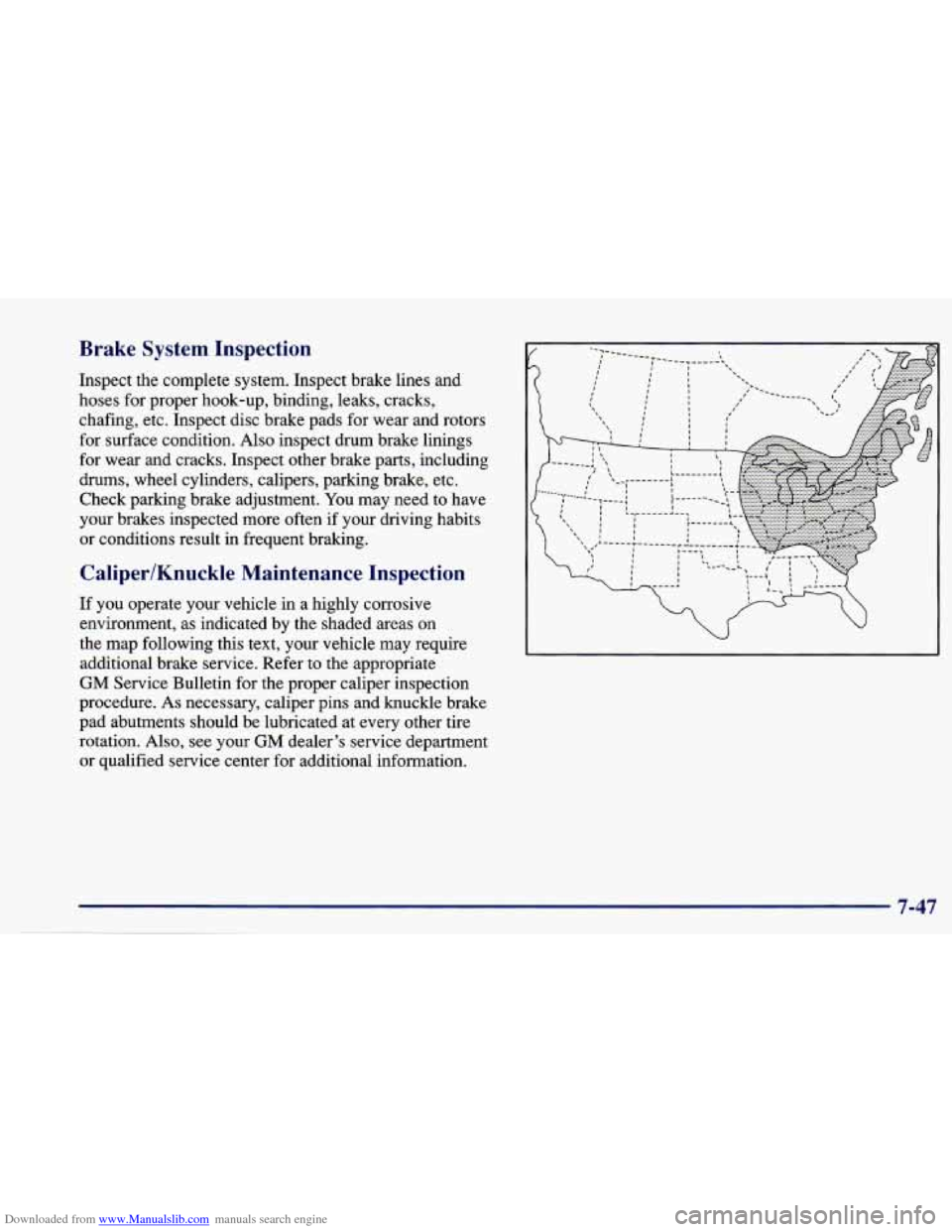
CalipedKnuckle Maintenance Inspection
If you operate your vehicle in a highly corrosive
environment, as indicated by the shaded areas
on
the map following this text, your vehicle may require
additional brake service. Refer to the appropriate
GM Service Bulletin for the proper caliper inspection
procedure. As necessary, caliper pins and knuckle brake
pad abutments should be lubricated at every other tire
rotation. Also, see your
GM dealer’s service department
or qualified service center for additional information.
7-47
Page 358 of 388
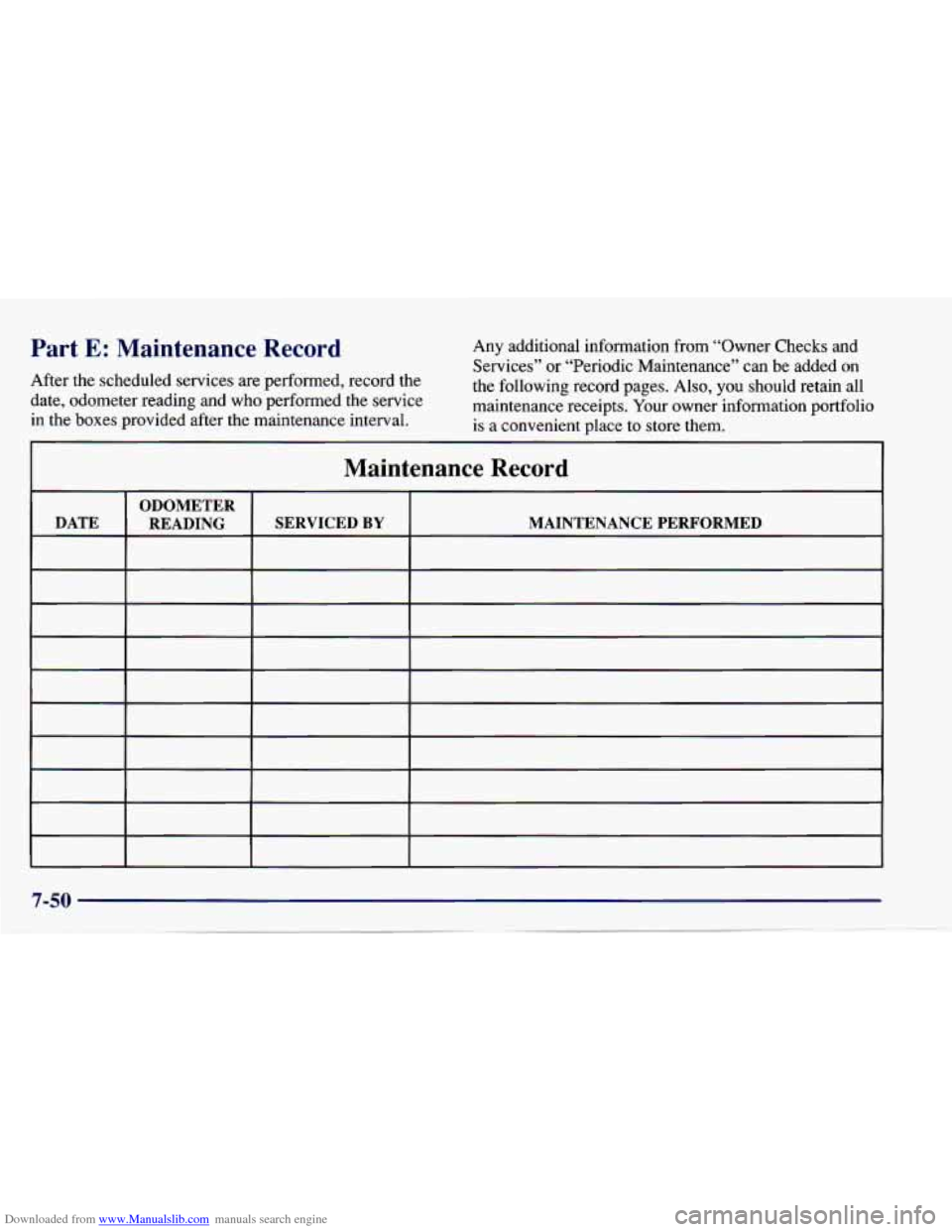
Downloaded from www.Manualslib.com manuals search engine Part E: Maintenance Record
After the scheduled services are performed, record the
date, odometer reading and who performed the service
in the boxes provided after the maintenance interval. Any additional information
from “Owner Checks and
Services” or “Periodic Maintenance” can be added
on
the following record pages. Also, you should retain all
maintenance receipts. Your owner information portfolio
is a convenient place to store them.
Maintenance Record
ODOMETER
DATE READING SERVICED
BY MAINTENANCE PERFORMED
Maintenance Record
Page 359 of 388
Downloaded from www.Manualslib.com manuals search engine Maintenance Record
ODOMETER
DATE READING SERVICED
BY MAINTENA - PERFORN D ~~ -
7-51
Page 361 of 388
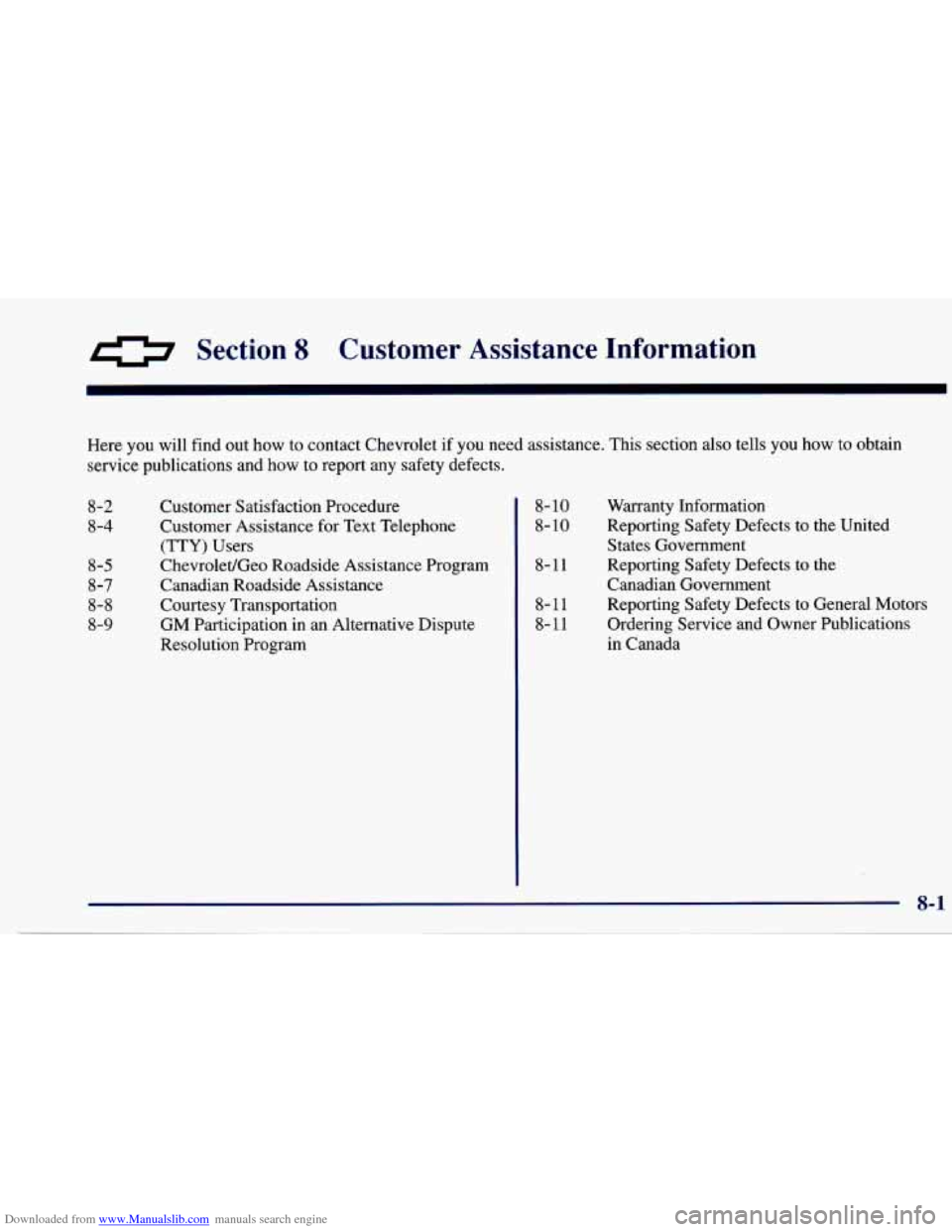
Downloaded from www.Manualslib.com manuals search engine 0 Section 8 Customer Assistance Infa- mation
Here you will find out how to contact Chevrolet if you need assistance. This section also tells you how to obtain
service publications and how
to report any safety defects.
8-2
8-4
8-5
8-7
8-8
8-9 Customer Satisfaction Procedure
Customer Assistance
for Text Telephone
(TTY) Users
Chevrolet/Geo Roadside Assistance Program
Canadian Roadside Assistance
Courtesy Transportation
GM Participation in an Alternative Dispute
Resolution Program 8- 10
8-
10
8-11
8-11
8-11 Warranty
Information
Reporting Safety Defects to the United
States Government
Reporting Safety Defects to the
Canadian Government
Reporting Safety Defects to General Motors
Ordering Service and Owner Publications
in Canada
Page 362 of 388
Downloaded from www.Manualslib.com manuals search engine Customer Satisfaction Procedure Chevrolet dealers have the facilities, trained technicians
and up-to-date information to promptly address any
concerns you may have. However,
if a concern has not
been resolved to your complete satisfaction, take the
following steps:
STEP ONE -- Discuss your concern with a member
of dealership management. Normally, concerns can
be quickly resolved at that level. If the matter has
already been reviewed with the Sales, Service or Parts
Manager, contact the owner of the dealership or the
General Manager.