1997 CHEVROLET CAMARO check engine
[x] Cancel search: check enginePage 221 of 404
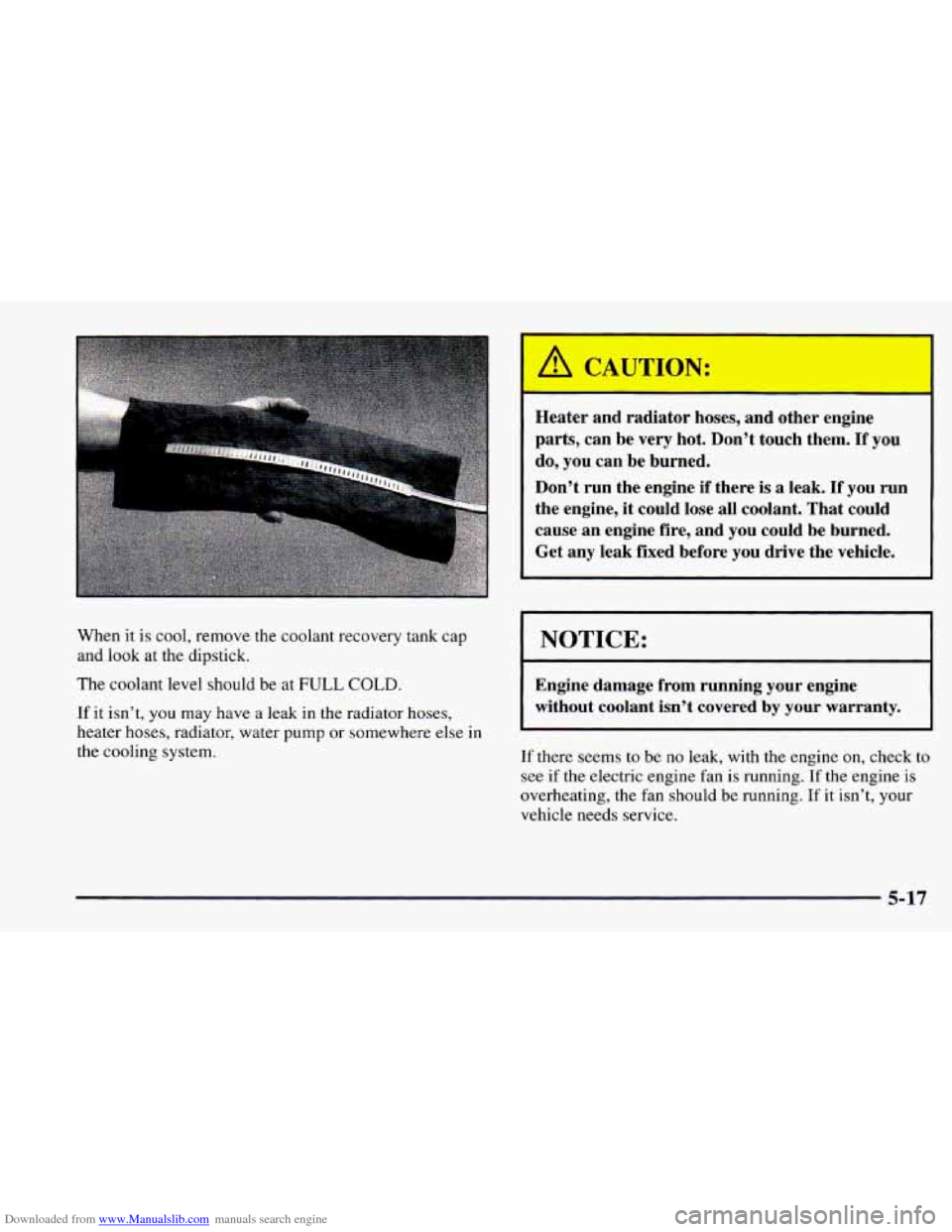
Downloaded from www.Manualslib.com manuals search engine When it is cool, remove the coolant recovery tank cap
and look at the dipstick.
The coolant level should be
at FULL COLD.
If it isn’t, you may have a leak in the radiator hoses,
heater hoses, radiator, water pump or somewhere
else in
the cooling system.
Heater and radiator hoses, and other engine
parts, can be very hot. Don’t touch them.
If you
do, you can be burned.
Don’t run the engine if there
is a leak. If you run
the engine, it could lose all coolant. That could
cause an engine fire, and you could be burned.
Get any leak fixed before you drive the vehicle.
NOTICE:
Engine damage from running your engine
without coolant isn’t covered
by your warranty.
If there seems to be no leak, with the engine on, check to
see if the electric engine fan is running. If the engine is
overheating, the fan should be running. If it isn’t, your
vehicle needs service.
5-17
Page 244 of 404

Downloaded from www.Manualslib.com manuals search engine Compact Spare Tire
Although the compact spare tire was fully inflated when
your vehicle was new, it can
lose air after a time. Check
the inflation pressure regularly. It should
be 60 psi
(420 Ea).
After installing the compact spare on your vehicle, you
should stop as soon as possible and make sure your spare
tire
is correctly inflated. The compact spare is made to
perform well at speeds up to 65 mph (105 km/h) for
distances up to
3,000 miles (5 000 km), so you can finish
your trip and have your full-size tire repaired or replaced
where
you want. (When the compact spare is used on
the rear axle, see Notice below.) Of course, it’s best to
replace your spare
with a full-size tire as soon as you can.
Your spare will last longer and be in good shape in case
you need it again.
When the compact spare
is on the rear axle, the optional
ASR system will cycle and limit acceleration for about
the first
15 seconds of driving after each engine start.
I I
NOTICE:
If the compact spare is used as a rear tire, do not
drive faster than 50 mph (80 km/h). Damage to
the rear axle may occur
if the compact spare is
driven faster than 50 mph (80 W).
NOTICE:
When the compact spare is installed, don’t take
your vehicle through an automatic car wash with
guide rails. The compact spare can get caught on
the rails. That can damage the tire and wheel,
and maybe other parts
of your vehicle.
5-40
Page 247 of 404
Downloaded from www.Manualslib.com manuals search engine 0 Section 6 Service and Appearance Care
Here you will find information about the care of your Chevrolet. This section begins with service and fuel
information, and then it shows how to check important fluid and lubricant levels. There is also technical information
about
your vehicle, and a part devoted to its appearance care.
6- 2
6-3'
6-5
6-6
6-8
6- 12
6-18
6-2
1
6-25 6-28
6-32
6-33
6-35
6-39
6-40 Service
Fuel
Fuels
in Foreign Countries
Filling Your Tank
Checking Things Under
the Hood
Engine Oil
Air Cleaner Automatic Transmission Fluid
Manual Transmission Fluid
Engine Coolant
Power Steering Fluid
Windshield Washer Fluid
Brakes
Battery
Bulb Replacement
6-50
6-58
6-59
6-62
6-62
6-63
6-65
6-66
6-67
6-68
6-68 6-68
6-74
6-74
6-76 Tires
Appearance Care
Cleaning the Inside of Your Chevrolet
Care of Safety Belts
Glass
Cleaning the Outside of Your Chevrolet
Aluminum or Chrome Wheels
Underbody Maintenance
Appearance Care Materials Chart
Vehicle Identification Number (VIN)
Service
Parts Identification Label
Electrical System
Replacement Bulbs
Capacities and Specifications
Air Conditioning Refrigerants
Page 249 of 404

Downloaded from www.Manualslib.com manuals search engine You can be injured and your vehicle could be
damaged
if you try to do service work on a
vehicle without knowing enough about it.
0 Be sure you have sufficient knowledge,
experience, the proper replacement parts
and tools before you attempt any vehicle
maintenance task.
Be sure to use the proper nuts, bolts and
other fasteners. “English” and “metric”
fasteners can be easily confused.
If you use
the wrong fasteners, parts can later break
or fall
off. You could be hurt.
Adding Equipment to the Outside of
Your Vehicle
Things you might add to the outside of your vehicle can
affect the airflow around it. This may cause wind noise
and affect windshield washer performance. Check with
your Chevrolet dealer before adding equipment to the
outside
of your vehicle.
Fuel
The 8th digit of your vehicle identification number
(VIN) shows the code letter for your engine. You will
find the VIN at the top left
of your instrument panel.
(See “Vehicle Identification Number” in the Index.)
If you have the 3800 engine (VIN Code K), use regular
unleaded gasoline rated at
87 octane or higher.
If
you have the 5.7L engine (VIN Code P), use premium
unleaded gasoline rated at
91 octane or higher for best
performance. You may use middle grade or regular
unleaded gasolines, but your vehicle may
not accelerate
as well.
6-3
Page 250 of 404

Downloaded from www.Manualslib.com manuals search engine At a minimum, the gasoline you use should meet
specifications ASTM
D4814 in the United States and
CGSB 3.5-M93 in Canada. Improved gasoline
specifications have been developed by the American
Automobile Manufacturers Association (AAMA) for
better vehicle performance and engine protection.
Gasolines meeting the AAMA specification could
provide improved driveability and emission control
system protection compared to other gasolines.
Be
sure the posted octane for premium is at least 9 1
(at least 89 for middle grade and 87 for regular). If the
octane is less than
87, you may get a heavy knocking
noise when you drive.
If it’s bad enough, it can damage
your engine.
If you’re using fuel rated at the recommended octane or
higher and you still hear heavy knocking, your engine
needs service. But don’t worry if you hear a little
pinging noise when you’re accelerating or driving up a
hill. That’s normal, and you don’t have to buy
a higher
octane fuel to get
rid of pinging. It’s the heavy, constant
knock that means you have a problem. If
your vehicle
is certified to meet California Emission
Standards (indicated
on the underhood tune-up label),
it is designed to operate
on fuels that meet California
specifications.
If such fuels are not available in states
adopting California emissions standards, your vehicle
will operate satisfactorily
on fuels meeting federal
specifications, but emission control system performance
may be affected. The malfunction indicator lamp on
your instrument panel may turn
on and/or your vehicle
may fail
a smog-check test. If this occurs, return to your
authorized Chevrolet dealer for diagnosis to determine
the cause of failure. In the event it is determined that the
cause
of the condition is the type of fuels used, repairs
may not be covered by your warranty.
Some gasolines that are not reformulated for low
emissions contain an octane-enhancing additive called
methylcyclopentadienyl manganese tricarbonyl (MMT);
ask your service station operator whether or not his fuel
contains MMT. General Motors does not recommend the
use
of such gasolines. If fuels containing MMT are used,
spark plug life may be reduced and your emission
control system performance may be affected. The
malfunction indicator lamp
on your instrument panel
may turn on. If this occurs, return to your authorized
Chevrolet dealer
for service.
6-4
Page 251 of 404

Downloaded from www.Manualslib.com manuals search engine To provide cleaner air, all gasolines in the United States
are now required to contain additives that will help
prevent deposits from forming in your engine and fuel
system, allowing your emission control system to
function properly. Therefore,
you should not have
to add anything to the fuel. In addition, gasolines
containing oxygenates, such as ethers and ethanol, and
reformulated gasolines may be available in your area to
help clean the air. General Motors recommends that
you
use these gasolines if they comply with the
specifications described earlier.
NOTICE:
Your vehicle was not designed for fuel that
contains methanol. Don’t use
it. It can corrode
metal parts in your fuel system and also damage
plastic and rubber parts. That damage wouldn’t
be covered under your warranty.
Fuels in Foreign Countries
If you plan on driving in another country outside the
United States or Canada, the proper fuel may be hard to
find. Never use leaded gasoline or any other fuel not
recommended in the previous
text on fuel. Costly repairs
caused by use of improper fuel wouldn’t be covered by
your warranty.
To check on fuel availability, ask an auto club, or
contact a major oil company that does business in the
country where you’ll be driving.
You can also write us at the following address for
advice. Just tell
us where you’re going and give your
Vehicle Identification Number
(VIN).
General Motors International Product Center
1908 Colonel Sam Drive
Oshawa, Ontario
LlH 8P7
6-5
Page 254 of 404

Downloaded from www.Manualslib.com manuals search engine When you put the cap back on, turn it to the right
(clockwise) until you hear a clicking sound. Make sure
you fully install the cap. The diagnostic system can
determine
if the fuel cap has been left off or improperly
installed. This would allow fuel to evaporate into the
atmosphere. See “Malfunction Indicator Lamp” in
the Index.
NOTICE:
If you need a new cap, be sure to get the right
type. Your dealer can get one for you.
If you get
the wrong type,
it may not fit or have proper
venting,
and your fuel tank and emissions system
might be damaged.
Checking Things Under the Yood
- -
An electric fan under the hood can start up and
injure you even when the engine
is not running.
Keep hands, clothing and tools
away from any
underhood electric fan.
I /A CAUTION:
Things that burn can get on hot engine parts and
start a fire. These include liquids like gasoline,
oil, coolant, brake fluid, windshield washer and
other fluids, and plastic or rubber. You or others
could be burned. Be careful not
to drop or spill
things that will burn onto
a hot engine.
Page 258 of 404

Downloaded from www.Manualslib.com manuals search engine Before closing the hood, be sure all the filler caps
are on.
Then just pull the hood down and close it firmly.
Engine Oil
If the LOW OIL light
on the instrument panel
comes on, it means you
need
to check your engine
oil level right away.
LOW OIL
For more information, see “Low Oil Light” in the Index.
You should check your engine oil level regularly; this is
an added reminder.
It’s a good idea
to check your engine oil every time you
get fuel. In order
to get an accurate reading, the oil must
be warm and the vehicle must be on level ground.
3800 Engine Oil Dipstick
The engine oil dipstick is the yellow loop near the back
of the engine
6-12