1997 CHEVROLET CAMARO check engine
[x] Cancel search: check enginePage 128 of 404

Downloaded from www.Manualslib.com manuals search engine Safety Belt Reminder Light
When the key is turned to RUN or START, a chime will
come on for about eight seconds to remind people to
fasten their safety belts.
The safety belt light will
also come on and stay on
for about
70 seconds. If the
driver’s belt is already
buckled, neither the chime
nor the light will come
on.
Air Bag Readiness Light
There is an air bag readiness light on the instrument
panel, which shows
AIR BAG. The system checks the
air bag’s electrical system for malfunctions. The light
tells you if there is an electrical problem. The system
check includes the air bag sensors, the air bag modules, the wiring and the
crash sensing and diagnostic module.
For more information on the air bag system, see “Air
Bag” in the Index.
AIR
BAG
This light will come on
when you start your engine,
and it will flash for
a few
seconds. Then the light
should go out. This means
the system is ready.
If the air bag readiness light stays on after you start the
engine or comes
on when you are driving, your air bag
system may not work properly. Have your vehicle
serviced right away.
The air bag readiness light should flash for a few
seconds when you turn the ignition key to
RUN. If the
light doesn’t come on then, have
it fixed so it will be
ready to warn you if there is a problem.
2-78
Page 129 of 404

Downloaded from www.Manualslib.com manuals search engine Voltmeter
You can read battery
voltage on your voltmeter.
If it reads less than 11 volts
or more than 16 volts while
your engine is running, and
it stays there, you may have
a problem with the
electrical charging system.
Have it checked right away. Driving with the voltmeter
reading in
a warning zone could drain your battery.
If you idle your engine for a while, the voltmeter reading
might move into the low voltage zone (indicated by red dots).
If the reading stays in the low voltage zone while you are
driving, you may have a problem with the electrical charging
system. Have it checked. While
the voltmeter reads in the
low voltage zone, your battery may not be able to power
certain electrical accessories, like
ABS. (If this happens,
your
ABS INOP light will come on. See “Anti-Lock
Brake System Warning Light” in
this section.)
If you must drive a short distance with the voltmeter
reading in a warning zone, turn
off all your accessories,
including your air conditioning system and audio system.
Brake System Warning Light
Your Chevrolet’s hydraulic brake system is divided into
two parts. If
one part isn’t working, the other part can
still work and stop you. For good braking, though, you
need both parts working well.
If the warning light comes on, there could be a brake
problem or the brake fluid level could be low. Have your
brake system inspected right away.
BRAKE
This light should come on
briefly when you turn the
ignition key to
RUN. If it
doesn’t come on then,
have it fixed
so it will be
ready to warn you if
there’s a problem.
If the light comes on while you are driving, pull
off the
road and stop carefully. You may notice that the pedal
is
harder to push. Or, the pedal may go closer to the floor.
It may take longer to stop. If the light is still on, or if the
anti-lock brake system warning light is flashing, have the
vehicle towed for service. (See “Anti-Lock Brake System
Warning Light” and “Towing Your Vehicle” in the Index.)\
2-79
Page 133 of 404

Downloaded from www.Manualslib.com manuals search engine Engine Coolant Temperature Gage
1
This gage shows the engine
coolant temperature. If the
gage pointer moves into
the red area, your engine
is approaching an
overheating condition.
Low Coolant Light (V8 Engine)
This warning light should
come on briefly while
you
are starting your engine. If
the light doesn’t come on,
m
If you have been operating your vehicle under normal
driving conditions, you should pull off the road, stop
your vehicle and turn off the road as soon as possible.
In “Problems on the Road” this section shows what
to
do. See “Engine Overheating” in the Index. Your
Camaro is equipped with a
LOW COOLANT
indicator that is designed to detect when the coolant
level drops below the set limit.
If the low coolant level
sensor (on the radiator) detects that the level drops while
the engine is running, the
LOW COOLANT indicator
will light and remain lit until the ignition switch is
turned to the
OFF position. Check the coolant level and
add coolant as needed.
2-83
Page 135 of 404

Downloaded from www.Manualslib.com manuals search engine NOTICE:
If you keep driving your vehicle with this light
on, after a while, your emission controls may not
work as well, your fuel economy may not be as
good and your engine may not run as smoothly.
This could lead to costly repairs that may not be
covered by your warranty.
This light should come on, as a check to show you it is
working, when the ignition is
on and the engine is not
running. If the light doesn’t come
on, have it repaired.
This light will also come
on during a malfunction in one
of two ways:
0
0
Light Flashing -- A misfire condition has been
detected. A misfire increases vehicle emissions and
may damage the emission control system on your
vehicle. Dealer or qualified service center diagnosis
and service is required.
Light On Steady -- An emission control system
malfunction has been detected on your vehicle.
Dealer or qualified service center diagnosis and
service may be required. If
the Light Is Flashing
The following
may prevent more serious damage to
your vehicle:
0 Reducing vehicle speed.
0 Avoiding hard accelerations.
0 Avoiding steep uphill grades.
0 If you are towing a trailer, reduce the amount of
cargo being hauled as soon as it is possible.
If the light stops flashing and remains on steady,
see “If
the Light
Is On Steady” following.
If the light continues to flash, when it is safe to do
so,
stop the vehicle. Find a safe place to park your vehicle.
Turn the key
off, wait at least 10 seconds and restart the
engine. If the light remains on steady, see “If the Light
Is On Steady’’ following. If the light is still flashing,
follow the previous steps, and drive the vehicle
to your
dealer or qualified service center for service.
2-85
Page 136 of 404
Downloaded from www.Manualslib.com manuals search engine If the Light Is On Steady Have you recently changed brands of fuel?
You may be able
to correct the emission system
malfunction by considering the following:
Did
you recently put fuel into your vehicle?
If
so, reinstall the fuel cap, making sure to fully install
the cap. The diagnostic system can determine if the fuel
cap has been left off or improperly installed.
A loose or
missing fuel cap will allow fuel to evaporate into the
atmosphere. A few driving trips with the cap properly
installed should turn the light off.
Did
you just drive through a deep puddle of water?
If
so, your electrical system may be wet. The condition
will usually be corrected when the electrical system
dries out.
A few driving trips should turn the light off.
Are you low on fuel?
As your engine starts to run
out of fuel, your engine may
not run as efficiently as designed since small amounts of
air are sucked into the fuel line causing a misfire.
The
system can detect this. Adding fuel should correct this
condition. Make sure
to install the fuel cap properly. It
will take a few driving trips to turn the light off. If
so, be sure
to fuel your vehicle with quality fuel (see
“Fuel” in the Index). Poor fuel quality will cause your
engine not
to run as efficiently as designed. You may
notice this as stalling after start-up, stalling when
you
put the vehicle into gear, misfiring, hesitation on
acceleration or stumbling
on acceleration. (These
conditions may go away once the engine is warmed up.)
This will be detected by the system and cause the light
to turn on,
If
you experience one or more of these conditions,
change the fuel brand
you use. It will require at least one
full tank of the proper fuel to turn the light off.
If none of the above steps have made the light turn
off,
have your dealer or qualified service center check the
vehicle. Your dealer has the proper test equipment and
diagnostic tools to fix any mechanical or electrical
problems that may have developed.
2-86
Page 137 of 404
Downloaded from www.Manualslib.com manuals search engine Engine Oil Pressure Gage low on oil, or that you might have some other oil
problem. See “Engine Oil” in the Index.
\+
0
/
0 80
ez
\+
0
/
120 0
5.7L Engine 3800 Engine
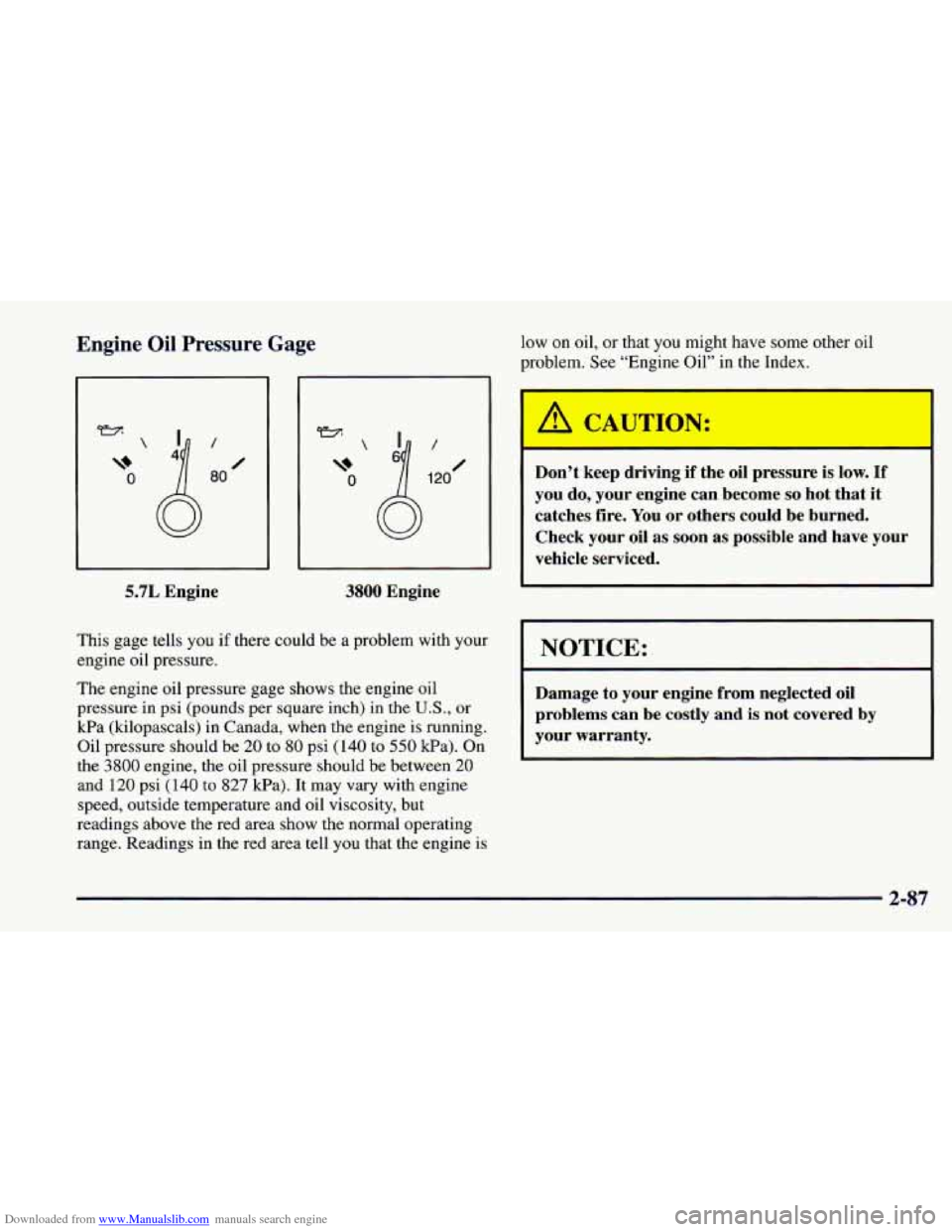
This gage tells you if there could be a problem with your
engine oil pressure.
The engine oil pressure gage shows the engine oil
pressure
in psi (pounds per square inch) in the U.S., or
kPa (kilopascals) in Canada, when the engine is running.
Oil pressure should be
20 to 80 psi (140 to 550 kPa). On
the
3800 engine, the oil pressure should be between 20
and 120 psi (140 to 827 kPa). It may vary with engine
speed, outside temperature and oil viscosity, but
readings above the red area show the normal operating
range. Readings in the red area
tell you that the engine is
Don’t keep driving if the oil pressure is low. If
you do, your engine can become so hot that it
catches fire. You or others could be burned.
Check your oil as soon
as possible and have your
vehicle serviced.
I NOTICE: I
Damage to your engine from neglected oil
problems can be costly and
is not covered by
your warranty.
Page 138 of 404
Downloaded from www.Manualslib.com manuals search engine Low Oil Light
This warning light should
come on while
you are
starting your engine.
If the
light doesn’t come on, have
LOW OIL it repaired.
If the light stays on after starting your engine, your
engine oil level may be
too low. You may need to add
oil. See “Engine Oil” in the Index.
NOTICE:
The oil level monitoring system only checks the
oil level when you are starting your engine.
It
does not keep monitoring the level once the
engine is running. Also, the oil level check only
works when the engine has been turned
off long
enough for the oil to drain back into the oil pan.
Check Gages Light
CHECK
GAGES
This warning light will
come
on briefly when you
are starting the engine. If
the light comes on and stays
on while
you are driving,
check your gages to
see if they are
in the
warning areas.
2-88
Page 154 of 404

Downloaded from www.Manualslib.com manuals search engine 'I
You must first load the magazine with discs before you
can play a compact disc. Each of the 12 trays holds one
disc. Press the button on the back of the magazine and
pull gently on one of the trays. Load the trays from
bottom to top, placing a disc on the tray label side down.
If you load a disc label side up, the disc will not play
and an error will occur. Gently push the tray back into
the magazine
slot. Repeat this procedure for loading up
to
12 discs in the magazine.
Once you have loaded the discs in the magazine, slide
open the door of the compact disc (CD) changer. Push
the magazine into the changer in the direction
of the
arrow marked
on top of the magazine. Close the door
by sliding it all the way
to the left. If the
door is
left partially open, the changer will not operate
and
an error will occur. When the door is closed, the
changer will begin checking for discs in the magazine.
This will continue for up
to two minutes depending on
the number of discs loaded.
To eject the magazine from the player, slide the CD
changer door all the way open. The magazine will
automatically eject. Remember to keep the door closed
whenever possible to keep dirt and dust from getting
inside
the changer.
Whenever a CD magazine with discs is loaded in the
changer, the CD symbol will appear
on the radio display.
If the CD changer
is checking the magazine for CDs, the
CD symbol will flash
on the display until the changer is
ready
to play. When a CD begins playing, a disc and
track number will be displayed.
The disc numbers are
listed on the front of the magazine.
All
of the CD functions are controlled by the radio
buttons, except for ejecting
the CD magazine.
PREV
(1): Press this button or the SEEK left arrow to
go to the start of the current track. If you hold or press
this button more than once, the player will continue
moving back through the disc. The sound will mute
while seeking.
3-14