Page 67 of 404
Downloaded from www.Manualslib.com manuals search engine PASS-Key@ I1
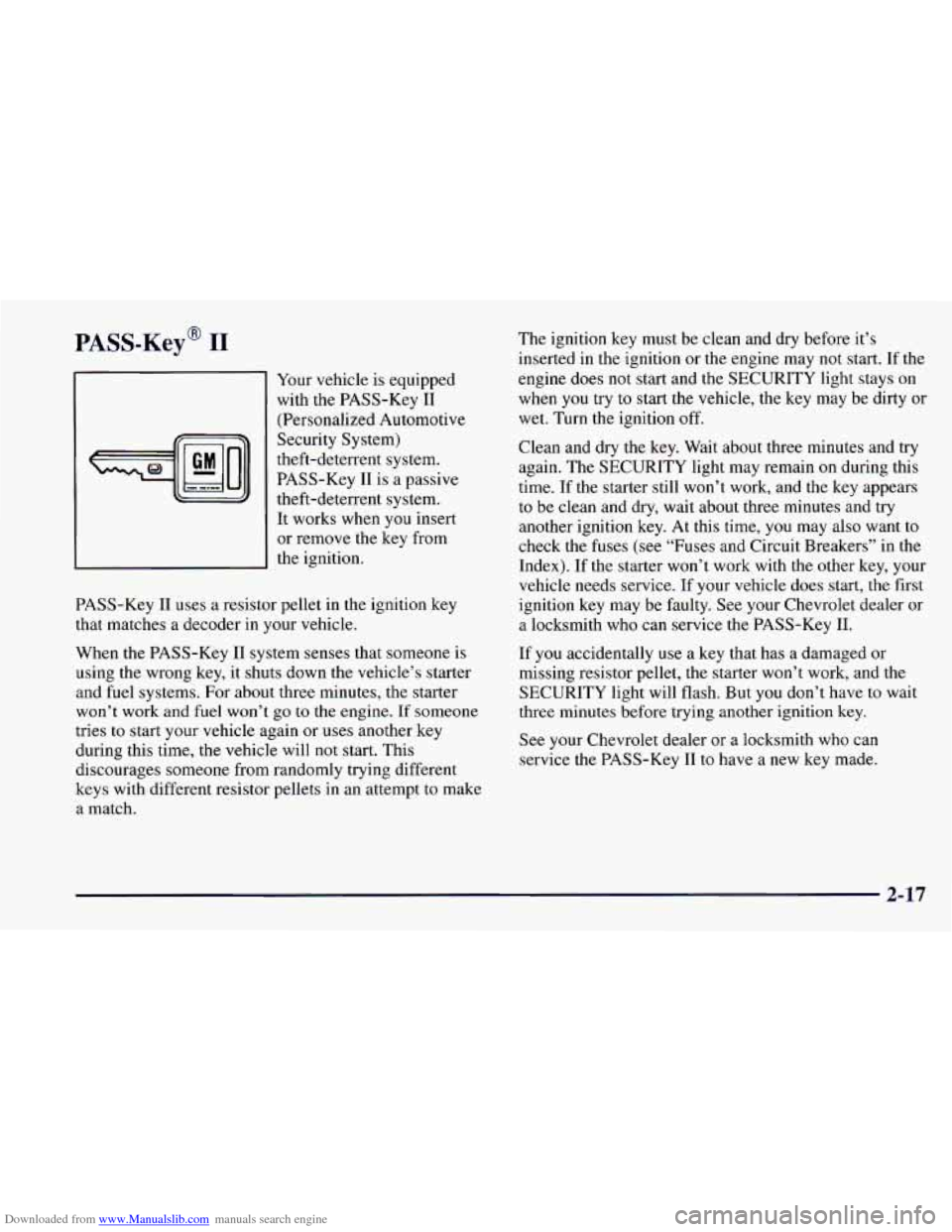
Your vehicle is equipped
with the PASS-Key I1
(Personalized Automotive
Security System)
theft-deterrent system.
PASS-Key
I1 is a passive
theft-deterrent system. It works when you insert
or remove the key from
the ignition.
PASS-Key 11 uses a resistor pellet in the ignition key
that matches a decoder in your vehicle.
When the PASS-Key I1 system senses that someone is
using the wrong key, it shuts down the vehicle’s starter
and fuel systems. For about three minutes, the starter
won’t work and fuel won’t
go to the engine. If someone
tries
to start your vehicle again or uses another key
during this time, the vehicle will not start. This
discourages someone from randomly trying different
keys with different resistor pellets in an attempt to make
a match. The
ignition key must be clean and dry before it’s
inserted in the ignition
or the engine may not start. If the
engine does not start and the SECURITY light stays on
when
you try to start the vehicle, the key may be dirty or
wet. Turn the ignition
off.
Clean and dry the key. Wait about three minutes and try
again. The SECURITY light may remain
on during this
time.
If the starter still won’t work, and the key appears
to be clean and dry, wait about three minutes and try
another ignition key. At this time,
you may also want to
check the fuses
(see “Fuses and Circuit Breakers” in the
Index). If the starter won’t work with the other key, your
vehicle needs service. If your vehicle does start, the first
ignition key may be faulty. See your Chevrolet dealer or
a locksmith who can service the PASS-Key 11.
If
you accidentally use a key that has a damaged or
missing resistor pellet, the starter won’t work, and
the
SECURITY light will flash. But you don’t have to wait
three minutes before trying another ignition key.
See your Chevrolet dealer or a locksmith who can
service the PASS-Key
I1 to have a new key made.
2-17
Page 77 of 404
Downloaded from www.Manualslib.com manuals search engine NOTICE:
Your engine is designed to work with the
electronics in your vehicle.
If you add electrical
parts
or accessories, you could change the way
the engine operates. Before adding electrical
equipment, check with your dealer.
If you don’t,
your engine might not perform properly.
If you ever have to have your vehicle towed, see
the part of this manual that tells how to
do it
without damaging your vehicle. See “Towing
Your Vehicle” in the Index.
Engine Coolant Heater (If Equipped)
In very cold weather, 0°F (- 18OC) or colder, the engine
coolant heater can help. You’ll get easier starting and
better fuel economy during engine warm-up. Usually,
the coolant heater should be plugged in a minimum of
four hours prior
to starting your vehicle.
Page 94 of 404

Downloaded from www.Manualslib.com manuals search engine Windows
Manual Windows
Rotate the window crank handle to open and close each
door window.
Power Windows
With power windows, switches on the door control each
window when the ignition
is on or when RAP is present.
(See “Retained Accessory Power” in the Index.)
You
can open the passenger’s window any amount by
pressing the switch and releasing it when the window
has lowered to the position
you want.
The switch for the driver’s window has an express-down
feature. Quickly press and release the switch for the
driver’s window and the window will lower completely.
You can also open the driver’s window any amount by
pressing the switch again while the window is in the
express-down mode when it has lowered
to the position
you want.
Horn
To sound the horn, press either horn symbol on your
steering wheel.
If your horn sounds two or three chirps when unlocking
your vehicle with the key chain transmitter
(if you have that
option), the
alarm was triggered while you were
away. Check the vehicle before entering.
Tilt Steering Wheel
A tilt steering wheel allows you to adjust the steering
wheel before
you drive.
You can also raise it to the highest level to give your
legs more room when
you exit and enter the vehicle.
To tilt the wheel, hold the steering wheel and pull the
lever. Move the steering wheel to a comfortable level,
then release
the lever to lock the wheel in place.
2-44
Page 96 of 404
Downloaded from www.Manualslib.com manuals search engine As you signal a turn or a lane change, if the arrows don’t
flash but just stay on
as you signal a turn or lane change,
a signal bulb
may be burned out and other drivers won’t
see your turn signal.
If a bulb is burned out, replace it to help avoid an
accident. If the arrows don’t go on at all when
you
signal a turn, check the fuse (see “Fuses and Circuit
Breakers” in the Index).
Headlamp High/Low Beam Changer
To change the headlamps
from low beam to high or
high to low, pull the turn
signal lever all the way
toward you. Then release it.
When the high beams are
on, this light on the
instrument panel also
will be on.
Windshield Wipers
You control the windshield wipers by turning the band
with
the wiper symbol on it.
For a single wiping cycle, turn the band to
MIST. Hold
it there until the wipers start, then let go. The wipers will
stop after one cycle. If you want more cycles, hold the
band on MIST longer.
2-46
Page 107 of 404
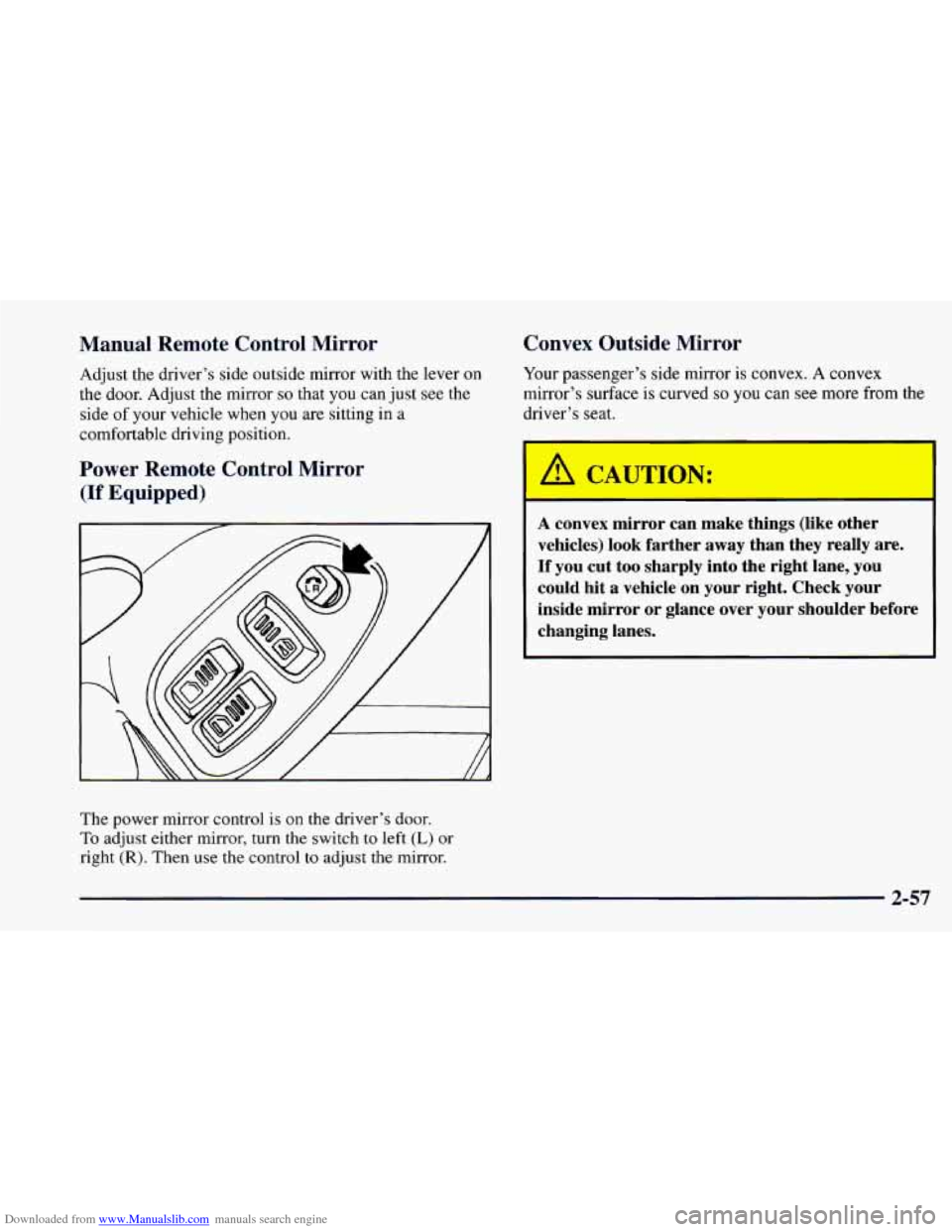
Downloaded from www.Manualslib.com manuals search engine Manual Remote Control Mirror
Adjust the driver’s side outside mirror with the lever on
the door. Adjust the mirror so that you can just see the
side
of your vehicle when you are sitting in a
comfortable driving position.
Power Remote Control Mirror
(If Equipped) Convex Outside Mirror
Your
passenger’s side mirror is convex. A convex
mirror’s surface is curved
so you can see more from the
driver’s seat.
The power mirror control is on the driver’s door.
To adjust either mirror, turn the switch to left (L) or
right
(R). Then use the control to adjust the mirror.
L- I
A convex mirror can make things (like other
vehicles) look farther away than they really are.
If you cut too sharply into the right lane, you
could hit
a vehicle on your right. Check your
inside mirror or glance over your shoulder before
changing lanes.
2-57
Page 116 of 404
Downloaded from www.Manualslib.com manuals search engine T-Top Sunshades
An improperly installed T-Top panel may fall
into or
fly off the vehicle. You or others could be
injured. After installing a T-Top panel, always
check that it is firmly attached by pushing up on
the underside
of the panel.
NOTICE:
High pressure car washes may cause water to
enter your vehicle. Never spray water directly
at
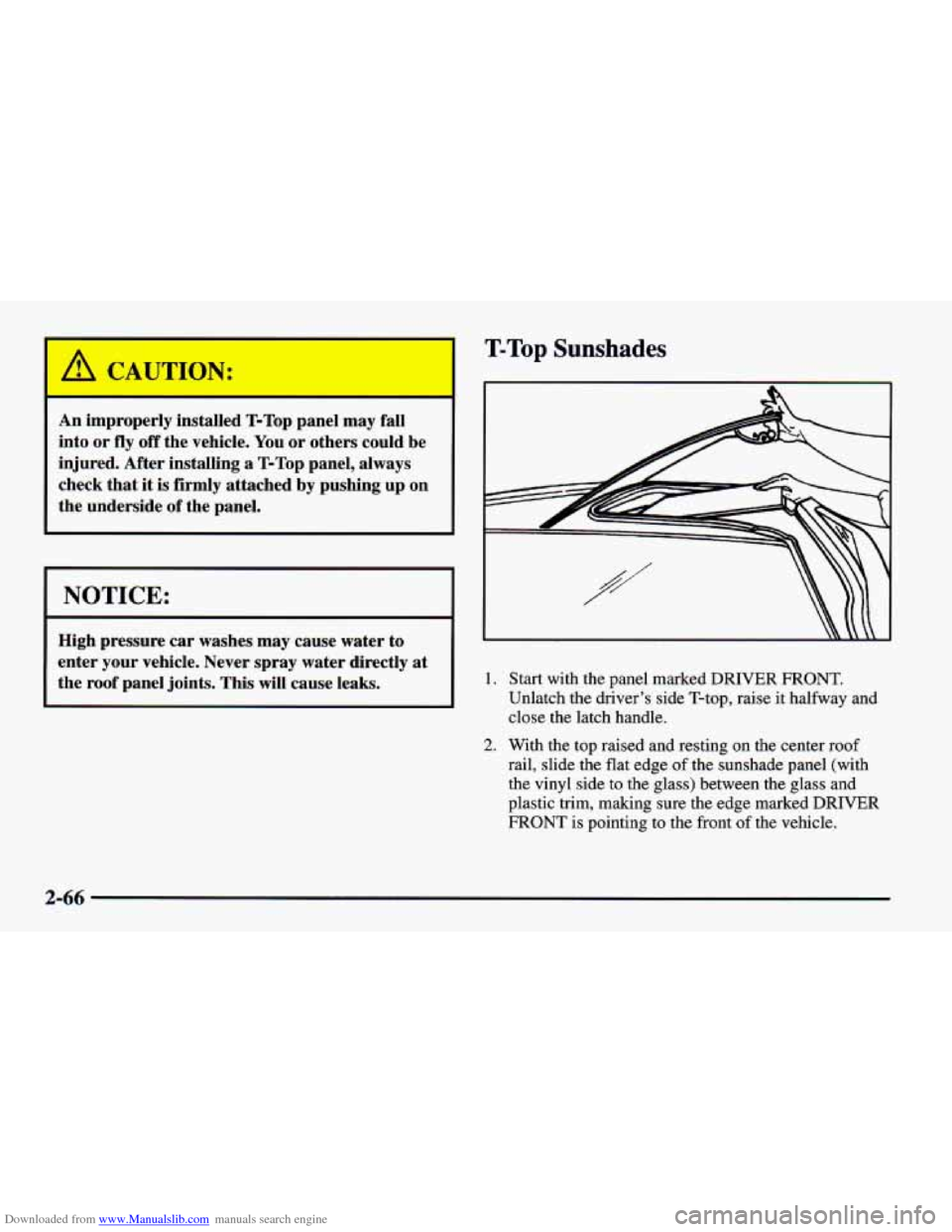
the roof panel joints, This will cause leaks. 1. Start with the panel marked DRIVER FRONT.
Unlatch the driver’s side T-top, raise it halfway and
close the latch handle.
2. With the top raised and resting on the center roof
rail, slide the flat edge of the sunshade panel (with
the vinyl side
to the glass) between the glass and
plastic trim, making sure the edge marked DRIVER
FRONT is pointing to the front
of the vehicle.
2-66
Page 117 of 404
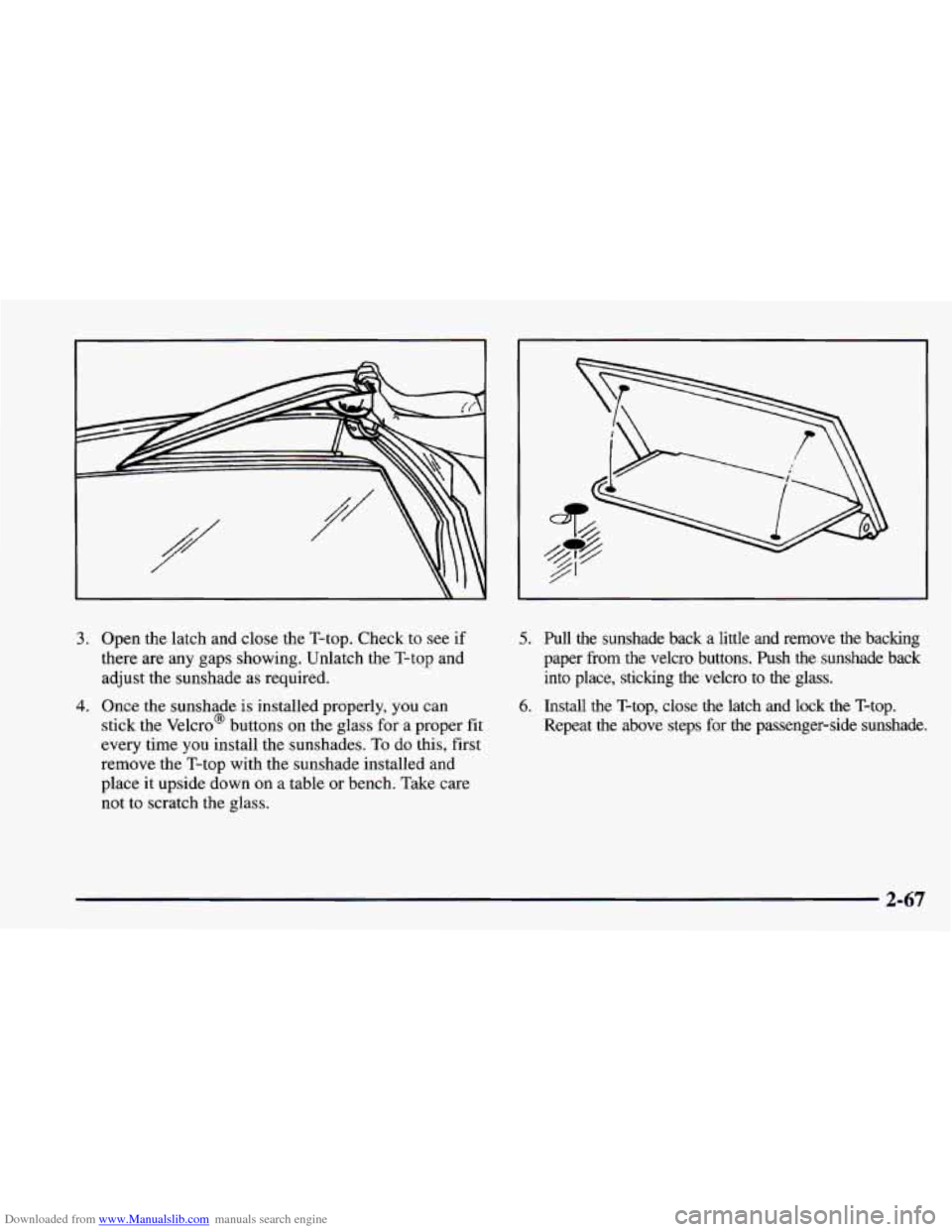
Downloaded from www.Manualslib.com manuals search engine 3. Open the latch and close the T-top. Check to see if
there are any gaps showing. Unlatch the T-top and
adjust the sunshade as required.
4. Once the sunshade is installed properly, you can
stick the Velcro@ buttons on the glass for a proper fit
every time you install the sunshades. To do this, first
remove the T-top with the sunshade installed and
place
it upside down on a table or bench. Take care
not to scratch the glass.
5. Pull the sunshade back a little and remove the backing
paper
fi-om the Velcro buttons. Push the sunshade back
into place, sticking the Velcro to the glass.
Repeat the above steps for the passenger-side sunshade.
6. Install the T-top, close the latch and lock the T-top.
2-67
Page 127 of 404

Downloaded from www.Manualslib.com manuals search engine Speedometer and Odometer
Your speedometer lets you see your speed in both miles
per hour (mph) and kilometers per hour
(km/h). Your
odometer shows how far your vehicle has been driven,
in either miles (used in the United States) or kilometers
(used in Canada).
You may wonder what happens if your Chevrolet needs a
new odometer installed.
If possible, the new one has to be
set to the same reading the old one had.
If it can’t be, then
it’s set at zero, but a label on the driver’s door must\
show
the old reading and when the new one was installed.
Dip Odometer
The trip odometer can tell you how far your car has been
driven since you last set the trip odometer to zero.
To set the trip odometer to zero, press the knob.
Tachometer
The tachometer displays the engine speed in thousands
of revolutions per minute (rpm).
NOTICE:
Do not operate the engine with the tachometer in
the red area, or engine damage may occur.
Warning Lights, Gages and Indicators
This part describes the warning lights and gages that may
be on your vehicle. The pictures will help you locate them.
Warning lights and gages can signal that something
is
wrong before it becomes serious enough to cause an
expensive repair or replacement. Paying attention to
your warning lights and gages could also save you or
others from injury.
Warning lights come on when
there may be or is a
problem with one of your vehicle’s functions.
As you will
see in the details on the next few pages, some warning
lights come on briefly when you
start the engine just to let
you know they’re working. If you are familiar with this
section, you should not be alarmed when this happens.
Gages can indicate when there may be or is a problem
with one
of your vehicle’s functions. Often gages and
warning lights work together to let you know when
there’s a problem with your vehicle.
When one of the warning lights comes on and stays on
when you are driving, or when one of the gages’ shows
there may be
a problem, check the section that tells you
what to do about
it. Please follow this manual’s advice.
Waiting to do repairs can be costly
-- and even
dangerous.
So please get to know your warning lights
and gages. They’re a big help.
2-77