Page 278 of 404
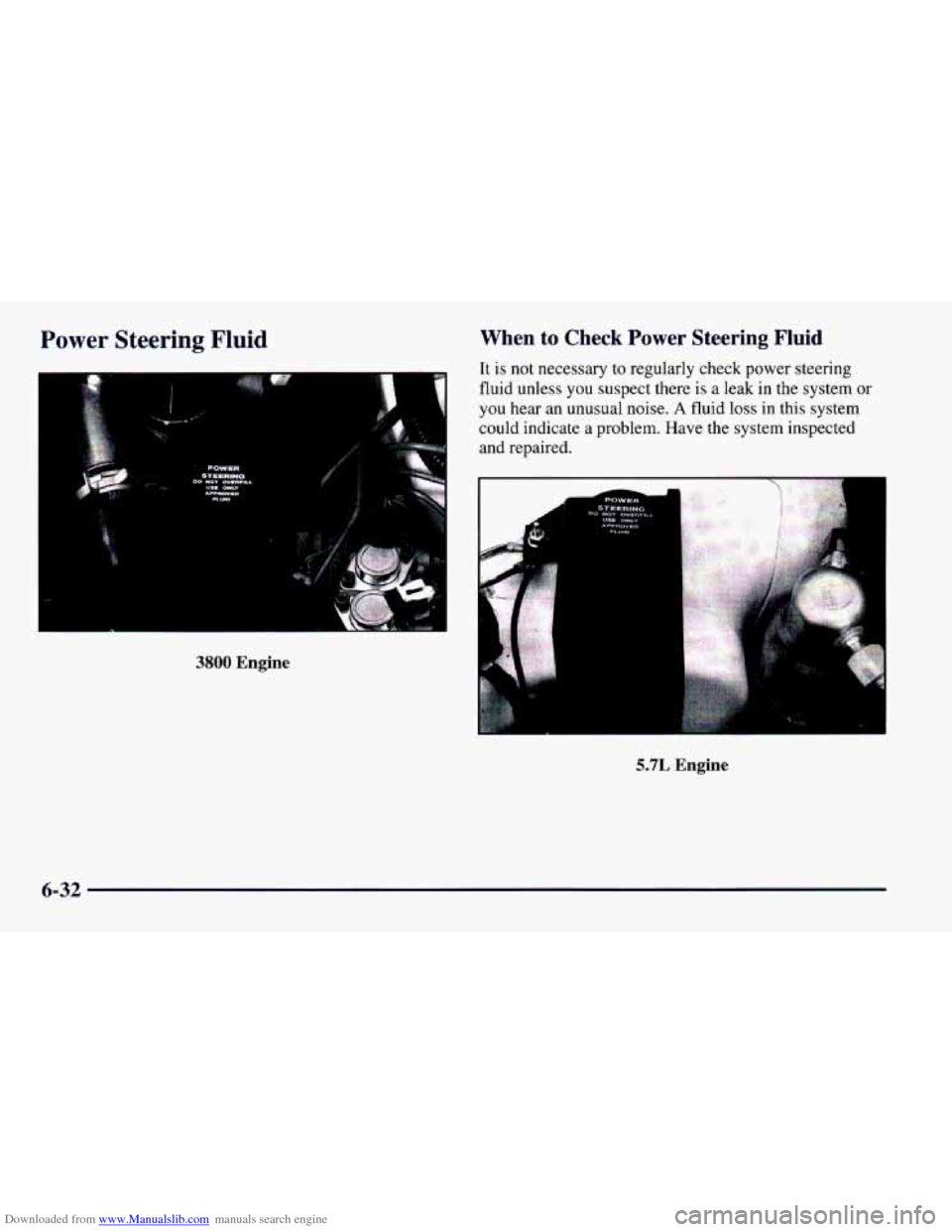
Downloaded from www.Manualslib.com manuals search engine Power Steering Fluid
3800 Engine
When to Check Power Steering Fluid
It is not necessary to regularly check power steering
fluid unless you suspect there is a leak in the system or
you hear an unusual noise. A fluid loss in this system
could indicate a problem. Have the
system inspected
and repaired.
5.7L Engine
6-32
Page 279 of 404

Downloaded from www.Manualslib.com manuals search engine How To Check Power Steering Fluid
When the engine compartment is cool, wipe the cap and
the top of the reservoir clean, then unscrew the cap and
wipe the dipstick with a clean rag. Replace the cap and
completely tighten it. Then remove the cap again and
look at the fluid level on the dipstick.
The level should be at the FULL COLD mark.
If
necessary, add only enough fluid to bring the level up to
the mark.
I > ...... -.
When the engine compartment is hot, the level
When the engine compartment is cool, the level
should
be at the
H or HOT mark.
should be at the
C or FULL COLD mark,
What to Use
Refer to the Maintenance Schedule to determine what
kind of fluid to use. See “Recommended Fluids and
Lubricants” in the Index. Always use the proper fluid.
Failure to use the proper fluid can cause leaks’and
damage hoses and seals.
Windshield Washer Fluid
What to Use
When you need windshield washer fluid, be sure to read
the manufacturer’s instructions before use. If you will be
operating your vehicle in an area where the temperature
may fall below freezing, use a fluid that has sufficient
protection against freezing.
6-33
Page 281 of 404

Downloaded from www.Manualslib.com manuals search engine Brakes
Brake Fluid
Your brake master cylinder reservoir is here. It is filled
with DOT-3 brake fluid.
There are only two reasons why the brake fluid level in
the reservoir might go down. The first
is that the brake
fluid goes down to an acceptable level during normal
brake lining wear. When new linings are put in, the fluid
level goes back up. The other reason is that fluid
is
leaking out of the brake system. If it is, you should have your
brake system fixed, since
a leak means that sooner
or later your brakes won’t work well, or won’t work
at all.
So, it isn’t a good idea to “top off’ your brake fluid.
Adding brake fluid won’t correct a leak.
If you add fluid
when your linings are worn, then you’ll have too much
fluid when
you get new brake linings. You should add
(or remove) brake fluid, as necessary, only when work
is
done on the brake hydraulic system.
A CA, TION:
If you have too much brake fluid, it can spill
on the engine. The fluid
will burn if the engine
is hot enough. You or others could be burned,
and your vehicle could be damaged. Add brake
fluid only when work
is done on the brake
hydraulic system.
Refer to the Maintenance Schedule to determine when to
check your brake fluid. See “Periodic Maintenance
In~pections’~ in the Index.
6-35
Page 282 of 404
Downloaded from www.Manualslib.com manuals search engine Checking Brake Fluid
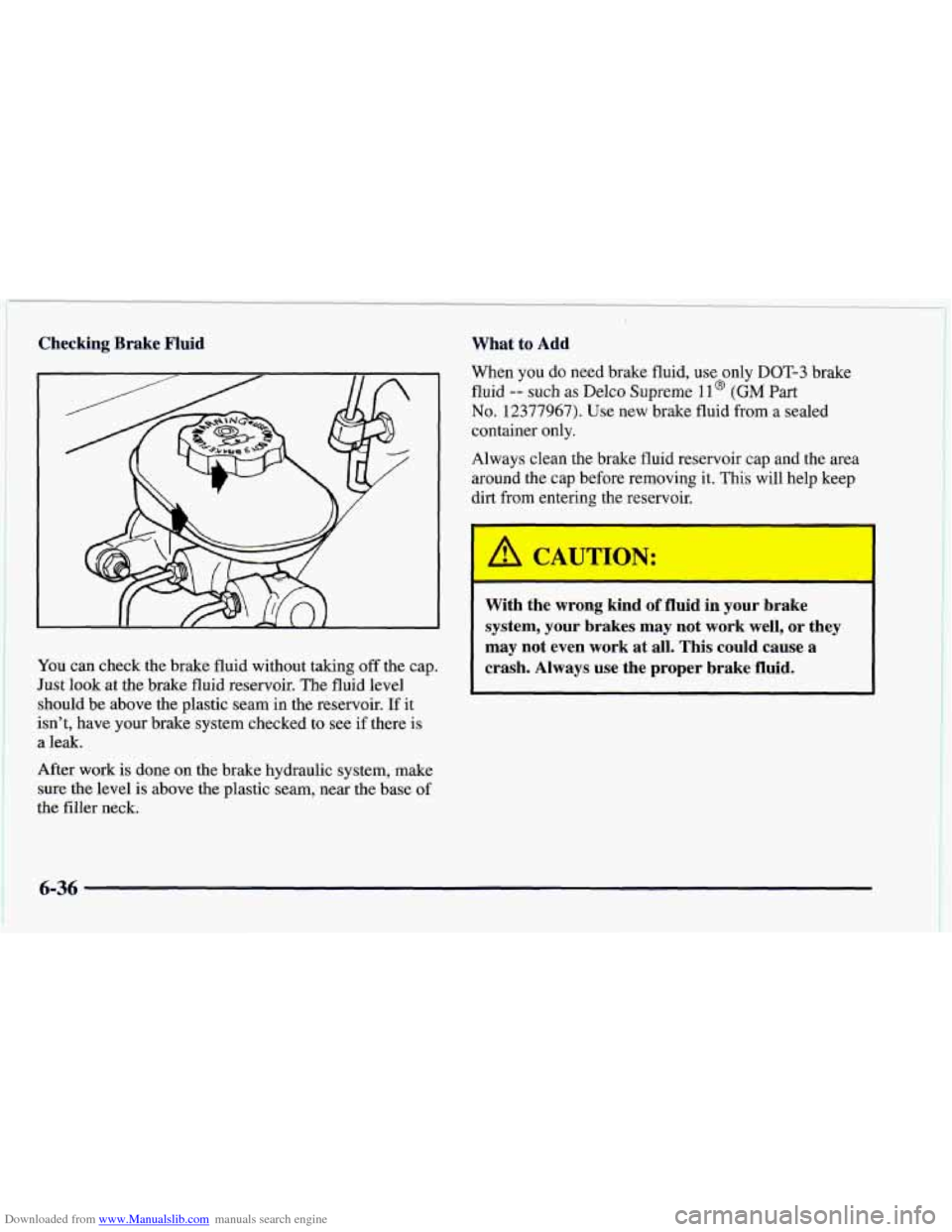
You can check the brake fluid without taking off the cap.
Just look at the brake fluid reservoir. The fluid level
should be above the plastic seam in the reservoir.
If it
isn’t, have your brake system checked to see if there is
a leak.
After work
is done on the brake hydraulic system, make
sure
the level is above the plastic seam, near the base of
the filler neck.
What to Add
When you do need brake fluid, use only DOT-3 brake
fluid
-- such as Delco Supreme 1 1 @ (GM Part
No. 12377967). Use new brake fluid from a sealed
container only.
Always clean the brake fluid reservoir cap and the area
around the cap before removing it. This will help keep
dirt from entering the reservoir.
With the wrong kind of fluid in your brake
system, your brakes may not work well,
or they
may not even work at all. This could cause a
crash. Always use the proper brake fluid.
1
6-36
Page 286 of 404

Downloaded from www.Manualslib.com manuals search engine Bulb Replacement
For the proper type of replacement bulb, see
“Replacement Bulbs”
in the Index.
Halogen Bulbs
Halogen bulbs have pressurized gas inside and
can burst if you drop or scratch the bulb. You or
others could be injured. Be sure to read and
follow the instructions on the bulb package.
Headlamp Aiming
Your vehicle has the 55 x 135 mini-quad headlamp
system. These headlamps have horizontal and vertical
aim indicators. The aim has been pre-set at the factory
and should need
no further adjustment.
If your vehicle is damaged in an accident and the
headlamp aim seems to be affected, see your
Chevrolet dealer. Headlamps on damaged vehicles may
require recalibration of the horizontal aim by your
Chevrolet dealer.
To check the aim, the vehicle should be properly
prepared as follows:
0
0
0
0
0
The vehicle must have all four tires on a perfectly
level surface.
The vehicle should not have any snow, ice or mud
attached to it.
There should not be any cargo or loading of the
vehicle, except it should have a full tank
of gas and
one person or
160 lbs. (75 kg) on the driver’s seat.
Tires should be properly inflated.
The horizontal indicator should read
“0.”
6-40
Page 287 of 404
Downloaded from www.Manualslib.com manuals search engine I NOTICE:
To make sure your headlamps are aimed
properly, read all the instructions before
beginning. Failure to follow these instructions
could cause damage
to headlamp parts.
State inspection stations will allow a vertical reading of
plus 0.76 degrees or minus 0.76 degrees from the center
of the bubble.
It
is recommended that the upper limit not exceed plus
0.4 degrees from the center of the bubble. Other drivers
may flash their high beams at
you if your adjustment is
much above plus
0.4 degrees.
If you find that the headlamp aiming needs adjustment,
follow these steps:
To adjust the aim of your headlamps:
1. Move your vehicle to a level surface. Use a spirit level
to be sure. Be sure to remove any items that
are not
part of your original equipment from the trunk and
passenger areas. No one should be seated in the vehicle
and
your fuel tank should be about half full. Check to
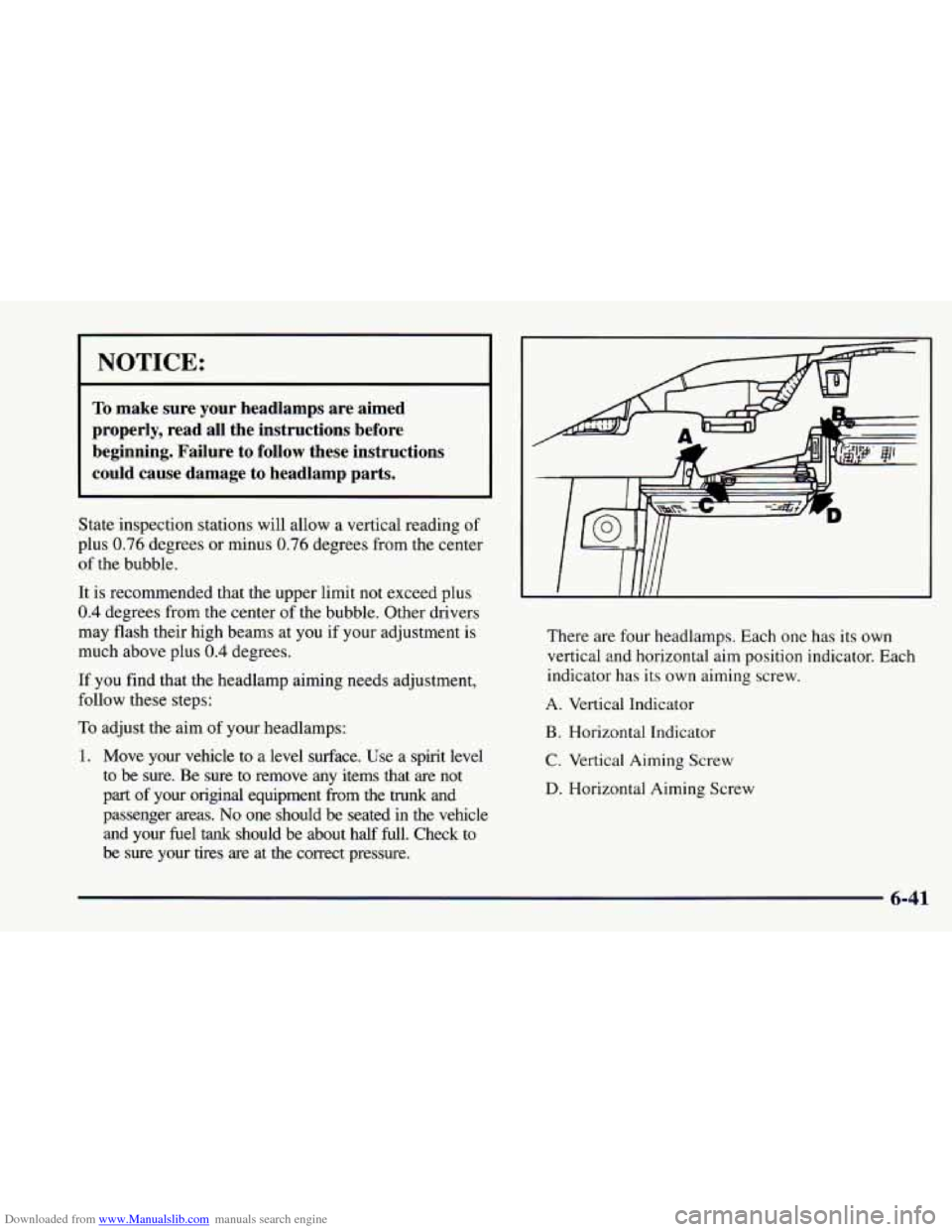
be sure your tires are at the correct pressure. There are four
headlamps. Each one has its own
vertical and horizontal aim position indicator. Each
indicator has its own aiming screw.
A. Vertical Indicator
B. Horizontal Indicator
C. Vertical Aiming Screw
D. Horizontal Aiming Screw
6-41
Page 288 of 404
Downloaded from www.Manualslib.com manuals search engine 2.
3.
4.
Start with the horizontal (left and right) headlamp
aim. Don’t try to adjust the vertical (up and down)
aim first.
Check the horizontal aim for each headlamp and
adjust it
as necessary.
Turn the horizontal aiming screw until the pointer is
lined
up with the 0 (zero).
5. Now adjust the vertical aim. Check the vertical aim
6. Turn the vertical aiming screw until the bubble in the
for each
headlamp and adjust it as necessary.
level is centered at
0 (zero).
7. If the gage readings are not centered, repeat Steps 2
and 3.
Try not to touch threaded parts other than the vertical
and horizontal aiming screws.
6-42
Page 289 of 404
Downloaded from www.Manualslib.com manuals search engine Headlamps
Before replacing a headlamp that does not light, check
to make sure that the wiring connector is securely
fastened to it.
See “Replacement Bulbs” in the Index to check the size
and type
of headlamp you need to use before you begin
to replace the headlamp. You must replace a headlamp
with
one that is exactly the same.
Be careful not to move the aiming screws when you
replace the headlamp.
If the headlamp being replaced
was properly aimed, the new one will be also if it
is
properly installed.
1. Remove the Tom@ head screws at the end of the
aiming ring.
6-43