1997 CADILLAC ELDORADO hood open
[x] Cancel search: hood openPage 85 of 361
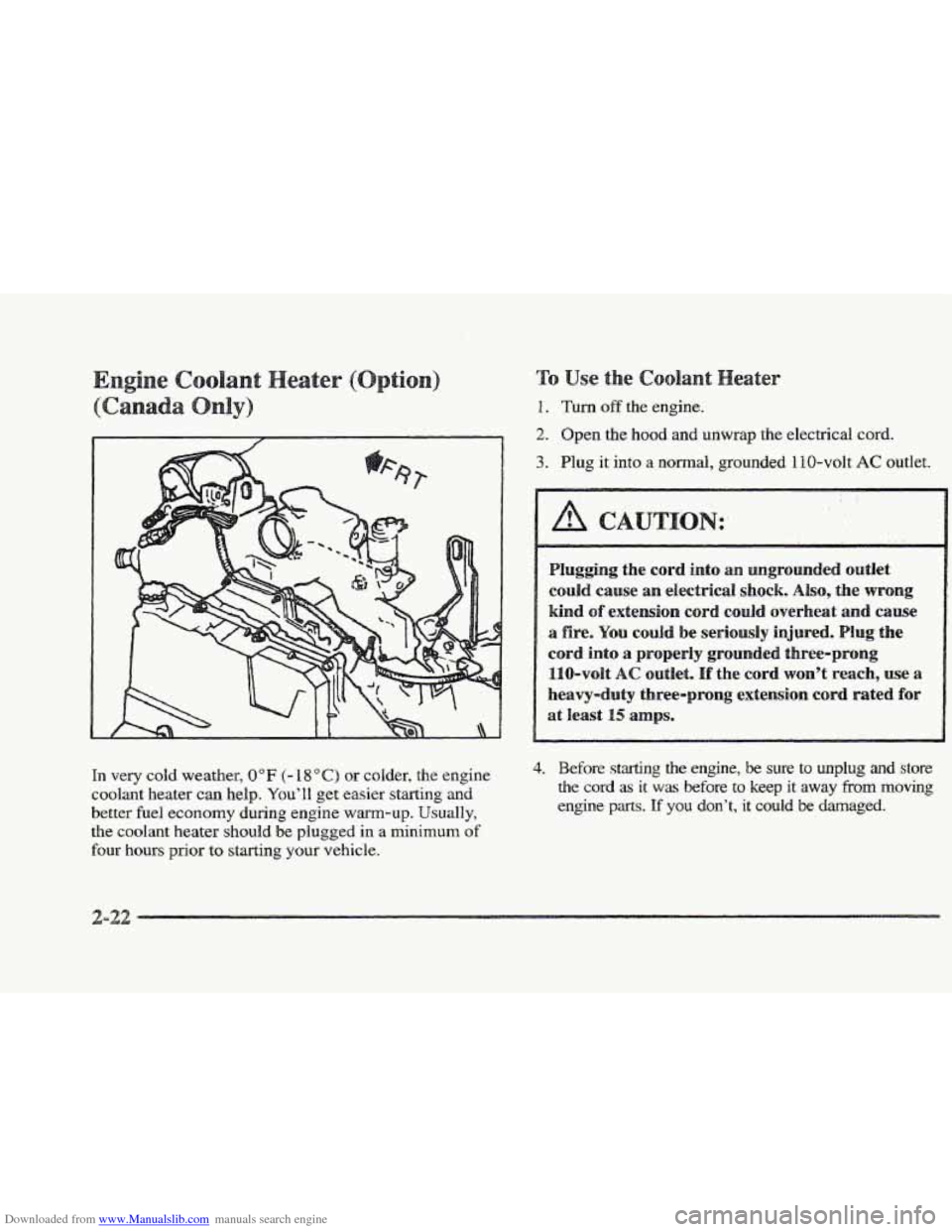
Downloaded from www.Manualslib.com manuals search engine 1. Turn off the engine.
2. Open the hood and unwrap the electrical cord.
3. Plug it into a normal, grounded 1 IO-volt AC outlet.
..
In very cold weather, WF (- 18 "C) or colder, the engine
coolant heater can help. You'll get easier starting and
better
fuel economy during engine warm-up. Usually,
the coolant heater should be plugged in a minimum of
four hours prior to starting your vehicle.
4. Before starting the engine, be sure to unplug and store
the cord as it was before to keep it away from moving
engine
parts. If you don't, it could be bmaged.
Page 230 of 361
Downloaded from www.Manualslib.com manuals search engine 2.
3.
4.
Get the vehicles close enough so the jumper cables
can reach, but be sure
the vehicles aren’t touching
each other.
If they are, it could cause a ground
connection you don’t want. You wouldn’t be able to
start your Cadillac and the bad grounding could
damage the electrical systems.
Turn off the ignition on both vehicles. Unplug
unnecessary accessories plugged into the cigarette
lighter.
Turn off all lamps that aren’t needed as well
as radios. This will
avoid sparks and help save both
batteries.
In addition, it could save your radio!
Open
the hoods and locate the batteries. Find the
positive (+) and negative (-) terminals on
each battery.
An electric fan can start up even when the engine
clothhg and tools away from any underhood
is not running and can injure you. Keep hands,
electric fan.
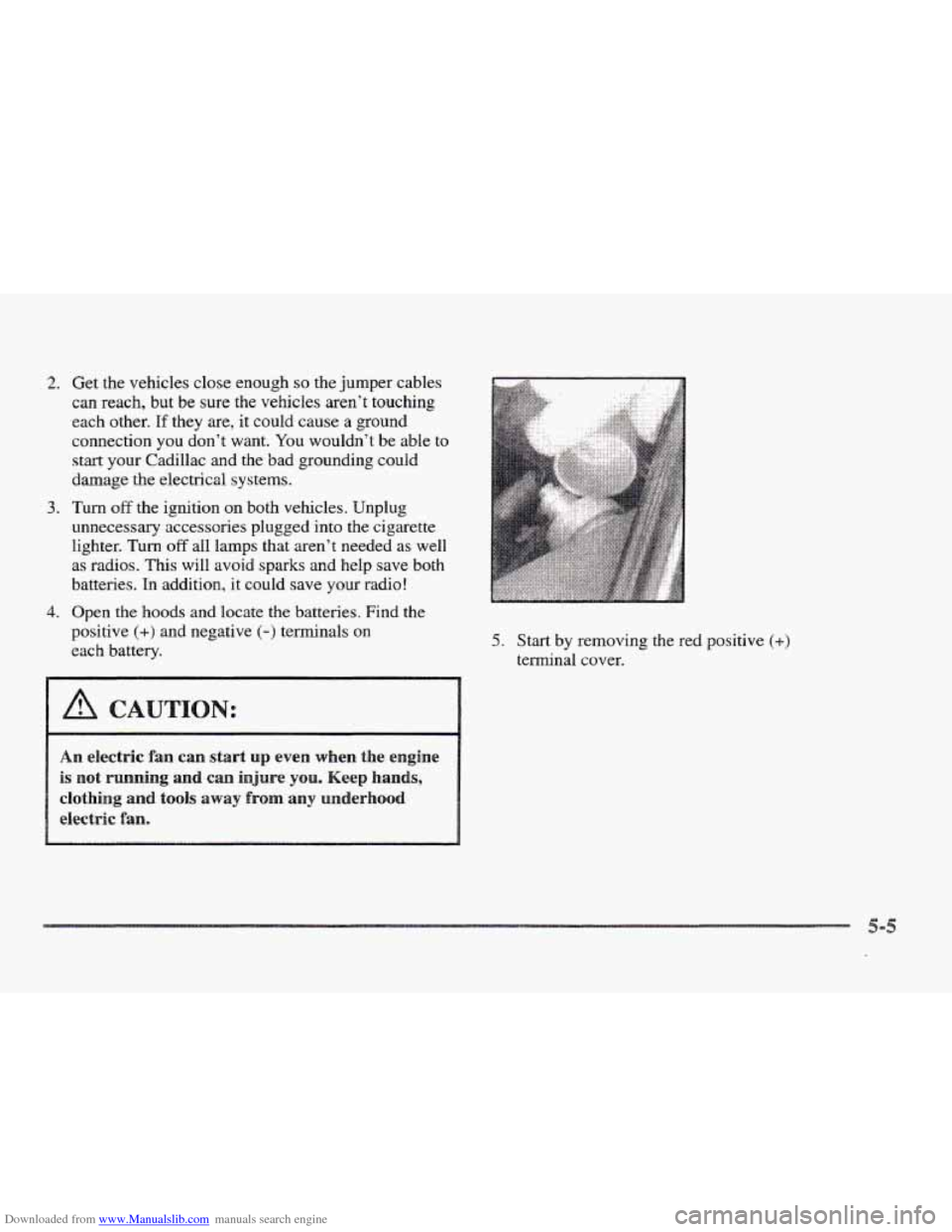
5. Start by removing the red positive (+)
terminal cover.
CAUTION:
Page 242 of 361
Downloaded from www.Manualslib.com manuals search engine L
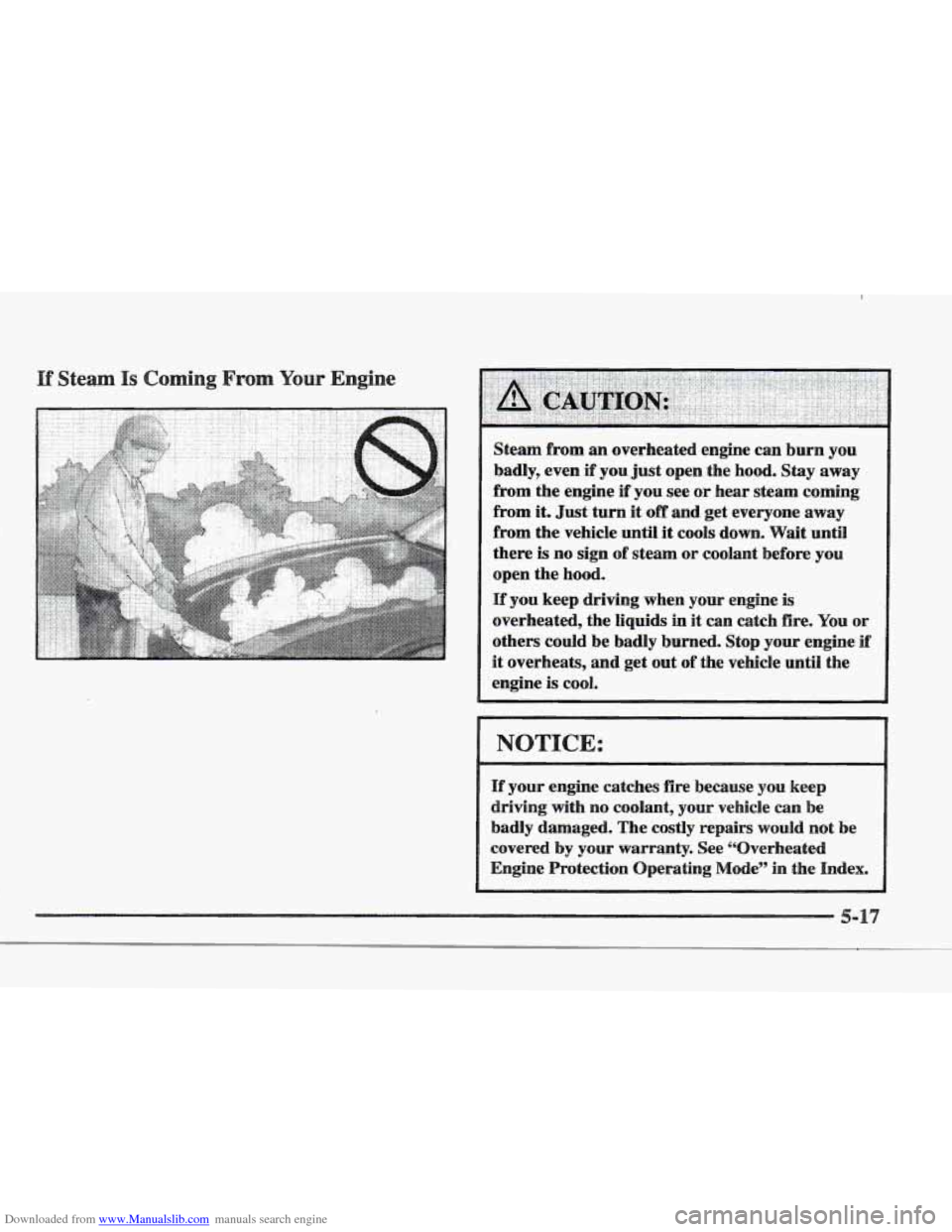
Steam from an overheated engine can burn you
badly, even
if you just open the hood. Stay away
from the engine if you see or hear steam coming
from it. Just turn it off and get everyone away
from the vehicle until it cools down. Wait until
there
is no sign of steam or coolant before you
open the hood,
If you keep driving when your engine is
overheated, the Iiquids in it
can catch fire. You or
others could be badly burned. Stop your engine if
it overheats, and get out
of the vehicle until the
engine is cool.
If your engine catches fire because you keep
driving with
no coolant, your vehicle can be
badly damaged. The costly repairs would not be
covered
by your warranty. See (‘Overheated
Engine Protection Operating Mode” in
the Index.
Page 243 of 361

Downloaded from www.Manualslib.com manuals search engine If you get the overheat warning but see or hear no
steam,
the problem may not be too serious. Sometimes
the engine can get a
little too hot when you:
Climb a long hill on a hot day.
Stop after high-speed driving.
Idle for long periods in traffic.
Tow
a trailer.
If you get the overheat warning with no sign of stem,
try this for
a minute or so:
I. Turn off your air conditioner.
2. Dial temperature control to the highest heat setting
and open the window, as necessary.
otherwise, shift
to the highest gear while
driving
-- OVERDRIVE (@) or THIRD (3).
3. If you’re in a traffic jam, shift to NEUTRAL (N);
If you no longer have the overheat warning, you can
drive. Just to be safe, drive slower for about IO minutes.
If the warning doesn’t come back on, you can
drive normally.
If the warning continues, pull over, stop and park your
vehicle right away.
If there’s still no sign of steam, YOU can idle the engine
for two
or three minutes while you’re parked, to see if
the warning stops. But then, if you still have the
warning, turn off the engine and get everyone out of the
vehicle until it cools down. Also, see “Overheated
Engine Protection Operating Mode” listed previously in
this section.
You may decide not to lift the hood
but to get service
help right away.
Page 266 of 361
Downloaded from www.Manualslib.com manuals search engine Things you might add to the outside of your vehicle can
affect the airflow around
it. This may cause wind noise
and affect windshield washer performance. Check with
your Cadillac dealer before adding equipment to the
outside
of your vehicle.
Use premium unleaded gasoline rated at
9 1 octane or
higher. At a minimum, it should meet specifications
ASTM D4814 in the United States and CGSB 3.5-WI93
in Canada. Improved gasoline specifications have been
developed by the American Automobile Manufacturers
Association
(AAMA) for better vehicle performance
and engine protection. Cholines meeting the
AAMA
specification could provide improved driveability and
emission control system protection compared to
other gasolines.
Be sure the posted octane
for premium is at least 9 I. If
the octane is less than
91, you may get a heavy knockmg
noise when
you drive. (In an emergency, you may be
able
to use a lower octane -- as low as 87 -- if heavy
knocking does not occur.) If
you're using 91 or higher
octane unleaded gasoline
and you hear heavy knocking,
your engine needs service.
If your vehicle is certified to meet California Emission
Standards (indicated on
the underhood tune-up label),
it is designed to operate on fuels that meet California
specifications. If such
fuels are not available in states
adopting California emissions standards, your vehicle
will operate satisfactorily
on fuels meeting federal
specifications, but emission control system performance
may be affected. The malfunction indicator lamp on
your instrument panel
may turn on and/or your vehicle
may fail a smog-check test. If this occurs, return to your
authorized Cadillac dealer
for diagnosis to determine the
cause
of failure. In the event it is determined that the
cause
of the condition is the type of fuels used, repairs
may not be covered by your warranty.
Some gasolines that are not reformulated for low
emissions contain an octane-enhancing additive called
rnethylcyclopentadienyl manganese tricarbonyi
(MMT);
ask your service station operator whether or not his fuel
contains
MMT. General Motors does not recommend the
use of such gasolines. If fuels containing MMT are used,
spark plug life may be reduced and your emission
controa system performance may be affected. The
malfunction indicator
lamp on your instrument panel
may turn on. If this occurs, return to your authorized
Cadililac dealer fox service.
Page 271 of 361
Downloaded from www.Manualslib.com manuals search engine t
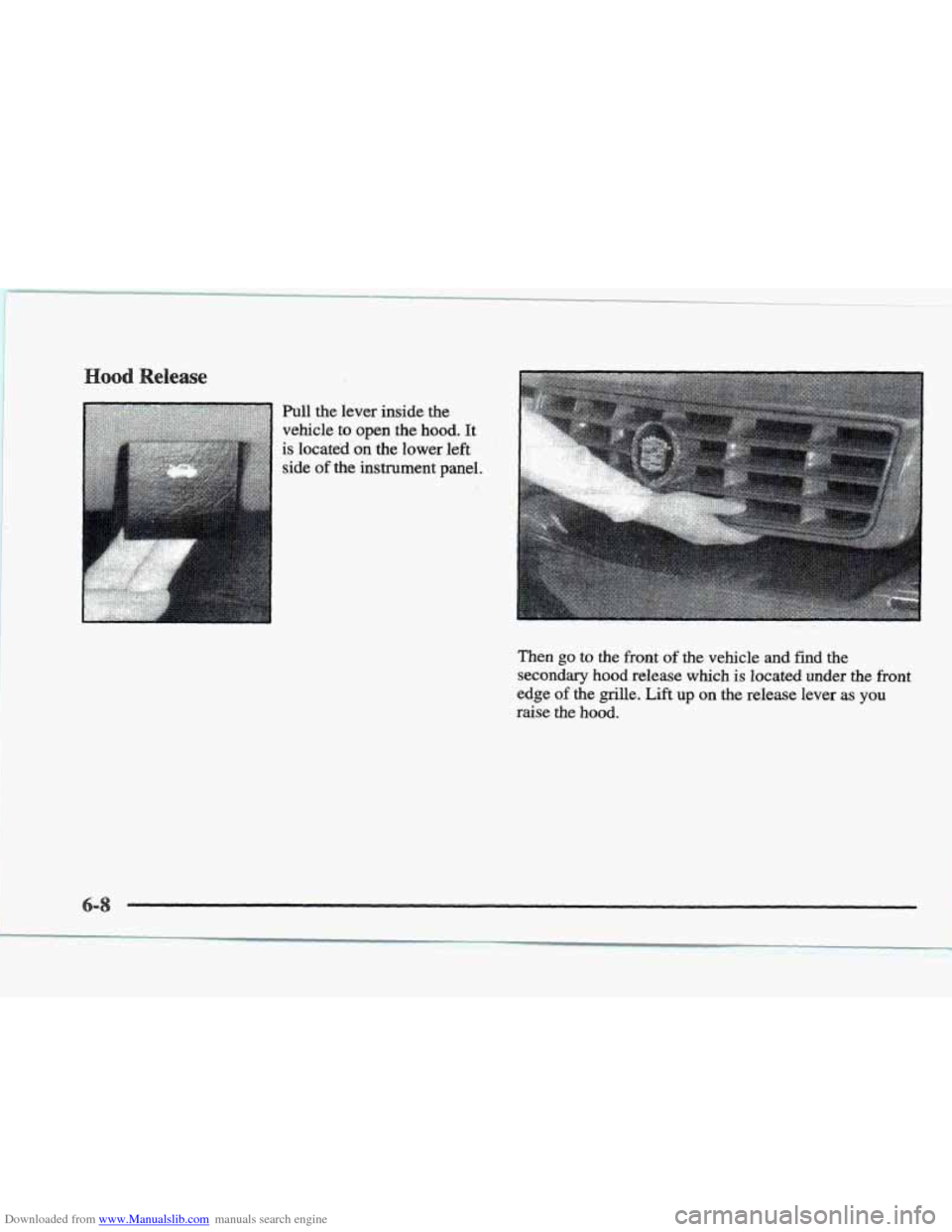
Pull the lever inside the
vehicle
to open the hood. It
is located’on the lower left
side of the instrument panel.
Then go to the front of the vehicle and find the
secondary hood release which is located under
the front
edge
of the grille. Lift up on the release lever as you
raise the hood.
Page 272 of 361
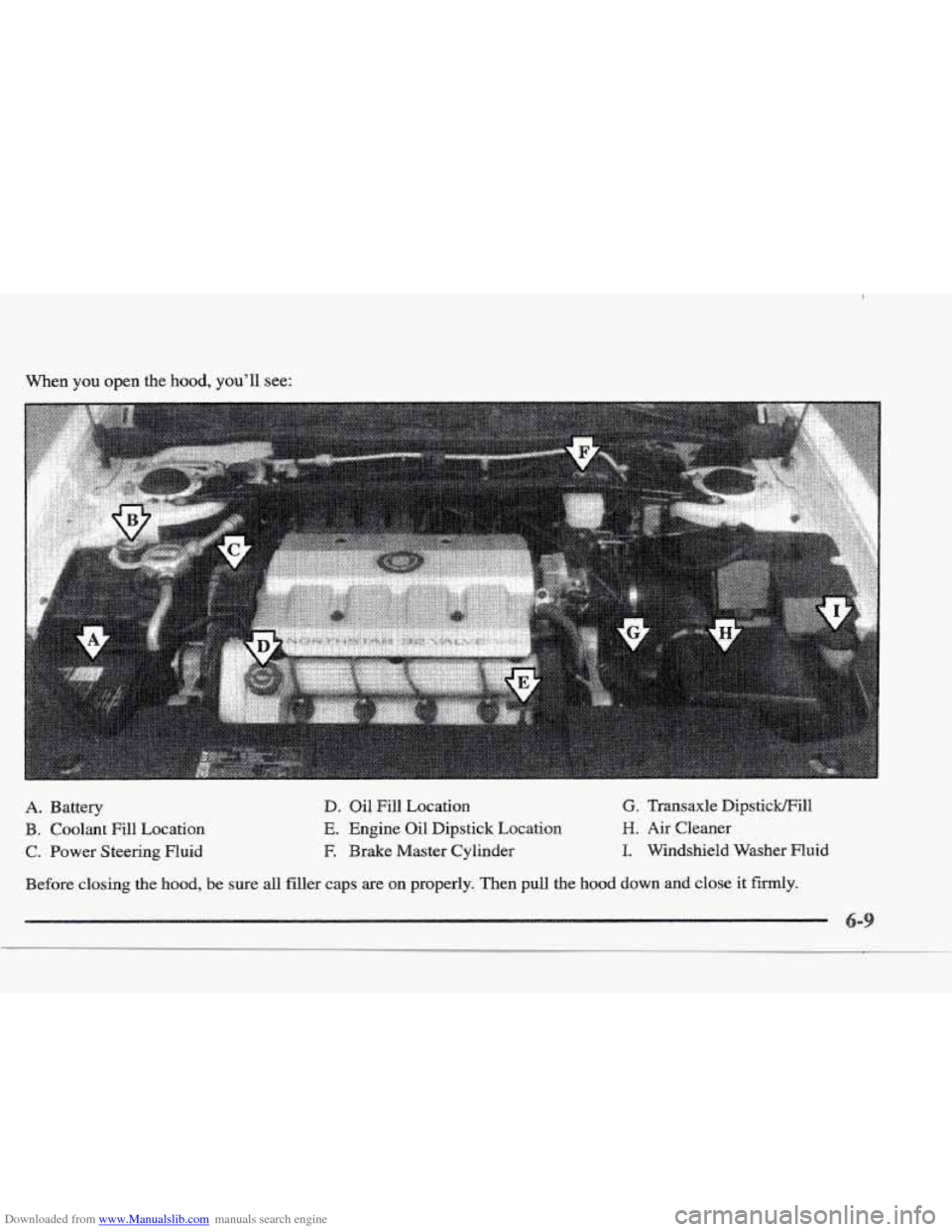
Downloaded from www.Manualslib.com manuals search engine When you open the hood, you’ll see:
A. Battery
B. Coolant Fill Location
C. Power Steering Fluid
D. Oil Fill Location
E. Engine Oil Dipstick Location
F. Brake Master Cylinder
G. Transaxle DipsticWill
H. Air Cleaner
I. Windshield Washer Fluid
Before closing
the hood, be sure all filler caps are on properly. Then pull the hood down and close it firmly.
Page 273 of 361
Downloaded from www.Manualslib.com manuals search engine Turn the parking lamps on to operate the underhood
lamp. The underhood lamp will come
on when the hood
is opened.
FUEL ONLY TRIP 0 u Bni!
@@BmaMm
....: ............... ” .... .............. : ... : :.* ......... .... : :.. : : :.. : : ::: : :*. .... : : e:* : :
......... ...... .... .... ...................................................
If you have the Driver Information Center (DIC), a
CHECK OIL LEVEL message will appear when the
engine oil is approximately
1 quart (1 L) low. If the
message is displayed, check the dipstick level and
add
oil as needed. It’s
a good
idea to check your engine oil every time you
get fuel.
In order to get an accurate reading, the oil must
be warm and the vehicle
must be on level ground.
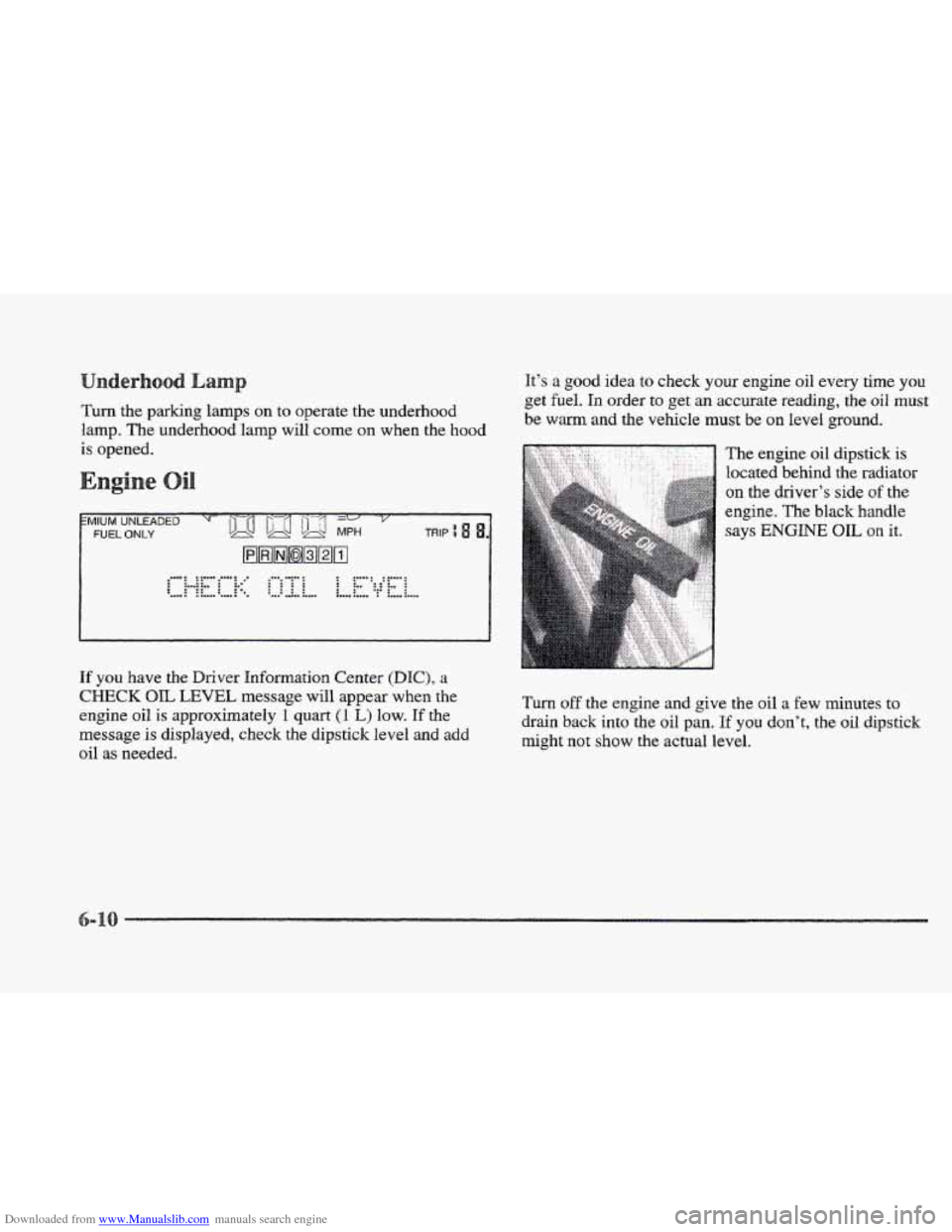
The engine oil dipstick
is
located behind the radiator
on the driver’s side
of the
engine. The black
handle
says ENGINE OIL on it.
Turn
off the engine and give the oil a few minutes to
drain back into the oil pan. If you don’t, the oil dipstick
might not show the actual
level.