Page 159 of 361
Downloaded from www.Manualslib.com manuals search engine With the automatic setting, the air conditioning
compressor automatically cycles when needed to cool
the
air. In cold weather, when the system senses the need
for heat, the airflow will be directed out
the floor
outlets. As the interior temperature approaches a desired
setting, the blower speed will decrease.
To maintain
interior comfort, the aifflow may move to the instrument
panel air outlets and floor outlets (bi-level mode). On
bright sunny days in cold weather,
the airflow may come
out of the air conditioning outlets (AC mode) to
maintain comfort and prevent stuffiness.
If your vehicle is sitting out on a hot day and you have it
set on
AUTO, the air will first flow out the floor air
outlets for a few seconds. That is normal. This is to
expel
hot air from the air outlets. As the air is cooled,
the airflow will move through
the air conditioning
outlets. If you start your vehicle with the
fan setting on
HI,
it will skip the air conditioning purge.
To avoid blowing cold
air in cold weather, the system will
delay
turning on the fan until warm air is available. The
length of delay depends on the outside
air temperature,
engine coolant temperature
or the time since the engine
was last started. As the coolant warms up, the blower fan
speed will gradually increase and air will flow from the
heater outlets, with some airflow to
the windshield to
prevent fogging under most normal conditions.
If you leave your vehicle, the system will remember the
control setting the next time you
start your engine,
except
for recirculation and defrost. Each ignition cycle
cancels recirculation, whereas,
DEFROST will change
to automatic operation when
the ignition is shut off and
then turned
back on.
You may manually adjust
the air delivery mode or
fan speed.
/.I AC: This setting directs airflow through the
middle instrument panel outlets.
'/J BI-LEVEL: This setting directs air into your
vehicle in two ways. Cool air is directed to the upper
portion
of your body through the four instrument panel
outlets while warmed
air is directed to the floor.
'fl HEATER/DEFROSE This setting directs air to
the floor outlets and toward the windshield.
1/J HEATER: This setting directs warmed air
through the
floor outlets. Some warm air is diverted to
the windshield to minimize fogging.
L*
Page 188 of 361
Downloaded from www.Manualslib.com manuals search engine Death and injury associated with drinking and driving is
a national tragedy. It’s
the number one contributor to
the highway death
toll, claiming thousands of victims
every year.
Alcohol affects four things that anyone needs
to drive
a vehicle:
Judgment
Muscular Coordination
Vision Attentiveness.
Police records show that almost half
of all motor
vehicle-related deaths involve alcohol.
In most cases,
these deaths are the result
of someone who was drinking
and driving. In recent years, some 17,000 annual motor
vehicle-related
deaths have been associated with the use
of alcohol, with more than 300,000 people injured.
Many adults
-- by some estimates, nearly half the
adult population -- choose never to drink alcohol, so
they never drive after drinking. For persons under 2 1,
it’s against the lzw in every U.S. state to drink alcohol.
There are good medical, psychological and
developmental reasons for these laws. The
obvious way
to solve this highway safety problem
is for people never to drink alcohol and then drive. But
what if people do? How much is “too much” if the
driver plans to drive?
It’s a lot less than many might
think. Although it depends
on each person and situation,
here
is some general information on the problem.
The
Blood Alcohol Concentration (BAC) of someone
who is dpinlung depends upon four things:
The amount of alcohol consumed
The drinker’s body weight
The amount
of food that is consumed before and
during drinking
The length
of time it has taken the drinker to
consume the alcohol.
According to the American Medical Association, a
180-lb.
(82 kg) person who drinks three 12-ounce
(355 ml) bottles of beer in an hour will end up with a
BAC of about 0.86 percent. The person would reach the
same BAC by drinking three 4-ounce ( 120 ml) glasses
of wine or three mixed drinks if each had 1- U2 ounces
(45 ml) of a liquor like whiskey, gin or vodka.
Page 300 of 361
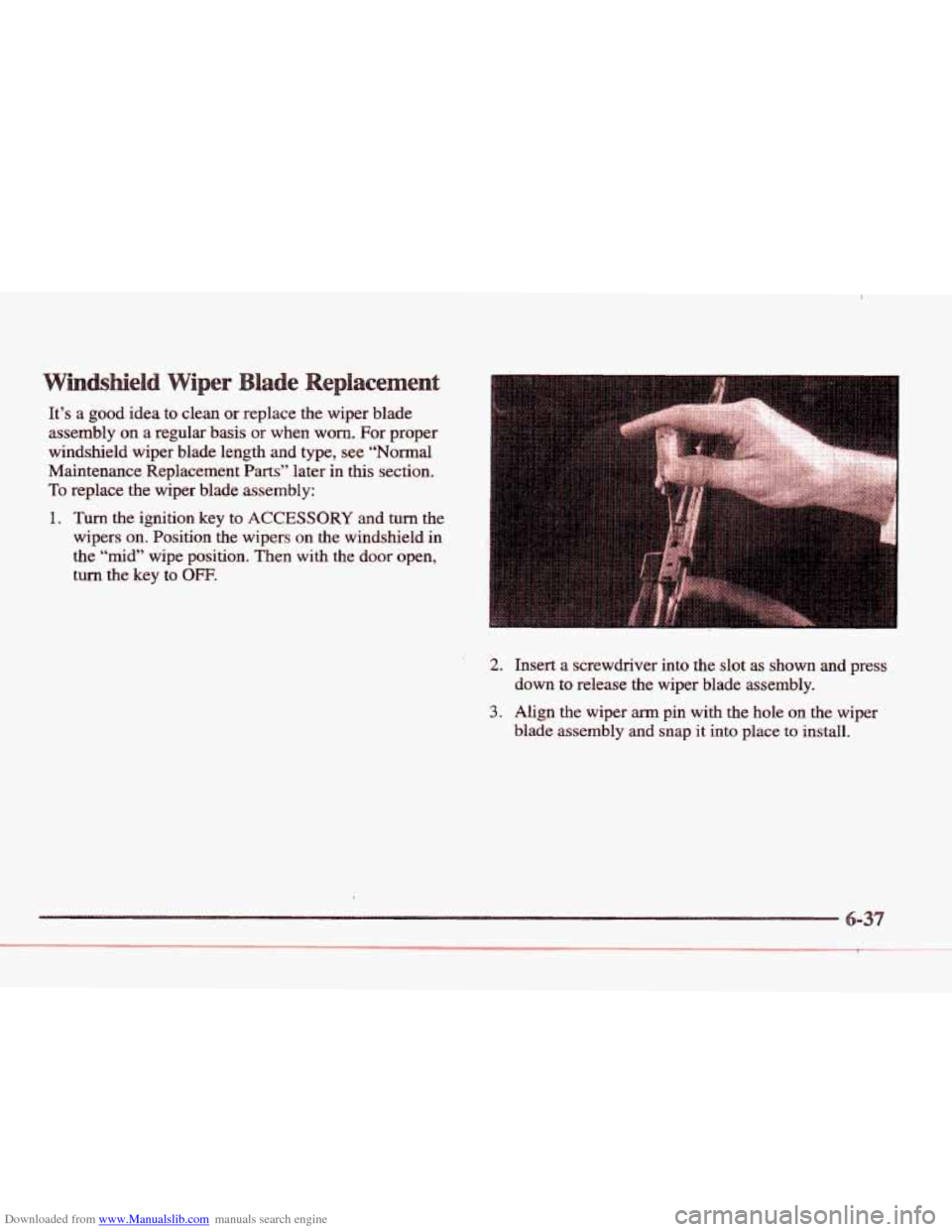
Downloaded from www.Manualslib.com manuals search engine It’s a good idea to clean ox replace the wiper blade
assembly on a regular basis
or when worn. For proper
windshield wiper blade length and type, see
“Normal
Maintenance Replacement Parts” later in this section.
To replace the wiper blade assembly:
I
1. Turn the ignition key to ACCESSORY and turn the
wipers on. Position the wipers on the windshield
in
the “mid” wipe position. Then with the door open,
turn the key
to OFF.
2. Insert a screwdriver into the slot as shown and press
down to release the wiper blade assembly.
3. Align the wiper arm pin with the hole on the wiper
blade assembly
and snap it into place to install.
Page 328 of 361
Downloaded from www.Manualslib.com manuals search engine Number
ce
Application
Headlamps Composite
Inner High Beam ....................... 9005
Outer
Low Beam ....................... 9006
Front Turn Signal ..................... 2357 NA
Rear Turn Signal and Taillamp ............. 2057
Center High-Mounted Stoplamp
(CHMSL) ... I156
s
Engine Specifications
Type ......................... 4.4 L DOHC V8
VIN Engine Code
Eldorado
................................ Y
ETC .................................... 9
Displacement ......... 279 cubic inches (4 565 cc)
Horsepower Eldorado
............... 275 (bhp) @ 5600 rprn
ET&: ................... 300 (bhp) @ 6000 rpm
205 (kW) @ 5600 rpm
224 (kW) @ 6000 rpm
Torque
Eldorado
. ......... 300 (Ib-ft) @ 4000 VIII
ETC .................. 295 (Ib-ft) @ 4400 rpm
Firing Order ................... 1-2-7-3-4-5-6-8
407
(N-m)
@ 4000 rpm
400 (Nem) @ 4400 rpm
Thermostat Starts To Open . . 177484°F (8I-85"C)
Capacities
Crankcase (Engine Oil with
Transaxle
(4T8O-E)
............ 15 quarts ( 14.2 L)
Filter Change) .............. 7.0 quarts (6.62 L)
Engine Cooling System ........ 12.5 quarts ( 1 1.8 Lj
Fuel Tank ................... 20 gallons (75.7 L)
R- 134a Refrigerant ............. 2.0 lbs. (0.91 kg)
Wheel Base ............... 108 inches (274.3 cm)
Length
................. 200.2 inches (508.6 cm)
Height..
................. 53.6 inches (136.2 cm)
Width
................... 75.5 inches (191.8 cm)
Front Tread
............... 60.9 inches (154.7 cm)
Rear Tread ............... 60.9 inches ( 154.7 cm)
Wheel Nut Torque .......... 100 Ib-ft ( 140 N-m)