1997 CADILLAC ELDORADO check oil
[x] Cancel search: check oilPage 141 of 361
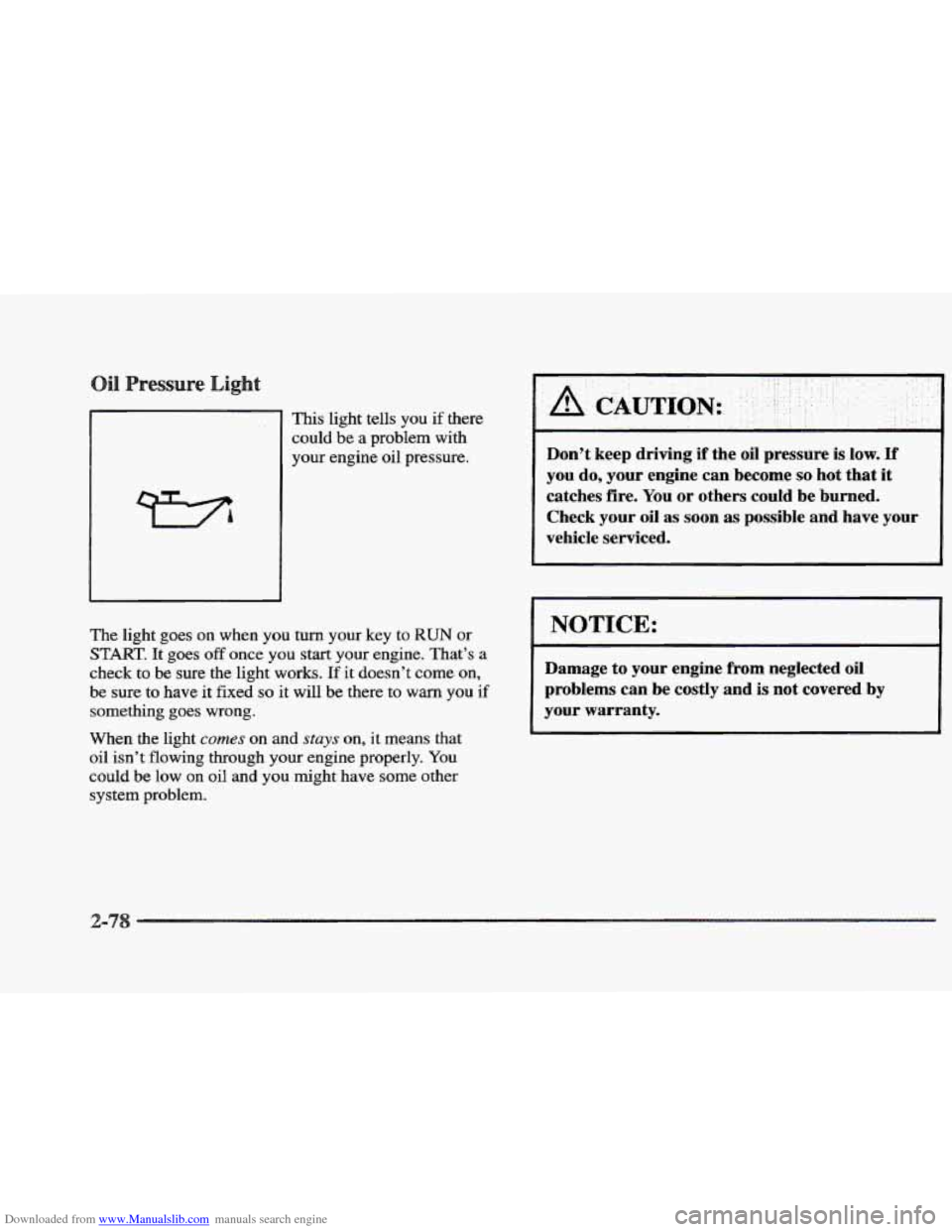
Downloaded from www.Manualslib.com manuals search engine I I This light tells you if there
could
be a problem with
your engine oil pressure. Don’t keep driving if the oil pressure is low. If
you do, your engine can become so hot that it
catches fire.
You or others could be burned.
Check
your oil as soon as possible and have your
vehicle serviced.
The light goes on when you turn your key to RUN or
START. It goes off once you start your engine. That’s a
check
to be sure the light works. If it doesn’t come on,
be sure to have it fixed so it will be there to warn you if
something goes wrong.
When the light comes on and stays on, it means that
oil
isn’t flowing through your engine properly. You
could be low on oil and you might have some other
system problem.
I NOTICE:
Damage to your engine from neglected oil
problems can be costly and is not covered by
your warranty.
L
Page 148 of 361
Downloaded from www.Manualslib.com manuals search engine BATTERY NO CHARGE - 87: Ths message will
appear if the battery is not being charged. Have the
electrical system checked
by your Cadillac dealership at
your earliest convenience.
BATTERY VOLTS HIGH - 08: This message shows
that the electrical charging system is overcharging (more
than 16 volts).
To avoid being stranded, have the
electrical system checked by your Cadillac dealership.
You can reduce
the charging overload by using the
accessories. Turn on the lamps and radio, set the climate
control on
AUTO and the fan speed on HI, and turn the
rear window defogger on.
You can monitor battery
voltage on the DIC by pressing the
INFORMATION
(INFO) button. The normal range is 1 1.5 to 15.5 volts
when the engine is running.
BATTERY VOLTS LOW - 06: This message will
appear when the electrical system is charging less than
10 volts or if the battery has been drained.
If this
message appears immediately after starting, it
is possible
that
the generator can still recharge the battery. The
battery should recharge after driving
a few miles and the
message should
go out. If this message appears while
driving or after starting your vehicle and stays on, have
it checked immediately to determine the cause of this
problem.
To help the generator recharge the battery
quickly, you
can reduce the load on the electrical system
by turning
off the accessories. You can monitor battery
voltage on the
DIC by pressing the INFORMATION
(INFO) button. The normal range is 11.5 to
15.5 volts.
BMKE VACUUM PROBLEM -108: The circuit in
the brake booster vacuum has shorted or is loose when
this message appears. Your vehicle may lose power
brakes
but you will ‘still have the use of manual brakes.
The power brakes will not be affected
if the problem is
caused by a failed sensor. Have your vehicle serviced
immediately at your Cadillac dealership.
CHANGE ENGINE OIL - 82: This means that
the life of the engine oil has expired and
it should be
changed within
200 miles. See “Engine Oil” and
“Filter Recommendations’’ in the Maintenance Schedule
booklet. After an oil change, the Oil Life Indicator must
be reset. See “Oil Life Indicator” in the Index on how to
reset it.
CHANGE TRANS FLUID - 47: This message will
appear when
it is time to replace the transaxle fluid. See
the Maintenance Schedule booklet for
the proper fluid
and change intervals.
Page 149 of 361
Downloaded from www.Manualslib.com manuals search engine CHECK BRAKE FLUID LEVEL - 37: This message
will display if
the ignition is in the RUN position to
inform the driver that the brake fluid level is low. Check
the brake reservoir
level and add fluid as needed. Have
the brake system serviced by
a Cadillac technician as
soon as possible. If the brake warning light is on, follow
the directions in that part.
CHECK COOLANT LEVEL - 02: This message will
appear when there is a low level of engi.ne coolant. Have
the cooling system serviced by
a Cadillac technician as
soon as possible.
CHECK FUEL GAGE - 39: This message will appear
when the
fuel supply is less than four gallons ( 15.2 L)
and the display is turned off (digital clusters only).
A single chime will also sound when this message
is displayed.
CHECK OIL LEVEL - 36: For correct operation of
the low oil sensing system, your vehicle should be on a
level surface.
A false CHECK OIL LEVEL message
may appear
if the vehicle is parked on grades. The oil
level sensing system does not check for actual oil level
if the engine has been
off for a short period of time, and
the oil level is never sensed while the engine is running.
If the CHECK OIL LEVEL message appears, and your vehicle has been parked
on level ground with the engine
off for at least 30 minutes, the oil level should be
checked by observing the oil dipstick. Prior to checking
the oil level, be sure the engine has been
off for five
minutes and your vehicle
is on a level surface. Then
check
the dipstick and add oil if necessary. See “Engine
Oil” in
the Index.
CHECK WASHER FLUID - 25: This message will
appear
for several seconds indicating that you need
washer solvent.
CRUISE ENGAGED - 43: This message will appear
for a few seconds when you select a speed at which
to cruise.
DOOR OPEN - 141: The passenger’s door is open
or ajar when
this message appears. The vehicle’s engine
must be running and the transaxle not
in PARK (P) for
this message to display.
A chime will also sound when
the vehicle’s speed
is greater than 5 mph (8.1 km/h).
DRIVER DOOR OPEN - 140: This message
will display when the vehicle is being shifted out of
PARK (P) with the engine running to signal that
the driver’s door
is open or ajar. A chime will also
sound when the vehicle’s speed is greater
than 5 mph
(8.1 km/h).
Page 155 of 361
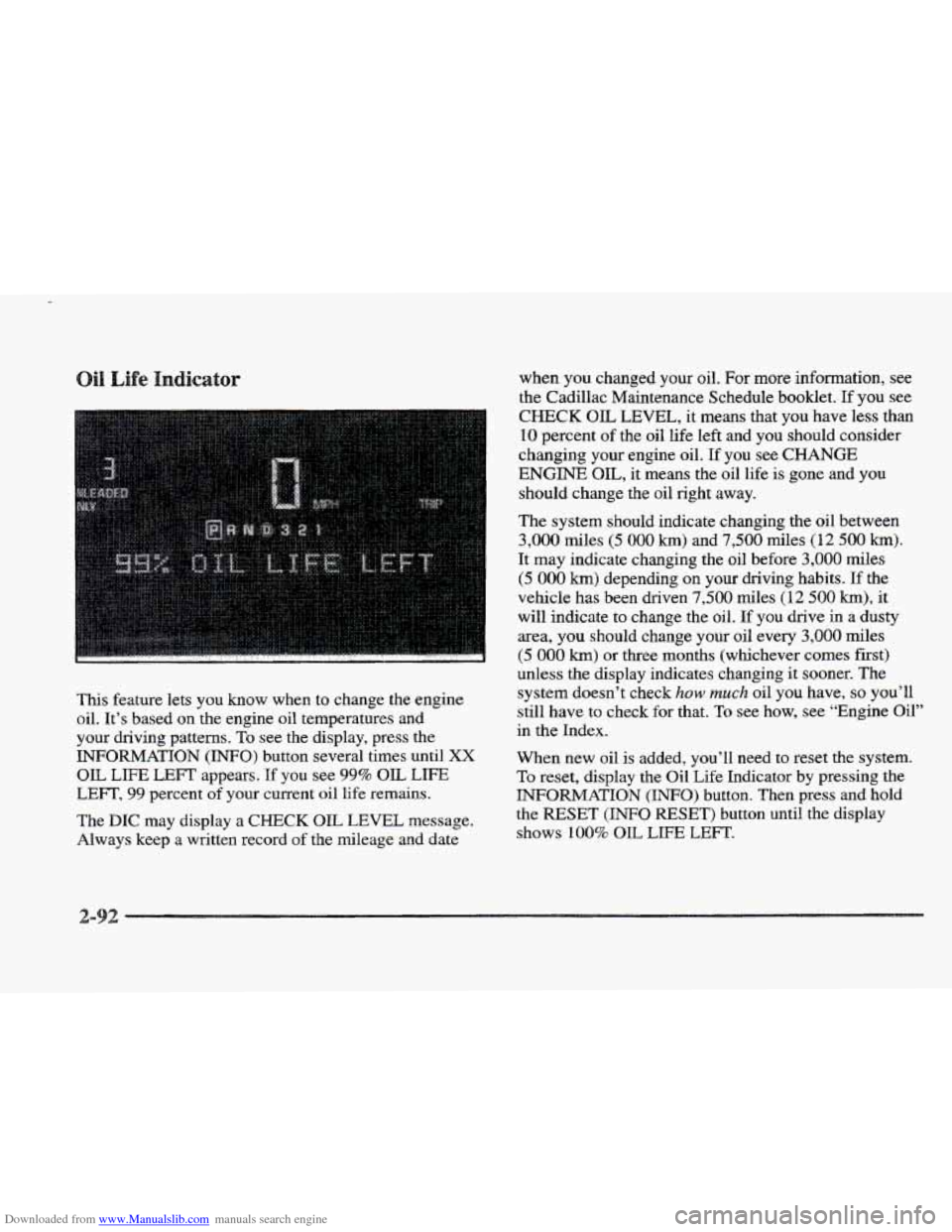
Downloaded from www.Manualslib.com manuals search engine This feature lets you know when to change the engine
oil. It’s based on the engine oil temperatures and
your driving patterns.
To see the display, press the
INFORMATION
(INFO) button several times until XX
OIL LIFE LEFT appears. If you see 99% OIL LIFE
LEFT, 99 percent of your current oil life remains.
The DIC may display a CHECK OK, LEVEL message.
Always keep
a written record of the mileage and date when you changed
your oil.
For more information, see
the Cadillac Maintenance Schedule booklet. If you see
CHECK OIL LEVEL, it means that you have less than
10 percent of the oil life left and you should consider
changing your engine oil.
If you see CHANGE
ENGINE OIL, it means the oil life is gone and you
should change the oil right away.
The system should indicate changing the oil between
3,000 miles (5 000 km) and 7,500 miles (12 500 km).
It may indicate changing the oil before 3,000 miles
(5 000 km) depending on your driving habits. If the
vehicle has been driven
7,500 miles (12 500 km), it
will indicate to change the oil. If you drive in a dusty
area, you should change your oil every
3,000 miles
(5 000 km) or three months (whichever comes first)
unless the display indicates changing
it sooner. The
system doesn’t check
how much oil you have, so you’ll
still have to check for that.
To see how, see “Engine Oil”
in the Index.
When new oil is added, you’ll need to reset
the system.
To reset, display the Oil Life Indicator by pressing the
INFORMATION (INFO) button. Then press and hold
the
RESET (INFO RESET) button until the display
shows
100% OIL LIE LEFT.
2-
Page 208 of 361
Downloaded from www.Manualslib.com manuals search engine The exit speed is usually posted.
Reduce your speed according to your speedometer, not
to your sense
of motion. After driving for any distance
at higher speeds, you may tend
to think you are going
slower than you actually are.
v
Make sure you’re ready. Try to be well rested. If you
must start when you’re not fresh
-- such as after a day’s
work
-- don’t plan to make too many miles that first part
of the journey. Wear comfortable clothing and shoes you
can easily drive in.
Is your vehicle ready for a long trip? If you keep
it
serviced and maintained, it’s ready to go. If it needs
service, have
it done before starting out. Of course,
you’ll find experienced and able service experts
in
Cadillac dealerships all across North America. They’ll
be ready and willing to help if you need it. Here
are some things you can check before
a trip:
e
e
QB
Q
Q
Windshield Washer Fluid: Is the reservoir full? Are
all windows clean inside and outside?
Wiper Blades: Are they in good shape?
Fuel, Engine Oil, Other Fluids: Have you checked
all levels?
Lamps: Are they all working? Are the lenses clean?
Tires: They are vitally important to a safe,
trouble-free trip. Is the tread good enough for
long-distance driving? Are the tires all inflated
to the
recommended pressure?
Weather Forecasts: What’s the weather outlook
along your route? Should you delay your trip a short
time to avoid
a major storm system?
Maps: Do you have up-to-date maps?
Page 223 of 361
Downloaded from www.Manualslib.com manuals search engine You really should not park your vehicle, with a trailer
attached,
on a hill. If something goes wrong, your rig
could start
to move. People can be injured, and both
your vehicle and the trailer can be damaged.
But if
you ever have to park your rig on a hill, here’s
how to do it:
1. Apply your regular brakes, but do not shift into
PARK (P).
2. Have someone place chocks under the trailer wheels.
3. When the wheel chocks are in place, release the
regular brakes until
the chocks absorb the load.
PARK (P) firmly and apply your parking brake.
4. Reapply the regular brakes. Then shift into
Release the regular brakes.
1. Apply your regular brakes and hold the pedal down
while you:
Start your engine;
e Shift into a gear; and
Be sure the parking brake has released.
2. Let up on the brake pedal.
3. Drive slowly until the trailer is clear of the chocks.
4. Stop and have someone pick up and store the chocks.
Your vehicle will need service
more often when you’re
pulling
a trailer. See the Maintenance Schedule for more
on this. Things that are especially important in trailer
operation are automatic transaxle fluid (don’t overfill),
engine oil, belt, cooling system and brake adjustment.
Each of these is covered in this manual, and
the Index
will help
you find them quickly. If you’re trailering, it’s
a good idea to review these sections before you start
your trip.
Check periodically to see that all hitch nuts
and bolts
are tight.
Page 264 of 361
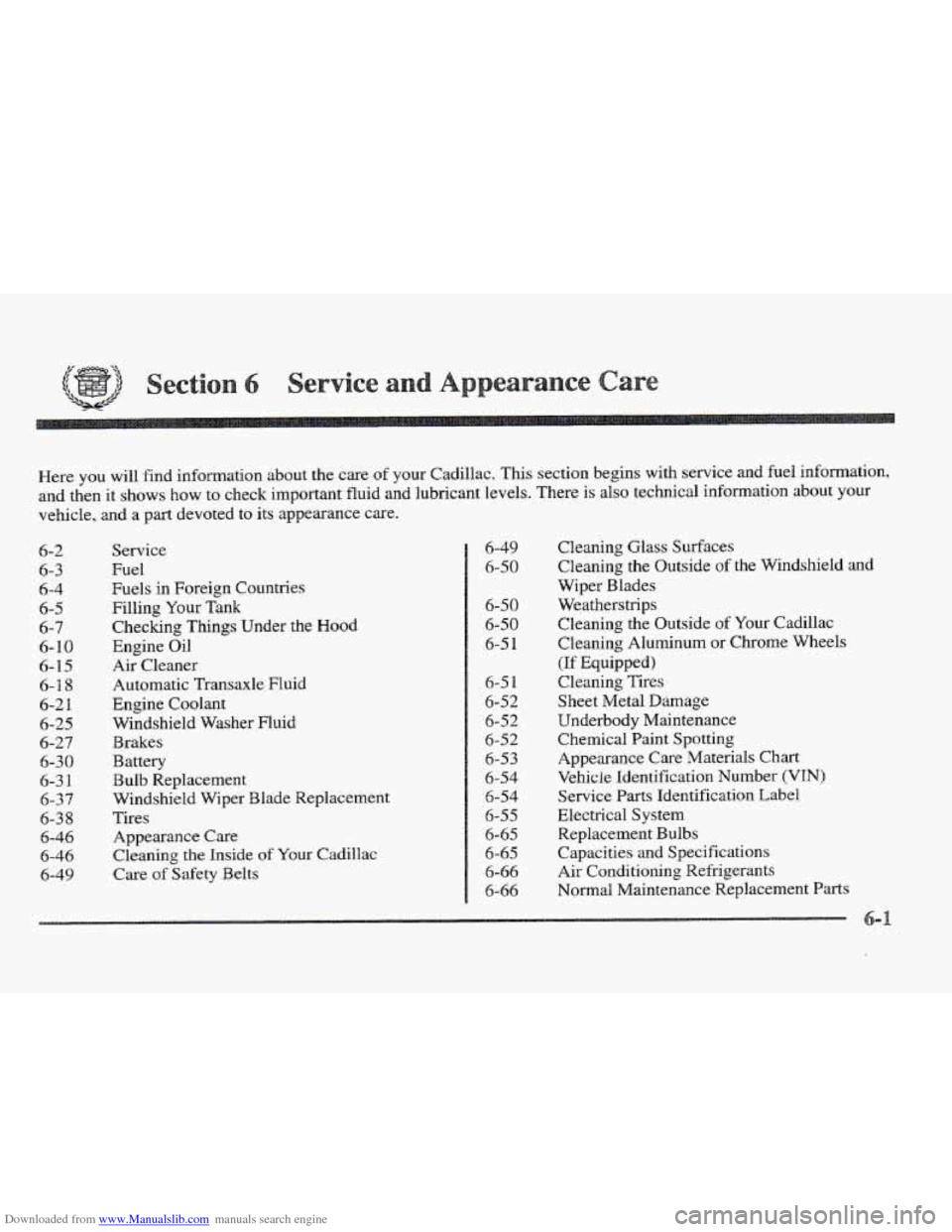
Downloaded from www.Manualslib.com manuals search engine Here you will find information about the care of your Cadillac. This section begins with service and fuel information,
and then
it shows how to check important fluid and lubricant levels. There is also technical information about your
vehicle, 2nd a part devoted to its appearance care.
6-2
6-3
6-4
6-5
6-7
6-10
6-
15
6-1 8
6-2 1
6-25
6-27
6-30
6-3
1
6-37
6-3 8
6-46
6-46
6-49
Service
Fuel
Fuels in Foreign Countries
Filling Your Tank
Checking Things Under the Hood
Engine Oil
Air Cleaner
Automatic Transaxle Fluid
Engine Coolant
Windshield Washer Fluid
Brakes
Battery
Bulb Replacement
Windshield Wiper Blade Replacement
Tires Appearance Care
Cleaning the Inside
of Your Cadillac
Care
of Safety Belts
4-49
6-50
6-50
6-50
6-5 1
6-5 1
6-52
6-52
6-52
6-53
6-54
6-54
6-55
6-65
6-65
6-66
6-66 Cleaning
Glass Surfaces
Cleaning the Outside
of the Windshield and
Wiper Blades
Weatherstrips Cleaning the Outside
of Your Cadillac
Cleaning Aluminum
or Chrome Wheels
(If Equipped)
Cleaning Tires
Sheet Metal
Damage
Underbody Maintenance
Chemical Paint Spotting
Appearance Care Materials Chart
Vehicle Identification Number
(VIN)
Service Parts Identification Label
Electrical System Replacement Bulbs
Capacities and Specifications
Air Conditioning Refrigerants
Normal Maintenance Replacement Parts
Page 267 of 361
Downloaded from www.Manualslib.com manuals search engine To provide cleaner air, all gasolines in the United States
are now required to contain additives that will help
prevent deposits from forming in your engine and fuel
system, allowing your emission control system
to
function properly. Therefore, you should not have to
add anything
to the fuel. In addition, gasolines
containing oxygenates, such
as ethers and ethanol, and
reformulated gasolines
may be available in your area to
help clean the air. General Motors recommends that you
use these gasolines
if they comply with the
specifications described earlier.
N B e
~ -~
Your vehicle was not designed for fuel that
contains methanol. Don% use it. I& can corrode
metal parts in YOU^: fuel system and also damage
plastic and rubber pasts. That damage wouldn’t
be covered under your warranty.
rei s
If you plan on driving in another country outside the
United States or Canada, the proper fuel may be hard to
find. Never use leaded gasoline or any other fuel not
recommended
in the previous text on fuel. Costly repairs
caused
by use of improper fuel wouldn’t be covered by
your warranty.
To check on
fuel availability, ask an auto club, or
contact a major oil company that does business in the
country where you’ll be driving.
You can also write
us at the following address for
advice. Just
tell us where you’re going and give your
Vehicle Identification Number
(VIN).
General Motors International Product Center
1908 Colonel Sam Drive
Oshawa, Ontario
LlH 8P7