1997 CADILLAC ELDORADO lock
[x] Cancel search: lockPage 172 of 361
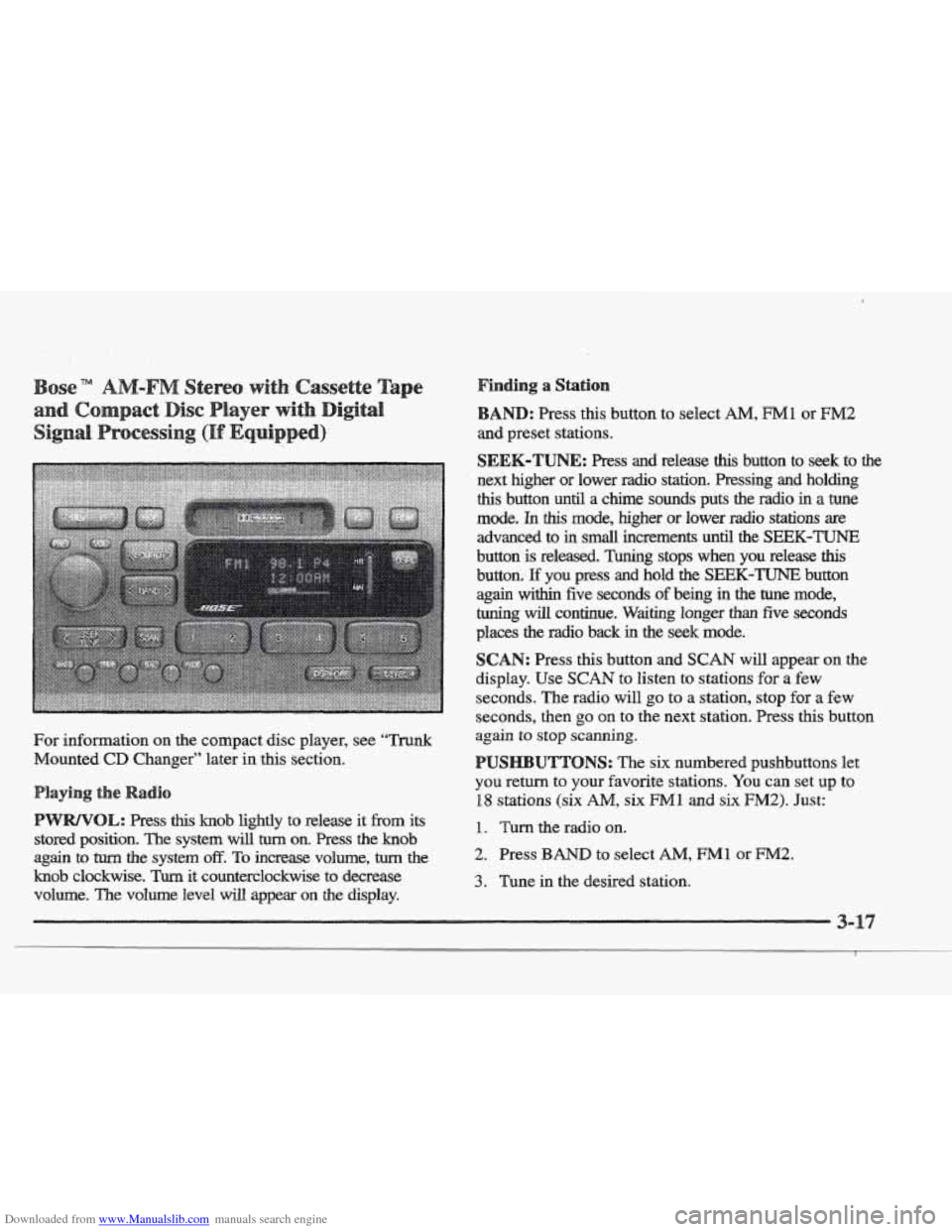
Downloaded from www.Manualslib.com manuals search engine For information on the compact disc player, see ‘‘Trunk
Mounted CD Changer” later in this section.
this knob lightly to release it from its
stored position.
The system will turn on. Press the knob
again
to turn the system off. To increase volume, turn the
knob clockwise. Turn it counterclockwise to decrease
volume. The volume level
will appear on the display.
Finding a Station
: Press this button to select AM, FM1 or EM2
SEEK-TUNE: Press and reiease this button to seek to the
next higher or lower radio station. Pressing and holding
this button until a chime sounds puts the radio in a tune
mode. In this mode, higher or lower radio stations are
advanced to
in small increments until the SEEK-TUNE
button is released. Tuning stops when you release this
button. E you press and hold the SEEK-TUNE button
again within five seconds of being in the tune mode,
tuning
will continue. Waiting longer than five seconds
places
the radio back in the seek mode.
SCAN: Press this button and SCAN will appear on the
display. Use
SCAN to listen to stations for a few
seconds. The radio will
go to a station, stop for a few
seconds, then
go on to the next station. Press this button
again to
stop scanning.
UTTONS: The six numbered pushbuttons let
you return to your favorite stations. You can set up to
18 stations (six AM, six Ml and six F”2). Just:
1. Turn the radio on.
2. Press BAND to select AM, FM1 or FM2.
3. Tune in the desired station.
Page 173 of 361
Downloaded from www.Manualslib.com manuals search engine 4. Press and hold one of the six numbered buttons until
you hear a chime.
A preset number will appear on
the display. The sound will mute. When it returns,
release the button. Whenever you press that
numbered button, the station
you set will return.
5. Repeat the steps for each pushbutton.
seconds until PRESET
SCAN appears on the display to
listen
to each of your preset stations for a few seconds
(Factory presets which have not been reprogrammed
with your stations will be ignored). The radio
will go to
the first preset station stored on your pushbuttons, stop
for a few seconds, then go on to the next preset station.
Press
SCAN again to stop scanning. If a preset station
has weak reception, the radio
will not stop at the
preset station.
ESET SCAN: Press and hold SCAN for two to three
ASS: Press this knob lightly so it extends. Turn the
knob clockwise to increase and counterclockwise to
decrease
bass.
T : Press this knob lightly so it extends. Turn the
knob clockwise to increase and counterclockwise to
decrease treble.
If a station is weak or noisy, you may
want to decrease the treble. Push
these knobs back into their stored positions when
you're not using them.
SP: The Digital Signal Processing (DSP) feature is
used to produce four audio effects. These include
TALK, DRIVER SEAT, LIVE and AUDITORIUM.
DSP can be used while listening to the radio, the
cassette tape player or the CD player. To activate DSP,
press the DSP button. Press this button again to go
through the
four effects. To turn the DSP feature off,
press OFF.
TALK: This setting is used when listening to
non-musical material such as baseball games, talk
shows
or news. TALK gives the best clarity of
spoken words. The high and low frequencies are
lowered, the mid-range is increased and the audio is
moved more toward the front speakers.
DRIVER SEAE This setting adjusts the audio to
give
the driver the best possible sound qualities. This
has been done by tailoring the sound arrival times
and equalization
for the driver seat. DRIVER SEAT
can be used at
any time for any material. Other
passengers
in the vehicle may not perceive the
same effect.
LIVE: This setting is used to imitate the sound of a
live performance.
Page 174 of 361
Downloaded from www.Manualslib.com manuals search engine UM: Ths setting is similar to LIVE,
however, more echo is present. The LIVE and
AUDITORIUM settings are best used for music.
LEVEL: Press the plus or minus symbol on this button
to adjust the amount
of effect desired when in DSP
mode. Some experimenting with this button will help
you determine the best sound.
usting the Speakers
AX,: Press this knob lightly so it extends. Turn the
knob clockwise to adjust sound to the right speakers and
counterclockwise for the left speakers. The middle
position balances the sound between
the speakers.
E: Press ths knob lightly so it extends. Turn the
knob clockwise
to adjust the sound to the front speakers
and counterclockwise
for the rear speakers. The middle
position balances the sound between
the speakers.
Push these knobs
back into their stored positions when
you’re
not using them.
laying a Cassette Tape
With the radio on, insert a cassette tape. The tape will
begin playing as
SOQII as it is inserted.
While
the tape is playing, we the VOL, FADE, BAL,
BASS and TREB controls just as you do for the radio.
Other controls
may have different functions when a tape
is inserted. The display will show
TAPE with an arrow
to indicate which side of the tape is playing. PLAY will
appear
on the display temporarily when a tape is
playing. The display will then revert back to showing
the time.
If an error occurs while trying to play a cassette tape, it
could be that:
The cassette tape is tight and the cassette player
cannot turn the hubs
of the tape. Hold the cassette
tape with the open end down and
try turning the right
hub counterclockwise with a pencil. Flip
the tape
over and repeat.
If the hubs do not turn easily, your
cassette tape may be damaged and should not be
used in the player. Try a new tape to be sure YQUI-
player is working properly.
The cassette tape is broken. (Check to see
if your
tape is broken.
Try a new tape.)
Page 179 of 361
Downloaded from www.Manualslib.com manuals search engine If ERR or ERROR appears on the display, an error has
occurred
and the compact disc temporarily cannot play.
CD CHANGER ERROR could be displayed for
the following:
The road
is too rough. The disc should play when the
road
is smoother.
The disc is dirty, scratched, wet or loaded label
side up.
@ The air is very humid. If so, wait about an hour and
try again.
CHEK DOOR or CD CHANGER DOOR OPEN is
displayed when the CD changer door is left open.
Completely close
the changer door to restore
normal operation.
CD CHANGER NO DISCS is displayed when an empty
magazine is inserted
in the CD changer. Try the
magazine again with a disc loaded
on one of the trays.
(This message does not appear in
the display on the
standard AM-FM Stereo radios.)
If any error occurs repeatedly or if an error cannot be
corrected, please contact your dealer.
If your radio
displays
an error number, write it down and provide it to
your dealer when reporting
the problem. With this
feature, your vehicle will recall the latest radio
settings as adjusted the last time your vehicle was
operated.
This feature allows two different drivers to
store and recall their own radio settings. The settings
recalled
by the radio are determined by which RKE
transmitter (“1” or “2”) was used to enter the vehicle.
The number on the back
of the RICE transmitter
corresponds to driver
1 or to driver 2. After the unlock
button is pressed on the
RKE transmitter or the ignition
key is placed in the ignition, the radio settings
will
automatically adjust to where they were last set. The
settings can also be changed by briefly pressing the
memory seat buttons
1 or 2 located on the driver’s door.
Your Cadillac has a “built-in” theft-deterrent feature on
each radio that is automatic
-- there is no programming
required. The
radio in your Cadillac cannot be used in
any other vehicle besides another Cadillac if it were to
be removed.
Page 192 of 361
Downloaded from www.Manualslib.com manuals search engine Avoid needless heavy braking. Some people drive in
spurts -- heavy acceleration followed by heavy
braking
-- rather than keeping pace with traffic. This is a
mistake. Your brakes
may not have time to cool between
hard stops. Your brakes will wear out much faster if you
do a lot of heavy braking.
If you keep pace with the
traffic and allow realistic following distances, you will
eliminate
a lot of unnecessary braking. That means
better braking and longer brake
life.
If your engine ever stops while you’re driving, brake
normally but don’t pump your brakes.
If you do, the
pedal may get harder to push down.
If your engine
stops, you will still have some power brake assist. But
you will use
it when you brake. Once the power assist is
used up, it may take longer to stop and the brake pedal
will be harder to push. Your
vehicle
has anti-lock brakes (ABS). ABS is an
advanced electronic braking system that will help
prevent a braking skid.
When
you start your engine and begin to drive away,
your anti-lock brake system will check itself. You may
hear a momentary motor or clicking noise while this test
is going on, and you may even notice that your brake
pedal moves a little. This
is normal.
ANTI -
LOCK
If there’s a problem with the
anti-lock brake system, this
warning light will stay on.
See “Anti-Lock Brake
System Warning Light” in
Page 193 of 361
Downloaded from www.Manualslib.com manuals search engine . . . . . . . . ., ...
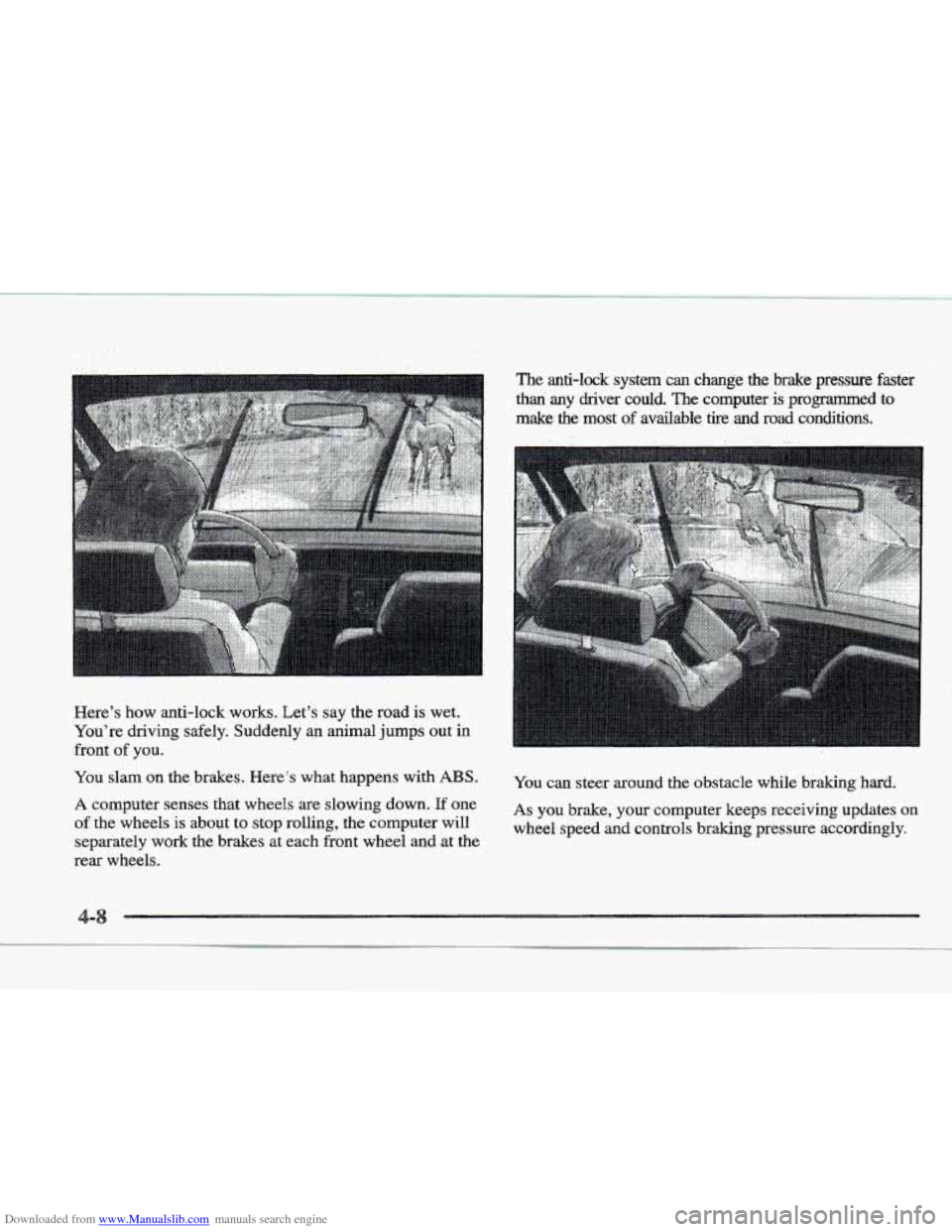
Here’s how anti-lock works. Let’s say the road is wet.
You’re driving safely. Suddenly
an animal jumps out in
front
of you.
You slam on the brakes. Here’s what happens with ABS.
A computer senses that wheels are slowing down. If one
of the wheels is about to stop rolling,
the computer will
separately work the brakes at each front wheel and at the
rear wheels.
The anti-lock system can change the br&e.pressure faster
than any driver could. The computer isqxogrammed to
make
the most of available &.and road conditions.
..
..
You can steer around the obstacle while braking hard.
As you brake, your computer keeps receiving updates on
wheel speed and controls braking pressure accordingly.
Page 194 of 361
Downloaded from www.Manualslib.com manuals search engine Remember: Anti-lock doesn’t change the time you need
to get your foot up to the brake pedal
or always decrease
stopping distance. If you get too close to the vehicle
in
front of you, you won’t have time to apply your brakes
if that vehicle suddenly slows or stops. Always leave
enough room up ahead
to stop, even though YOU have
anti-lock brakes.
using Anti-Lock
Don’t pump the brakes. Just hold the brake pedal down
and
let anti-lock work for YOU. You may hear the
anti-lock pump or motor operate, and feel
the brake
pedal pulsate, but this is normal.
Your vehicle has a traction control system that limits wheel
spin.
This is especially useful in slippery road conditions.
The system operates only
if it senses that one or both of
the front wheels are spinning or beginning to lose traction.
When
this happens, the system works the front brakes and
reduces engine power to limit wheel spin.
The TRACTION
ENGAGED message will display on
the Driver Information Center when the traction control
system is limiting wheel spin. See “Driver Information
Center Messages”
in the Index. You may feel or hear the
system working, but this is normal.
If your vehicle is in cruise control when the traction
control system begins to limit wheel spin, the cruise
control will automatically disengage. When road
Conditions allow you
to safely use it again, you may
re-engage the cruise control. (See “Cruise Control” in
the Index.)
This warning light will
come
on to let you know if
there’s a problem with your
traction control system.
See “Traction Control System Warning Light” in the
Index. When this
warning light is on, the system will not
limit wheel
spin. Adjust your driving accordingly.
The traction control system automatically comes on
whenever you start your vehicle.
To liHnit wheel spin,
especially in slippery
road conditions, you should
always leave
the system on. But you can turn the
traction control system
off if you ever need to. (You
Page 195 of 361
Downloaded from www.Manualslib.com manuals search engine should turn the system off if your vehicle ever gets stuck
in sand, mud,
ice or snow. See “Rocking Your Vehicle”
in the Index.)
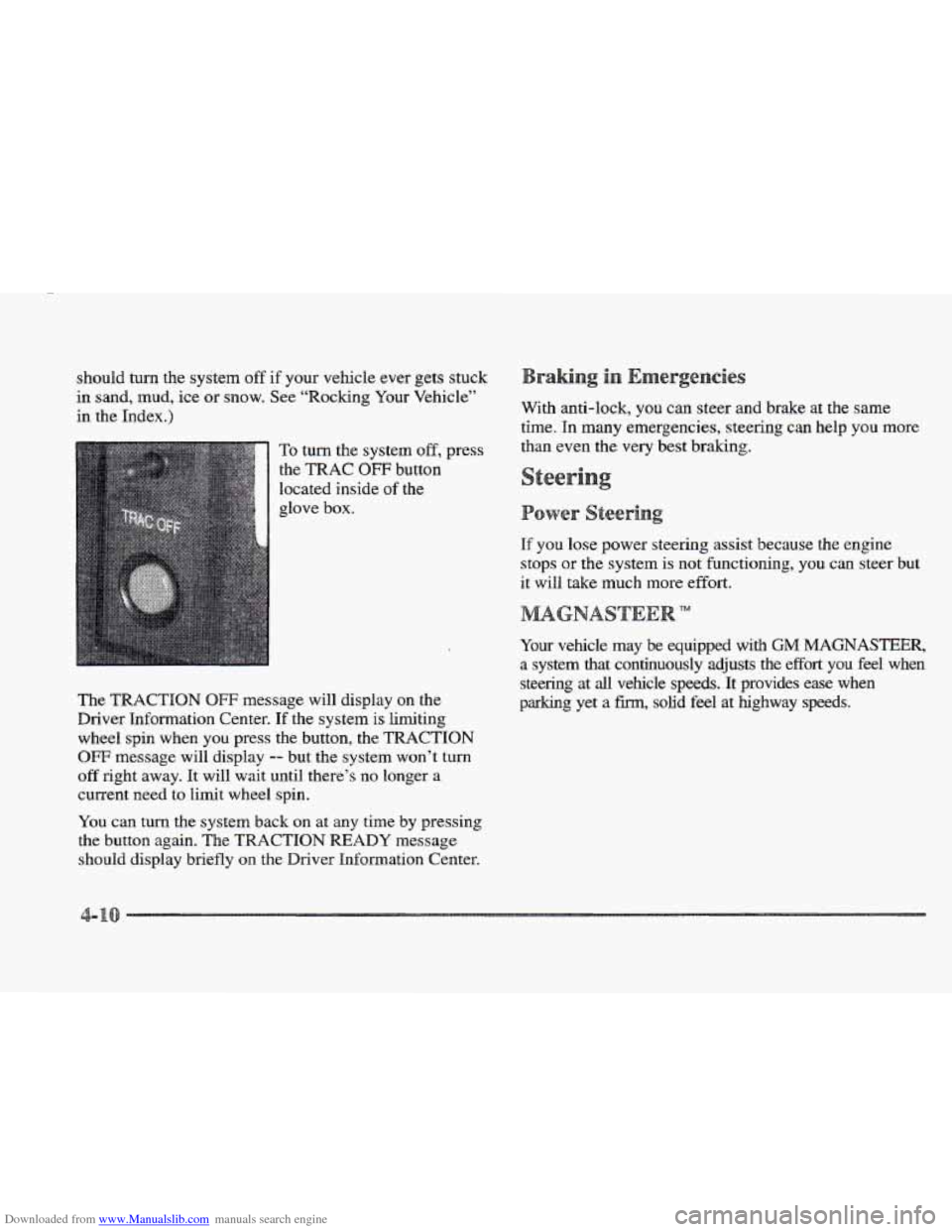
To turn the system off, press
the TRAC OFF button
located inside
of the
glove box.
The
TRACTION OFF message will display on the
Driver Information Center.
If the system is limiting
wheel spin when you press the button, the TRACTIQN
OFF message will display -- but the system won’t turn
off right away. It will wait until there’s no longer a
current need to limit wheel spin.
You can turn the system back on at any time
by pressing
the button again. The
TRACTION READY message
should display briefly
on the Driver Infomation Center. With
anti-lock,
you can steer and brake at the same
time.
In many emergencies, steering can help you more
than even the very best braking.
If you lose power steering assist because the engine
stops or the system is not functioning, you can steer but
it will take much more effort.
TM
Your vehicle may be equipped with GM MAGNASTEER,
a system that continuously adjusts the effort you feel when
steering at all vehicle speeds. It provides ease when
parking yet a
fm, solid feel at highway speeds.