1997 CADILLAC ELDORADO lock
[x] Cancel search: lockPage 197 of 361
Downloaded from www.Manualslib.com manuals search engine teering in
There are times when steering can be more effective
than braking. For example, you come over a hill and
find a truck stopped in your lane, or a car suddenly pulls
out
from nowhere, or a child darts out from between
parked cars and stops right
in front of you. You can
avoid these problems by bralung
-- if you can stop in
the. But sometimes you can’t; there
isn’t room.
That’s the time
for evasive action -- steering around
the problem.
Your Cadillac can perfonn very well
in emergencies like
these. First apply your brakes.
(See “Braking in
Emergencies” earlier
in this section.) It is better to
remove as
much speed as you can from a possible
collision. Then steer around
the problem, to the left or
right depending
on the space available.
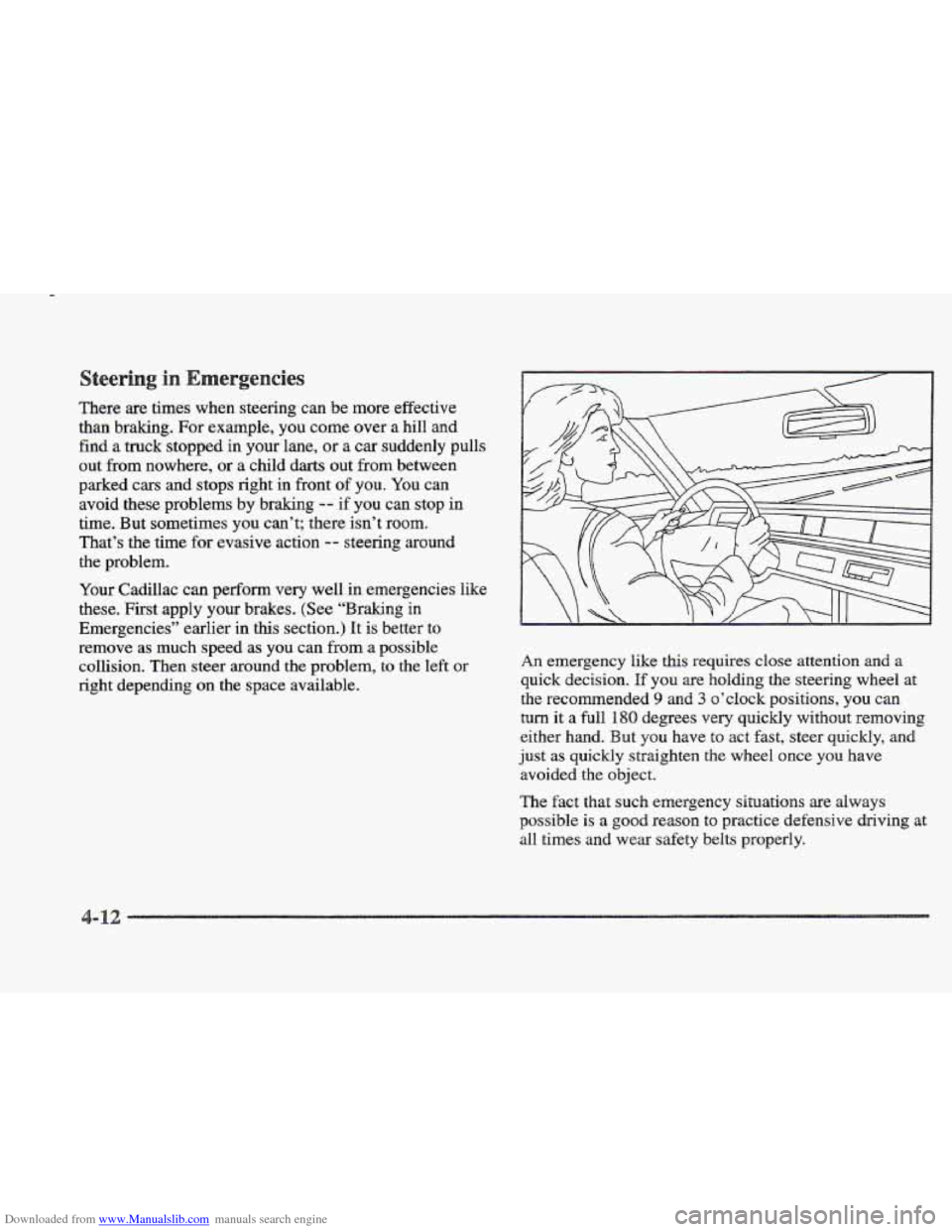
An emergency like this requires close attention and a
quick decision.
If you are holding the steering wheel at
the recommended
9 and 3 o’clock positions, you can
turn it a full 180 degrees very quickly without removing
either hand. But
you have to act fast, steer quickly, and
just
as quickly straighten the wheel once you have
avoided
the object.
The fact
that such emergency situations are always
possible is
a good reason to practice defensive driving at
all times and wear safety belts properly.
Page 200 of 361
Downloaded from www.Manualslib.com manuals search engine In a skid, a driver can lose control of the vehicle.
Defensive drivers avoid most skids by taking reasonable
care suited to existing conditions, and by not “overdriving”\
those conditions. But skids are always possible.
The
three types of skids correspond to your Cadillac’s
three control systems.
In the bralung skid, your wheels
aren’t rolling. In the steering or cornering shd, too
much speed or steering in
a curve causes tires to slip and
lose cornering force. And
in the acceleration skid, too
much throttle causes the driving wheels to spin.
A cornering skid is best handled by easing your foot off
the accelerator pedal.
Remember: Any traction control system helps avoid
only the acceleration
skid.
If your traction control system is off, then an
acceleration
skid is also best handled by easing your
foot
off the accelerator pedal.
If your vehicle starts to slide, ease your foot
off the
accelerator pedal
and quickly steer the way you want the
vehicle to
go. If you start steering quickly enough, your
vehicle may straighten out. Always
be ready for a
second skid
if it occurs. If you
have
the Eldorado ETC, you may see the
STABILITY
SYS ENGAGED message on the Driver
Information Center. See “Stability Engaged Message”
in
the Index.
Of course, traction is reduced when water, snow, ice,
gravel or other material is on
the road. For safety, you’ll
want to slow down and adjust your driving
to these
conditions.
It is important to slow down on slippery
surfaces because stopping distance will be longer and
vehicle control more limited.
While driving on a surface with reduced traction, try
your best to avoid sudden steering, acceleration or
braking (including engine braking by shifting to a lower
gear). Any sudden changes could cause the tires to
slide. You may not realize the surface
is slippery until
your vehicle
is skidding. Learn to recognize warning
clues
-- such as enough water, ice or packed snow on
the road to make a “mirrored surface” -- and slow
down when you have any doubt.
Remember: Any anti-lock brake system
(ABS) helps
avoid only the braking
skid.
Page 213 of 361
Downloaded from www.Manualslib.com manuals search engine Your anti-lock brakes improve your vehicle’s stability
when you make
a hard stop on a slippery road. Even
though yonhave the anti-lock braking system, you’ll
want to begin stopping sooner than you would
on dry
pavement. See “Anti-Lock’’ in the Index.
Allow greater following distance
on any
slippery road.
Watch for slippery spots. The road might be fine
until
you hit a spot that’s covered with ice. On an
otherwise clear road, ice patches may appear in
shaded areas where the sun can’t reach:
around
clumps of trees, behind buildings or under bridges.
Sometimes the surface
of a curve or an overpass may
remain icy when
the surrounding roads are clear. If
you see a patch of ice ahead of you, brake before you
are
on it. Try not to brake while you’re actually on
the ice, and avoid sudden steering maneuvers.
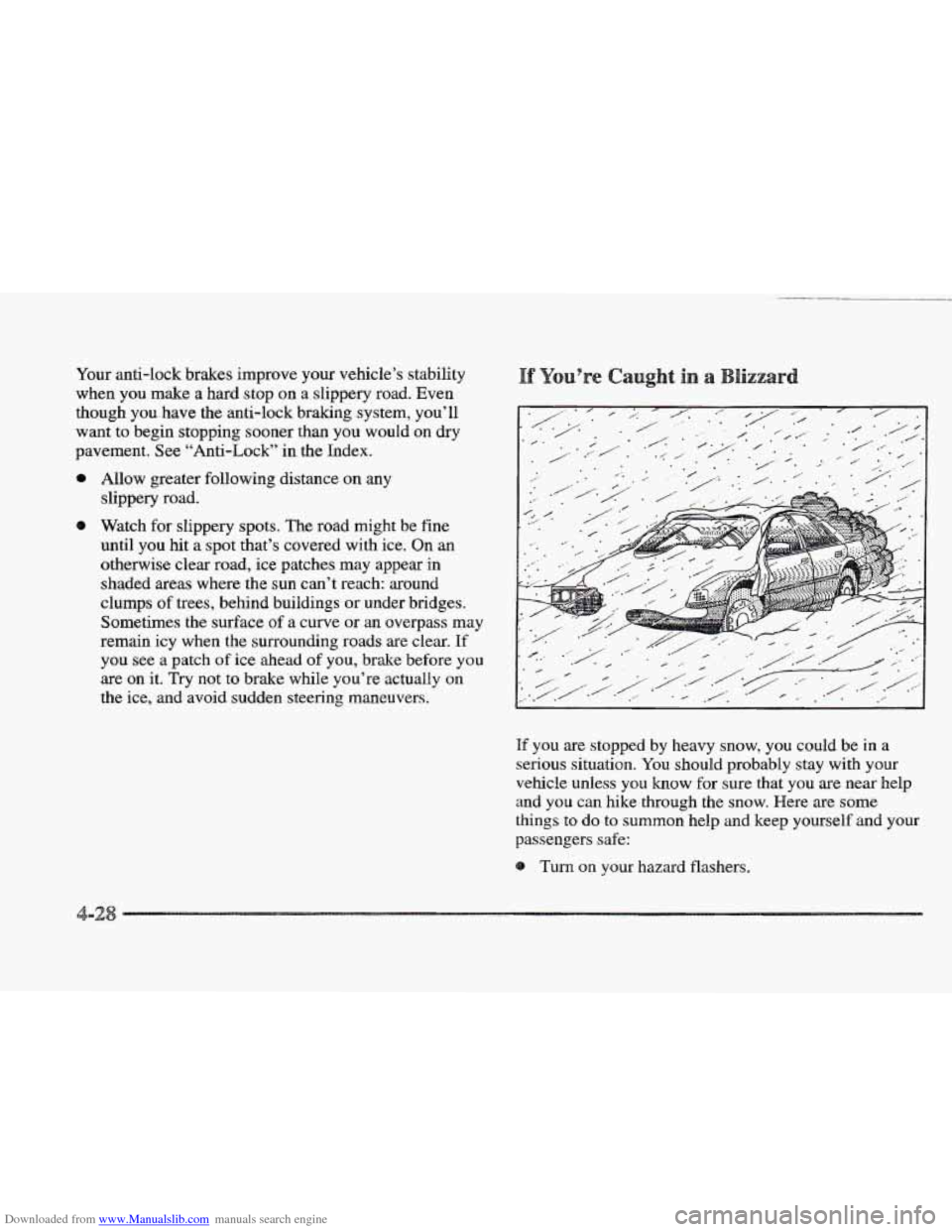
If you are stopped by heavy snow, you could be in a
serious situation.
You should probably stay with your
vehicle unless you know for sure that you
are near help
and
you can hike through the snow. Here are some
things to do to summon help and keep yourself and your
passengers
safe:
Turn on your hazard flashers.
-2
Page 214 of 361
Downloaded from www.Manualslib.com manuals search engine Tie a red cloth to your vehicle to alert police that
you’ve been stopped by the snow.
Put
on extra clothing or wrap a blanket around you.
If you have no blankets or extra clothing, make body
insulators from newspapers, burlap bags, rags,
floor
mats -- anything you can wrap around yourself or
tuck under your clothing to keep warm.
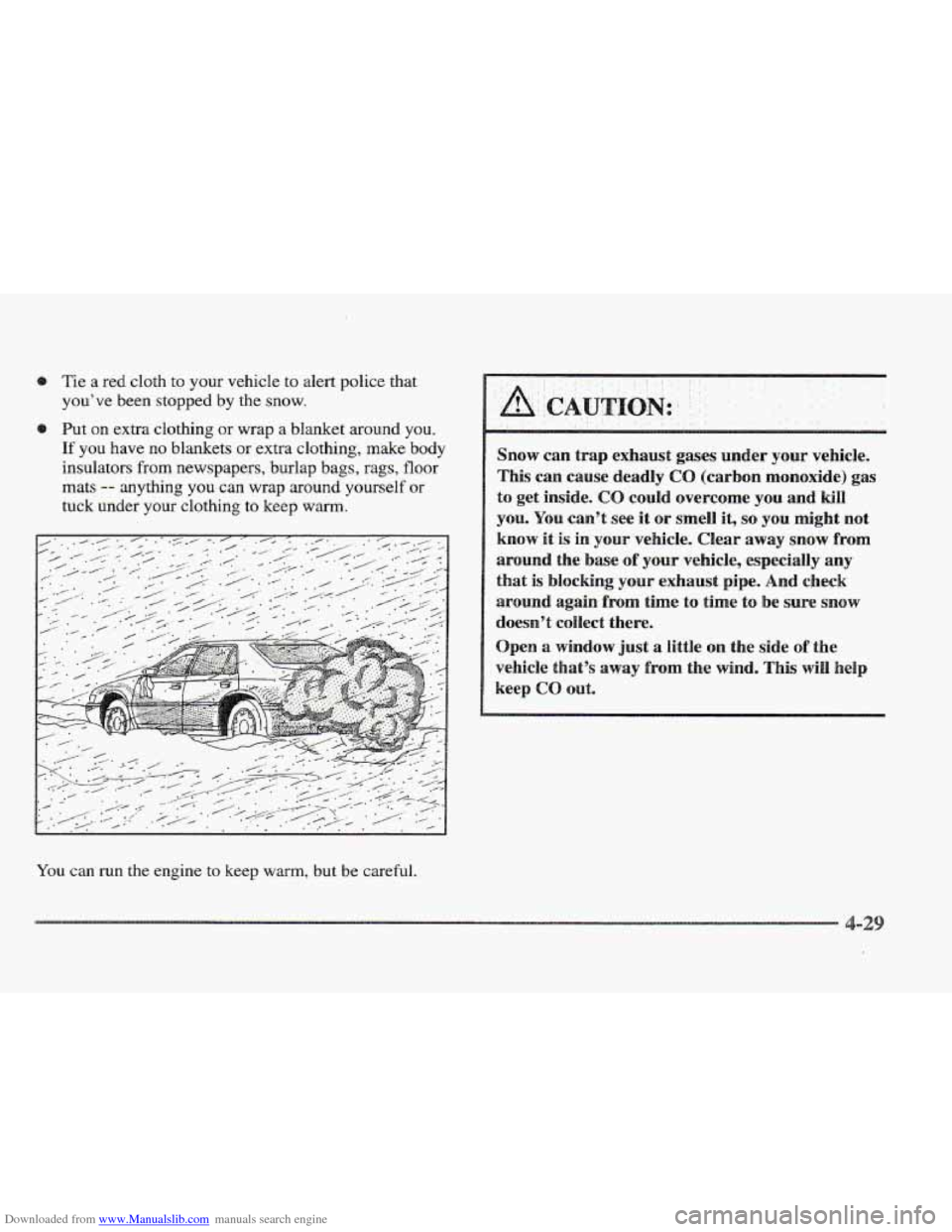
You can run the engine to keep warm, but be careful.
Snow can trap exhaust gases under your vehicle.
This can cause deadly
CO (carbon monoxide) gas
to get inside. CO could overcome you and kill
you. You can’t see it or smell it, so you might not
know it is in your vehicle. Clear away snow from
around the base of your vehicle, especially any
locking your exhaust ipe. And check
around again from time to time to be sure snow
doesn’t collect there.
pen
a window just a little on the side of the
vehicle
that’s away from the wind. This will he8
keep CO out.
Page 221 of 361
Downloaded from www.Manualslib.com manuals search engine You should always attach chains between your vehicle
and your trailer. Cross the safety chains under the tongue
of the trailer
so that the tongue will not drop to the road
if it becomes separated from the
hitch. Instructions
about safety chains may be provided by the hitch
manufacturer or by
the trailer manufacturer. Follow the
manufacturer’s recommendation
for attaching safety
chains and do
not attach them to the bumper. Always
leave just enough slack
so you can turn with your rig.
And, never allow safety chains to drag
on the ground.
Because you have anti-lock brakes, don’t
try to tap into
your vehicle’s hydraulic brake system.
If you do, both
brake systems won’t work well, or at all.
Be
sure to read and follow the instructions for the trailer
brakes
so you’ll be able to install, adjust and maintain
them properly.
Towing a trailer requires a certain amount
of experience.
Before setting out for
the open road, you’ll want to get
to know your
rig. Acquaint yourself with the feel of
handling and braking with the added weight of the trailer. And always
keep
in mind that the vehicle you are
driving is now a good deal longer and not nearly as
responsive
as your vehicle is by itself.
Before you start, check the trailer hitch and platform
(and attachments), safety chains, electrical connector,
lamps, tires and mirror adjustment.
If the trailer has
electric brakes, start your vehicle and trailer moving
and
then apply the trailer brake controller by hand to be sure
the brakes are working. This lets you check your
electrical connection at the same time.
During your trip, check occasionally to be sure that
the
load is secure, and that the lamps and any trailer brakes
are still working.
Stay at least twice as far behind the vehicle ahead as you
would when driving your vehicle without a trailer. This
can help you avoid situations that require heavy braking
and sudden turns.
You’ll need more passing distance
up ahead when
you’re towing
a trailer. And, because you’re a good deal
longer, you’ll need to
go much farther beyond the
passed vehicle before you can return to your lane.
Page 236 of 361
Downloaded from www.Manualslib.com manuals search engine ..
CA,U
.. .. . ,
A vehicle ran fall from a car-carrier if it isn’t
adequately secured. This can cause a ccollisiora,
serious
personal injury and vehicle damage. The
vehicle should
be tightly secured with chains or
steel cabIes before it is transported.
Donst
use substitutes (ropes, leather straps,
canvas webbing, etc.) that can be cut by sharp
edges underneath the towed vehicle. Always use
2’-hooks inserted in the front T-h~ok slots or
Ha-hooks inserted in the rear R-hook slots. Never
use J-lho~ks~
They will damage drivetrain and
suspension components.
When your vehicle is being towed, have the ignition
key turned
to the OFF position. The steering wheel
should be clamped in a straight-ahead position, with
a clamping device designed for towing service. Do not
use the vehicle’s steering column lock for this. The
transaxle should be
in NEUTRAL (N) and the parking
brake released.
Don’t have your vehicle towed on the drive wheels
unless you must. If the vehicle must be towed on the
drive wheels,
be sure to follow the speed and distance
restrictions later
in this section or your transaxle will be
damaged. If these limitations must be exceeded, then the
drive wheels
have to be supported on a dolly.
Page 248 of 361

Downloaded from www.Manualslib.com manuals search engine I NOTICE:
In cold weather, water can freeze and crack the
engine, radiator, heater core and other parts.
So
use the recommended coolant.
You can be burned if yoa Spill coolant on hot
engine parts. Coolant contains ethylene glycol
and
it will burn if the engine parts are hot
enough.
Don’t spill coolant on a hot engine.
1. You can remove the coolant surge tank pressure cap
when
the cooling system, including the coolant surge
tank pressure cap and upper radiator hose, is
no
longer hot. Turn the pressure cap slowly
counterclockwise until
it first stops. (Don’t press
down while turning the pressure cap.)
If you hear a hiss, wait for that to stop. A hiss means
there is
still some pressure left.
-23
Page 252 of 361

Downloaded from www.Manualslib.com manuals search engine ........................................................................\
....... ........................................................................\
........
........................................... / ..................
.........
.. ...
The following steps will tell you how to use the jack and
change a tire.
The equipmiifit you’ll need is in the trunk. Pull the
carpeting from
the floor of the trunk. Turn the retainer
(center dial)
on the compact spare cover
counterclockwise
to remove it. Lift and remove the
cover. (See “Compact Spare Tire” later in this section
for more information about the compact spare.)