Page 228 of 361
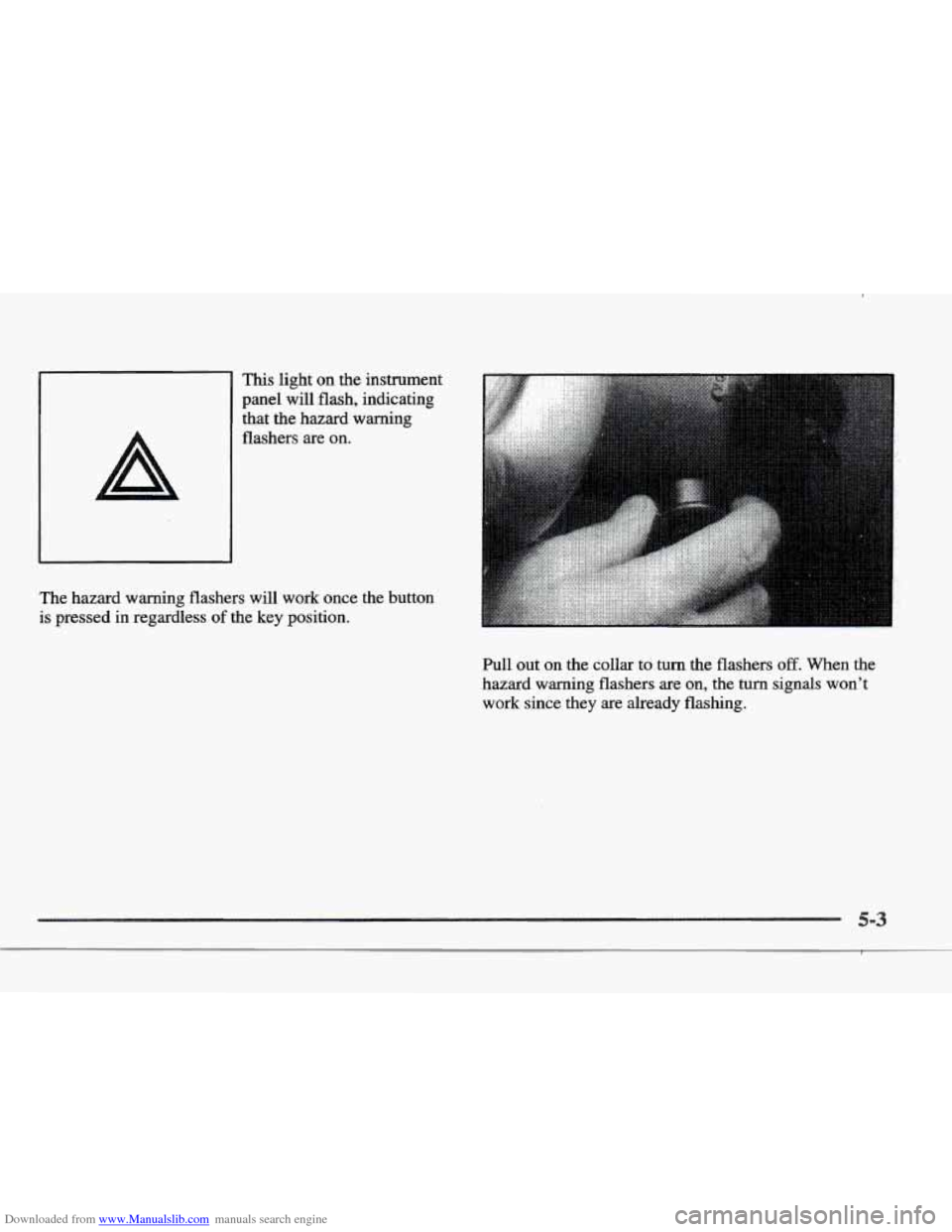
Downloaded from www.Manualslib.com manuals search engine This light on the instrument
I panel will flash, indicating
The hazard warning flashers will work once the button
is pressed in regardless
of the key position.
hll out on the collar to turn the flashers off. When the
hazard warning flashers are on, the turn signals won’t
work since they are already flashing.
Page 234 of 361
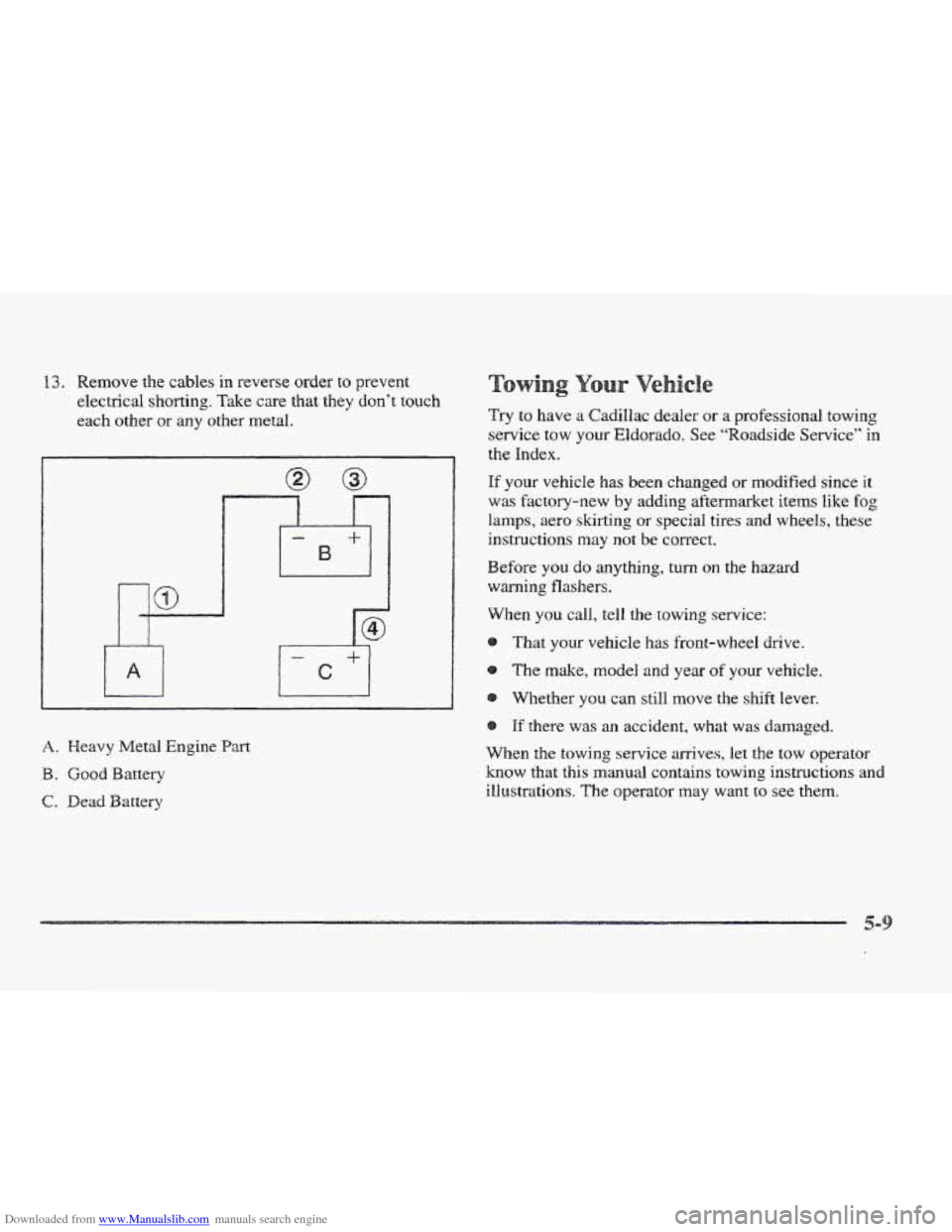
Downloaded from www.Manualslib.com manuals search engine 13. Remove the cables in reverse order to prevent
electrical
shorting. Take care that they don’t touch
each other or any other metal.
A. Heavy Metal Engine Part
B. Good Battery
C. Dead Battery
Try to have a Cadillac dealer or a professional towing
service tow
your Eldorado. See “Roadside Service” in
the Index.
If your vehicle has been changed or modified since it
was Factory-new by adding aftermarket items like fog
lamps, aero skirting or special tires and wheels, these
instructions
may not be correct.
Before
you do anything, turn on the hazard
warning flashers.
When you call, tell the towing service:
That
your vehicle has front-wheel drive.
The make, model and year of your vehicle.
Whethef you can still move the shift lever.
If there was an accident, what was damaged.
When the towhg service arrives, let the tow operator
know that this manual contains towing instructions and
illustrations. The operator may
want to see them.
Page 241 of 361
Downloaded from www.Manualslib.com manuals search engine . -.-
You will find an ENGINE COOLANT HOT-IDLE
ENGINE message or a STOP ENGINE ENGINE
OVERHEATED message on the Driver Information
Center
(IDIC). There is also an engine temperature
warning light andor gage on
the instrument panel.
See “Engine Coolant Temperature
Warning Light” or
“Engine Coolant Temperature Gage” in the Index.
Overheated Engine Protection
Should a low coolant condition exist and the message
STOP ENGINE ENGINE OVERHEATED is displayed,
an overheat protection mode which alternates firing
groups
of four cylinders helps prevent engine damage.
In this mode, you will notice a loss in power and engine
performance.
This operating mode allows your vehicle
to be driven to
a safe place in an emergency; you may
drive up to
50 miles (80 km). Towing a trailer in the
overheat protection mode
should be avoided.
NOTICE:
After driving in the overheated engine protection
operating mode, to avoid engine damage, allow the engine to cool before attempting
any repair.
The engine
oil will be severely degraded. Repair
the cause of coolant loss, change the
oil and reset
the
oil life indicator. See “Engine Oil, When to
Change” in the Index.
Page 243 of 361

Downloaded from www.Manualslib.com manuals search engine If you get the overheat warning but see or hear no
steam,
the problem may not be too serious. Sometimes
the engine can get a
little too hot when you:
Climb a long hill on a hot day.
Stop after high-speed driving.
Idle for long periods in traffic.
Tow
a trailer.
If you get the overheat warning with no sign of stem,
try this for
a minute or so:
I. Turn off your air conditioner.
2. Dial temperature control to the highest heat setting
and open the window, as necessary.
otherwise, shift
to the highest gear while
driving
-- OVERDRIVE (@) or THIRD (3).
3. If you’re in a traffic jam, shift to NEUTRAL (N);
If you no longer have the overheat warning, you can
drive. Just to be safe, drive slower for about IO minutes.
If the warning doesn’t come back on, you can
drive normally.
If the warning continues, pull over, stop and park your
vehicle right away.
If there’s still no sign of steam, YOU can idle the engine
for two
or three minutes while you’re parked, to see if
the warning stops. But then, if you still have the
warning, turn off the engine and get everyone out of the
vehicle until it cools down. Also, see “Overheated
Engine Protection Operating Mode” listed previously in
this section.
You may decide not to lift the hood
but to get service
help right away.
Page 247 of 361
Downloaded from www.Manualslib.com manuals search engine I
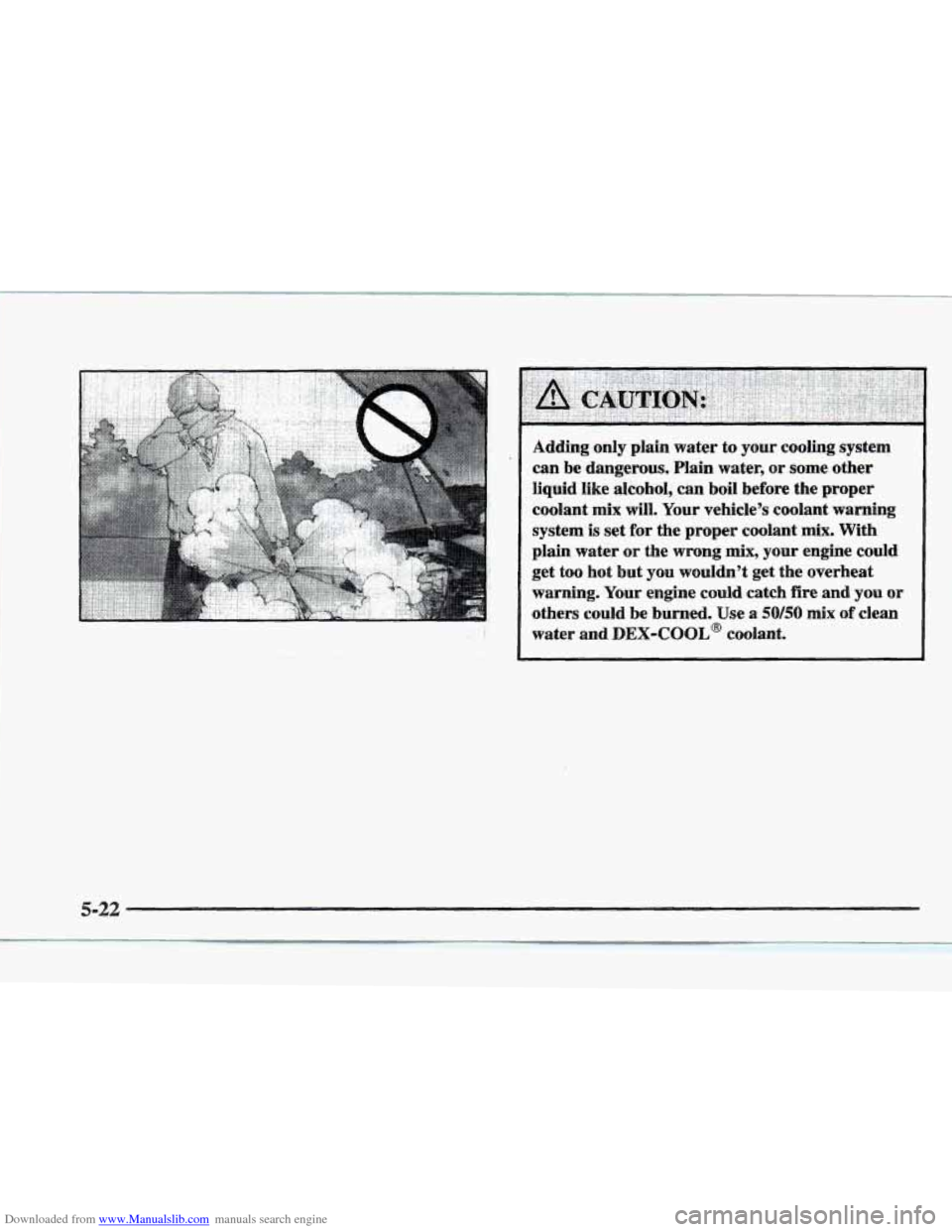
Adding only plain water to your cooling system
can be dangerous. Plain water,
or some other
liquid like alcohol, can boil before the proper
coolant
mix will. Your vehicle’s coolant warning
system
is set for the proper coolant mix. With
plain water
or the wrong mix, your engine could
get
too hot but you wouldn’t get the overheat
warning. Your engine could catch fire and you or
others could be burned. Use a 50/50 mix of clean
water and
DEX-COOL@ coolant.
5-22
Page 251 of 361
Downloaded from www.Manualslib.com manuals search engine ir s
It’s unusual for a tire to “blow out’’ while you’re driving,
especially if you maintain your tires properly.
If air goes
out of a tire, it’s much more likely to leak out slowly.
But if you should ever have a ”blowout,” here
are a few
tips about what to expect and what to
do:
If a front tire fails, the flat tire will create a drag that
pulls the vehicle toward that side. Take your foot off the
accelerator pedal and grip the steering wheel firmly.
Steer to maintain lane position, and
then gently brake to
a stop well out of the traffic lane.
A rear blowout, particularly on a curve, acts much like a
skid and may require the same correction you’d use in a
skid. In any rear blowout, remove your foot from the
accelerator pedal. Get the vehicle under control by
steering the way you want the vehicle to go. It may be
very bumpy and noisy, but you can still steer. Gently
brake to a stop -- well off the road if possible.
Hf a tire goes flat, the next part shows how to use your
jacking equipment
to change a flat tire safely. If
a tire
goes flat, avoid further tire and wheel damage
by driving slowly to a level place.
Turn on your hazard
warning flashers.
-2
Page 277 of 361
Downloaded from www.Manualslib.com manuals search engine itives
Don’t add anything to your oil. Your Cadillac dealer is
ready to advise if you tlunk something should be added.
Your Cadillac has an Oil Life Indicator. This feature
will let you
know when to change your oil and
filter
-- usually between 3,000 miles (5 000 km) and
7,500 miles
(12 500 km) since your last oil change.
Under severe conditions,
the indicator may come on
before 3,000 miles (5 000 km). Never drive your vehicle
more than 7,500 miles (12
500 km) or 12 months
(whichever occurs first) without an
oil change.
The system won’t detect dust
in the oil. So, if you
drive
in a dusty area, be sure to change your oil every
3,000 miles
(5 000 km) or sooner if the CHANGE
ENGINE OIL message comes on. Remember to reset
the Oil Life Indicator when the oil has been changed.
For more information, see “Oil Life Indicator”
in
the Index.
After
the oil has been changed, display the OIL LIFE
LEFT message by pressing the INFORMATION (INFO)
button. Then press and hold the RESET (INFO RESET)
button until the display shows “loo.” This resets the oil life
index. The message will remain
off until the next oil
change
is needed. The percentage of oil life remaining
may be checked at any time by pressing the
INFORMATION (INIFQ) button several times until
the OIL LIFE LEFT message appears. For more
information on the Oil Life feature, see “Oil Life
Indicator”
in the Index.
at to
Did you know that used engine oil contains certain
elements that may be unhealthy for your skin and could
even cause cancer? Don’t let used
oil stay on your skin
for very long. Clean your skin and nails with soap and
water,
or a good hand cleaner. Wash or properly throw
away clothing or rags containing used engine oil. (See
the manufacturer’s warnings about the use and disposal
of oil products.)
Used oil can be
a real threat to the environment. If you
change your own oil, be sure to drain all free-flowing oil
from
the filter before disposal. Don’t ever dispose of oil
by putting
it in the trash, pouring it on the ground, into
sewers, or into streams QI- bodies of water. Instead,
recycle
it by takmg it to a place that collects used oil. If
you have
a problem properly disposing of your used oil,
ask your dealer, a service station or a local recycling
center for help.
Page 284 of 361
Downloaded from www.Manualslib.com manuals search engine Your vehicle is equipped with a transaxle fluid change
indicator.
A CHANGE TRANS FLUID message will
display on
the Driver Information Center (DIC) when
the powertrain computer determines that the transaxle
fluid needs to be changed or at each
100,080 miles
(160 080 km) interval, whichever occurs first. See your
Maintenance Schedule booklet for more information.
When this message appears, change the transaxle fluid
and reset the transaxle fluid life indicator as follows:
I. Turn the ignition on but do not start the engine.
2. Press and hold the OFF and rear defog buttons on the
climate control at the same time until the
TRANS
FLUID RESET message appears on the DHC.
The cooling s stern in your vehicle is filled with
DEX-COOL engine coolant. This coolant is designed
to remain
in your vehicle for 5 years or 150,000 miles
(240 000 km) whichever occurs first, if you add only
DEX-COOL‘ extended life coolant.
2
The following explains your cooling system and how to
add coolant when
it is low. If YOU have a problem with
engine overheating, see “Engine Overheating”
in
the Index.
A 50/50 mixture of water and DEX-COOL@
coolant will:
@ Give freezing protection down to -34” F (-37°C).
Give boiling protection up to 265 OF (1 29°C).
Protect against rust and corrosion.
Help keep the proper engine temperature.
Let the warning lights and gages work as
they should.
When adding coolant, it is important that you use
only DEX-COOL~ (silicate-free) coolant.
If coolant other than DEX-COOL@is added t~
the system, premature engine, heater core or
radiator corrosion may result. In addition, the
engine coolant
will require change SOQWW 0- at
34b,8(Bo miles (50 000 km) or 24 months,
whichever CD~CUP’S first. Damage caused
of coolant other than
covered
by your new vehicle warranty.