1997 CADILLAC ELDORADO air condition
[x] Cancel search: air conditionPage 159 of 361
Downloaded from www.Manualslib.com manuals search engine With the automatic setting, the air conditioning
compressor automatically cycles when needed to cool
the
air. In cold weather, when the system senses the need
for heat, the airflow will be directed out
the floor
outlets. As the interior temperature approaches a desired
setting, the blower speed will decrease.
To maintain
interior comfort, the aifflow may move to the instrument
panel air outlets and floor outlets (bi-level mode). On
bright sunny days in cold weather,
the airflow may come
out of the air conditioning outlets (AC mode) to
maintain comfort and prevent stuffiness.
If your vehicle is sitting out on a hot day and you have it
set on
AUTO, the air will first flow out the floor air
outlets for a few seconds. That is normal. This is to
expel
hot air from the air outlets. As the air is cooled,
the airflow will move through
the air conditioning
outlets. If you start your vehicle with the
fan setting on
HI,
it will skip the air conditioning purge.
To avoid blowing cold
air in cold weather, the system will
delay
turning on the fan until warm air is available. The
length of delay depends on the outside
air temperature,
engine coolant temperature
or the time since the engine
was last started. As the coolant warms up, the blower fan
speed will gradually increase and air will flow from the
heater outlets, with some airflow to
the windshield to
prevent fogging under most normal conditions.
If you leave your vehicle, the system will remember the
control setting the next time you
start your engine,
except
for recirculation and defrost. Each ignition cycle
cancels recirculation, whereas,
DEFROST will change
to automatic operation when
the ignition is shut off and
then turned
back on.
You may manually adjust
the air delivery mode or
fan speed.
/.I AC: This setting directs airflow through the
middle instrument panel outlets.
'/J BI-LEVEL: This setting directs air into your
vehicle in two ways. Cool air is directed to the upper
portion
of your body through the four instrument panel
outlets while warmed
air is directed to the floor.
'fl HEATER/DEFROSE This setting directs air to
the floor outlets and toward the windshield.
1/J HEATER: This setting directs warmed air
through the
floor outlets. Some warm air is diverted to
the windshield to minimize fogging.
L*
Page 160 of 361
Downloaded from www.Manualslib.com manuals search engine DEFROST: Press this button to quickly remove
fog
or frost from the windshield. This setting sends most
of the airflow to the windshield with only a small
amount to the floor outlets.
88 FAN SPEEDS: Press the button with the fan symbol
on it until
AUTO is displayed on the screen. At this
setting, the fan speed is automatically controlled. If it is
cold outside, the blower may
not run in the maximum
hgh
fan speed right away. The system checks the
temperature
of the engine coolant to assure it is warm
enough to provide heat.
When the engine coolant is
warm, the controller allows the
fan to gradually increase
to a higher speed.
This prevents cold air from blowing
into the passenger compartment.
If you want the blower
fan at a high speed, press the up arrow button until you
see
HI on the display. If you want the fan speed to be
automatic, but you like the
fan speed to be higher than
the
AUTO setting, press the fan symbol button until HI
AUTO is shown on the display. If you want the blower
fan at a low speed, press the down
arrow button until LO
is shown on the display. If you want the fan speed to run
lower
than the AUTO setting, press the button until LO
AUTO is shown on the display.
OFF: Press this button to turn the system off. Fresh air
will continue to flow through the vehicle, and the
system will try to maintain the previously set
temperature. The outside temperature will show on the
display when the system
is OFF.
AC: Press this button to turn the air conditioning on and
off. The system will cool and dehumidify the air inside
the vehicle. In the AUTO mode, the display will show
that
AC is active, but the air conditioning compressor
only operates when the system determines
it is needed.
RECIRCULATION: Press this button to limit the
amount of fresh
air entering your vehicle. This is helpful
when you are trying to cool the air quickly or limit odors
entering your vehcle. In the
AUTO mode, the system
will use recirculation as necessary to cool the air.
Pressing the recirculation button will change the
operation to a manual mode and the air will recirculate
non-stop. Press
this button again to turn off the
recirculation feature.
If you notice the windows fogging, press the
recirculation button to exit the recirculation mode.
Page 161 of 361

Downloaded from www.Manualslib.com manuals search engine . .. ..
The sensor monitors the sun’s solar radiation and is
located
on top of the instrument panel near the
windshield. The
ECC system uses this information to
automatically make the necessary temperature and
airflow ‘adjustments to maintain your comfort.
Air Conditioning
On hot. days,.open the windows long enough to let hot
inside air escape.
This reduces the time it takes for your
vehicle
to cool down. Then keep your windows closed
for the
air conditioner to work its best.
Press the
AC button or the TEMP/AUTO knob to turn
the system on and then select the proper MODE to direct
airflow. The system will cool and dehumidify the
air
inside the vehicle. Also while in the AUTO mode, the
system will
use recirculation as necessary to cool the air.
You may also need.to adjust the interior temperature and
fan speed as needed.
When the
air conditioner is on, you may sometimes notice
slight changes
in your vehicle’s engine speed and power.
This is normal because the system is designed to cycle. the
compressor
on and off to keep the desired temperature.
1
eating
Press the MODE button to select heater. Adjust the
interior temperature to
a comfortable level and if the fan
speed needs adjusting, press the up or down arrow.
With each system, outside air will be brought in and sent
through the floor, air conditioning or bi-level outlets
(depending on the condition). The heater works best
if
you keep your wind0w.s closed while using it.
, !
P
Page 162 of 361
Downloaded from www.Manualslib.com manuals search engine ystem
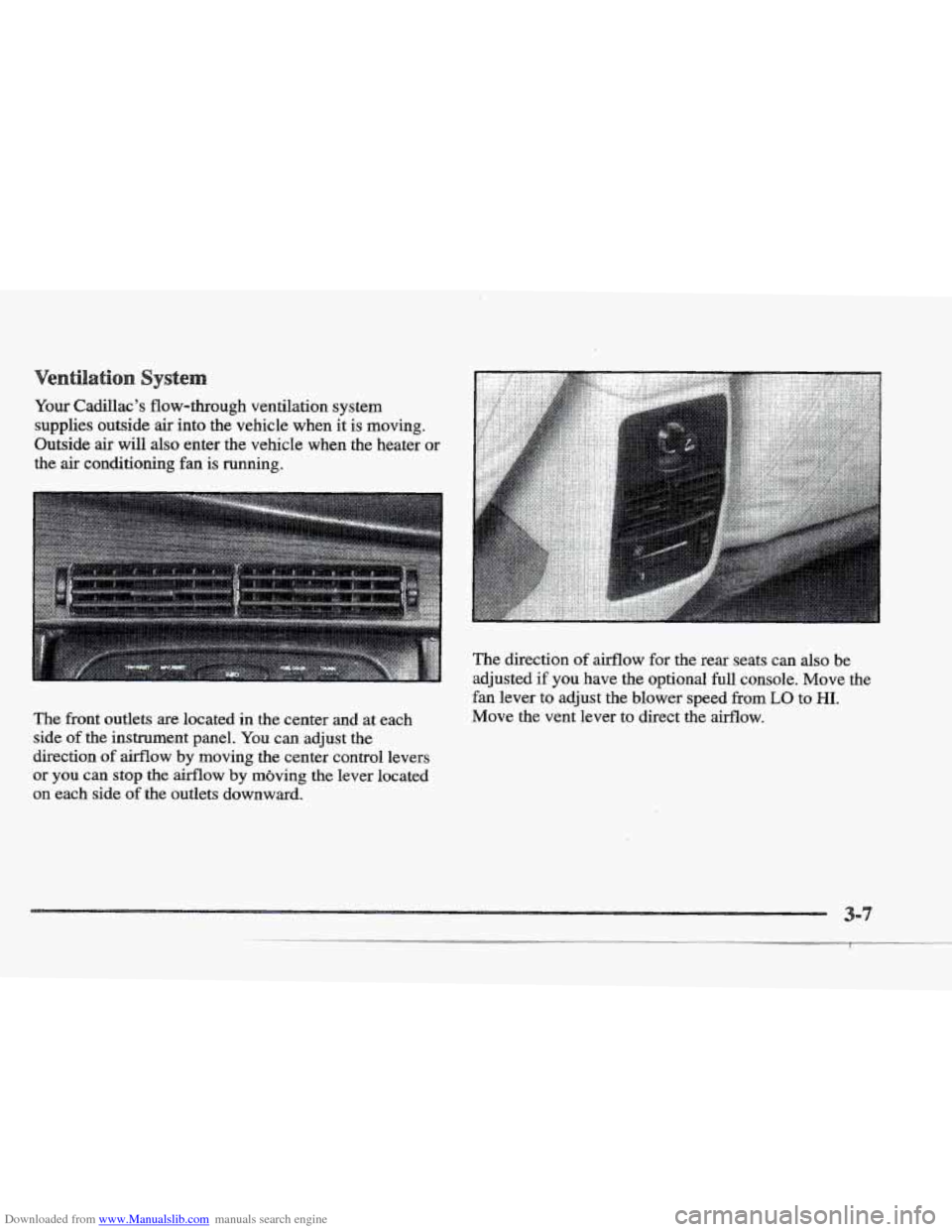
Your Cadillac’s flow-through ventilation system
supplies outside
air into the vehicle when it is moving.
Outside air will also enter the vehicle when
the heater or
the air conditioning fan is running.
The front outlets are located
in the center and at each
side
of the instrument panel. You can adjust the
direction of airflow by moving the center control levers
or
you can stop the airflow by moving the lever located
on each side
of the outlets downward. The direction
of airflow
for the rear seats can also be
adjusted
if you have the optional full console. Move the
fan lever to adjust the blower speed from
LO to HI.
Move the vent lever to direct the airflow.
-7
I
Page 163 of 361

Downloaded from www.Manualslib.com manuals search engine Ventilation Tips
a Keep the hood and front air inlet free of ice, snow or
any other obstruction (such as leaves). The heater
and defroster will work
far better, reducing the
chance of fogging the inside of the windows.
0 When you enter a vehicle in cold weather, adjust the
fan to
the highest speed for a few moments before
driving
off. This helps clear the intake outlets of
snow and moisture, and reduces the chance of
fogging
the inside of the windows.
0 Keep the air path under the front seats clear of
objects. This helps circulate air throughout
your vehicle.
Use
DEFROST to remove fog or ice from the windshield
quickly in extremely humid or cold conditions.
Press the DEFROST button.
If you select DEFROST,
adjust the fan speed by pressing the fan button up or
down.
If you select DEFROST from AUTO, the system
will control the fan speed. The temperature also needs to
be adjusted by turning
the TEMP/AUTO knob.
Note that recirculation
is not available in the defrost or
defog modes. The lines
you see
on the
rear window wm the
glass. Press
this button to
turn on the rear defogger.
With
it, the rear window
and both outside rearview
mirrors
are heated.
The system will automatically shut
off after 10 minutes.
If further defogging is desired, press the button again.
Do not attach a temporary vehicle license, tape or decals
across the defogger grid on the rear window.
cut and damage the heating grids. Your warranty
would not cover this damage.
And don’t put
decals there; you might have to scrape them off.
Page 241 of 361
Downloaded from www.Manualslib.com manuals search engine . -.-
You will find an ENGINE COOLANT HOT-IDLE
ENGINE message or a STOP ENGINE ENGINE
OVERHEATED message on the Driver Information
Center
(IDIC). There is also an engine temperature
warning light andor gage on
the instrument panel.
See “Engine Coolant Temperature
Warning Light” or
“Engine Coolant Temperature Gage” in the Index.
Overheated Engine Protection
Should a low coolant condition exist and the message
STOP ENGINE ENGINE OVERHEATED is displayed,
an overheat protection mode which alternates firing
groups
of four cylinders helps prevent engine damage.
In this mode, you will notice a loss in power and engine
performance.
This operating mode allows your vehicle
to be driven to
a safe place in an emergency; you may
drive up to
50 miles (80 km). Towing a trailer in the
overheat protection mode
should be avoided.
NOTICE:
After driving in the overheated engine protection
operating mode, to avoid engine damage, allow the engine to cool before attempting
any repair.
The engine
oil will be severely degraded. Repair
the cause of coolant loss, change the
oil and reset
the
oil life indicator. See “Engine Oil, When to
Change” in the Index.
Page 243 of 361

Downloaded from www.Manualslib.com manuals search engine If you get the overheat warning but see or hear no
steam,
the problem may not be too serious. Sometimes
the engine can get a
little too hot when you:
Climb a long hill on a hot day.
Stop after high-speed driving.
Idle for long periods in traffic.
Tow
a trailer.
If you get the overheat warning with no sign of stem,
try this for
a minute or so:
I. Turn off your air conditioner.
2. Dial temperature control to the highest heat setting
and open the window, as necessary.
otherwise, shift
to the highest gear while
driving
-- OVERDRIVE (@) or THIRD (3).
3. If you’re in a traffic jam, shift to NEUTRAL (N);
If you no longer have the overheat warning, you can
drive. Just to be safe, drive slower for about IO minutes.
If the warning doesn’t come back on, you can
drive normally.
If the warning continues, pull over, stop and park your
vehicle right away.
If there’s still no sign of steam, YOU can idle the engine
for two
or three minutes while you’re parked, to see if
the warning stops. But then, if you still have the
warning, turn off the engine and get everyone out of the
vehicle until it cools down. Also, see “Overheated
Engine Protection Operating Mode” listed previously in
this section.
You may decide not to lift the hood
but to get service
help right away.
Page 264 of 361
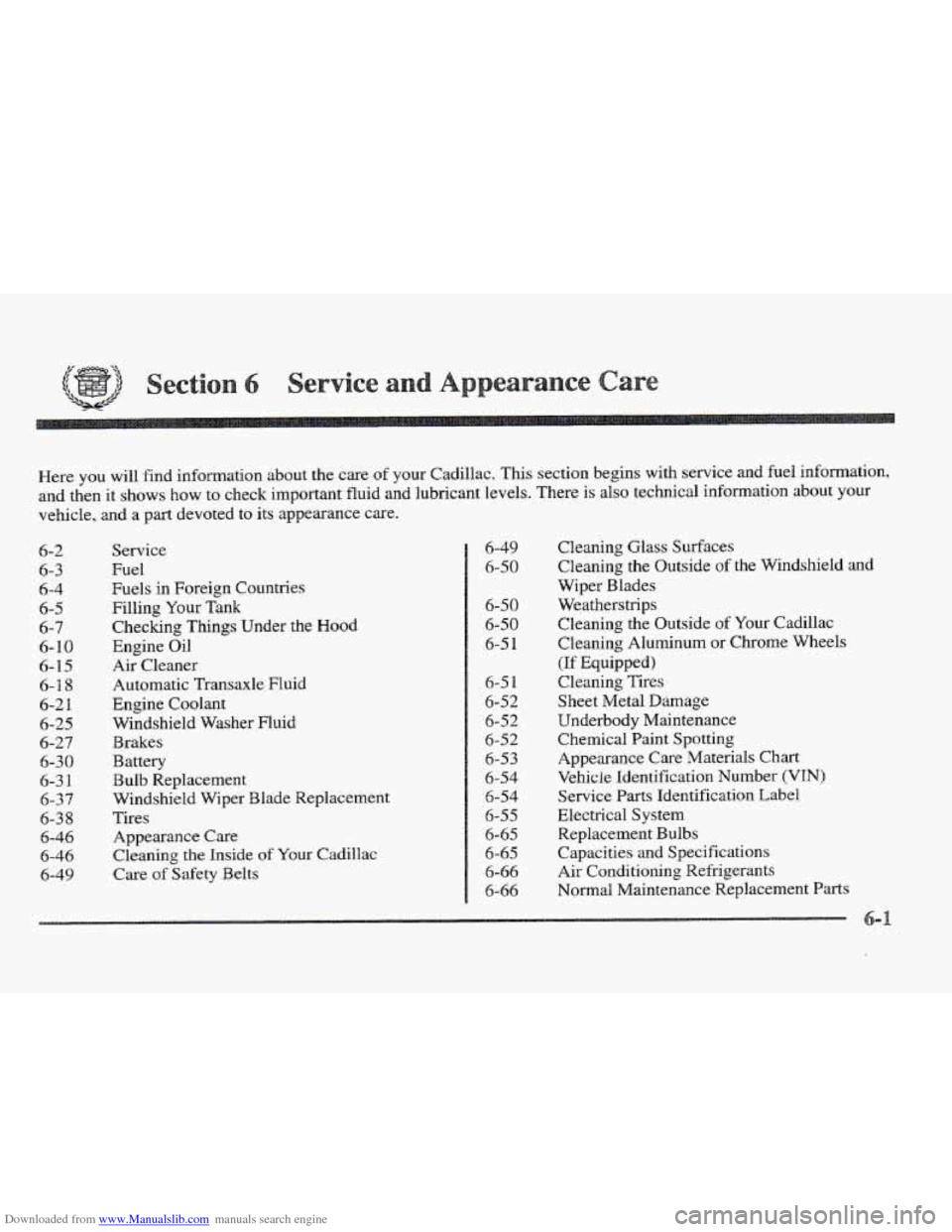
Downloaded from www.Manualslib.com manuals search engine Here you will find information about the care of your Cadillac. This section begins with service and fuel information,
and then
it shows how to check important fluid and lubricant levels. There is also technical information about your
vehicle, 2nd a part devoted to its appearance care.
6-2
6-3
6-4
6-5
6-7
6-10
6-
15
6-1 8
6-2 1
6-25
6-27
6-30
6-3
1
6-37
6-3 8
6-46
6-46
6-49
Service
Fuel
Fuels in Foreign Countries
Filling Your Tank
Checking Things Under the Hood
Engine Oil
Air Cleaner
Automatic Transaxle Fluid
Engine Coolant
Windshield Washer Fluid
Brakes
Battery
Bulb Replacement
Windshield Wiper Blade Replacement
Tires Appearance Care
Cleaning the Inside
of Your Cadillac
Care
of Safety Belts
4-49
6-50
6-50
6-50
6-5 1
6-5 1
6-52
6-52
6-52
6-53
6-54
6-54
6-55
6-65
6-65
6-66
6-66 Cleaning
Glass Surfaces
Cleaning the Outside
of the Windshield and
Wiper Blades
Weatherstrips Cleaning the Outside
of Your Cadillac
Cleaning Aluminum
or Chrome Wheels
(If Equipped)
Cleaning Tires
Sheet Metal
Damage
Underbody Maintenance
Chemical Paint Spotting
Appearance Care Materials Chart
Vehicle Identification Number
(VIN)
Service Parts Identification Label
Electrical System Replacement Bulbs
Capacities and Specifications
Air Conditioning Refrigerants
Normal Maintenance Replacement Parts