1997 BUICK PARK AVENUE engine
[x] Cancel search: enginePage 3 of 420

The 1997 Buick Park Avenue Owner’s Manual
1-1
2-1
3-1
4-1
5-1
6-1
7-1
8- 1
9- 1
Seats and Restraint Systems
This section tells you how to use your seats and safety belts properly. It also explains the “SRS” system.
Features and Controls
This section explains how to start and operate your Buick.
Comfort Controls and Audio Systems
This section tells you how to adjust the ventilation and comfort controls and how to operate your audio system.
Your Driving and the Road
Here you’ll find helpful information and tips about the road and how to drive under different conditions.
Problems on the Road
This section tells what to do if you have a problem while driving, such as a flat tire or overheated engine, etc.
Service and Appearance Care
Here the manual tells you how to keep your Buick running properly and looking good,
Maintenance Schedule
This section tells you when to perform vehicle maintenance and what fluids and lubricants to use.
Customer Assistance Information
This section tells you how to contact Buick for assistance and how to get service and owner publications.
It also gives you information on “Reporting Safety Defects” on page
8-8.
Index
Here’s an alphabetical listing of almost every subject in this manual. You can use it to quickly find
sometlvng you want to read.
i
ProCarManuals.com
Page 6 of 420

Walter Marr and Thomas Buick
Buick’s chief engineer, Walter L. Marr (left), and
Thomas D. Buick, son of founder David Dunbar Buick,
drove the first Flint Buick in a successful Flint-Detroit
round trip in July 1904.
David Buick was building gasoline engines by 1899, and
Marr, his engineer, apparently built the first auto to
be called a Buick in 1900. However, Buick traditionally dates its beginnings to 1903. That was the year the
company was reorganized, refinanced and moved from
Detroit to Flint. Buick has always been a product innovator. Buick engineers developed the “valve-in-head” engine,
a light, powerful and reliable
engine which would eventually influence the entire
automotive industry.
William C. Durant was instrumental in promoting
Buicks across the country using his Durant-Dort Carriage Co. outlets and salespeople as the nucleus
of a
giant distribution system. He knew the Buick as a “self-seller.”
If automobiles could be this good, he
thought, maybe it was time to switch from the horse and
buggy business to automobiles.
William C. (Billy) Durant
At the 1905 New York
Auto Show, Durant took
orders for
1,000 Buicks
before the company had
built
40. On Buick’s
success, Durant created a
holding company, September
16, 1908. He
called it General Motors.
iv
ProCarManuals.com
Page 7 of 420

Durant also created a racing team that won 500 racing
trophies in 1909 and 1910, including successes at
Indianapolis two years before the Indy
500 began.
The success of Buick engines was visible not only on
the race track, but in endurance tests across the country and around the world. Buick was the only car to
complete a 1,000-mile Chicago-to-New York race in 1906. And a Buick was the first car to travel across
South America, driven from Buenos Aires, Argentina,
over the Andes to Santiago, Chile in 1914. Buick drew plenty of attention because
it could climb
hills and run through mud like no other car. Buick’s endurance and reliability were world famous.
During World War
I, Buick built Liberty aircraft engines
as well as Red Cross ambulances
so successfully that
one Buick ambulance was awarded the Croix de Guerre
by the French government.
As a builder of premier automobiles, Buick was hard hit
by the Great Depression. However, new General
Manager Harlow
H. Curtice created popular new models
including the Special and the Roadmaster. Buick sales
soon flourished.
1911 Model 21 Touring Car on Buick’s Test Hill
First Buick Factory
V
ProCarManuals.com
Page 8 of 420

In World War 11, Buick built aircraft engines, tanks and
other military hardware. This post-war period brought
great styling and engineering changes which resulted in
increased sales. The torque converter automatic
transmission, Dynaflow, was introduced in the
1948
Roadmaster. Buick’s famous “portholes” came along
in
1949.
1949 Roadmaster
A high-compression V-8 engine was introduced in 1953.
And Buick’s famous vertical pillar “toothy” grille
(introduced in
1942) became more massive in the
post-war era.
I953 Skylark
Motor Trend magazine named the 1962 Buick Special
“Car of the Year.” The first production
V-6 engine was
used in the Special.
vi
ProCarManuals.com
Page 12 of 420
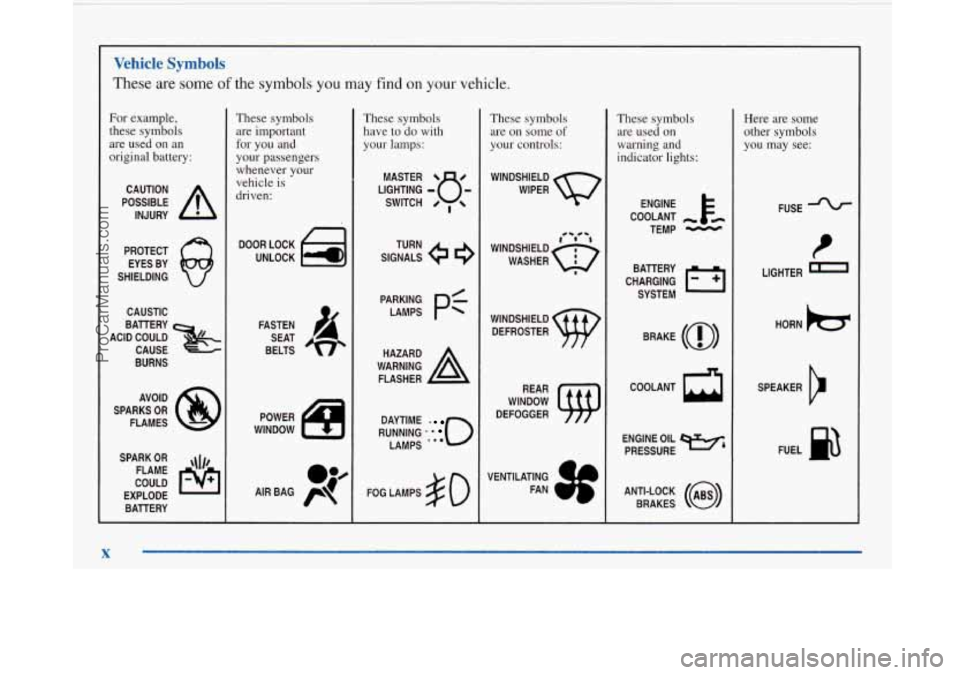
Vehicle Symbols
These are some of the symbols you may find on your vehicle.
For example,
these symbols
are used on an
original battery:
POSSIBLE A
CAUTION
INJURY
PROTECT EYES BY
SHIELDING
CAUSTIC
ACID COULD
&
BAllERY
CAUSE
BURNS
AVOID
SPARKS
OR
FLAMES
SPARK
OR ,\I/,
COULD FLAME
EXPLODE BAllERY
X
These symbols are important
for you and
your passengers
whenever your
vehicle is
driven:
DOOR LOCK
UNLOCK
FASTEN SEAT
BELTS
POWER
WINDOW
These symbols have to do with
your lamps:
SIGNALS 6
TURN
RUNNING
* ' 0
DAYTIME -
LAMPS .'*
FOG LAMPS $0
These symbols
are
on some of
your controls:
WINDSHIELD
WIPER
WINDSHIELD DEFROSTER
WINDOW
DEFOGGER
These symbols are used
on
warning and
indicator lights:
COOLANT -
TEMP -
CHARGING I-1
BAlTERY
SYSTEM
BRAKE
(a)
COOLANT a
ENGINE OIL e,
PRESSURE
ANTI-LOCK
(@)
BRAKES
Here are some
other symbols
you may see:
FUSE
LIGHTER
a
HORN )tr
SPEAKER
IJ
FUEL p3
1 I
ProCarManuals.com
Page 61 of 420
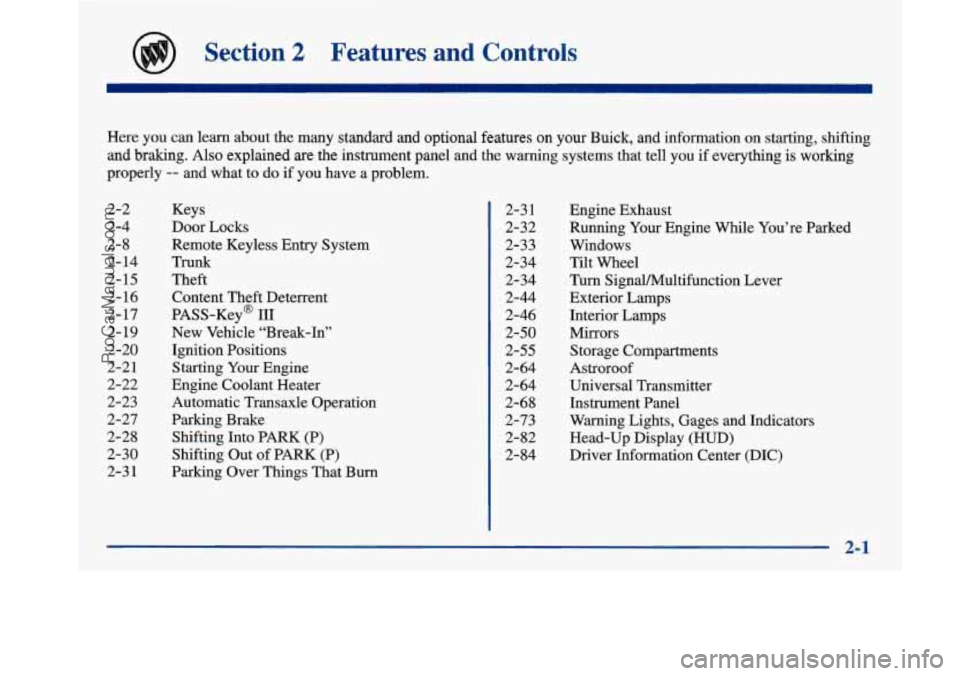
Section 2 Features and Controls
Here you can learn about the many standard and optional features on your Buick, and information on starting, shifting
and braking. Also explained are the instrument panel and the warning systems that tell you if everything is working
properly
-- and what to do if you have a problem.
2-2
2-4
2-8
2- 14
2-15 2-16
2- 17
2-
19
2-20
2-2 1
2-22
2-23
2-27
2-28
2-30
2-3
1
Keys
Door Locks
Remote Keyless Entry System
TrUnk
Theft
Content Theft Deterrent
PASS-Key@
III
New Vehicle “Break-In”
Ignition Positions
Starting Your Engine
Engine Coolant Heater
Automatic Transaxle Operation
Parking Brake Shifting Into PARK
(P)
Shifting Out of PARK (P)
Parking Over Things That
Burn
2-3 1
2-32
2-33
2-34
2-34
2-44
2-46
2-50
2-55
2-64
2-64
2-68
2-73
2-82
2-84 Engine Exhaust
Running
Your Engine While You’re Parked
Windows
Tilt Wheel
Turn Signal/Multifunction Lever
Exterior Lamps
Interior Lamps
Mirrors
Storage Compartments
Astroroof
Universal Transmitter
Instrument Panel
Warning Lights, Gages and Indicators
Head-Up Display (HUD)
Driver Information Center (DIC)
2-1
ProCarManuals.com
Page 75 of 420
It can be dangerous to drive with the trunk lid
open because carbon monoxide
(CO) gas can
come into your vehicle.
You can’t see or smell
CO.
It can cause unconsciousness and even death.
If you must drive with the trunk lid open or if
electrical wiring or other cable connections must
pass through the seal between the body and the
trunk lid:
0 Make sure all windows are shut.
0 Tbrn the fan on your heating or cooling
system to its highest speed with the setting
on any airflow selection except RECIRC.
That will force outside
air into your vehicle.
See “Comfort Controls’’ in the Index.
0 If you have air outlets on or under the
instrument panel, open them all the way.
See “Engine Exhaust’’ in the Index.
Theft
Vehicle theft is big business, especially in some cities.
Although your Buick has a number
of theft-deterrent
features, we know that nothing
we put on it can make it
impossible to steal. However, there are ways you can help.
Key in the Ignition
If you leave your vehicle with the keys inside, it’s an
easy target for joy riders or professional thieves
-- so
don’t do it.
With the ignition
off and the driver’s door open, you’ll
hear a chime reminding you to remove your key from
the ignition and take it with you. Always do this. Your
ignition and transaxle will be locked. And remember to
lock the doors.
Parking at Night
Park in a lighted spot, close all windows and lock your
vehicle. Remember to keep your valuables out
of sight.
Put them in a storage area, or take them with you.
2-15
ProCarManuals.com
Page 78 of 420

This device complies with Part 15 of the FCC Rules.
Operation
is subject to the following two conditions:
(1) ths device may not cause harmful interference,
and
(2) this device must accept any interference
received, including interference that may cause
undesired operation.
This device complies with
RSS-210 of Industry and
Science Canada. Operation is subject to the following
two conditions:
(1) this device may not cause
interference, and
(2) this device must accept any
interference received, including interference that may cause undesired operation of the device.
Changes or modifications to this system by other than
an authorized service facility could void authorization
to use this equipment.
When the PASS-Key
III system senses that someone is
using the wrong key, it shuts down the vehicle’s starter
and fuel systems. The starter will not work and fuel
will stop being delivered to the engine. Anyone using
a trial-and-error method to start the vehicle will be
discouraged because of the high number of electrical
key codes. If
when trying to start the vehicle, the engine does not
start and the
SECURITY light comes on, the key may
have a damaged transponder. Turn the ignition off
and
try again.
If the engine still does not start, and the key appears to
be undamaged, try another ignition key. At this time,
you may also want to check the fuse (see “Fuses and
Circuit Breakers” in the Index). If the engine still does
not start with the other key, your vehicle needs service.
If your vehicle does start, the first key may be faulty.
See your Buick dealer or a locksmith who can service
the PASS-Key I11 to have a new key made.
It is possible for the PASS-Key
111 decoder to learn the
transponder value of
a new or replacement key. Up to
ten additional keys may be programmed for the vehicle.
This procedure is for learning additional keys only. If all
the currently programmed keys are lost or do not
operate, you must see your Buick dealer or a locksmith
who can service PASS-Key
I11 to have keys made and
programmed to the system.
See your dealer or a locksmith who can service
PASS-Key
I11 to get a new key blank that is a cut
exactly as a current black colored driver’s key that
operates the system.
Do not use a gray colored valet
key for this procedure.
2-18
~
ProCarManuals.com