1997 BUICK PARK AVENUE engine
[x] Cancel search: enginePage 88 of 420
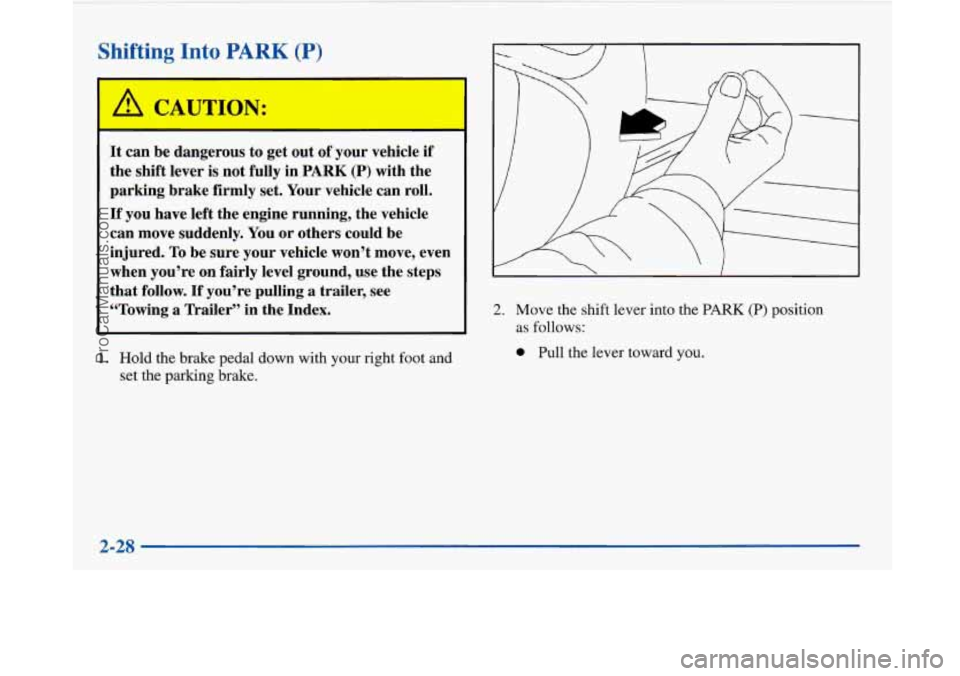
Shifting Into PA RY (P)
r A CAdTION:
It can be dangerous to get out of your vehicle if
the shift lever is not fully in
PARK (P) with the
parking brake firmly set. Your vehicle can roll.
If you have left the engine running, the vehicle
can move suddenly. You or others could be
injured.
To be sure your vehicle won’t move, even
when you’re on fairly level ground, use the steps
that follow.
If you’re pulling a trailer, see
“Towing a Trailer” in the Index.
1. Hold the brake pedal down with your right foot and
set the parking brake.
2. Move the shift lever into the PARK (P) position
as follows:
0 Pull the lever toward you.
ProCarManuals.com
Page 89 of 420
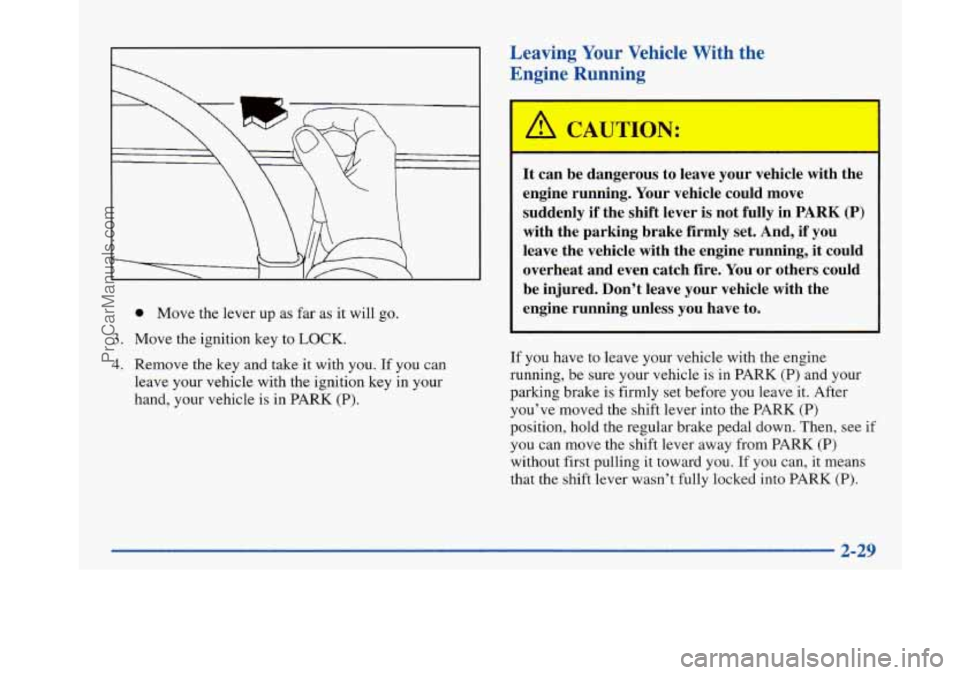
0 Move the lever up as far as it will go.
3. Move the ignition key to LOCK.
4. Remove the key and take it with you. If you can
leave your vehicle with the ignition key in your
hand, your vehicle is in PARK (P).
Leaving Your Vehicle With the
Engine Running
I
It can be dangerous to leave your vehicle with the
engine running. Your vehicle could move
suddenly if the shift lever
is not fully in PARK (P)
with the parking brake firmly set. And, if you
leave the vehicle with the engine running, it could
overheat and even catch fire. You or others could
be injured. Don’t leave your vehicle with the
engine running unless you have to.
If you have to leave your vehicle with the engine
running, be sure your vehicle is in PARK
(P) and your
parking brake is firmly set before you leave it. After
you’ve moved the shift lever into the PARK (P)
position, hold the regular brake pedal down. Then, see
if
you can move the shift lever away from PARK (P)
without first pulling it toward you.
If you can, it means
that the shift lever wasn’t fully locked into PARK (P).
2-29
ProCarManuals.com
Page 91 of 420
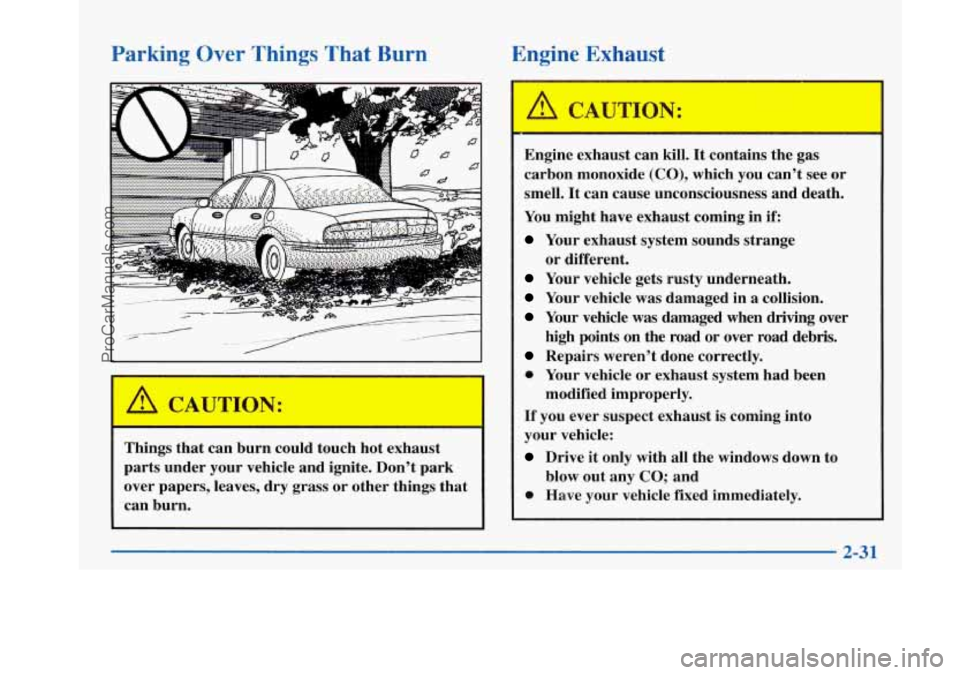
Parking Over Things That Burn Engine Exhaust
Things that can burn could touch hot exhaust
parts under your vehicle and ignite. Don’t park
over papers, leaves, dry grass or other things that
can burn. Engine exhaust can
kill.
It contains the gas
carbon monoxide
(CO), which you can’t see or
smell. It can cause unconsciousness and death.
You might have exhaust coming in if:
Your exhaust system sounds strange
Your vehicle gets rusty underneath.
Your vehicle was damaged in a collision.
Your vehicle was damaged when driving over
high points on the road or over road debris.
Repairs weren’t done correctly.
0 Your vehicle or exhaust system had been
If you ever suspect exhaust is coming into
your vehicle:
Drive it only with all the windows down to
0 Have your vehicle fixed immediately.
or different.
modified improperly.
blow out any
CO; and
2-31
ProCarManuals.com
Page 92 of 420
Running Your Engine While
You’re Parked
It’s better not to park with the engine running. But if you
ever have to, here are some things to know.
I
CAUl
Idling the engine with the climate control system
off could allow dangerous exhaust into your vehicle
(see the earlier Caution under “Engine Exhaust”).
Also, idling in
a closed-in place can let deadly
carbon monoxide
(CO) into your vehicle even if
the fan switch is
at the highest setting. One place
this can happen is
a garage. Exhaust -- with
CO -- can come in easily. NEVER park in a
garage with the engine running.
Another closed-in place can be
a blizzard.
(See “Blizzard” in the Index.)
/r CAUTION:
It can be dangerous to get out of your vehicle if
the shift lever is not fully in PARK (P) with the
parking brake firmly set. Your vehicle can roll.
Don’t leave your vehicle when the engine is
running unless you have to.
If you’ve left the
engine running, the vehicle can move suddenly.
You or others could be injured.
To be sure your
vehicle won’t move, even when you’re on
fairly
level ground, always set your parking brake and
move the shift lever to PARK
(P).
Follow the proper steps to be sure your vehicle won’t
move. See “Shifting Into
PARK (P)” in the Index.
If you are parking on a hill and if you’re pulling
a
trailer, also see “Towing a Trailer” in the Index.
2-32
ProCarManuals.com
Page 106 of 420
Twilight Sentinel Interior Lamps
Instrument Panel Intensity Control
Instrument panel light brightness can be adjusted by
rotating the headlamp
knob clockwise.
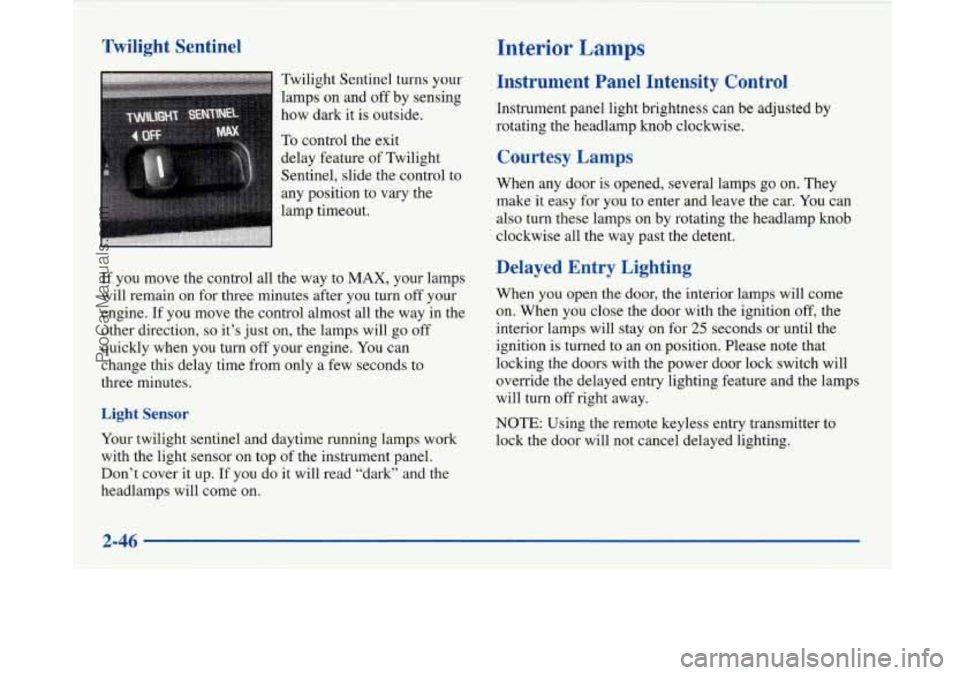
Twilight
Sentinel turns your
lamps on and
off by sensing
how dark
it is outside.
To control the exit
delay feature of Twilight
Sentinel, slide the control to
any position to vary the
lamp timeout.
If you move the control all the way to MAX, your lamps
will remain on for three minutes after you turn off your
engine.
If you move the control almost all the way in the
other direction,
so it’s just on, the lamps will go off
quickly when you
turn off your engine. You can
change this delay time from only a few seconds to
three minutes.
Light Sensor
Your twilight sentinel and daytime running lamps work
with the light sensor on top of the instrument panel.
Don’t cover it up. If you do
it will read “dark” and the
headlamps will come on.
Courtesy Lamps
When any door is opened, several lamps go on. They
make it easy for
you to enter and leave the car. You can
also turn these lamps on by rotating the headlamp knob
clockwise all the way past the detent.
Delayed Entry Lighting
When you open the door, the interior lamps will come
on. When you close the door with the ignition
off, the
interior lamps will stay on for
25 seconds or until the
ignition is turned to an on position. Please note that
locking the doors with the power door lock switch will
override the delayed entry lighting feature and the lamps
will turn off right away.
NOTE: Using the remote keyless entry transmitter to
lock the door will not cancel delayed lighting.
2-46
ProCarManuals.com
Page 107 of 420
Theater Dimming
This feature allows for a three to five-second fade out of
the courtesy lamps instead
of immediate turn off.
Delayed Exit Lighting
With this feature, the interior lamps will come on for
25 seconds after you remove the key from the ignition.
This will give you time to find the door pull handle or
lock switches.
Illuminated Entry System
When you open either front door or press the UNLOCK
button on the remote keyless entry transmitter, the
lamps inside your vehicle will turn on. These lamps
will turn
off after about 40 seconds. These lamps will
also turn
off if you start the engine or activate the power
door locks.
Perimeter Lighting
When the UNLOCK button on the Remote Keyless
Entry transmitter is pressed, the daytime running lamps
(high-beams at reduced intensity), parking lamps and
back-up lamps will come on if it is dark enough outside
according to the twilight sentinel. This feature
will only be activated when the security
feedback feature is programmed to be in modes
1, 3 or 5
on the transmitter. Modes 0,2 and 4 do not respond with
exterior lights flashing when unlocking the vehicle
so
perimeter lighting will not be active.
This feature can be prograrnmed'on or off for
each transmitter.
To turn the feature
off
1. Press and hold the door lock switch on the door
throughout this procedure. All doors will lock.
2. Press the instant alarm button on the transmitter to
enter the programming mode. Perimeter lighting
remains on at this time and the horn will chirp
two times.
3. Press the instant alarm button on the key transmitter
again. Perimeter lighting is disabled and the horn
will chirp one time.
4. Release the door lock switch. The perimeter lighting
feature is now off.
NOTE: Pressing the UNLOCK button repeatedly may
cause the back-up lamps to turn on.
2-47
ProCarManuals.com
Page 125 of 420
It will operate garage doors and gates, or other devices
controlled by radio frequency such as home/office
lighting systems.
The transmitter will learn and transmit the frequencies
of most current transmitters and is powered by your
vehicle’s battery and charging system.
This device complies with Part
15 of the FCC Rules.
Operation is subject to the following two conditions:
(1) This device may not cause harmful interference,
and
(2) This device must accept any interference
received, including interference that may cause
undesired operation.
Programming the Transmitter
Do not use the universal transmitter with any garage
door opener that does not have the “stop and reverse”
safety feature. This includes any garage door opener
model manufactured before April 1, 1982.
Be sure that people and objects are clear of the garage
door
you are programming!
Your vehicle’s engine should be turned off while
programming your transmitter. Follow these steps to
program up to three channels:
1.
2.
3.
4.
If you have previously programmed a universal
transmitter channel, proceed to Step
2. Otherwise,
hold down the two outside buttons on the universal
transmitter until the amber light begins to flash
rapidly (approximately
20 seconds). Then release the
buttons. This procedure initializes the memory and
erases any previous settings for all three channels.
Hold the end of your hand-held transmitter against
the bottom surface of the universal transmitter
so
that you can still see the amber light.
Decide which one of the three channels you want to
program. Using both hands, press the hand-held
transmitter button and the desired button on the
universal transmitter. Continue to hold both buttons
through Step
4.
Hold down both buttons until you see the amber light
on the universal transmitter first flash slowly, then
rapidly. The rapid flashing, which could take up to
90 seconds, indicates that the universal transmitter
has been programmed. Release both buttons once the
light starts
to flash rapidly.
2-65
ProCarManuals.com
Page 132 of 420

Speedometer and Odometer
Your speedometer lets you see your speed in both miles
per hour (mph) and kilometers per hour (km/h).
Your
odometer shows how far your vehicle has been driven,
in either miles (used in the United States)
or kilometers
(used in Canada).
Your Buick has a tamper-resistant odometer. You may
wonder what happens
if your vehicle needs a new
odometer installed.
If possible, the new one has to be set
to the same reading the old one had.
If it can’t be, then
it’s set at zero and a label must be put on the driver’s
door to show the old mileage reading and when the new
odometer was installed.
Trip Odometer
A trip odometer can tell how far you’ve driven since
you last set it back to zero. To reset it, push the TRIP
RESET button. The trip odometer
is reset through the
DIC if your vehicle is equipped with this feature.
Tachometer
The tachometer tells you
how fast the engine is
running. It displays
engine speed
in
thousands of revolutions
per minute (rpm).
NOTICE:
Do not operate the engine with the tachometer in
the red area, or engine damage may occur.
2-72
ProCarManuals.com