Page 87 of 420
Parking Brake
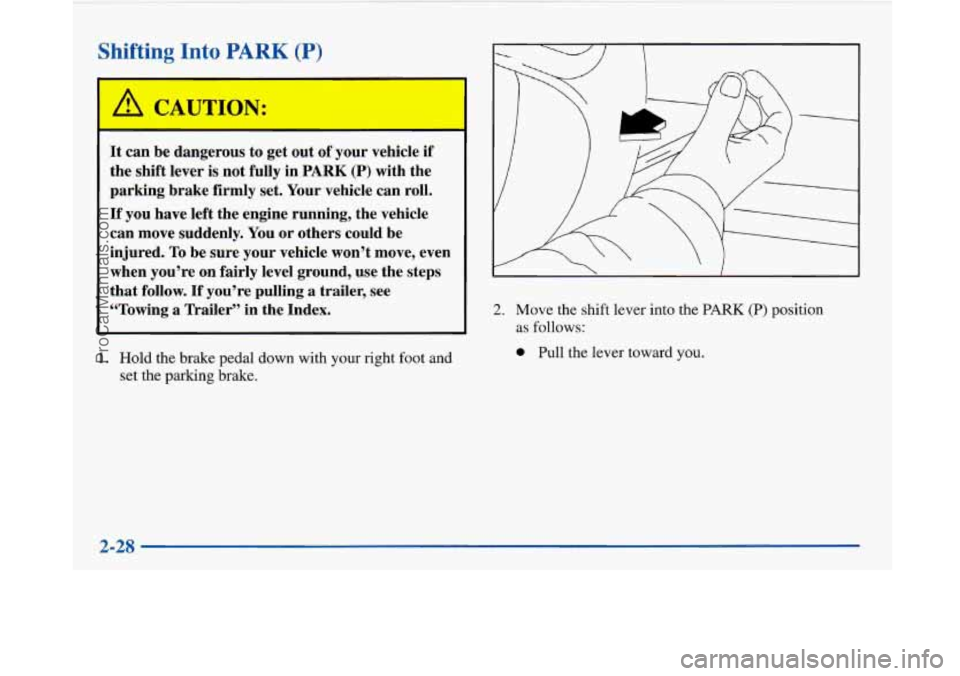
Your Park Avenue has a
PUSH TO RELEASE
parking brake pedal. To set
the parking brake, hold the
regular brake pedal down
with your right foot. Push
down the parking brake
pedal with your left foot.
~___
Whether the ignition key is
in RUN or OFF, the brake
system warning light stays on while the parking brake
is set.
The parking brake uses the brakes on the rear wheels.
To release the parking brake, hold the regular brake
pedal down and push the parking brake pedal with your
left foot. This will unlock the pedal. When you lift your
left foot, the parking brake pedal will follow it to the
release position. If you
try to drive
off (approximately 20 feet (6.1 m)),
with the parking brake on, the brake light stays on and a continuous chime sounds until you release the
parking brake.
I NOTICE:
Driving with the parking brake on can cause
your rear brakes to overheat.
You may have to
replace them, and you could also damage other
parts
of your vehicle.
If you are towing a trailer and are parking on any hill,
see “Towing a Trailer” in the Index. That part shows
what to do first to keep the trailer from moving.
2-27
ProCarManuals.com
Page 88 of 420
Shifting Into PA RY (P)
r A CAdTION:
It can be dangerous to get out of your vehicle if
the shift lever is not fully in
PARK (P) with the
parking brake firmly set. Your vehicle can roll.
If you have left the engine running, the vehicle
can move suddenly. You or others could be
injured.
To be sure your vehicle won’t move, even
when you’re on fairly level ground, use the steps
that follow.
If you’re pulling a trailer, see
“Towing a Trailer” in the Index.
1. Hold the brake pedal down with your right foot and
set the parking brake.
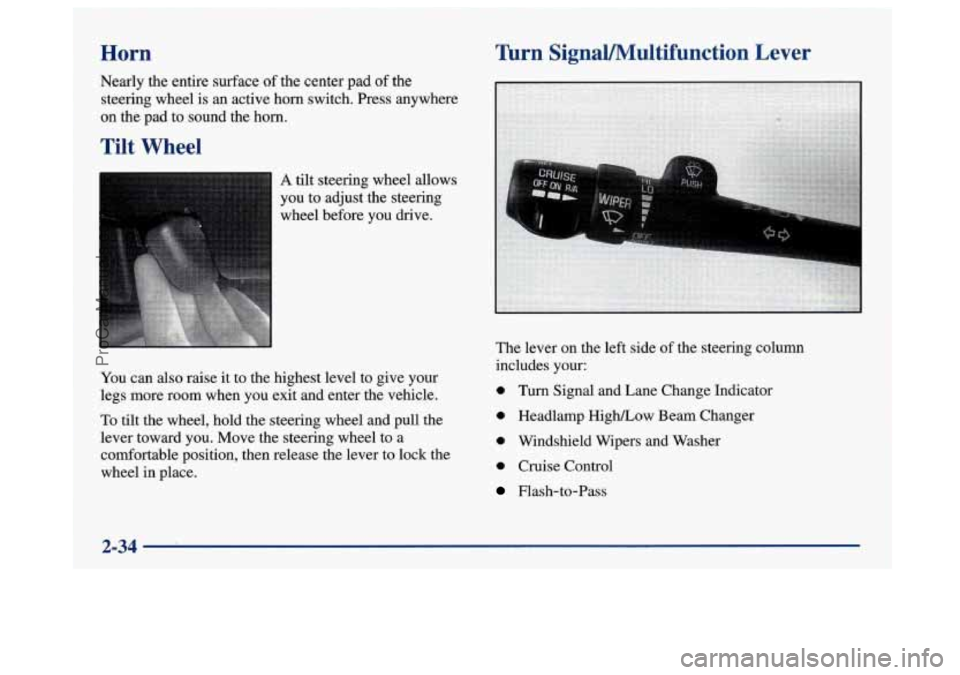
2. Move the shift lever into the PARK (P) position
as follows:
0 Pull the lever toward you.
ProCarManuals.com
Page 89 of 420
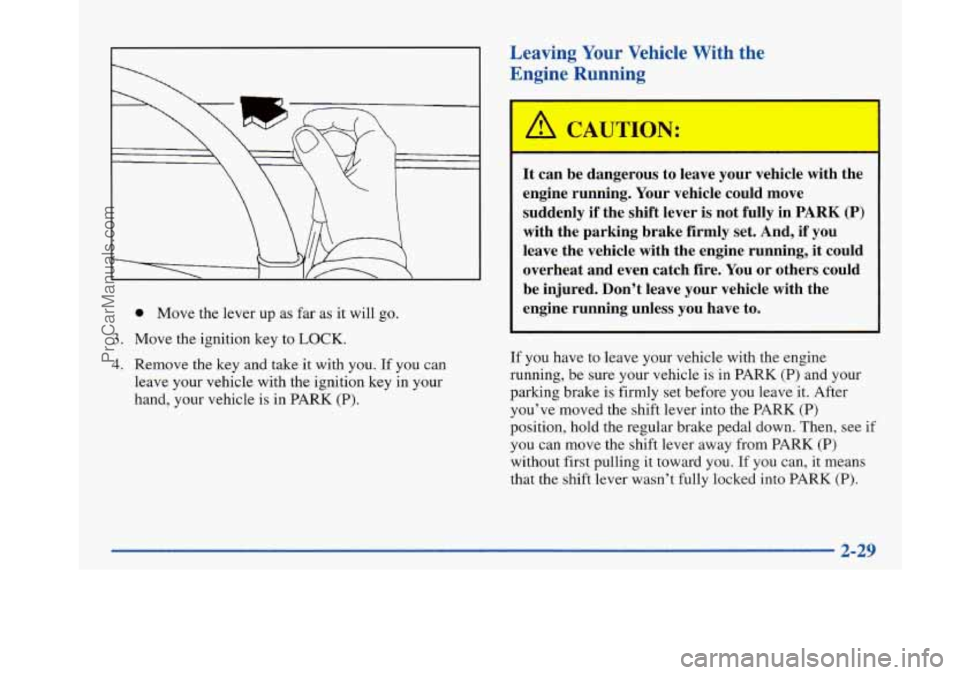
0 Move the lever up as far as it will go.
3. Move the ignition key to LOCK.
4. Remove the key and take it with you. If you can
leave your vehicle with the ignition key in your
hand, your vehicle is in PARK (P).
Leaving Your Vehicle With the
Engine Running
I
It can be dangerous to leave your vehicle with the
engine running. Your vehicle could move
suddenly if the shift lever
is not fully in PARK (P)
with the parking brake firmly set. And, if you
leave the vehicle with the engine running, it could
overheat and even catch fire. You or others could
be injured. Don’t leave your vehicle with the
engine running unless you have to.
If you have to leave your vehicle with the engine
running, be sure your vehicle is in PARK
(P) and your
parking brake is firmly set before you leave it. After
you’ve moved the shift lever into the PARK (P)
position, hold the regular brake pedal down. Then, see
if
you can move the shift lever away from PARK (P)
without first pulling it toward you.
If you can, it means
that the shift lever wasn’t fully locked into PARK (P).
2-29
ProCarManuals.com
Page 92 of 420
Running Your Engine While
You’re Parked
It’s better not to park with the engine running. But if you
ever have to, here are some things to know.
I
CAUl
Idling the engine with the climate control system
off could allow dangerous exhaust into your vehicle
(see the earlier Caution under “Engine Exhaust”).
Also, idling in
a closed-in place can let deadly
carbon monoxide
(CO) into your vehicle even if
the fan switch is
at the highest setting. One place
this can happen is
a garage. Exhaust -- with
CO -- can come in easily. NEVER park in a
garage with the engine running.
Another closed-in place can be
a blizzard.
(See “Blizzard” in the Index.)
/r CAUTION:
It can be dangerous to get out of your vehicle if
the shift lever is not fully in PARK (P) with the
parking brake firmly set. Your vehicle can roll.
Don’t leave your vehicle when the engine is
running unless you have to.
If you’ve left the
engine running, the vehicle can move suddenly.
You or others could be injured.
To be sure your
vehicle won’t move, even when you’re on
fairly
level ground, always set your parking brake and
move the shift lever to PARK
(P).
Follow the proper steps to be sure your vehicle won’t
move. See “Shifting Into
PARK (P)” in the Index.
If you are parking on a hill and if you’re pulling
a
trailer, also see “Towing a Trailer” in the Index.
2-32
ProCarManuals.com
Page 94 of 420
Horn
Nearly the entire surface of the center pad of the
steering wheel is an active horn switch. Press anywhere
on the pad to sound the horn.
Tilt Wheel
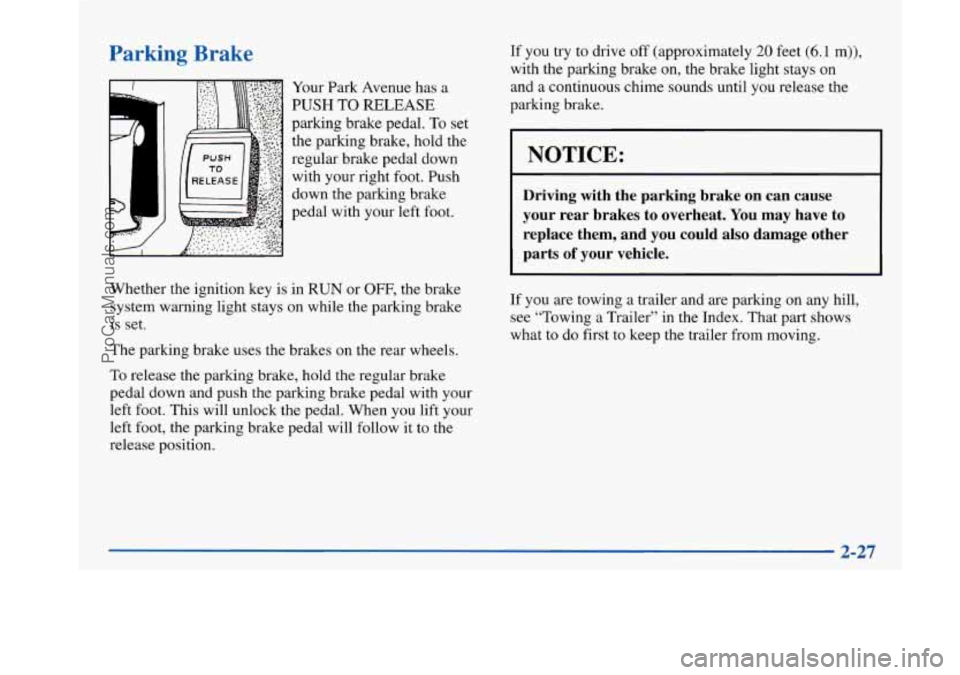
A tilt steering wheel allows
you to adjust the steering
wheel before you drive.
You can also raise it to the highest level to give your
legs more room when you exit and enter the vehicle.
To tilt the wheel, hold the steering wheel and pull the
lever toward you. Move the steering wheel to a
comfortable position, then release the lever to lock the
wheel in place.
'hrn SignaVMultifunction Lever
The lever on the left side of the steering column
includes your:
0 Turn Signal and Lane Change Indicator
0 Headlamp High/Low Beam Changer
0 Windshield Wipers and Washer
0 Cruise Control
Flash-to-Pass
2-34
ProCarManuals.com
Page 96 of 420

If a bulb is burned out, replace it to help avoid an
accident. If the arrows don’t go on at all when you
signal a turn, check the fuse (see “Fuses and Circuit
Breakers” in the Index) and for burned-out bulbs.
If you have a trailer towing option with added wiring
for the trailer lamps, the signal indicator will flash even
if
a turn signal bulb is burned out. Check the front
and rear turn signal lamps regularly to make sure
they
are working. Note: You do not need to add a
different flasher.
’hrn Signal On Chime
If your turn signal is left on for more than 3/4 of a mile
(1.2 km), a chime will sound at each flash of the turn
signal. To turn off the chime, move the turn signal lever
to the off position.
Headlamp High/Low Beam Changer
To change the headlamps from low beam to high or high to
low, pull the turn signal lever toward you, then release it.
Flash-To-Pass Feature
When the high beams are
on, a light on the instrument
panel will also be on. If
your vehicle is equipped
with
HUD, this light
will also appear in the
display area.
This feature lets you use your high-beam headlamps to
signal a driver in front
of you that you want to pass. It
works even if your headlamps are off.
To use it, pull the turn signal lever toward you, but not
so far that you hear a click.
If your headlamps are off or on low beam, your
high-beam headlamps will turn on. They’ll stay on as
long as you hold the lever toward you and the
high-beam indicator on the dash will come on. Release
the lever to turn the high-beam headlamps off.
ProCarManuals.com
Page 98 of 420
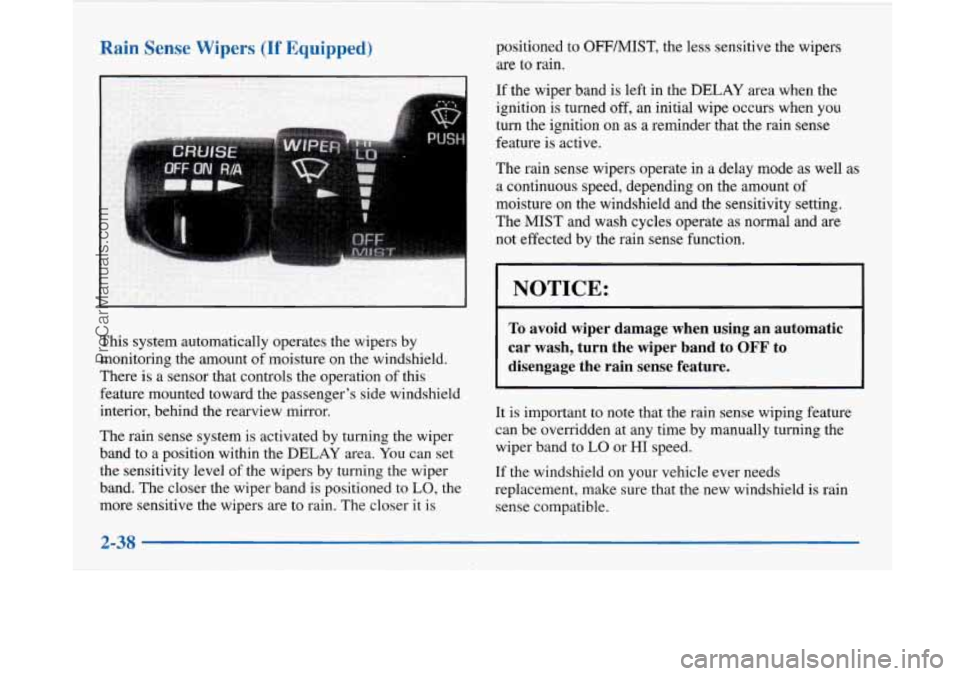
Rain Sense Wipers (If Equipped)
This system automatically operates the wipers by
monitoring the amount of moisture on the windshield.
There is a sensor that controls the operation of this
feature mounted toward the passenger’s side windshield
interior, behind the rearview mirror.
The rain sense system is activated by turning the wiper
band to a position within the
DELAY area. You can set
the sensitivity level of the wipers by turning the wiper
band. The closer the wiper band is positioned to
LO, the
more sensitive the wipers are to rain. The closer it is positioned to
OFFMIST, the
less sensitive the wipers
are to rain.
If the wiper band is left in the DELAY area when the
ignition is turned
off, an initial wipe occurs when you
turn the ignition on as a reminder that the rain sense
feature
is active.
The rain sense wipers operate in a delay mode as well as
a continuous speed, depending on the amount of
moisture on the windshield and the sensitivity setting.
The MIST and wash cycles operate as normal and are
not effected by the rain sense function.
NOTICE:
To avoid wiper damage when using an automatic
car wash, turn the wiper band to
OFF to
disengage the rain sense feature.
It is important to note that the rain sense wiping feature
can be overridden at any time by manually turning the
wiper band
to LO or HI speed.
If the windshield on your vehicle ever needs
replacement, make sure that the new windshield
is rain
sense compatible.
2-38
ProCarManuals.com
Page 135 of 420

Brake System Warning Light
Your Buick’s hydraulic brake system is divided into two
parts. If one part isn’t working, the other part can still
work and stop you. For good braking, though, you need
both parts working well.
If the warning light comes on, there could be a brake
problem. Have your brake system inspected right away.
BRAKE
This light should come on
when you turn the key to
RUN. If it doesn’t come on
then, have
it fixed so it will
be ready to warn you if
there’s a problem.
I I
Your brake system may not be working properly
if the brake system warning light is on. Driving with the brake system warning light on can lead
to an accident. If the light is still on after you’ve pulled off the road and stopped carefully, have
the vehicle towed for service.
When the ignition is on, the brake system warning light will also come on when you set your parking
brake. The light will stay on if your parking brake
doesn’t release fully. If you try to drive off with the
parking brake set, a chime will also come on until you
release the parking brake.
If the light and chime stay on
after your parking brake
is fully released, it means you
have a brake problem.
If the light and chime come on while you are driving,
pull
off the road and stop carefully. You may notice that
the pedal is harder to push. Or, the pedal may go closer
to the floor. It may take longer to stop. If the light is still
on, have the vehicle towed for service. (See “Towing
Your Vehicle” in the Index.)
2-75
ProCarManuals.com