Page 310 of 406
NOTICE:
The wrong wheel can also cause problems with
bearing life, brake cooling, speedometer
or
odometer calibration, headlamp aim, bumper
height, vehicle ground clearance and tire or tire
chain clearance to the body and chassis.
See “Changing a
Flat Tire” in the Index for
more information.
It Wknnls
Putting
a used wheel on your vehicle is
dangerous. You can’t know how it’s been used or
how far it’s been driven. It could fail suddenly
and cause an accident.
If you have to replace a
wheel, use a new GM original equipment wheel.
Tire Chains
NOTICE:
Use tire chains only where legal and only when
you must. Use only
SAE Class “S” type chains
that are the proper size
for your tires. Install
them on the front tires and tighten them as
tightly as possible with the ends securely
fastened. Drive slowly
and follow the chain
manufacturer’s instructions.
If you can hear the
chains contacting your vehicle, stop and retighten
them.
If the contact continues, slow down until it
stops. Driving too fast or spinning the wheels
with chains on will damage your vehicle.
6-44
ProCarManuals.com
Page 317 of 406
NOTICE:
Machine compounding or aggressive polishing on
a basecoatklearcoat paint finish may dull the
finish or leave swirl marks.
Foreign materials such as calcium chloride and other
salts, ice melting agents, road oil and
tar, tree sap, bird
droppings, chemicals from industrial chimneys, etc., can
damage your vehicle’s finish if they remain on painted
surfaces. Wash the vehicle as soon as possible. If
necessary, use non-abrasive cleaners that are marked
safe for painted surfaces to remove foreign matter.
Exterior painted surfaces are subject to aging, weather
and chemical fallout that can take their toll over
a period
of years.
You can help to keep the paint finish looking
new by keeping your Buick garaged
or covered
whenever possible.
Cleaning Aluminum Wheels
(If Equipped)
Keep your wheels clean using a soft clean cloth with
mild soap and water. Rinse with clean water. After
rinsing thoroughly, dry with a soft clean towel.
A wax
may then be applied.
The surface
of these wheels is similar to the painted
surface of your vehicle. Don’t use strong soaps,
chemicals, abrasive polishes, abrasive cleaners or
abrasive cleaning brushes on them because you could
damage the surface.
Don’t take your vehicle through an automatic car wash
that has silicon carbide tire cleaning brushes. These
brushes can also damage the surface
of these wheels.
6-51
ProCarManuals.com
Page 318 of 406
Cleaning Tires
To clean your tires, use a stiff brush with a tire cleaner.
NOTICE:
When applying a tire dressing always take care to
wipe off any overspray
or splash from all painted
surfaces
on the body or wheels of the vehicle.
Petroleum-based products may damage the
paint finish.
Sheet Metal Damage
If your vehicle is damaged and requires sheet metal
repair or replacement, make sure the body repair
shop
applies anti-corrosion material to the parts repaired or
replaced to restore corrosion protection.
Finish Damage
Any stone chips, fractures or deep scratches in the finish
should be repaired right away. Bare metal will corrode
quickly and may develop into
a major repair expense.
Minor chips and scratches can be repaired with touch-up
materials available from your dealer or other service
outlets. Larger areas of finish damage can be corrected
in your dealer’s body and paint shop.
6-52
ProCarManuals.com
Page 325 of 406
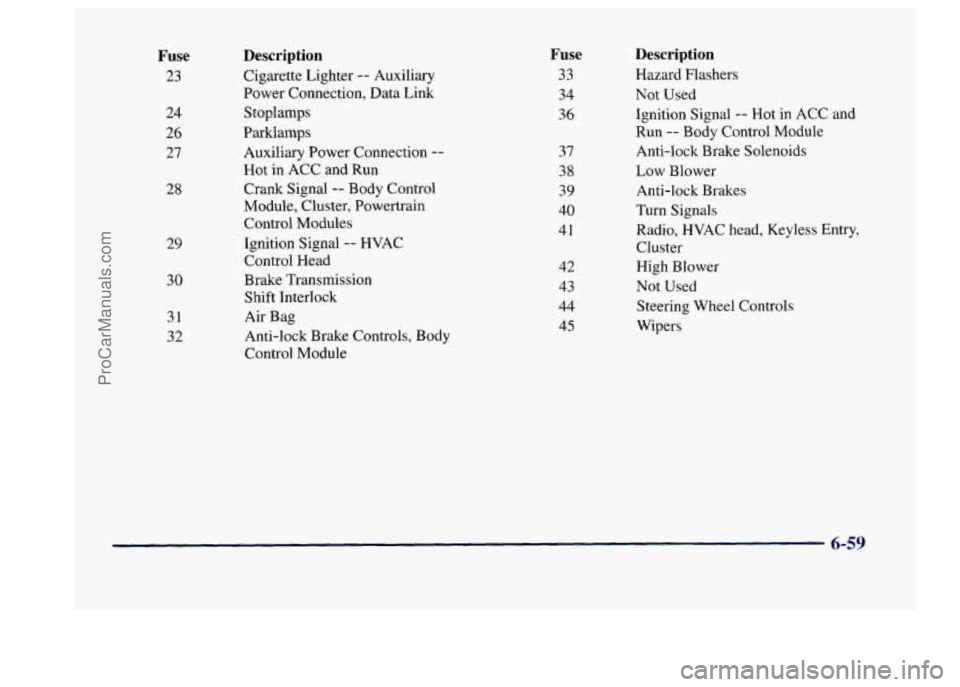
Fuse
23 24
26 27
28
29
30
31
32
Description
Cigarette Lighter -- Auxiliary
Power Connection, Data Link
Stoplamps
Parklamps Auxiliary Power Connection
--
Hot in ACC and Run
Crank Signal
-- Body Control
Module, Cluster, Powertrain
Control
Modules
Ignition Signal -- HVAC
Control Head
Brake Transmission
Shift Interlock
Air Bag
Anti-lock Brake Controls, Body
Control Module
Fuse
33
34
36
37
38
39
40
41
42
43
44
45
Description
Hazard Flashers
Not Used
Ignition Signal
-- Hot in ACC and
Run
-- Body Control Module
Anti-lock Brake Solenoids
Low Blower
Anti-lock Brakes
Turn Signals Radio,
HVAC head, Keyless Entry,
Cluster
High Blower
Not Used
Steering Wheel Controls
Wipers
6-59
ProCarManuals.com
Page 326 of 406
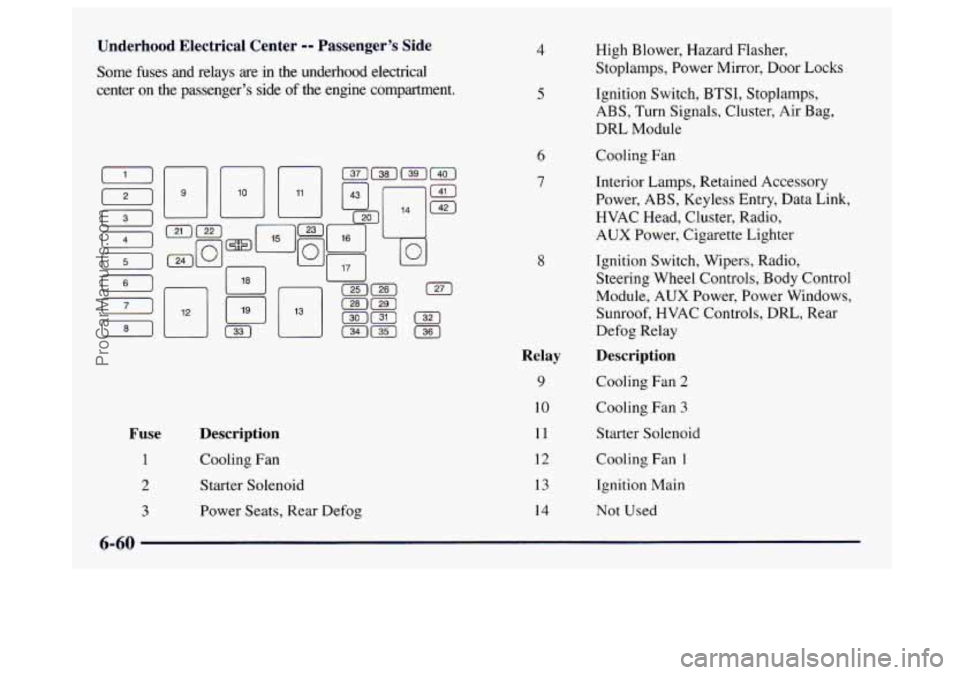
Underhood Electrical Center -- Passenger's Side
Some fuses and relays are in the underhood electrical
center on the passenger's side
of the engine compartment.
D
121
(31
(41
(51 F I I I I
m
[61
18j
(71 [TI
Fuse
1
2
3
Description
Cooling Fan
Starter Solenoid
Power Seats, Rear Defog
4
5
6
7
8
Relay
9
10
11
12
13
14
High Blower, Hazard Flasher,
Stoplamps, Power Mirror, Door Locks
Ignition Switch, BTSI, Stoplamps,
ABS, Turn Signals, Cluster, Air Bag,
DRL Module
Cooling Fan
Interior Lamps, Retained Accessory
Power, ABS, Keyless Entry, Data Link,
HVAC Head, Cluster, Radio,
AUX Power, Cigarette Lighter
Ignition Switch, Wipers, Radio,
Steering Wheel Controls, Body Control
Module, AUX Power, Power Windows,
Sunroof, HVAC Controls, DRL, Rear
Defog Relay
Description
Cooling Fan 2
Cooling Fan 3
Starter Solenoid
Cooling Fan
1
Ignition Main
Not Used
ProCarManuals.com
Page 328 of 406
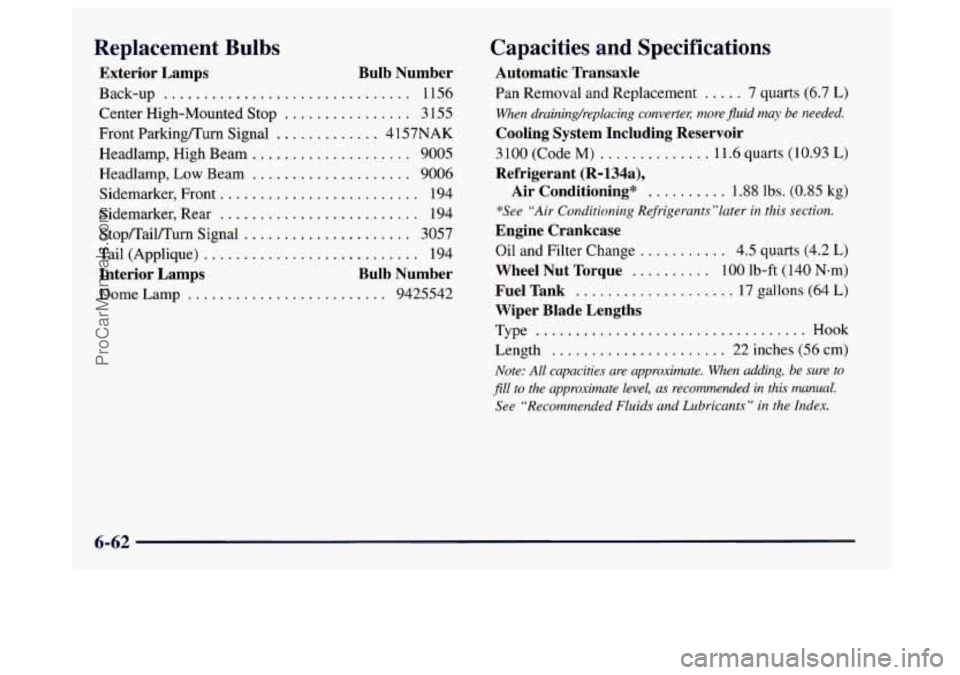
Replacement Bulbs
Exterior Lamps Bulb Number
Back-up ............................... 1156
Center High-Mounted Stop
................ 3 155
Front Parkingnurn Signal
............. 4 157NAK
Headlamp, High Beam
.................... 9005
Headlamp,
Low Beam .................... 9006
Sidemarker, Front
......................... 194
Sidemarker, Rear
......................... 194
Stop/Tail/Turn Signal
..................... 3057
Tail (Applique)
........................... 194
Interior Lamps Bulb Number
Dome Lamp ......................... 9425542
Capacities and Specifications
Automatic Transaxle
Pan
Removal and Replacement ..... 7 quarts (6.7 L)
When druiningheplacing convertec more .fluid muy be needed.
Cooling System Including Reservoir
3100 (Code M) .............. 11.6 quarts (10.93 L)
Refrigerant (R-l34a),
*See “Air Conditioning Rejrigerants”1ater in. this section.
Engine Crankcase
Oil and Filter Change ........... 4.5 quarts (4.2 L)
Wheel Nut Torque .......... 100 lb-ft (140 Nsm)
Wiper Blade Lengths
Type .................................. Hook
Note: All capacities are approximate. When adding, be sure to
.fill to the upproximate level, as recommended in this manual.
See “Recommended Fluids and Lubricants” in the Index.
Air Conditioning* .......... 1.88 lbs. (0.85 kg)
Fuel Tank .................... 17 gallons (64 L)
Length
...................... 22 inches (56 cm)
6-62
ProCarManuals.com
Page 329 of 406
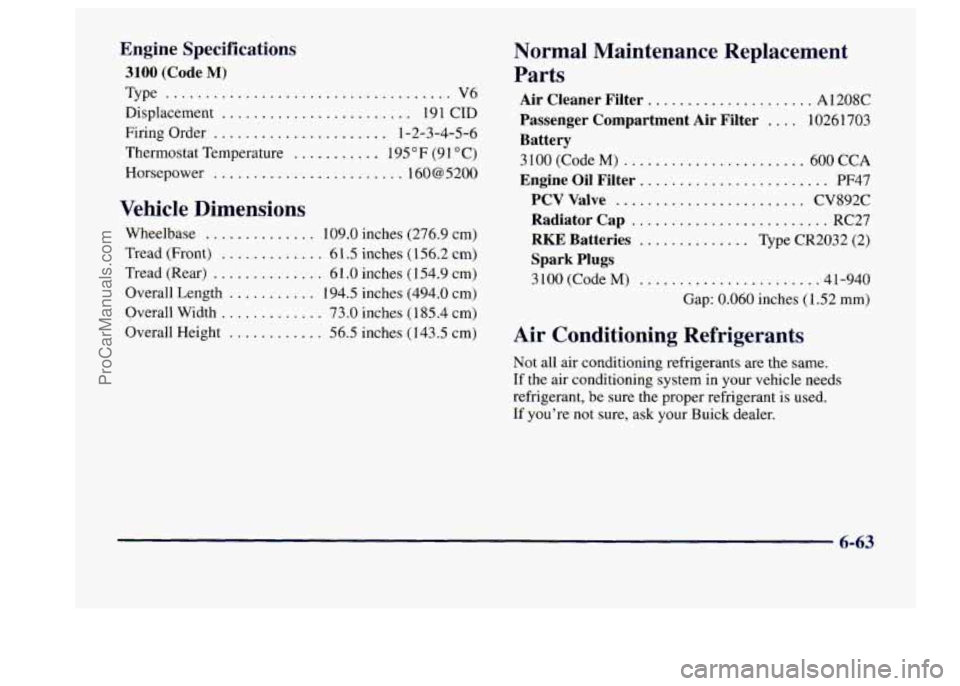
Engine Specifications
3100 (Code M)
Type .................................... V6
Displacement
........................ 191 CID
Firing Order
...................... 1-2-3-4-5-6
Thermostat Temperature
........... 195 OF (9 1 O C)
Horsepower
........................ 160 @ 5200
Vehicle Dimensions
Wheelbase .............. 109.0 inches (276.9 cm)
Tread (Front)
............. 6 1.5 inches ( 156.2 cm)
Tread (Rear)
.............. 61 .O inches ( 154.9 cm)
Overall Length
........... 194.5 inches (494.0 cm)
Overall Width
............. 73.0 inches (185.4 cm)
Overall Height
............ 56.5 inches (143.5 cm)
Normal Maintenance Replacement
Parts
Air Cleaner Filter ..................... A 1208C
Passenger Compartment Air Filter .... 10261703
Battery
3100 (Code M) ....................... 600 CCA
PCVValve ........................ CV892C
Engine Oil Filter ........................ PF47
Radiator Cap ......................... RC27
RKE Batteries .............. Type CR2032 (2)
3 100 (Code M) ...................... .41-940
Spark Plugs
Gap: 0.060 inches (1.52 mm)
Air Conditioning Refrigerants
Not all air conditioning refrigerants are the same.
If the air conditioning system in your vehicle needs
refrigerant, be sure the proper refrigerant
is used.
If you’re not sure, ask your Buick dealer.
6-63
ProCarManuals.com
Page 371 of 406
Part C: Periodic Maintenance
Inspections
Listed below are inspections and services which should be
performed at least twice a year (for instance, each spring
and fall). You should let your
GM dealer’s service
department or other qualified service center do these jobs.
Make sure any necessary repairs are completed at once.
Proper procedures
to perform these services may be
found in a
GM service manual. See “Service and Owner
Publications” in the Index.
Steering, Suspension and Front Drive Axle
Boot and Seal Inspection
Inspect the front and rear suspension and steering
system for damaged, loose or missing parts, signs
of
wear or lack of lubrication. Inspect the power steering
lines and hoses for proper hook-up, binding, leaks,
cracks, chafing, etc. Clean and then inspect the drive
axle boot seals for damage, tears or leakage. Replace
seals if necessary.
Exhaust System Inspection
Inspect the complete exhaust system. Inspect the body
near the exhaust system.
Look for broken, damaged,
missing or out-of-position parts
as well as open seams, holes,
loose connections or other conditions which could
cause
a heat build-up in the floor pan or could let
exhaust fumes into the vehicle. See “Engine Exhaust’’
in the Index.
Radiator and Heater Hose Inspection
Inspect the hoses and have them replaced if they are
cracked, swollen or deteriorated. Inspect all pipes,
fittings and clamps; replace
as needed.
Throttle Linkage Inspection
Inspect the throttle linkage for interference or binding,
and for damaged or missing parts. Replace parts
as
needed. Replace any cables that have high effort or
excessive wear. Do
not lubricate accelerator and cruise
control cables.
Brake System Inspection
Inspect the complete system. Inspect brake lines and
hoses for proper hook-up, binding, leaks, cracks,
chafing, etc. Inspect disc brake pads for wear and rotors
for surface condition. Also inspect drum brake linings
for wear and cracks. Inspect other brake parts, including
drums, wheel cylinders, calipers, parking brake, etc.
Check parking brake adjustment. You may need to have
your brakes inspected more often
if your driving habits
or conditions result in frequent braking.
7-41
ProCarManuals.com