Page 218 of 1354
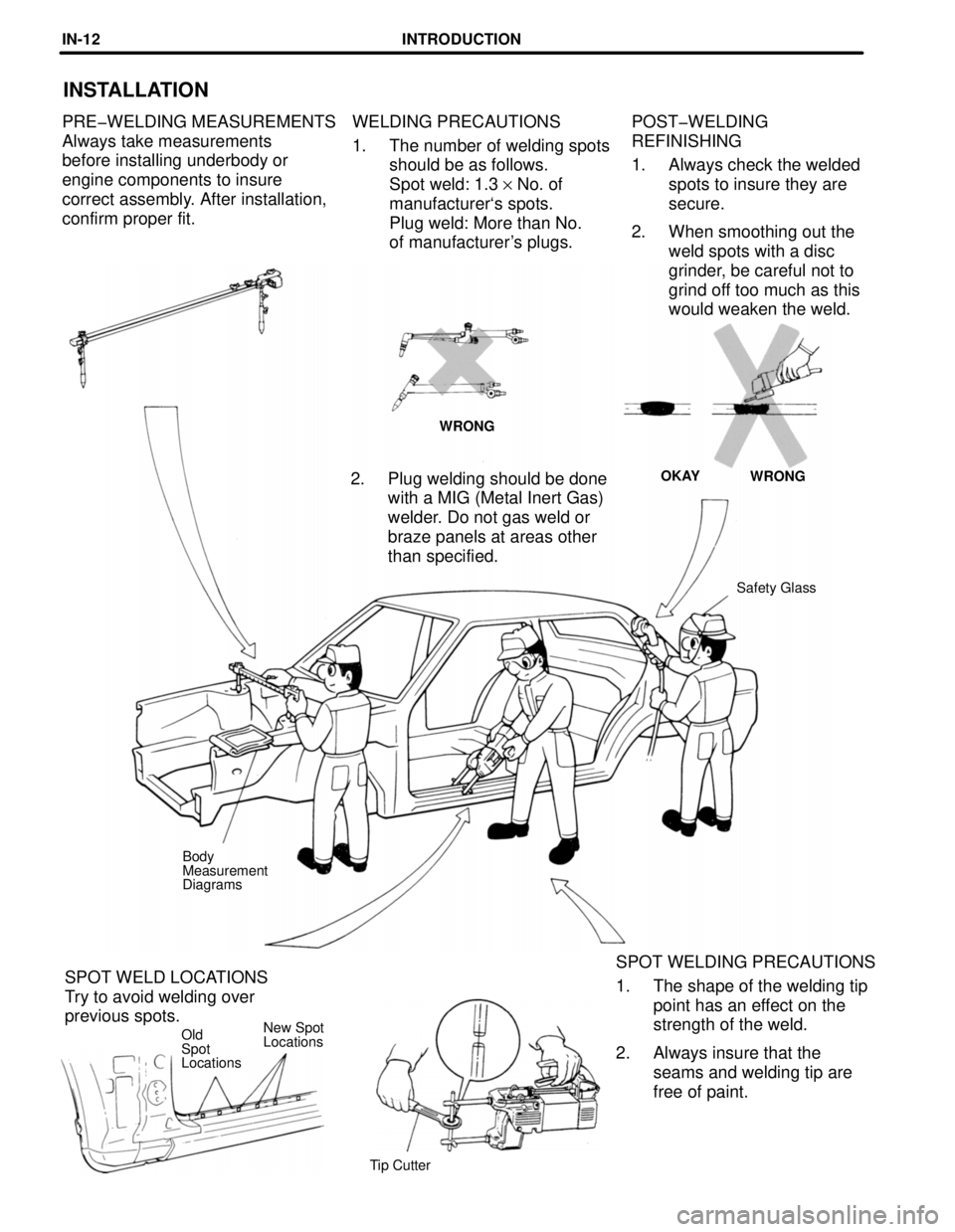
New Spot
Locations
POST-WELDING
REFINISHING
1. Always check the welded
spots to insure they are
secure.
2. When smoothing out the
weld spots with a disc
grinder, be careful not to
grind off too much as this
would weaken the weld.
INSTALLATION
PRE-WELDING MEASUREMENTS
Always take measurements
before installing underbody or
engine components to insure
correct assembly. After installation,
confirm proper fit.WELDING PRECAUTIONS
1. The number of welding spots
should be as follows.
Spot weld: 1.3 y No. of
manufacturer`s spots.
Plug weld: More than No.
of manufacturer's plugs.
WRONG
WRONG OKAY
2. Plug welding should be done
with a MIG (Metal Inert Gas)
welder. Do not gas weld or
braze panels at areas other
than specified.
Safety Glass
Body
Measurement
Diagrams
SPOT WELDING PRECAUTIONS
1. The shape of the welding tip
point has an effect on the
strength of the weld.
2. Always insure that the
seams and welding tip are
free of paint. SPOT WELD LOCATIONS
Try to avoid welding over
previous spots.
Old
Spot
Locations
Tip Cutter
INTRODUCTIONINœ12
Page 278 of 1354
CL04F−03
− CLUTCHTROUBLESHOOTING
CL−1
1996 RAV4 (RM447U)
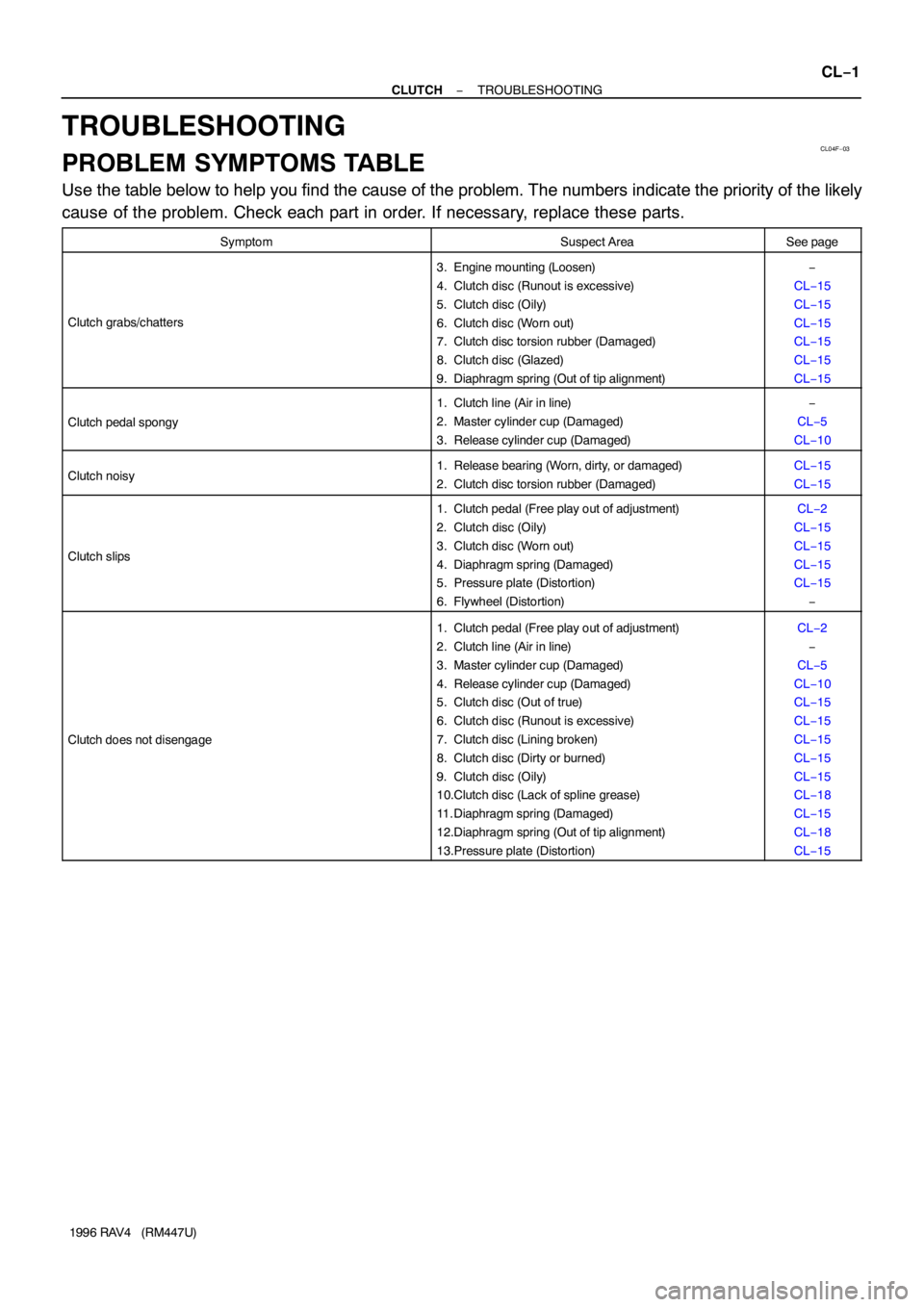
TROUBLESHOOTING
PROBLEM SYMPTOMS TABLE
Use the table below to help you find the cause of the problem. The numbers indicate the priority of the likely
cause of the problem. Check each part in order. If necessary, replace these parts.
SymptomSuspect AreaSee page
Clutch grabs/chatters
3. Engine mounting (Loosen)
4. Clutch disc (Runout is excessive)
5. Clutch disc (Oily)
6. Clutch disc (Worn out)
7. Clutch disc torsion rubber (Damaged)
8. Clutch disc (Glazed)
9. Diaphragm spring (Out of tip alignment)−
CL−15
CL−15
CL−15
CL−15
CL−15
CL−15
Clutch pedal spongy
1. Clutch line (Air in line)
2. Master cylinder cup (Damaged)
3. Release cylinder cup (Damaged)−
CL−5
CL−10
Clutch noisy1. Release bearing (Worn, dirty, or damaged)
2. Clutch disc torsion rubber (Damaged)CL−15
CL−15
Clutch slips
1. Clutch pedal (Free play out of adjustment)
2. Clutch disc (Oily)
3. Clutch disc (Worn out)
4. Diaphragm spring (Damaged)
5. Pressure plate (Distortion)
6. Flywheel (Distortion)CL−2
CL−15
CL−15
CL−15
CL−15
−
Clutch does not disengage
1. Clutch pedal (Free play out of adjustment)
2. Clutch line (Air in line)
3. Master cylinder cup (Damaged)
4. Release cylinder cup (Damaged)
5. Clutch disc (Out of true)
6. Clutch disc (Runout is excessive)
7. Clutch disc (Lining broken)
8. Clutch disc (Dirty or burned)
9. Clutch disc (Oily)
10.Clutch disc (Lack of spline grease)
11. Diaphragm spring (Damaged)
12.Diaphragm spring (Out of tip alignment)
13.Pressure plate (Distortion)CL−2
−
CL−5
CL−10
CL−15
CL−15
CL−15
CL−15
CL−15
CL−18
CL−15
CL−18
CL−15
Page 279 of 1354

Q08873
Push Rod Play
Adjust Point
Pedal Height
Adjust Point
Push Rod
Play
Pedal HeightCL04G−02
CL0042
Pedal Freeplay
CL0512
25 mm (0.98 in.) or more
Release Point
Full Stroke
End Position CL−2
− CLUTCHCLUTCH PEDAL
1996 RAV4 (RM447U)
CLUTCH PEDAL
INSPECTION
1. CHECK PEDAL HEIGHT IS CORRECT
Pedal height from asphalt sheet:
157.6 − 167.6 mm (6.205 − 6.598 in.)
2. IF NECESSARY, ADJUST PEDAL HEIGHT
Loosen the lock nut and turn the stopper bolt until the height is
correct. Tighten the lock nut.
3. CHECK PEDAL FREEPLAY AND PUSH ROD PLAY
(a) Push in on the pedal until the beginning of clutch resis-
tance is felt.
Pedal freeplay: 5.0−15.0 mm (0.197−0.591 in.)
(b) Gently push on the pedal until the resistance begins to in-
crease a little.
Push rod play at pedal top:
1.0−5.0 mm (0.039−0.197 in.)
4. IF NECESSARY, ADJUST PEDAL FREEPLAY AND
PUSH ROD PLAY
(a) Loosen the lock nut and turn the push rod until the free-
play and push rod play are correct.
(b) Tighten the lock nut.
(c) After adjusting the pedal freeplay, check the pedal height.
(d) Connect the air duct and install the lower finish panel.
5. INSPECT CLUTCH RELEASE POINT
(a) Pull the parking brake lever and install wheel stopper.
(b) Start the engine and idle the engine.
(c) Without depressing the clutch pedal, slowly shift the shift
lever into the reverse position until the gears contact.
(d) Gradually depress the clutch pedal and measure the
stroke distance from the point the gear noise stops (re-
lease point) up to the full stroke end position.
Standard distance:
25 mm (0.98 in.) or more
(From pedal stroke end position to release point)
If the distance is not as specified.
�Inspect pedal height.
�Inspect push rod play and pedal freeplay.
�Bleed the clutch line.
�Inspect the clutch cover and disc.
Page 280 of 1354

Q08874
Clutch Start Switch
Q08667
8 ± 0.5 mm
(0.31 ± 0.020 in.)
Q08677
No continuity
321
Q08678
No continuity
321
− CLUTCHCLUTCH PEDAL
CL−3
1996 RAV4 (RM447U)
6. CHECK CLUTCH START SYSTEM
(a) Check that the engine does not start when the clutch ped-
al is released.
(b) Check that the engine starts when the clutch pedal is fully
depressed.
If necessary, replace the clutch start switch.
7. CHECK CONTINUITY OF CLUTCH START SWITCH
Check the continuity between terminals when the switch is ON
and OFF.
Switch positionCondition
ON (pushed)Continuity
OFF (free)No Continuity
If continuity is not as specified, replace the switch.
8. CHECK CONTINUITY OF CLUTCH START CANCEL
SWITCH
(a) Check that there is no continuity when connecting the
positive (+) lead from the ohmmeter to terminal 2 and the
negative (−) lead to terminal 1.
(b) Check that there is no continuity when connecting the
positive (+) lead from the ohmmeter to terminal 3 and the
negative (−) lead to terminal 1 and 2.
If continuity is not as specified, replace the clutch start cancel
switch.
Page 295 of 1354

CL04U−02
Q06037
Flywheel
Side
SST
Q06038
Matchmarks8 2, 5
6
SST
3
7 1, 4
Q06039SST
Q06245
CL−18
− CLUTCHCLUTCH UNIT
1996 RAV4 (RM447U)
INSTALLATION
1. INSTALL CLUTCH DISC AND CLUTCH COVER ON
FLYWHEEL
(a) Insert SST in the clutch disc, and then set them and the
clutch cover in position.
SST 09301−00220
(b) Align the matchmarks on the clutch cover and flywheel.
(c) Temporarily tighten the topmost bolt from the 3 near the
knock pins.
HINT:
Temporarily tighten the No.3 bolt.
(d) Torque the bolts on the clutch cover in the order shown.
Torque: 19 N·m (195 kgf·cm, 14 ft·lbf)
2. CHECK DIAPHRAGM SPRING TIP ALIGNMENT
Using a dial indicator with roller instrument, check the dia-
phragm spring tip alignment.
Maximum non−alignment: 0.5 mm (0.020 in.)
If alignment is not as specified, using SST, adjust the dia-
phragm spring tip alignment.
SST 09333−00013
3. APPLY MOLYBDENUM DISULPHIDE LITHIUM BASE
GREASE (NLGI NO.2)
(a) Apply release hub grease to the following parts.
�Release fork and hub contact point
�Release fork and push rod contact point
�Release fork pivot point
(b) Apply clutch spline grease.
�Clutch disc spline
HINT:
Recommended grease part number 08887−01706 (100g).
4. INSTALL RELEASE BEARING AND FORK TO TRANS-
AXLE
Install the bearing to the release fork, and then install them to
the transaxle.
5. INSTALL TRANSAXLE TO ENGINE
(2WD: See page MX−2)
(4WD: See page MX−8)
Page 296 of 1354
CO0BD−01
− COOLINGCOOLANT
CO−1
1996 RAV4 (RM447U)
COOLANT
INSPECTION
1. CHECK ENGINE COOLANT LEVEL AT RADIATOR RESERVOIR
The engine coolant level should be between the ”LOW” and ”FULL” lines, when engine is cold.
If low, check for leaks and add engine coolant up to the ”FULL” line.
2. CHECK ENGINE COOLANT QUALITY
(a) Remove the radiator cap.
CAUTION:
To avoid the danger of being burned, do not remove the radiator cap while the engine and radiator
are still hot, as fluid and steam can be blown out under pressure.
(b) There should not be any excessive deposits of rust or scale around the radiator cap or radiator filler
hole, and the coolant should be free from oil.
If excessively dirty, replace the coolant.
(c) Reinstall the radiator cap.
Page 297 of 1354

CO0BE−01
S01292Drain Plug CO−2
− COOLINGCOOLANT
1996 RAV4 (RM447U)
REPLACEMENT
1. DRAIN ENGINE COOLANT
(a) Remove the radiator cap.
CAUTION:
To avoid the danger of being burned, do not remove the ra-
diator cap while the engine and radiator are still hot, as fluid
and steam can be blown out under pressure.
(b) Loosen the radiator drain plug (on the left side of the ra-
diator lower tank) and engine drain plug (on the left rear
of the cylinder block), and drain the coolant.
(c) Close the drain plugs.
Torque: Engine drain plug
25 N·m (250 kgf·cm, 18 ft·lbf)
2. FILL ENGINE COOLANT
(a) Slowly fill the system with coolant.
�Use a good brand of ethylene−glycol base coolant
and mix it according to the manufacture’s direc-
tions.
�Using coolant which includes more than 50 % ethyl-
ene−glycol (but not more than 70 %) is recom-
mended.
NOTICE:
�Do not use an alcohol type coolant.
�The coolant should be mixed with demineralized wa-
ter or distilled water.
Capacity (w/ Heater):
M/T: 8.0 liters (8.5 US qts, 7.0 lmp. qts)
A/T: 7.7 liters (8.1 US qts, 6.8 lmp. qts)
(b) Install radiator cap.
(c) Start the engine, and bleed the cooling system.
(d) Refill the radiator reservoir with coolant until it reaches the
”FULL” line.
3. CHECK ENGINE COOLANT FOR LEAKS
Page 302 of 1354
CO0BH−02
CO0877
− COOLINGWATER PUMP
CO−7
1996 RAV4 (RM447U)
INSPECTION
INSPECT WATER PUMP
(a) Visually check the drain hole for coolant leakage.
If leakage is found, replace the water pump.
If engine coolant has leaked onto the timing belt, replace the
timing belt.
(b) Turn the pulley, and check that the water pump bearing
moves smoothly and quietly.
If necessary, replace the water pump.