1996 NISSAN FRONTIER automatic transmission
[x] Cancel search: automatic transmissionPage 107 of 198
If you have a flat tire, follow the instructions
below:
Stopping the vehicle
1. Safely move the vehicle off the road
away from traffic.
2. Turn on the hazard warning flashers.
3. Park on a level surface and apply the
parking brake. Shift the manual transmis-
sion into Reverse (R) (automatic trans-
mission in P).
WARNING
The transfer control lever must
be in the 2H, 4H or 4L position.
Never place it in the N position. Other-
wise, the vehicle could roll unexpect-
edly even if the manual transmission is
in gear.
4. Turn off the engine.
WARNING
cMake sure that the parking brake is
securely applied and the manual
transmission is shifted into Reverse
(R) (automatic transmission in P).
cNever change tires when the vehicle
is on a slope, ice or a slippery area.
This is dangerous.
cNever change tires if oncoming traf-
fic is close to your vehicle. Wait for
professional road assistance.
cRaise the hood to warn other traffic
and to signal professional road as-
sistance personnel that you require
assistance.
cHave all passengers get out of the
vehicle and stand in a safe place
away from traffic and clear of the
vehicle.
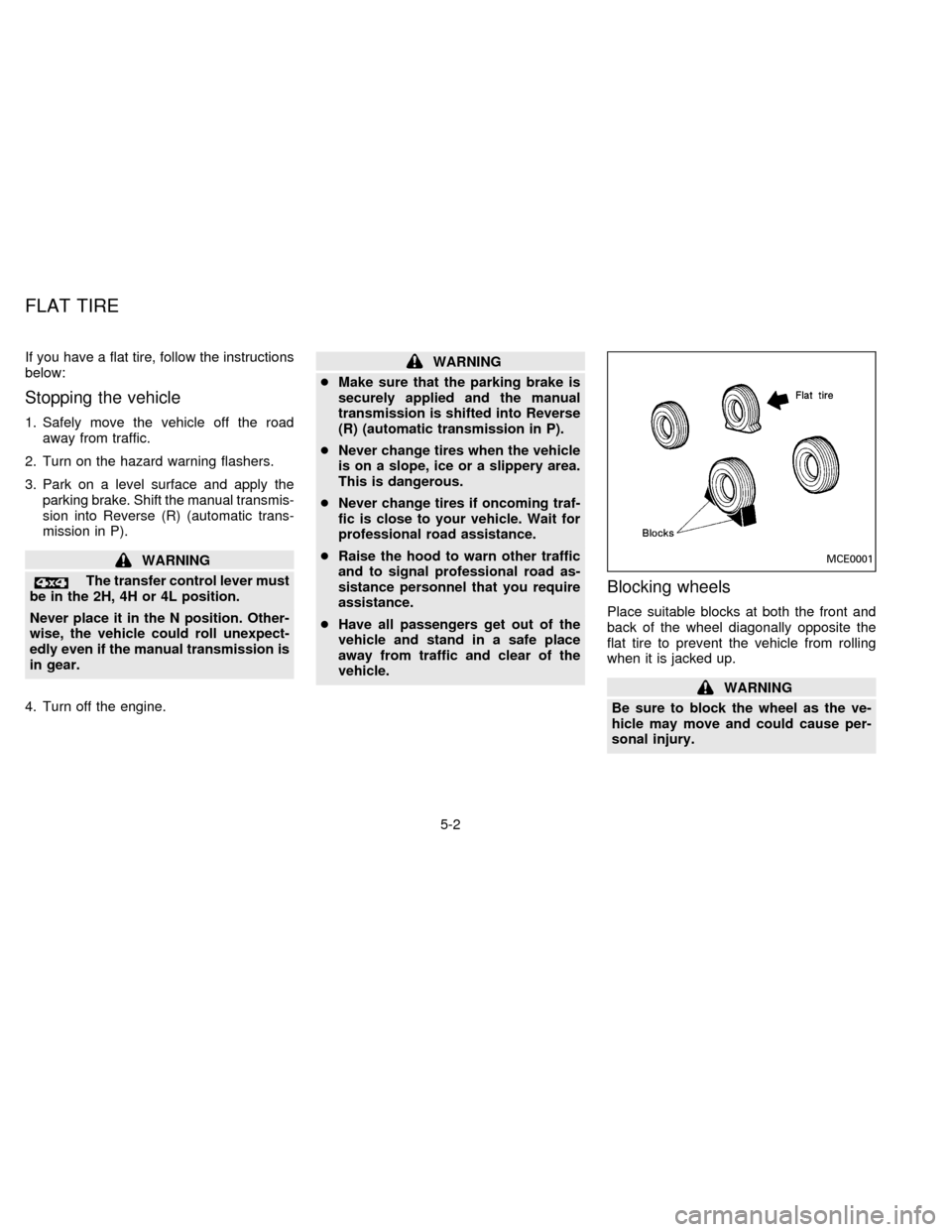
Blocking wheels
Place suitable blocks at both the front and
back of the wheel diagonally opposite the
flat tire to prevent the vehicle from rolling
when it is jacked up.
WARNING
Be sure to block the wheel as the ve-
hicle may move and could cause per-
sonal injury.
MCE0001
FLAT TIRE
5-2
ZX
Page 114 of 198
cMake sure that cables do not touch
moving parts in the engine compart-
ment and that clamps do not contact
any other metal.
5. Start the engine of the booster vehicle
and let it run for a few minutes.
6. Keep the engine speed of the booster
vehicle at about 2,000 rpm, and start
your engine in the normal manner.
CAUTION
Do not keep the starter motor engaged
for more than 10 seconds. If the engine
does not start right away, turn the key
off and wait 3 to 4 seconds before
trying again.
7. After starting your engine, carefully dis-
connect the negative cable and then the
positive cable.
8. Replace the vent caps (if so equipped).
Be sure to dispose of the cloth used to
cover the vent holes as it may be con-
taminated with corrosive acid.
CAUTION
cAutomatic transmission models can-
not be started by pushing. This may
cause transmission damage.
cThree-way catalyst equipped models
should not be started by pushing
since the three-way catalyst may be
damaged.
cNever try to start the vehicle by tow-
ing it; when the engine starts, the
forward surge could cause the ve-
hicle to collide with the tow vehicle.If your vehicle is overheating (indicated by
an extremely high temperature gauge read-
ing), or if you feel a lack of engine power,
detect abnormal noise, etc., take the follow-
ing steps:
WARNING
cDo not continue to drive if your ve-
hicle overheats. Doing so could
cause a vehicle fire.
cTo avoid the danger of being
scalded, never remove the radiator
cap while the engine is still hot.
When the radiator cap is removed,
pressurized hot water will spurt out,
possibly causing serious injury.
cDo not open the hood if steam is
coming out.
1. Move the vehicle safely off the road,
apply the parking brake and move the
gearshift lever to Neutral (automatic
transmission to P).
Do not stop the engine.
2. Turn off the air conditioning. Open all the
windows, move the heater or air condi-
tioner temperature control to maximum
PUSH STARTING IF YOUR VEHICLE
OVERHEATS
5-9
ZX
Page 116 of 198
on the ground:
Turn the ignition key to the OFF
position and secure the steering
wheel in a straight-ahead position
with a rope or similar device. Never
place the ignition key in the LOCK
position. This will result in damage
to the steering lock mechanism.
cWhen towing with the rear wheels on
the ground, release the parking
brake and move the gearshift lever
to the Neutral position (N position).
cOn automatic transmission models,
to move the shift lever to Neutral (N
position), turn the ignition key to the
ACC position. After moving the shift
lever to neutral (N position), be sure
to turn the ignition key to the OFF
position.
cFor 4-wheel drive model:
Set the free-running hubs to the free
position (See ``
Auto-lock free-
running hubsº or ``Manual-lock
free-running hubsº as appropriate inthe ``Starting and driving'' section).
Move the transfer case shift lever into
the 2H position and the transmission
shift lever into the Neutral (N) position.
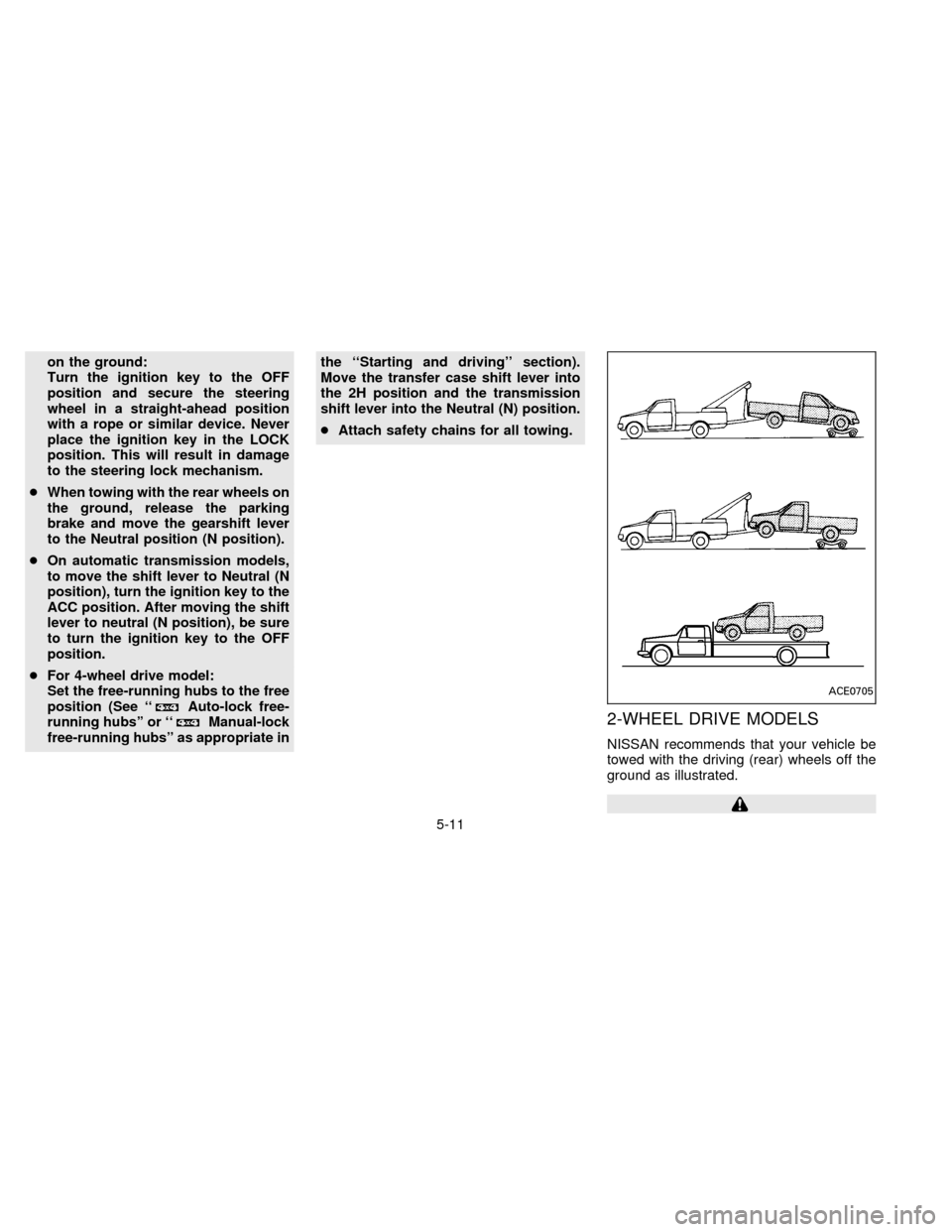
cAttach safety chains for all towing.2-WHEEL DRIVE MODELS
NISSAN recommends that your vehicle be
towed with the driving (rear) wheels off the
ground as illustrated.
ACE0705
5-11
ZX
Page 117 of 198
CAUTION
If you have to tow your vehicle with four
wheels on ground or with front wheels
raised (with rear wheels on ground),
observe the following restricted towing
speeds and distances:
Automatic transmission model:
cSpeed: Below 30 MPH (50 km/h)
cDistance: Less than 40 miles (65 km)
Manual transmission model:
cSpeed: Below 60 MPH (95 km/h)
cDistance: Less than 500 miles (800
km)
If the speed or distance must necessarily be
greater, remove the propeller shaft before-
hand to prevent damage to the transmis-
sion.
CAUTION
Never tow your vehicle from the rear
(i.e., backward) with four wheels on the
ground as this may cause serious and
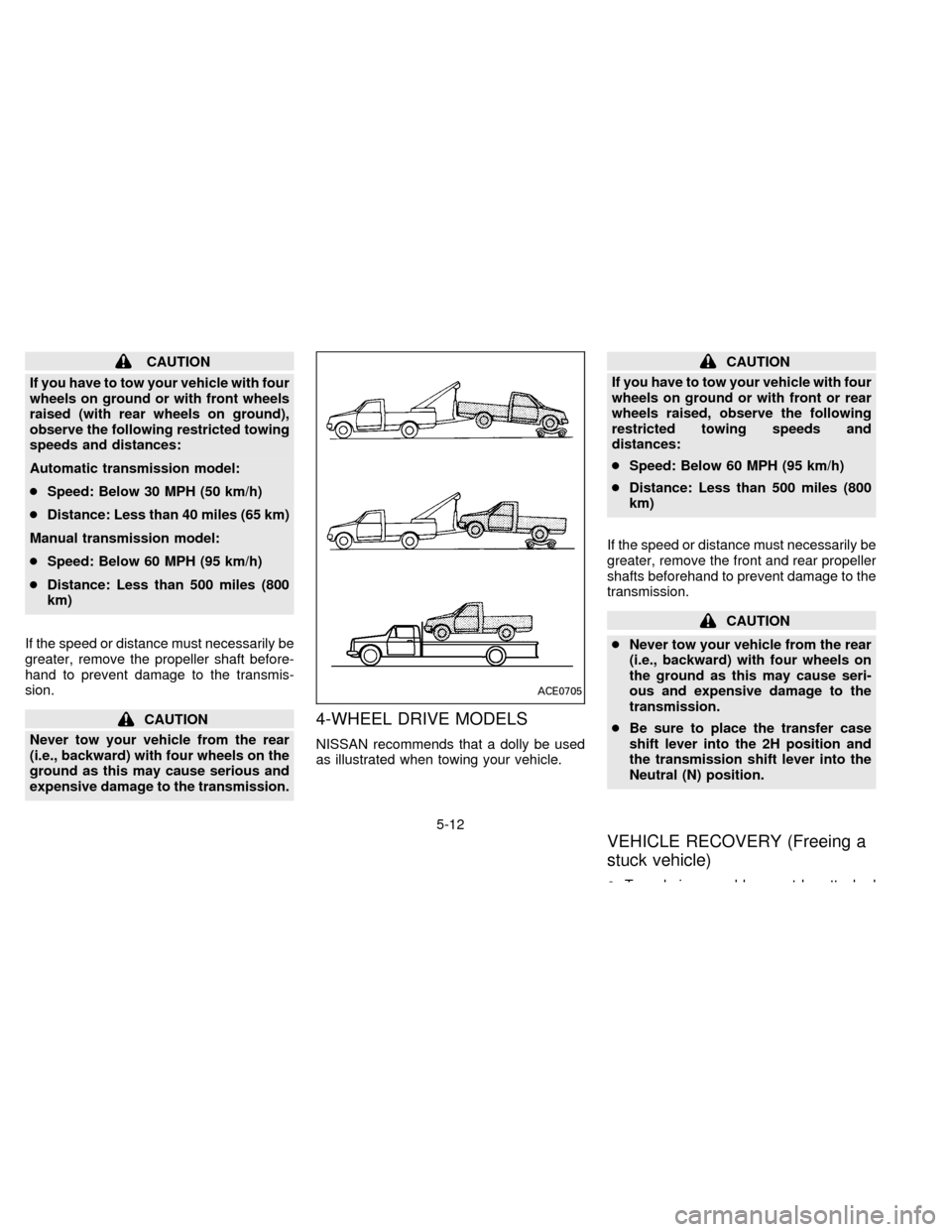
expensive damage to the transmission.4-WHEEL DRIVE MODELS
NISSAN recommends that a dolly be used
as illustrated when towing your vehicle.
CAUTION
If you have to tow your vehicle with four
wheels on ground or with front or rear
wheels raised, observe the following
restricted towing speeds and
distances:
cSpeed: Below 60 MPH (95 km/h)
cDistance: Less than 500 miles (800
km)
If the speed or distance must necessarily be
greater, remove the front and rear propeller
shafts beforehand to prevent damage to the
transmission.
CAUTION
cNever tow your vehicle from the rear
(i.e., backward) with four wheels on
the ground as this may cause seri-
ous and expensive damage to the
transmission.
cBe sure to place the transfer case
shift lever into the 2H position and
the transmission shift lever into the
Neutral (N) position.
VEHICLE RECOVERY (Freeing a
stuck vehicle)
cTow chains or cables must be attached
only to the main structual members of the
vehicle.
cPulling devices should be routed so they
do not touch any part of the suspension,
steering, brake or cooling systems.
cAlways pull the cable straight out from
the front or rear of the vehicle. Never pull
on the vehicle at an angle.
cPulling devices such as ropes or canvas
straps are not recommended for use in
vehicle towing or recovery.
ACE0705
5-12
ZX
Page 124 of 198

7 Do-it-yourself operations
Maintenance precautions ................................... 7-2
Engine compartment check locations ................ 7-3
Engine cooling system ....................................... 7-4
Engine oil ............................................................ 7-6
Automatic transmission fluid .............................. 7-9
Power steering fluid .......................................... 7-11
Brake and clutch fluid ....................................... 7-11
Window washer fluid ........................................ 7-12
Battery .............................................................. 7-13
Drive belts ........................................................ 7-14
Spark plug replacement ................................... 7-14
Air cleaner housing filter .................................. 7-15
Wiper blades .................................................... 7-16
Parking brake check ......................................... 7-17
Brake pedal ...................................................... 7-18
Brake booster ................................................... 7-19
Clutch pedal ..................................................... 7-19
Fuses ................................................................ 7-20
Light bulbs ........................................................ 7-20
Bulb replacement ............................................. 7-22
Wheels and tires .............................................. 7-24
Clutch housing ..................................... 7-29
ZX
Page 125 of 198

When performing any inspection or mainte-
nance work on your vehicle, always take
care to prevent serious accidental injury to
yourself or damage to the vehicle. The
following are general precautions which
should be closely observed.
cPark the vehicle on a level surface,
apply the parking brake securely and
block the wheels to prevent the ve-
hicle from moving. For a manual
transmission, move the shift lever to
Neutral. For an automatic transmis-
sion, move the shift lever to P (Park).
cBe sure the ignition key is OFF when
performing any parts replacement or
repairs.
cDo not work under the hood while the
engine is hot. Turn the engine off and
wait until it cools down.
cIf you must work with the engine run-
ning, keep your hands, clothing, hair
and tools away from moving fans,
belts, and any other moving parts.
cIt is advisable to remove ties and any
jewelry, such as rings, watches, etc.,
before working on your vehicle.cIf you must run the engine in an en-
closed space such as a garage, be
sure there is proper ventilation for
exhaust gases.
cNever get under the vehicle while it is
supported only by a jack. If it is nec-
essary to work under the vehicle, sup-
port it with safety stands.
cKeep smoking materials, flame and
sparks away from fuel and battery.
cNever connect or disconnect either
the battery or any transistorized com-
ponent connector while the ignition is
on.
cOn gasoline engine models with the
Multiport Fuel Injection (MFI) system,
the fuel filter or fuel lines should be
serviced by a NISSAN dealer because
the fuel lines are under high pressure
even when the engine is off.
cFailure to follow these or other com-
mon sense guidelines may lead to
serious injury or vehicle damage.
cImproperly disposed motor oil and/or
other vehicle fluids can hurt the envi-
ronment. Always conform to localregulations for disposal of vehicle
fluid. Avoid contact with used motor
oil.
This ``Do-it-yourself operations'' section
gives instructions regarding only those
items which are relatively easy for an owner
to perform.
You should be aware that incomplete or
improper servicing may result in operating
difficulties or excessive emissions, and
could affect your warranty coverage.If in
doubt about any servicing, have it done
by your NISSAN dealer.
MAINTENANCE
PRECAUTIONS
7-2
ZX
Page 132 of 198
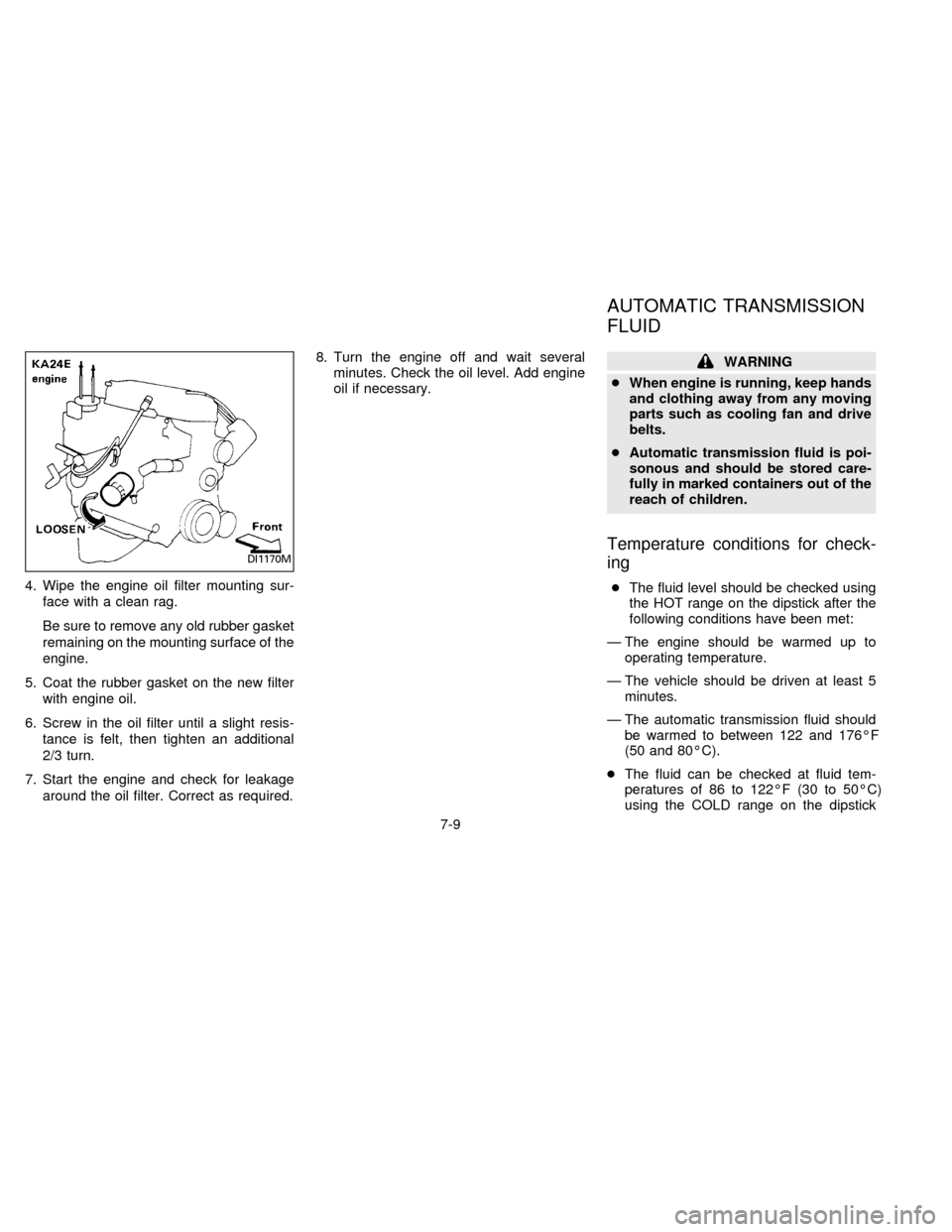
4. Wipe the engine oil filter mounting sur-
face with a clean rag.
Be sure to remove any old rubber gasket
remaining on the mounting surface of the
engine.
5. Coat the rubber gasket on the new filter
with engine oil.
6. Screw in the oil filter until a slight resis-
tance is felt, then tighten an additional
2/3 turn.
7. Start the engine and check for leakage
around the oil filter. Correct as required.8. Turn the engine off and wait several
minutes. Check the oil level. Add engine
oil if necessary.
WARNING
cWhen engine is running, keep hands
and clothing away from any moving
parts such as cooling fan and drive
belts.
cAutomatic transmission fluid is poi-
sonous and should be stored care-
fully in marked containers out of the
reach of children.
Temperature conditions for check-
ing
cThe fluid level should be checked using
the HOT range on the dipstick after the
following conditions have been met:
Ð The engine should be warmed up to
operating temperature.
Ð The vehicle should be driven at least 5
minutes.
Ð The automatic transmission fluid should
be warmed to between 122 and 176ÉF
(50 and 80ÉC).
cThe fluid can be checked at fluid tem-
peratures of 86 to 122ÉF (30 to 50ÉC)
using the COLD range on the dipstick
DI1170M
AUTOMATIC TRANSMISSION
FLUID
7-9
ZX
Page 133 of 198
after the engine is warmed up and before
driving. However, the fluid should be
re-checked using the HOT range.
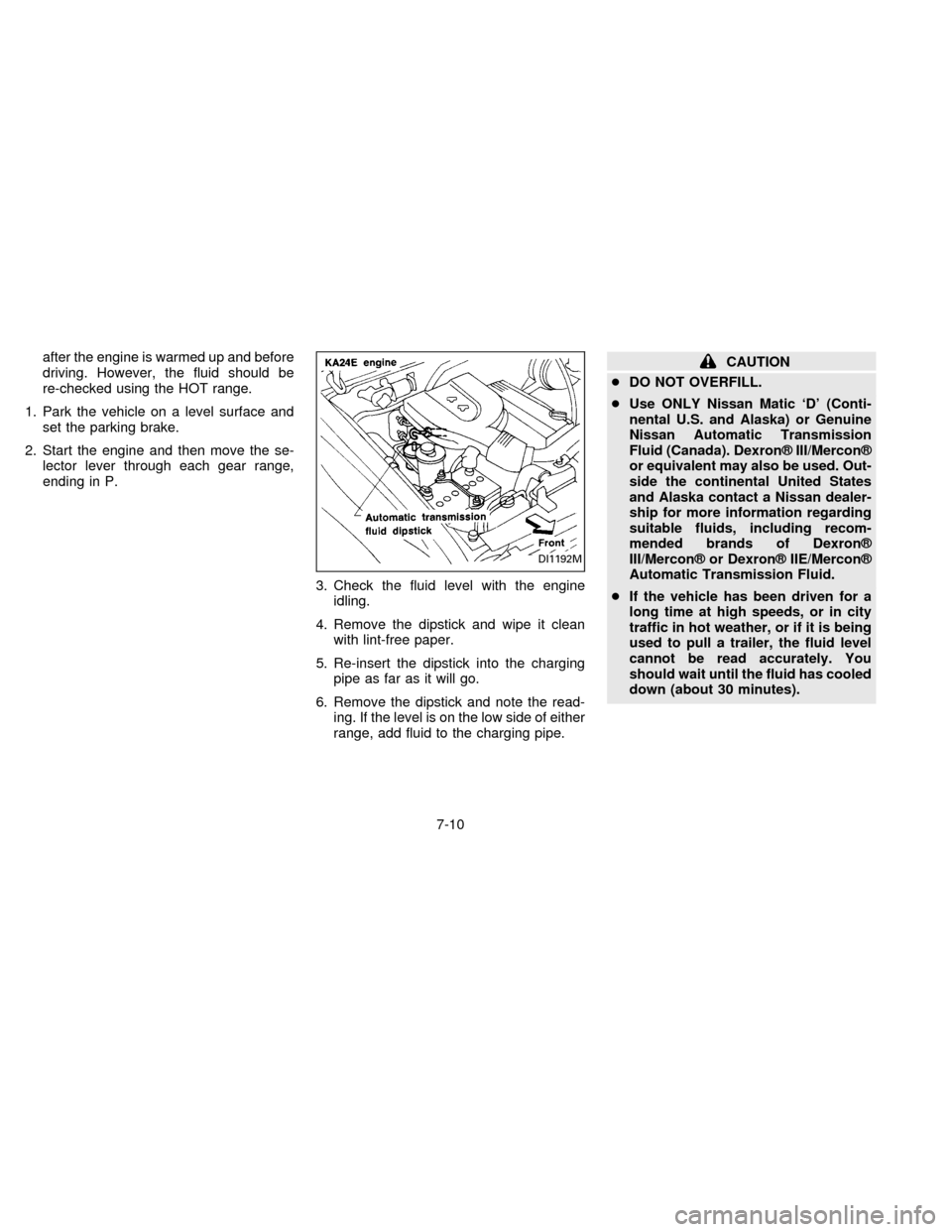
1. Park the vehicle on a level surface and
set the parking brake.
2. Start the engine and then move the se-
lector lever through each gear range,
ending in P.
3. Check the fluid level with the engine
idling.
4. Remove the dipstick and wipe it clean
with lint-free paper.
5. Re-insert the dipstick into the charging
pipe as far as it will go.
6. Remove the dipstick and note the read-
ing. If the level is on the low side of either
range, add fluid to the charging pipe.CAUTION
cDO NOT OVERFILL.
cUse ONLY Nissan Matic `D' (Conti-
nental U.S. and Alaska) or Genuine
Nissan Automatic Transmission
Fluid (Canada). Dexronž III/Merconž
or equivalent may also be used. Out-
side the continental United States
and Alaska contact a Nissan dealer-
ship for more information regarding
suitable fluids, including recom-
mended brands of Dexronž
III/Merconž or Dexronž IIE/Merconž
Automatic Transmission Fluid.
cIf the vehicle has been driven for a
long time at high speeds, or in city
traffic in hot weather, or if it is being
used to pull a trailer, the fluid level
cannot be read accurately. You
should wait until the fluid has cooled
down (about 30 minutes).
DI1192M
7-10
ZX