1996 NISSAN FRONTIER ECO mode
[x] Cancel search: ECO modePage 84 of 198

Shifting with manual transmission
To change gears, fully depress the clutch
pedal, then move the gearshift lever. After
shifting, release the clutch slowly.
You cannot shift directly from 5th gear into
Reverse (R). First shift into the Neutral (N)
position, then into Reverse (R).
If it is difficult to move the shift lever into
Reverse or 1st, shift into Neutral, then re-
lease the clutch pedal. Depress the pedal
and shift into Reverse or 1st again.
Driving precautions
cDo not rest your foot on the clutch pedal
while driving. This may cause clutch
damage.
cStop your vehicle completely before shift-
ing into Reverse.
Suggested shift-up speeds
The folllowing table provides suggested speed
ranges for shifting into a higher gear. These
suggestions relate to fuel economy and vehicle
performance. Actual shift ranges should be
adjusted for specific road conditions, weather
conditions and individual driving habits.
c2-wheel drive models and 4-wheel drive
models (2H and 4H position):
Shift from MPH (km/h)
1st to 2nd 15 (25)
2nd to 3rd 25 (40)
3rd to 4th 40 (65)
4th to 5th 45 (75)
c4-wheel drive model (4L position):
Shift from MPH (km/h)
1st to 2nd 8 (13)
2nd to 3rd 12 (20)
3rd to 4th 20 (32)
4th to 5th 22 (36)
Suggested maximum speed in each
gear
Downshift to a lower gear if the engine is not
running smoothly, or if you need to accelerate.
Do not exceed the maximum suggested
speed (shown below) in any gear. For level
road driving, use the highest gear sug-
gested for that speed. Always observe
posted speed limits, and drive according to
the road conditions, which will ensure safe
operation. Do not overrev the engine when
shifting to a lower gear as it may cause
engine damage or loss of vehicle control.
Allowable maximum speed in each gear:
2-wheel drive models MPH (km/h)
1st 30 (50)
2nd 55 (90)
3rd 80 (130)
4th & 5th þ (þ)
4-wheel drive models MPH (km/h)
2H/4H position
1st 25 (40)
2nd 43 (70)
3rd 68 (110)
4th & 5th þ (þ)
4L position
1st 12 (20)
SD1017M
DRIVING WITH MANUAL
TRANSMISSION
4-9
ZX
Page 85 of 198
2nd 22 (35)
3rd 30 (48)
4th & 5th þ (þ)þ (þ)1. Apply the parking brake.
2.Automatic transmission:
Move the selector lever to P (Park) or N
(Neutral) (P preferred).
The shift lever cannot be moved out of
P and into any of the other gear posi-
tions if the ignition key is turned to
OFF or if the key is removed from the
switch.
The starter is designed not to operate
if the selector lever is in one of the
driving positions.
Manual transmission:
Move the gearshift lever to N (Neutral),
and depress the clutch pedal to the floor
while starting the engine.
The starter is designed not to operate
unless the clutch pedal is depressed.
3. Crank the enginewith your foot off the
accelerator pedalby turning the ignition
key to START. Release the key when the
engine starts. If the engine starts, but
fails to run, repeat the above procedure.
Ð If the engine is very hard to start in
extremely cold or hot weather, de-press the accelerator pedal fully and
hold it to help start the engine.
Ð In the summer, when restarting the
engine within 30 minutes after it has
been stopped, keep the accelerator
pedal fully depressed while starting.
CAUTION
Do not operate the starter for more than
15 seconds at a time. If the engine does
not start, turn the key off and wait 10
seconds before cranking again, other-
wise the starter could be damaged.
4.Warm-up
Always allow the engine to idle for at
least 30 seconds after starting. Drive at
moderate speed for a short distance first,
especially in cold weather.
STARTING THE ENGINE
4-10
ZX
Page 88 of 198

During the first 1,000 miles (1,600 km),
follow these recommendations for the future
reliability and economy of your new vehicle.
Failure to follow these recommendations
may result in vehicle damage or shortened
engine life.
cDo not run the engine over 4,000 rpm.
cDo not drive over the following speed
limits:
2-wheel drive models:
55 MPH (90 km/h)
4-wheel drive models
(2H or 4H position):
55 MPH (90 km/h)
4-wheel drive models
(4L position):
30 MPH (50 km/h)
cDo not accelerate at full throttle in any
gear.
cAvoid quick starts.
cAvoid hard braking as much as possible.
cDo not tow a trailer for the first 500 miles
(800 km).c
For the first 300 miles (500 km), it is
recommended that you drive in the
2-wheel drive (2H) position with the free-
running hubs set in LOCK if your vehicle
is equipped with manual-lock free-
running hubs.
cAccelerate slowly and smoothly. Maintain
cruising speeds with a constant accelera-
tor position.
cDrive at moderate speeds on the high-
way. Driving at high speeds lowers fuel
economy.
cAvoid unnecessary stopping and brak-
ing. Maintain a safe distance behind
other vehicles.
cUse a proper gear range which suits road
conditions. On level roads, shift into high
gear as soon as possible.
cAvoid unnecessary engine idling.
SD0001
BREAK-IN SCHEDULE INCREASING FUEL
ECONOMY
4-13
ZX
Page 98 of 198
cBefore operating vehicle, ensure
that the driver and all passengers
have their seat belts fastened.
cAlways drive with the floor mats in
place as the floor may become very
hot. Particular care should be taken
if you are barefoot.
cLower your speed when encounter-
ing strong crosswinds. With its
higher center of gravity, your NIS-
SAN is more affected by gusty side
winds. Slower speeds ensure better
vehicle control.
cDo not drive beyond the perfor-
mance of the tires even with 4WD.
Sudden acceleration, steering or
braking may cause loss of control or
the vehicle to stick in the road.
cInstall the same size of winter tires
on all four (4) wheels (such as stud-
less tires) or install tire chains to the
rear wheels when driving on slippery
roads (e.g., after a snow) and drive
carefully using 4WD.
cBe sure to check the brakes immedi-
ately after driving in mud or water as
specified in ``Wet brakes'' under theheading ``Precautions when driv-
ing'', later in this section.
cWhenever you drive off-road
through sand, mud or water as deep
as the wheel hub, more frequent
maintenance may be required. For
details, refer to ``Maintenance for off-
road driving in the ``Maintenance
schedule'' section.
cAvoid parking your vehicle on steep
hills. If you get out of the vehicle and
it rolls forward, backward or side-
ways, you could be injured.CAUTION
Always use tires of the same size,
brand, construction (bias, bias-belted
or radial), and tread pattern on all four
wheels. Failure to do so may result in a
circumference difference between tires
on the front and rear axles which will
cause excessive tire wear and may
damage the transmission, transfer
case and differential gears.
If excessive tire wear is found, it is recom-
mended that all four tires be replaced with
tires of the same size, brand, construction
and tread pattern. The tire pressure and
wheel alignment should also be checked
and corrected as necessary. Contact your
NISSAN dealer.
Snow tires
If you install snow tires, they must also be
the same size, brand, construction and
tread pattern on all four wheels.
CAUTION
ONLY use spare tires specified for each
4-wheel drive model.
TIRES OF 4-WHEEL
DRIVE
4-23
ZX
Page 114 of 198
cMake sure that cables do not touch
moving parts in the engine compart-
ment and that clamps do not contact
any other metal.
5. Start the engine of the booster vehicle
and let it run for a few minutes.
6. Keep the engine speed of the booster
vehicle at about 2,000 rpm, and start
your engine in the normal manner.
CAUTION
Do not keep the starter motor engaged
for more than 10 seconds. If the engine
does not start right away, turn the key
off and wait 3 to 4 seconds before
trying again.
7. After starting your engine, carefully dis-
connect the negative cable and then the
positive cable.
8. Replace the vent caps (if so equipped).
Be sure to dispose of the cloth used to
cover the vent holes as it may be con-
taminated with corrosive acid.
CAUTION
cAutomatic transmission models can-
not be started by pushing. This may
cause transmission damage.
cThree-way catalyst equipped models
should not be started by pushing
since the three-way catalyst may be
damaged.
cNever try to start the vehicle by tow-
ing it; when the engine starts, the
forward surge could cause the ve-
hicle to collide with the tow vehicle.If your vehicle is overheating (indicated by
an extremely high temperature gauge read-
ing), or if you feel a lack of engine power,
detect abnormal noise, etc., take the follow-
ing steps:
WARNING
cDo not continue to drive if your ve-
hicle overheats. Doing so could
cause a vehicle fire.
cTo avoid the danger of being
scalded, never remove the radiator
cap while the engine is still hot.
When the radiator cap is removed,
pressurized hot water will spurt out,
possibly causing serious injury.
cDo not open the hood if steam is
coming out.
1. Move the vehicle safely off the road,
apply the parking brake and move the
gearshift lever to Neutral (automatic
transmission to P).
Do not stop the engine.
2. Turn off the air conditioning. Open all the
windows, move the heater or air condi-
tioner temperature control to maximum
PUSH STARTING IF YOUR VEHICLE
OVERHEATS
5-9
ZX
Page 116 of 198
on the ground:
Turn the ignition key to the OFF
position and secure the steering
wheel in a straight-ahead position
with a rope or similar device. Never
place the ignition key in the LOCK
position. This will result in damage
to the steering lock mechanism.
cWhen towing with the rear wheels on
the ground, release the parking
brake and move the gearshift lever
to the Neutral position (N position).
cOn automatic transmission models,
to move the shift lever to Neutral (N
position), turn the ignition key to the
ACC position. After moving the shift
lever to neutral (N position), be sure
to turn the ignition key to the OFF
position.
cFor 4-wheel drive model:
Set the free-running hubs to the free
position (See ``
Auto-lock free-
running hubsº or ``Manual-lock
free-running hubsº as appropriate inthe ``Starting and driving'' section).
Move the transfer case shift lever into
the 2H position and the transmission
shift lever into the Neutral (N) position.
cAttach safety chains for all towing.2-WHEEL DRIVE MODELS
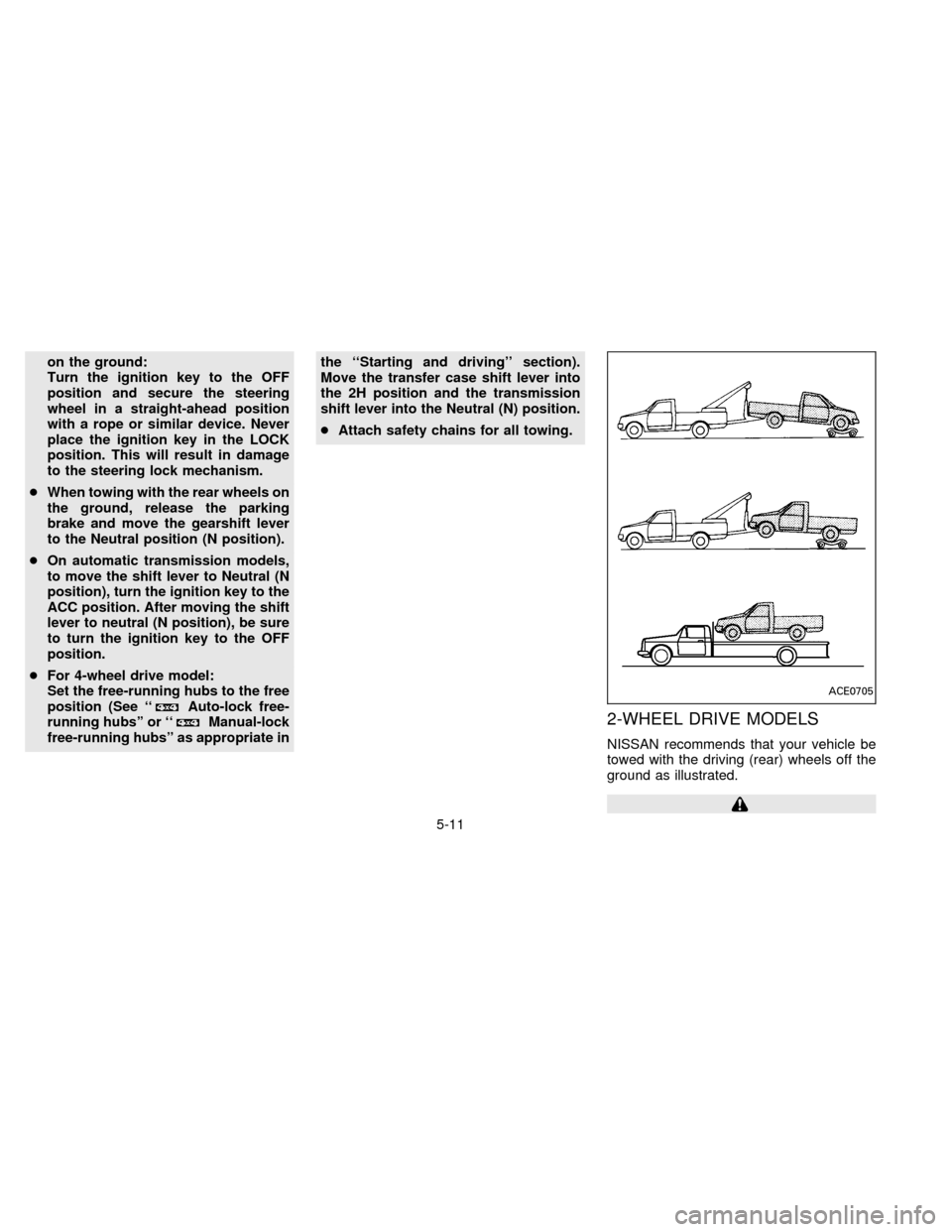
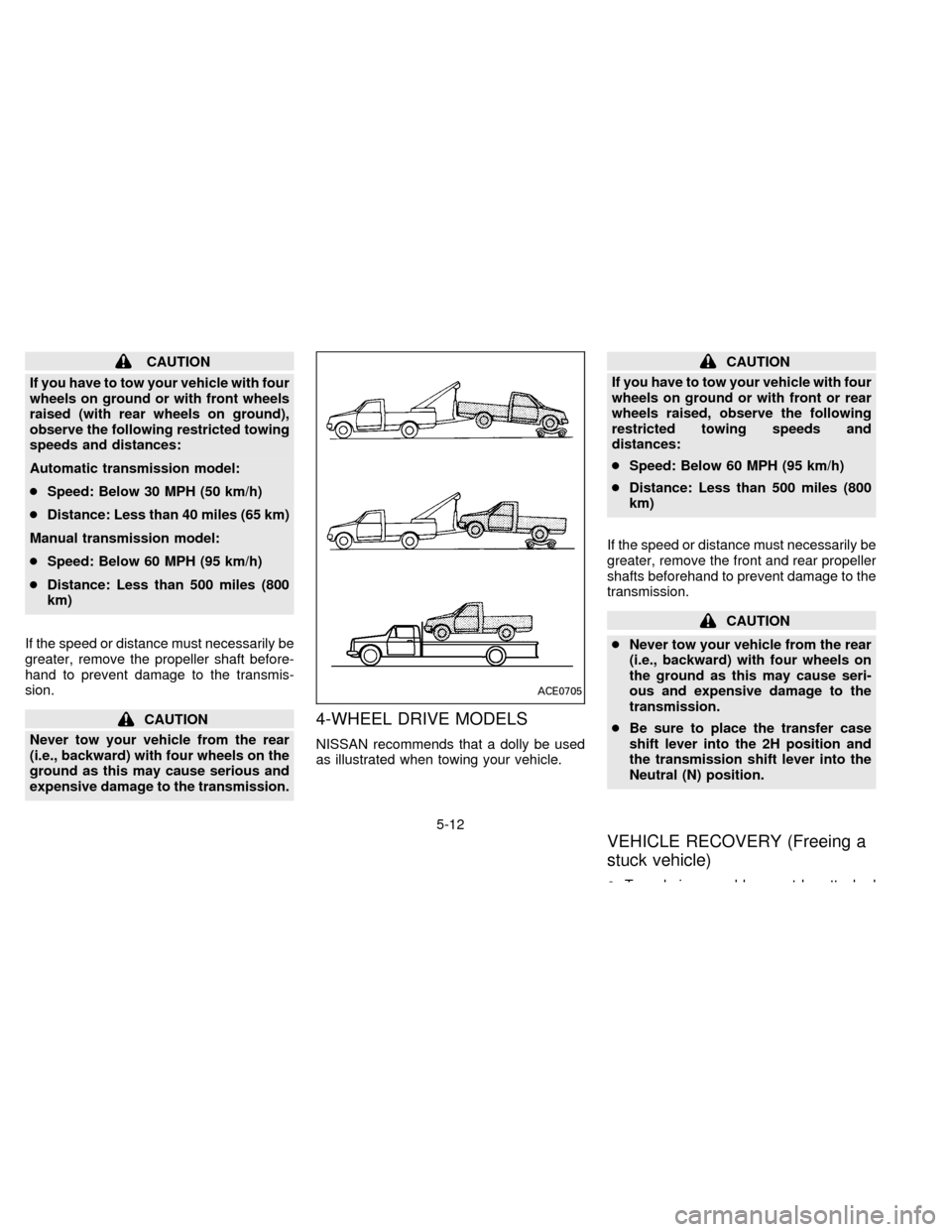
NISSAN recommends that your vehicle be
towed with the driving (rear) wheels off the
ground as illustrated.
ACE0705
5-11
ZX
Page 117 of 198
CAUTION
If you have to tow your vehicle with four
wheels on ground or with front wheels
raised (with rear wheels on ground),
observe the following restricted towing
speeds and distances:
Automatic transmission model:
cSpeed: Below 30 MPH (50 km/h)
cDistance: Less than 40 miles (65 km)
Manual transmission model:
cSpeed: Below 60 MPH (95 km/h)
cDistance: Less than 500 miles (800
km)
If the speed or distance must necessarily be
greater, remove the propeller shaft before-
hand to prevent damage to the transmis-
sion.
CAUTION
Never tow your vehicle from the rear
(i.e., backward) with four wheels on the
ground as this may cause serious and
expensive damage to the transmission.4-WHEEL DRIVE MODELS
NISSAN recommends that a dolly be used
as illustrated when towing your vehicle.
CAUTION
If you have to tow your vehicle with four
wheels on ground or with front or rear
wheels raised, observe the following
restricted towing speeds and
distances:
cSpeed: Below 60 MPH (95 km/h)
cDistance: Less than 500 miles (800
km)
If the speed or distance must necessarily be
greater, remove the front and rear propeller
shafts beforehand to prevent damage to the
transmission.
CAUTION
cNever tow your vehicle from the rear
(i.e., backward) with four wheels on
the ground as this may cause seri-
ous and expensive damage to the
transmission.
cBe sure to place the transfer case
shift lever into the 2H position and
the transmission shift lever into the
Neutral (N) position.
VEHICLE RECOVERY (Freeing a
stuck vehicle)
cTow chains or cables must be attached
only to the main structual members of the
vehicle.
cPulling devices should be routed so they
do not touch any part of the suspension,
steering, brake or cooling systems.
cAlways pull the cable straight out from
the front or rear of the vehicle. Never pull
on the vehicle at an angle.
cPulling devices such as ropes or canvas
straps are not recommended for use in
vehicle towing or recovery.
ACE0705
5-12
ZX
Page 121 of 198

Floor mat positioning aid
(Driver side only)
Some models include a floor mat pin to act
as a floor mat positioning aid. Nissan floor
mats have been specially designed for your
vehicle model. The driver's side floor mat
has a grommet hole incorporated in it. Sim-
ply position the mat by placing the floor mat
pin through the floor mat grommet hole
while centering the mat in the floor pan
contour. Periodically check to make certain
that the mats are properly positioned.
Floor mats
The use of Genuine Nissan floor mats can
extend the life of your vehicle carpet and
make it easier to clean the interior. No
matter what mats are used, be sure they are
fitted for your vehicle and are properly posi-
tioned in the footwell to prevent interference
with pedal operation. Mats should be main-
tained with regular cleaning and replaced if
they become excessively worn.
Seat belts
The seat belts can be cleaned by wiping
them with a sponge dampened in a mild
soap solution. Allow the belts to dry com-
pletely before using them. Do not allow wet
belts to roll up in the retractor. NEVER use
bleach, dye or chemical solvents since
these may severely weaken the seat belt
webbing.
Most common factors contributing
to vehicle corrosion:
1. The accumulation of moisture-retaining
dirt and debris in body panel sections,
cavities, and other areas.
2. Damage to paint and other protective
coatings caused by gravel and stone
chips or minor traffic accidents.
Environmental factors influencing
the rate of corrosion:
1. Moisture
The accumulation of sand, dirt and water on
the underside of the body accelerates cor-
rosion. Floor sections which have snow and
ice trapped under the floor matting will not
dry.
2. Relative humidity
Corrosion will be accelerated:
cin areas of high relative humidity.
cespecially in areas where the tempera-
tures stay above freezing.
cwhere atmospheric pollution exists.
cwhere road salt is used.AAI0500
CORROSION PROTECTION
6-4
ZX